武夷岩茶大紅袍完整解析:岩骨花香與炭焙工藝,搭配 Cohiba Siglo IV 的醇厚對話
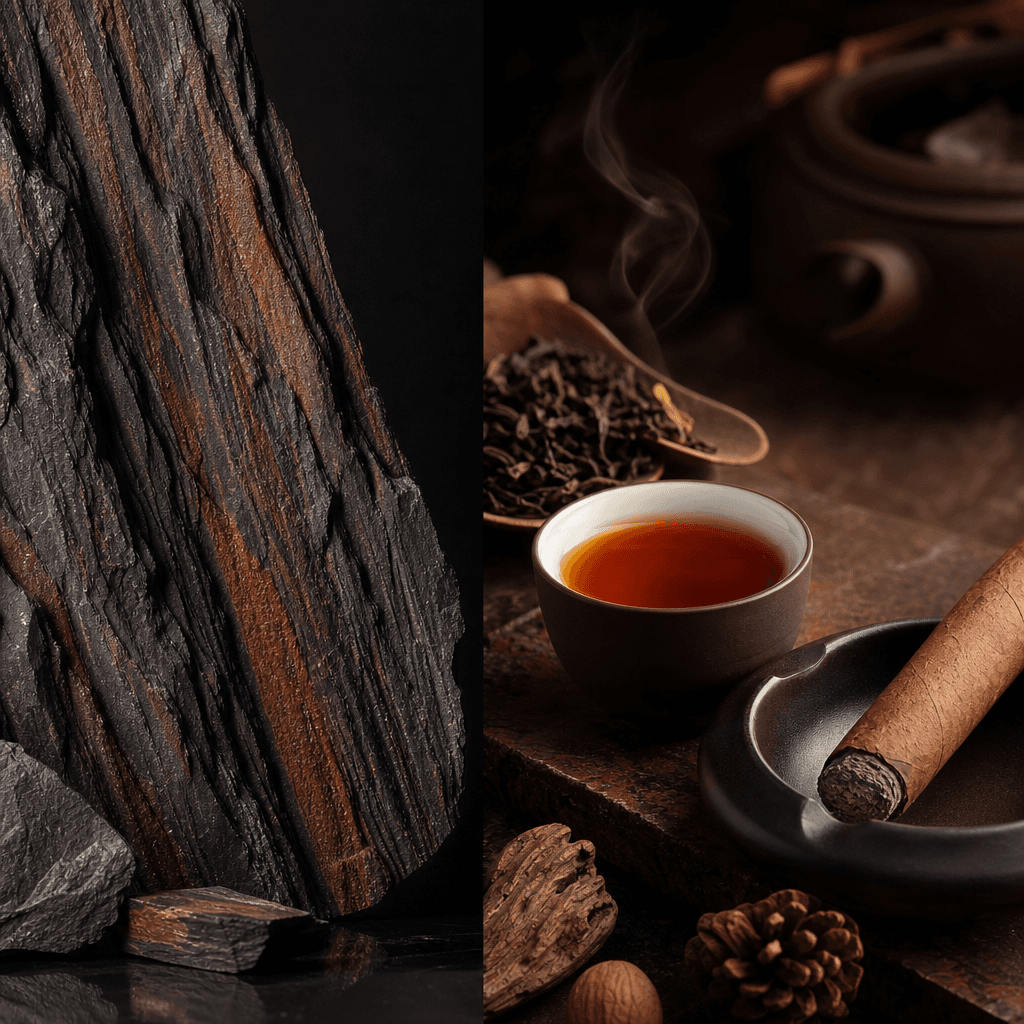
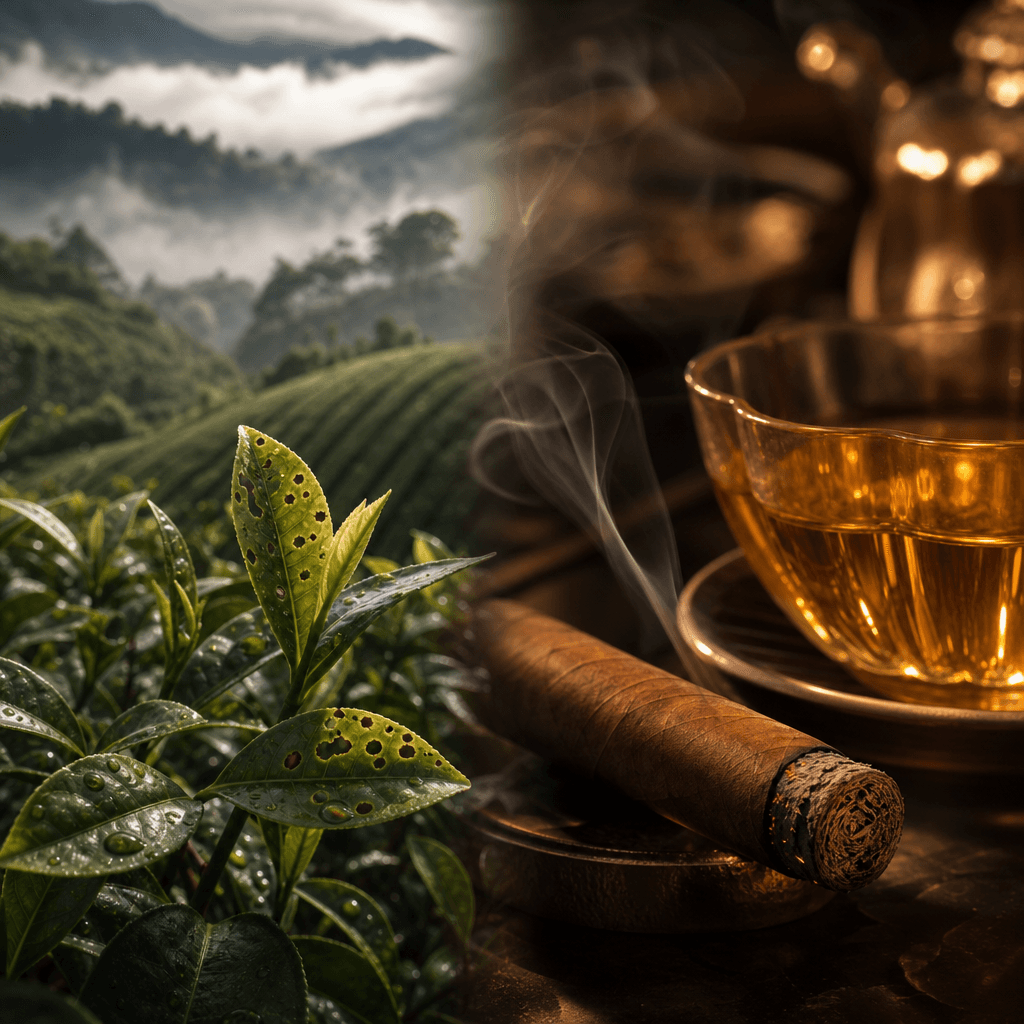
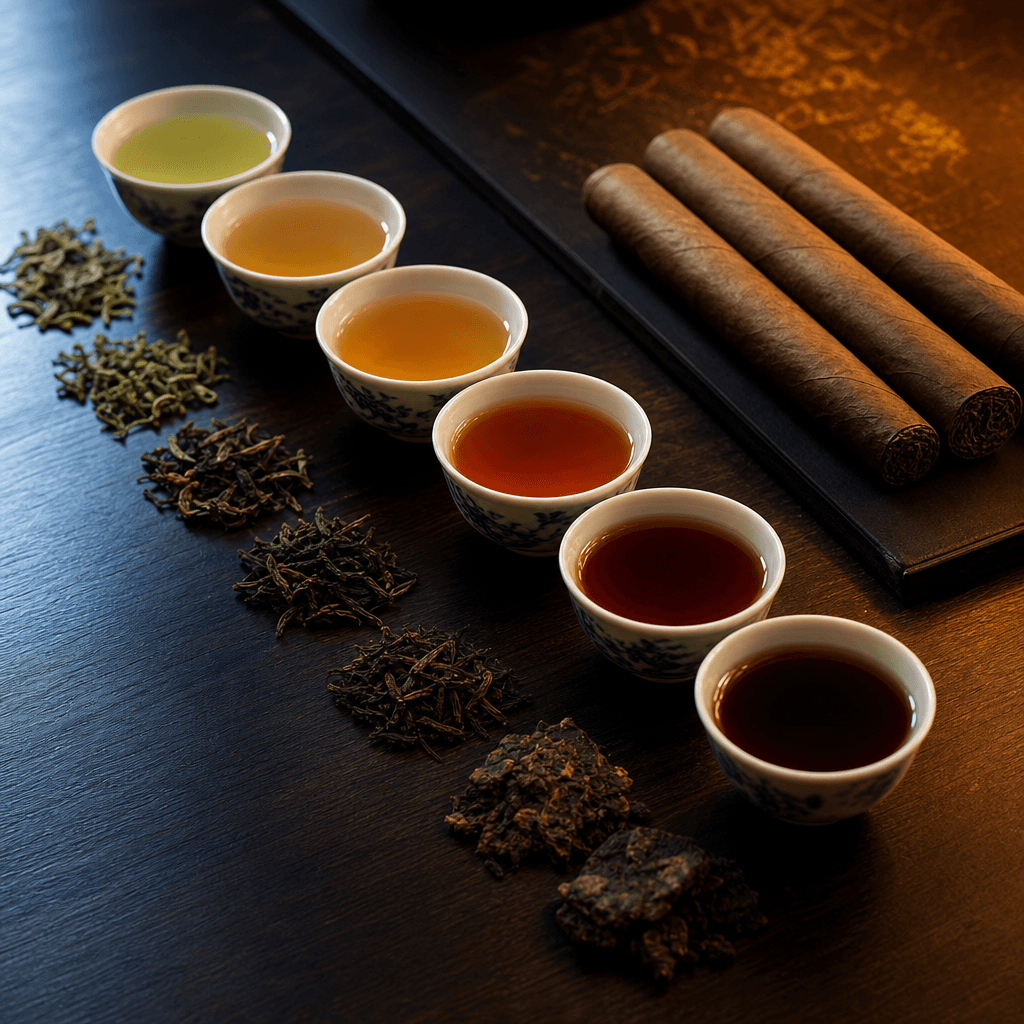
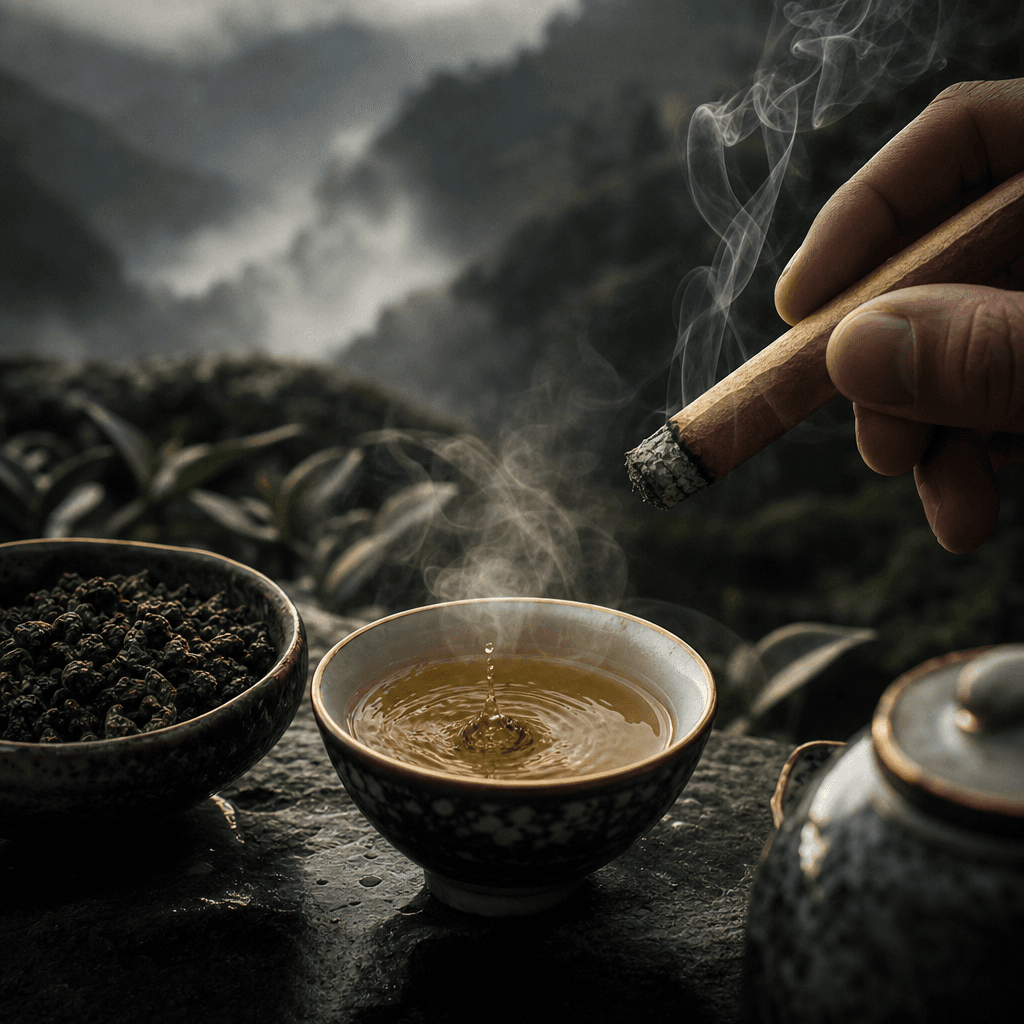
武夷岩茶大紅袍的核心,不只是「岩骨花香」四字,而是正岩丹霞地貌、三坑兩澗山場、搖青做青與炭焙烏龍火功共同塑成的立體結構。當它遇上 Cohiba Siglo IV 的奶油、雪松、蜂蜜與烤堅果,炭焙焦糖、礦石硬度與蘭花底香會逐層牽動雪茄煙氣,形成文人茶對貴族煙的醇厚對話。
- 大紅袍的岩韻來自正岩山場、品種血緣與炭焙火功共同疊合。
- Cohiba Siglo IV 的雪松與烤堅果,能承接岩茶礦石與焦糖層次。
- 茶湯溫度、出湯濃度與雪茄節奏,會決定搭配是否清晰立體。
Complete Analysis of Wuyi Rock Tea Da Hong Pao: Rock Bone Floral Fragrance and Charcoal Roasting Craft, in a Rich Dialogue with Cohiba Siglo IV
Wuyi Rock Tea Da Hong Pao's encounter with Cohiba Siglo IV is a precise debate between rock bone floral fragrance and the medium-bodied Cuban cigar. As an editor of the "Cigar Bible," I often say that true high-level pairing is not about putting two "good flavors" on the same table, but about whether their structures can support each other. The charcoal-roasted caramel, mineral feel, and orchid base fragrance of Da Hong Pao can perfectly catch the cream, cedar, honey, and roasted nuts of Cohiba Siglo IV. In this article, I will start with the tea, then break down each flavor token and compare them with the chemical and tactile changes in the smoke.
This is a non-alcoholic beverage theme, but it does not mean it is simpler. Tea soup lacks the volatilization thrust of alcohol, and instead relies more on water temperature, steeping time, roasting degree, and oral residue to form pairing logic. Wuyi Rock Tea is worthy of being placed on the cigar table because it has its own "framework": not soft sweet fragrance, but a combination of rock, charcoal fire, floral fragrance, fructose conversion, and slight bitterness. Cohiba Siglo IV responds to it with the delicate sweetness and woody lines of Cuban tobacco leaves, not covering each other but calibrating each other.
時間線呈現丹霞山場到退火穩定的岩茶工藝流程
The True Rock Roots of Wuyi Rock Tea: Danxia, Pits and Streams, and Rock Rhyme
The roots of Wuyi Rock Tea must be traced back to the Danxia landform of Wuyi Mountain in Fujian. The red sandstone, weathered rock debris, and narrow pits and streams here form a microenvironment that retains water without stagnation, shades without dampness. The roots of the tea trees penetrate the rock crevices, absorbing not only mineral elements but also the rhythm shaped by low sunlight, slow growth, and day-night temperature differences. The so-called "rock rhyme" is not a mystical term, but the hardness, astringency, aftertaste, and throat resonance of the tea soup.
The reason why true rock tea is repeatedly discussed by old tea enthusiasts is that the mountain field is not the background but part of the flavor structure. The pit and stream terrain allows moisture to stay, sunlight is divided by rock walls, and the proportion of aromatic precursors and amino acids accumulated in the tea leaves is different from that of outer mountain tea. When the tea soup exhibits a mineral feel, slight saltiness, and fine granular feel on the tongue, it is not really drinking stones, but the perception of polyphenols, mineral ions, and the dry touch after roasting. The essence of rock rhyme is that the microclimate of the mountain field makes the tea soup a liquid with bones.
I often use the "framework" of cigars to explain true rock. A good Cuban cigar is not just about aroma, but the combination of burn line, smoke density, woody support, and tail length; true rock tea is the same. Da Hong Pao, if removed from the true rock context, will become flat if only floral and roasted aromas are discussed. When placed next to Cohiba Siglo IV, this rock-like verticality will truly appear.

三張卡列出岩骨、焙火與濃淡節奏的搭配重點
Da Hong Pao: The Legend of Six Mother Trees and the Contemporary Grammar of Asexual Reproduction
The most fascinating part of Da Hong Pao is the coexistence of legend and agronomy. The six mother trees of Da Hong Pao on the rock wall of Jiulongke have long been regarded as a symbol of Wuyi tea culture; but in modern tea science, what truly affects the flavor in the cup is asexual reproduction, variety sorting, and the blending understanding of tea masters. Since the twentieth century, through cuttings, the related varieties of mother trees have been extended to more controllable tea garden environments. This makes "Da Hong Pao" not just a legend on the rock wall, but a flavor language that can be interpreted by craftsmanship.
It must be clarified that in today's market context, Da Hong Pao is often not a single narrow variety name, but may be a variety, product name, blending concept, or style name. Experienced tea people will look at whether Da Hong Pao has rock bones, whether the roasting is clean, and whether the floral and fruity aromas are hidden in the soup rather than floating on the lid. If compared to cigars, it is more like the style framework of a classic vitola: specifications are just the starting point, the real distinction lies in the balance after raw materials and aging. The core of Da Hong Pao is not in the myth itself, but in how the bloodline of the mother tree is translated into drinkable rock bone floral fragrance through craftsmanship.
When juxtaposed with Cohiba Siglo IV, the legendary feeling must retreat to the background. Because cigars cannot be convinced by stories, only by the flavor structure in combustion. The creaminess and honey sweetness of Cohiba Siglo IV will test whether Da Hong Pao's firework is clean; if the roasting is rough, the bitterness will push the smoke towards dryness. If the tea soup structure is stable, the orchid and ripe fruit dark lines derived from the mother tree system will slowly be pulled up after the second segment of the cigar.

矩陣對照大紅袍、世紀四與交會點的風味結構
Shaking and Making Green: Floral Engineering in Semi-Fermentation
Wuyi Rock Tea belongs to the oolong tea system, and one of the most critical processes is shaking and making green. After picking, the tea leaves undergo withering, reducing cell water content, and then through shaking, the leaf edges collide and slightly damage, promoting enzymatic oxidation. This is not simply "injuring" the leaves, but controlling polyphenol oxidation, aromatic substance release, and green gas conversion. If the green making is too light, the tea soup will be sharp, green, and thin; if too heavy, the floral fragrance will be suppressed by ripe fruit and dull sweetness.
In high-grade Da Hong Pao, good green making will leave orchid, osmanthus, ripe pear peel, and slight milky fragrance. These aromas often come from the generation and transformation of terpenes, alcohols, and esters, such as linalool, geraniol, nerolidol, and their oxidation derivatives. They are not sprayed out like perfume, but hidden in the middle and back of the tea soup, emerging as the temperature drops. The true decision of shaking and making green is whether Da Hong Pao's floral fragrance can still retain a sense of life after charcoal roasting.
This is extremely important for pairing with Cohiba Siglo IV. The honey and cream of Siglo IV are not suitable for being restrained by overly green tea soup, otherwise, the smoke edge will appear cold. Properly green-made Da Hong Pao can approach the sweet core of the cigar with floral and ripe fruit feelings. When the orchid base of the tea soup is first in the mouth, followed by a sip of Cohiba's delicate smoke, the honey sweetness will become longer rather than more cloying.
The Firework of Charcoal-Roasted Oolong: How Caramel, Minerals, and Orchids Are Fixed
The brilliance of charcoal-roasted oolong lies not in heavy fire flavor, but in whether the fire can fix the tea's framework. Traditional Wuyi Rock Tea often uses low-temperature long roasting with charcoal, multiple fire retreats, and re-roasting to redistribute moisture, cut green gas, and produce Maillard reactions between sugars and amino acids. The tea soup thus exhibits caramel, roasted wheat, nuts, candied peel, and dry woodiness. If the firework is rough, only charred black remains; if the firework is deep and clean, the floral fragrance will be like being wrapped in minerals, slowly floating from the bottom of the soup.
The key flavors produced by charcoal roasting can be understood from furfural, hydroxymethylfurfural, maltol, and pyrazine classes. Furfural brings roasted grain and almond shell feelings, maltol brings caramel sweetness, and pyrazine classes provide roasted nuts and dry roasted aromas. These molecules have a strong homology with the roasted nuts and woody smoke of cigars after burning, as both involve thermal reactions and the dry transformation of plant tissues. Charcoal roasting is not about cooking the tea, but locking floral fragrance, saccharification, and rock touch into the same depth.
I often say that clean firework Da Hong Pao is most suitable for cigars starting from the middle segment. When the cream and cedar of Cohiba Siglo IV have not fully unfolded in the front segment, the tea soup can first lay a medium concentration base; after entering the middle segment, the charcoal-roasted caramel and roasted nuts begin to amplify each other. In the later segment, if the tea soup is too strong, it will compete with the cigar's spicy aroma, so the steeping time should be shortened to retain the mineral feel.

三張卡提醒重焙、茶溫與濃泡節奏的常見誤解
Three Pits and Two Streams and the Twin Pillars of Varieties: How Shuixian and Rougui Support Da Hong Pao
Talking about true rock tea, three pits and two streams are a compulsory course. Generally referred to as three pits and two streams, they often refer to core mountain field terms such as Niulan Pit, Huiyuan Pit, Daoshui Pit, and Liuxiang Stream, Wuyuan Stream. These places have close rock walls, sufficient stream moisture, and a high proportion of diffused light, making the tea trees not win by strong aroma, but by thickness, coolness, and aftertaste. The mountain field is not just a noun; it changes the maturity of tea leaves, the content of leaf substances, and the subsequent roasting endurance.
Shuixian and Rougui are the twin pillars of Wuyi Rock Tea varieties. Shuixian is known for its thick soup, woody depth, and deep orchid base, with good roasting resistance, providing a broad base for Da Hong Pao's style. Rougui is known for its cinnamon spiciness, penetration, and clear lines, often making the tea soup appear more upright and brighter. Many Da Hong Pao style blends use the thickness of Shuixian and the sharpness of Rougui to give the tea soup both depth and spirit. Three pits and two streams give Da Hong Pao the bone of the mountain field, while Shuixian and Rougui give it muscles and nerves.
Placed next to Cohiba Siglo IV, the Shuixian feeling will catch the cream and cedar, while the Rougui feeling will illuminate the honey and roasted nuts. If the tea soup is Shuixian-type, the pairing will be more stable and steady, like the roasted aroma emanating from a wooden box. If the tea soup is Rougui-type, the sweet and spicy lines of the smoke will be more pronounced, but also require concentration control. The reason Da Hong Pao is flexible is that it can adjust the proportion between mountain field, variety, and firework.

長條圖比較水仙型與肉桂型大紅袍的搭配取向
Cohiba Siglo IV: The Medium-bodied Corona Gorda and Cuban Framework
Cohiba Siglo IV (Cuba, Corona Gorda, 46 × 143mm) is a cigar very suitable for testing beverage pairing. It does not dominate with a sense of oppression like heavy-bodied cigars, nor is it so gentle that it can only be led by tea fragrance. Its typical profile is cream, cedar, honey, roasted nuts, medium-bodied, with delicate and layered smoke. The proportion of Corona Gorda also allows enough space for the front, middle, and back segments to unfold, without reaching the spicy end too quickly.
The charm of Cohiba lies in its sweetness, which is not syrupy but a gentle sweetness formed after the maturation and fermentation of Cuban tobacco leaves. The creaminess mostly comes from the oily feel of the smoke, softened woodiness, and grain sweetness; cedar provides dry wooden box, pencil core, and faint resin feel. The honey aroma is not sticky but has lines of floral nectar, dry grass, and light fruit peel. The medium-bodied of Siglo IV allows Da Hong Pao to have space to voice, and also allows the tea soup not to use concentration to confront.
When pairing with Da Hong Pao, I would avoid pushing the cigar into strong tea at the beginning. The front segment can use lighter tea soup to let the honey and cream of Cohiba Siglo IV first establish the sweet core; the middle segment then increases the thickness of the tea soup, connecting with charcoal-roasted caramel and rock rhyme minerals. When the cedar feeling becomes obvious, the dry rock touch of true rock tea will make the woodiness clearer. At this time, it is not the tea clearing the mouth, nor the smoke pressing the tea, but the two frameworks interlocking.

三張問答卡整理火功、山場與喝茶時機的建議
Rock Bone Floral Fragrance Meets Cohiba Siglo IV: Flavor Chemistry of token×token
True pairing should be broken down into token×token. The first group is "charcoal-roasted caramel × roasted nuts' firework homology": the maltol, furfural, and pyrazine classes in Da Hong Pao's charcoal roasting will correspond to the roasted nuts, roasted grains, and light cocoa edges of Cohiba Siglo IV after burning. These two belong to the thermal reaction language system, so when they meet, they are not added but make the mouth mistakenly think that the nuts are wrapped in a layer of caramel film. If the tea soup is too hot, the caramel feeling will be sharp; after slight cooling, the sweet fragrance will fit the smoke oil better.
The second group is "rock rhyme minerals × cedar framework's hardness dialogue". The dry granular feel, slight saltiness, and astringency in rock rhyme will make cedar not just a fragrance but a perceivable structure. The woodiness, resin, and dry fiber feel in cedar can stretch the mineral feel of the tea soup to the back of the throat. The most exciting moment of Da Hong Pao and Siglo IV is when the mineral hardness straightens the cedar, and the cedar polishes the rock rhyme into delicate edges.
The third group is "orchid base fragrance × honey sweetness's subtle high notes". The linalool, geraniol, and nerolidol-based aromas left by Da Hong Pao's green making, when encountering Cohiba's floral honey and light dry grass feel, will form a kind of not loud but lasting upward line. This is not sweetness plus sweetness, but floral fragrance making honey more contoured, and honey pushing orchid from cold fragrance to warm fragrance. The pairing of tea and cigars is truly established not by posture, but by the mutual translation of molecules and touch.
| Pairing token | Da Hong Pao Source | Cohiba Siglo IV Correspondence | Oral Change |
|---|---|---|---|
| Charcoal-roasted caramel × roasted nuts | Maltol, furfural, pyrazine classes | Roasted nuts, light cocoa, grain smoke | Sweet fragrance thickens, caramel edges rounder |
| Rock rhyme minerals × cedar framework | True rock mountain field, astringency, and dry touch | Cedar, dry wood, resin feel | Woodiness more three-dimensional, tea soup deeper |
| Orchid base fragrance × honey sweetness | Terpene floral fragrance formed by green making | Honey, cream, dry grass sweetness | High notes finer, sweetness extended |
| Charcoal fire slight bitterness × medium-bodied | Bitter-sweet conversion after re-roasting | Gentle spiciness of Cuban smoke | Tail note convergence, avoiding sweetness looseness |
Frequently Asked Questions
Does Da Hong Pao need to be heavily roasted to suit Cohiba Siglo IV?
Not necessarily. If the heavy roast is clean, it can amplify roasted nuts and cedar, but if the fire flavor is rough, it will dull the creaminess of Siglo IV. Medium fire with complete fire retreat Da Hong Pao usually retains orchid base fragrance and rock bone floral fragrance better.
What is the difference between pairing true rock tea and semi-rock tea?
The focus of true rock tea is on framework, astringency, and throat rhyme, forming a clearer hardness dialogue with the woody of cigars. Semi-rock tea, if the aroma is beautiful, can also be paired, but often relies on aroma to win, with shorter tail support. For experienced cigar guests, the difference will appear after the second or third puff.
Should the tea soup be brewed strong or light?
I would adopt a rhythm of light front, thick middle, and thin end. Light brew in the front segment, allowing the honey and cream of Cohiba Siglo IV to open first; slightly thick in the middle segment to connect with charcoal-roasted caramel and roasted nuts; thin again in the end segment to avoid heavy stacking of charcoal fire bitterness and smoke spiciness.
Which is closer to Siglo IV, Shuixian-type or Rougui-type Da Hong Pao?
Shuixian-type is more stable, able to support cream, cedar, and woodiness; Rougui-type is brighter, pulling up the honey sweetness and spicy lines. If the cigar state is soft, Rougui-type can increase spirit; if the smoke is dry, Shuixian-type will have more coverage. Choosing the variety orientation is actually deciding whether this pairing will go for thickness or penetration.
Does the temperature of charcoal-roasted oolong affect the pairing?
Yes, and very obviously. When too hot, caramel and mineral feel tend to be sharp, making cedar appear dry. After slight cooling, orchid, ripe fruit, and honey feel more easily connect with the sweet core of Siglo IV.
Which segment of the cigar is suitable to start drinking tea with this pairing?
You can start with a small cup of light tea before lighting to establish the rock and floral fragrance background in the mouth. Keep light tea in the front segment, increase tea soup thickness in the middle segment, and maintain clarity with short steeping in the end segment. This allows the rock bone floral fragrance of Da Hong Pao to accompany the cigar's progress without stealing the spotlight.
I often say that the best tea and cigar pairing is not about volume but about structural mutual verification. Wuyi Rock Tea Da Hong Pao condenses Danxia mountain field, shaking and making green, and charcoal roasting firework into rock bone floral fragrance; Cohiba Siglo IV responds with cream, cedar, honey, and roasted nuts. When the two meet, Wuyi Rock Tea and Cohiba Siglo IV do not need to argue, just let the tail note speak.
Further Reading|Complete Guide to Six Types of Tea: Fermentation Spectrum from Green Tea to Pu'er, Overview of Flavors Paired with Cigars|Junshan Silver Needle Yellow Tea Steaming Craft: The Rarest Flavor Among Six Types of Tea, Paired with San Cristóbal El Príncipe's Delicate Small Piece|Complete Guide to Taiwan High Mountain Tea: The Cold Floral Fragrance of Lishan and Alishan, Paired with Davidoff Signature 2000's Elegant Route
—Cigar Prince Wilson Tsai
Smoking is harmful to health. Smoking is prohibited for those under twenty. Quitline: 0800-636363. This article is intended for adults over the age of twenty as a reference for cigar culture, preservation, and regulatory knowledge, not as a tobacco advertisement, promotion, or purchase suggestion.
Like this article?Share with friends
Share this W Cigar Bible piece with friends who want to learn cigar culture, storage, and tasting.
想把這篇 化為實踐
雪茄聖經是知識;雪茄文化要在空間裡發生

W Cigar Bar 大安總店資訊
台北大安區 · 雪茄聖經總編輯 Wilson Tsai 主理的雪茄文化空間

33 座 24 小時恆溫恆濕醇化室
W Cigar Bar 提供的會員醇化空間 · 場地資訊請洽編輯部
雪茄剪 / 打火機 / 雪茄盒 / Boveda
W Cigar 配件官網 · 專營雪茄配件正品
加 LINE 好友 · 文化諮詢
文化空間資訊 · 紳士沙龍 · 私人包場
本網站內容僅供雪茄文化、歷史、收藏與品吸知識研究參考。菸品有害健康、未滿法定年齡者請勿吸菸。實際規範請依所在地法律為準。
吸菸有害健康・戒菸專線 0800-636363・本站僅供 20 歲以上成年人閱覽。
讀到這裡,你不只是路過的人
留下 Email,加入 W 雪茄聖經內圈——總編輯 Wilson Tsai 親選的學院深文與國際新訊,先你一步送到信箱。
· 教育用途非銷售 · 隨時一鍵退訂 · Email 絕不對外公開 · 由勝茄股份有限公司營運
同分類延伸閱讀
資料來源:W Cigar Bible 編輯部整理 · 雪茄王子 Wilson Tsai 親自審稿
本文僅供雪茄文化、歷史、收藏與品鑑知識研究,不作為菸品促銷、銷售或購買建議。吸菸有害健康,未滿二十歲不得吸菸。