美式咖啡與手沖日常:親民入門的黑咖啡指南,搭配 José L. Piedra Petit Cazadores
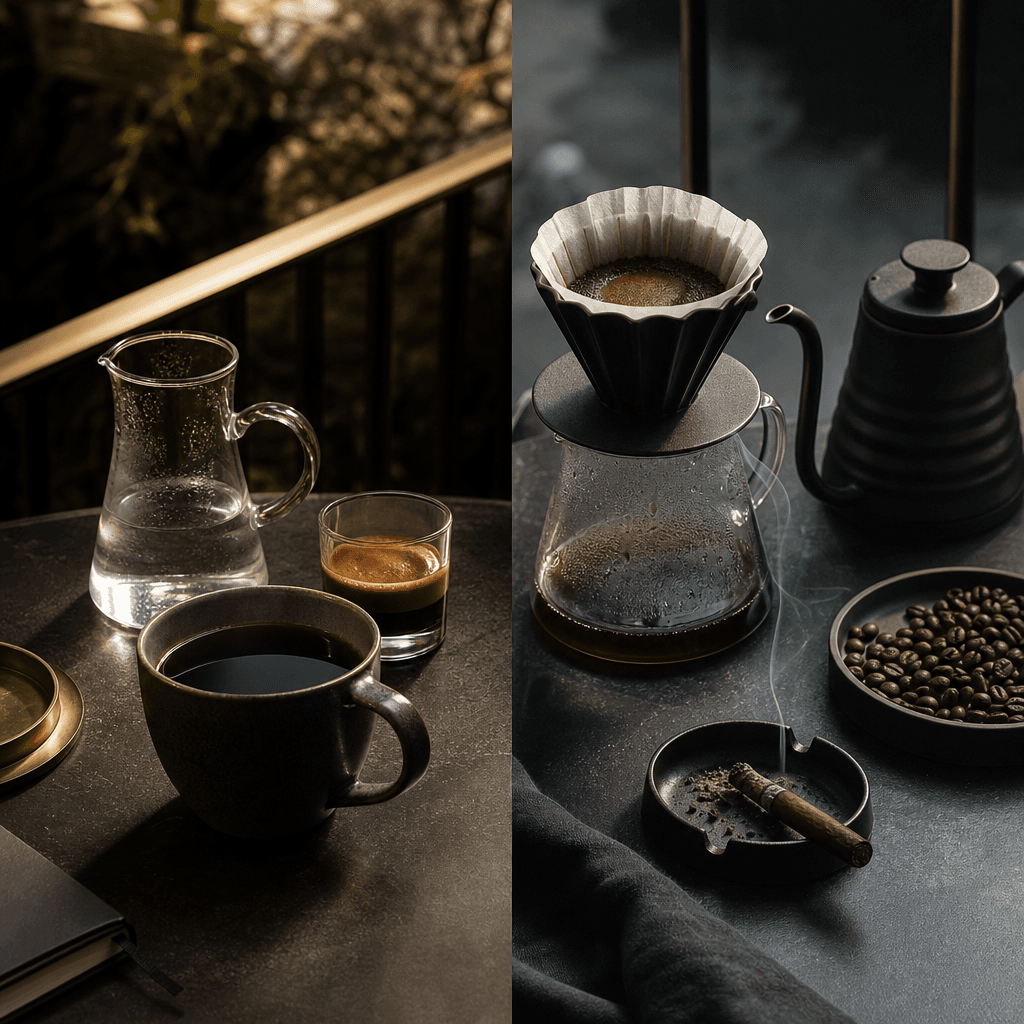
美式咖啡與手沖咖啡都是日常黑咖啡,差別不只在濃淡,而是萃取邏輯、口感結構與風味乾淨度。本文以 José L. Piedra Petit Cazadores 為搭配核心,從 Americano 歷史、V60、Chemex、法壓器材,到日常選豆與泥土、木質、淡可可雪茄風味的化學互動,建立零壓力的咖啡入門路線。
- 美式咖啡是 espresso 加水,手沖咖啡是濾泡萃取,兩者的濃度、油脂與層次完全不同。
- José L. Piedra Petit Cazadores 的泥土、木質、淡可可,適合乾淨或稀釋感明確的黑咖啡。
- 日常咖啡選豆先看烘焙日期、烘焙度與處理法,再談產區敘事與包裝文字。
Americano and Pour-Over Daily: An Accessible Black Coffee Guide, Paired with José L. Piedra Petit Cazadores
The charm of the encounter between Americano coffee and José L. Piedra Petit Cazadores lies not in extravagance, but in how both clearly articulate the concept of "everyday." As an editor of the "Cigar Bible," I often say that the best pairings for beginners should not first pursue overwhelming intensity, but rather understand how strength, bitterness, sweetness, smokiness, and woodiness line up in the mouth. This Cuban Petit Cazadores, 43 × 105mm, with its earthy, woody, and light cocoa notes, medium-bodied and straightforward short-filler craftsmanship, perfectly allows the details of black coffee to be appreciated.
This article is not about making everyday coffee seem distant, nor about portraying cigars as a high wall. Americano coffee, pour-over coffee, and a short Cuban cigar can all start from a morning on the balcony, simple utensils, and stable heat. Beginners only need to grasp the extraction method, the state of the beans, and the rhythm of the cigar to read the layers of a cup of black coffee and a José L. Piedra Petit Cazadores.
五步流程呈現磨豆萃取降溫到短茄搭配順序
Two Paths of Everyday Black Coffee: The Essential Difference Between Americano and Pour-Over Coffee
The core of Americano coffee is to first extract espresso under high pressure and then dilute it with water. Espresso is typically extracted at about 9 bar pressure, using finely ground coffee, in a short time, resulting in a high-concentration liquid with oils and a deep caramel feel. After adding water, the concentration decreases, the bitterness elongates, and the mouthfeel transitions from compressed to expanded.
Pour-over coffee, on the other hand, is a drip extraction where water flows over a layer of coffee grounds, passing through a filter paper or filter into the lower pot. It lacks the high pressure of espresso and does not use crema as a flavor entry point, but instead relies on water temperature, grind size, pouring speed, and the structure of the grounds to determine cleanliness. This is why pour-over is often described as transparent, clear, and capable of dissecting acidity, sweetness, and bitterness.
Americano coffee is espresso expanded by water, while pour-over coffee is coffee grounds slowly read by water. This difference is crucial because when pairing with cigars, the former is like amplifying the focus and then diluting it, while the latter arranges the layers in lines. For José L. Piedra Petit Cazadores, the dilution of Americano can soften the rough earthiness of the short cigar's front end; the cleanliness of pour-over can give more boundaries to the light cocoa and woodiness.
When beginners drink black coffee, they often consider "bitterness" as the only indicator, but bitterness is just part of the structure. The bitterness of Americano often comes from the high extraction concentration of espresso, roasting reactions, and fine grounds; the bitterness of pour-over coffee may come from over-fine grinding, too high water temperature, or over-extraction at the end. Understanding these ensures that when pairing with cigars, the coffee bitterness, tobacco bitterness, and burning bitterness do not mix into one.
Origin of the Name Americano: The Encounter Between WWII American Soldiers and Italian Espresso
The name Americano is often linked to Italy during World War II. After the Allies entered Italy in 1943, American soldiers encountered local espresso but were not necessarily accustomed to the short, high-concentration, intensely bitter-sweet drinking style. So they added hot water to espresso, making the flavor closer to the long black coffee they were familiar with, and the story of Americano took shape in this cultural collision.
The modern appearance of espresso itself was not fixed from the start. Luigi Bezzera's patent in 1901 made quick extraction a symbol of industrial city drinks; Achille Gaggia's lever machine in 1948 further pushed pressure and crema to a new flavor language. In other words, Americano coffee is not just "diluted coffee"; it has behind it the intersection of Italian machinery, wartime mobility, and everyday drinking habits.
For beginners, the easiest to understand ratio for Americano coffee is about 1:3 to 1:5 between espresso and water. More water makes the bitterness lighter, and the smokiness recedes; less water brings caramel, nuts, and dark chocolate closer to the essence of espresso. When pairing with José L. Piedra Petit Cazadores, I would place it in a lighter direction so that the 105mm short size is not overwhelmed by the coffee.
A good Americano coffee does not dilute espresso to the point of losing character, but rather makes the concentrated caramel, nuts, and bittersweetness conversational. This "conversational" aspect is the key to pairing with cigars. The earthiness and woodiness of Petit Cazadores do not need to be surrounded by a heavy drink; they need a cup of black coffee that can clear the gaps in the smoke while retaining the coffee's framework.
三張重點卡說明美式手沖與中焙短茄搭配
Entry-Level Pour-Over Coffee Equipment: V60, Chemex, and French Press Each Have Their Character
The most common entry-level equipment for pour-over coffee is the Hario V60. Introduced in 2004 with a 60-degree cone angle, spiral ribs, and a large drainage hole, it has been widely discussed for its variable flow rate and high operational freedom. Beginners may initially find it sensitive, but because of this sensitivity, the effects of water flow, grind size, and pouring rhythm are easily tasted.
The history of Chemex is even earlier, designed in 1941 by German chemist Peter Schlumbohm, with thick filter paper as its flavor core. The thick filter paper traps more oils and fine particles, resulting in a typically cleaner cup with a more pronounced tea-like quality. When paired with José L. Piedra Petit Cazadores, the clarity of Chemex can bring out the light cocoa in the tobacco and reduce the muddiness of the earthiness.
The French press takes a different path. After Attilio Calimani obtained the relevant patent in 1929, this immersion extraction method became a common household coffee tool; the coffee grounds and water are in contact for a long time, then separated by a metal filter. Because of the higher oil and fine particle content, the French press has a thick mouthfeel and a noticeable graininess, which should be noted when pairing with short-filler cigars as it may add to the roughness.
V60 emphasizes variability, Chemex emphasizes cleanliness, and the French press emphasizes thickness; these determine the mouthfeel when black coffee meets cigars. If trying for the first time, I would place V60 or Chemex at the forefront because they more easily allow one to recognize the lines of coffee and cigars separately. The French press is not bad, but its oils and fine particles can push the earthiness of tobacco heavier, which is less intuitive for beginners.
| Equipment | Extraction Logic | Cup Characteristics | Effect with Petit Cazadores |
|---|---|---|---|
| V60 | Cone-shaped drip, controllable flow rate | Bright, clear layers | Better separation of woodiness and light cocoa |
| Chemex | Thick filter paper drip | Clean, tea-like, low oil | Earthiness refined, smoke clearer |
| French Press | Full immersion, metal filter | Thick, oily, fine particle feel | Enhances tobacco's rugged side, needs concentration control |
| Americano | Espresso with water | Bittersweet concentrated then expanded | Light rhythm of short cigar, does not overwhelm taste |
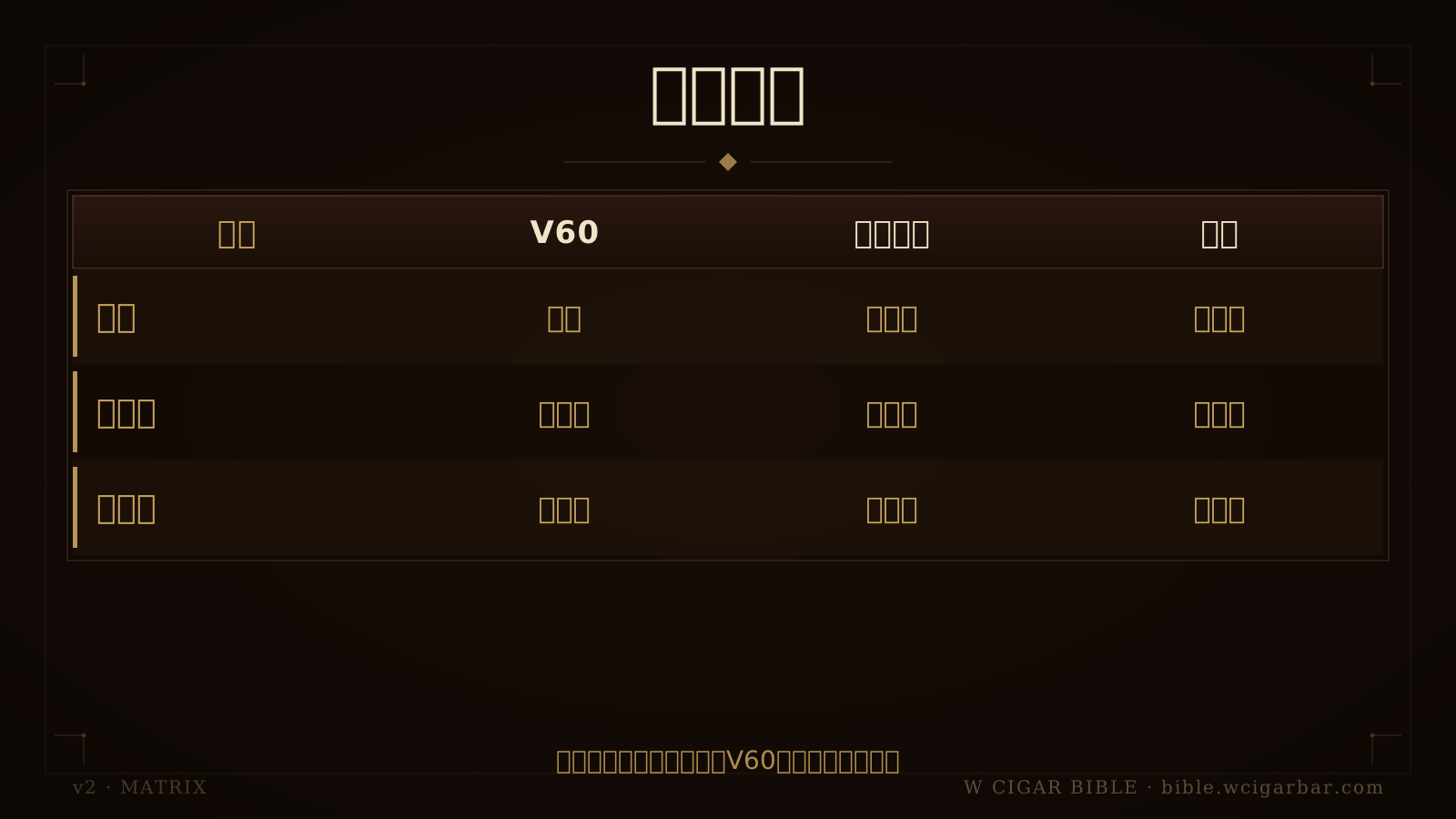
矩陣比較V60化美克斯與法壓的口感差異
Coffee Bean Selection for Beginners: Look at Roast Date, Not Packaging Rhetoric
When choosing everyday entry-level beans, my first principle is to look at the roast date. Coffee beans continue to degas after roasting, with the release of carbon dioxide, changes in aromatic molecules, and oxidation of oils affecting the cup's performance. Most everyday black coffee achieves stable flavors between one to six weeks after roasting; too new may have gas interfering with extraction, too old and the aroma flattens.
The second key point is the roast level. Light roasts often have citrus, floral, berry, and bright acidity, but if extraction is unstable, it can easily show sharp acidity or herbal notes. Medium roasts are easier to enter the daily black coffee routine, with nuts, caramel, cocoa, and balanced mild acidity and sweetness; dark roasts have smokiness, bittersweetness, and dark chocolate, but when paired with cigars, it's essential to avoid stacking bitter notes.
Processing methods also change the pairing. Washed beans are usually clean with clear acidity, suitable for highlighting the woodiness of Petit Cazadores; natural processed beans have thicker fruit aromas, potentially pushing light cocoa towards a berry chocolate direction; honey processed often strikes a balance between sweetness and mouthfeel. The origin is not better the more unfamiliar; beginners can start understanding differences from clearly labeled beans like Colombia, Brazil, Guatemala, and Ethiopia.
When selecting everyday coffee beans, ask three questions: when was it roasted, to what degree, and what processing method was used. The story on the packaging can be read, but it should not replace judgment in the cup. If pairing with José L. Piedra Petit Cazadores, I would prioritize medium-roast washed or medium-roast Brazilian natural sweetness routes, keeping cocoa, nuts, woodiness, and tobacco earthiness in the same context.
三張錯誤卡列出黑咖啡與雪茄搭配常見問題
José L. Piedra Petit Cazadores: The Simple Cuban Flavor of Short-Filler Craftsmanship
José L. Piedra is a recognizable name in Cuban cigars, with the brand family originating from Asturias, Spain, and developing in central Cuba in the late 19th century. It is often discussed in the context of an accessible style and everyday entry-level option, not relying on elaborate decorations but retaining the soil, wood, cocoa, and direct feel of Cuban tobacco. This directness is actually very helpful for beginners because it doesn't hide the flavors too deeply.
The specification of Petit Cazadores is José L. Piedra Petit Cazadores (Cuba, Petit Cazadores, 43 × 105mm). The 43 ring gauge ensures the smoke is not too thin, and the 105mm length concentrates the rhythm, making the overall sense of time much shorter than larger cigars. The short size also means that temperature management needs to be more precise; drawing too quickly will increase spiciness and bitterness rapidly in the later stages.
Its flavor axis is earthiness, woodiness, and light cocoa, medium-bodied, with a straightforward short-filler craftsmanship. Short-filler craftsmanship often brings more direct burning performance and a more noticeable graininess, unlike long-filler cigars that pull out long changes in each segment. But this simplicity is precisely what corresponds to the everyday nature of black coffee: no need for grand attire, no need for complex cup sets, just a clean hot black coffee to get into the state.
The value of Petit Cazadores is not in elaborate variations but in succinctly expressing Cuban earthiness, woodiness, and light cocoa with a short size. When pairing, the coffee should not be too strong, too oily, or too bitter, or it will overshadow its light cocoa. Conversely, clean pour-over or lighter Americano can clarify the simple outline of this cigar.
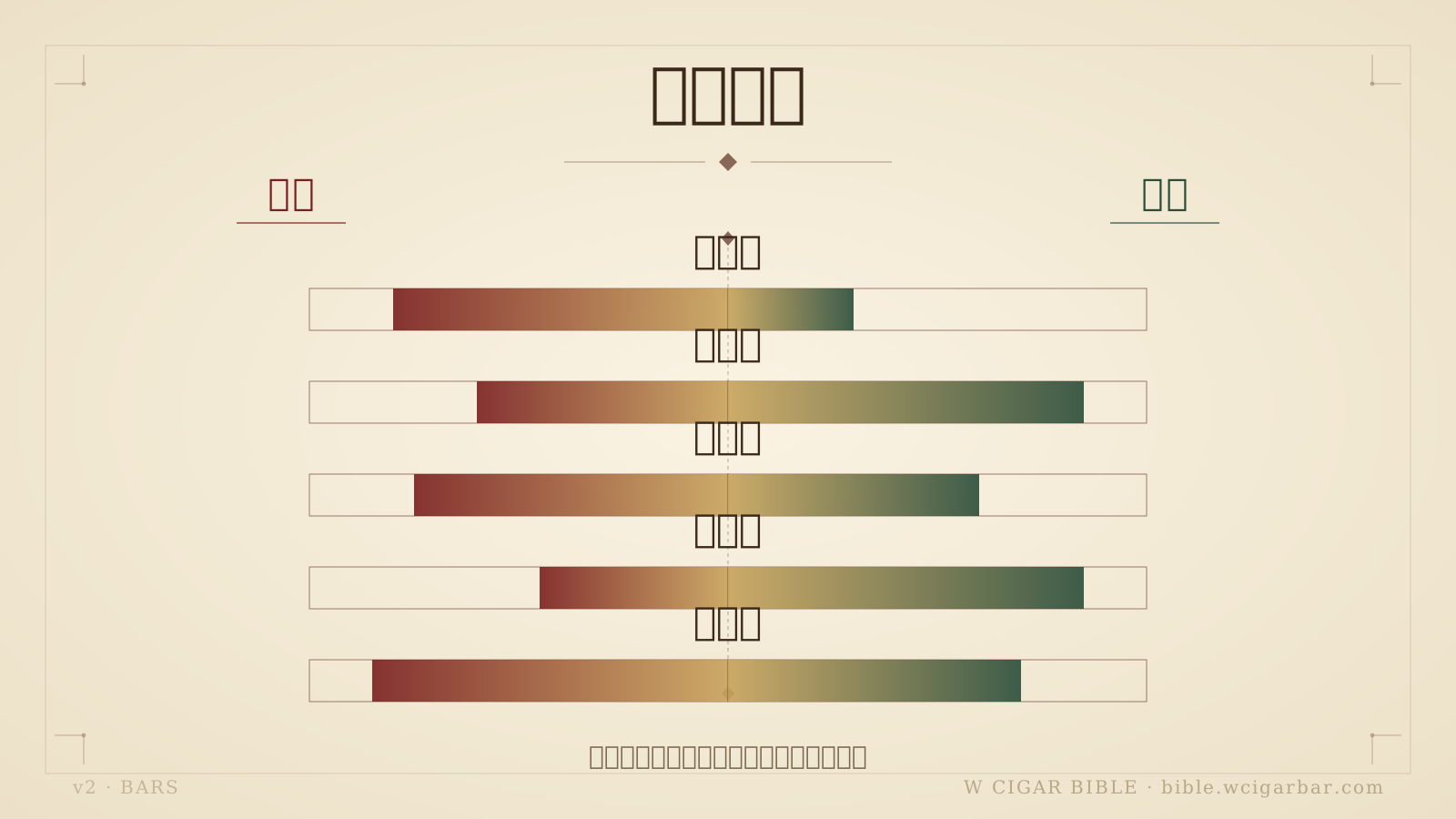
長條圖比較美式咖啡與手沖咖啡五項取向
Flavor Chemistry: Black Coffee × Simple Tobacco Token to Token
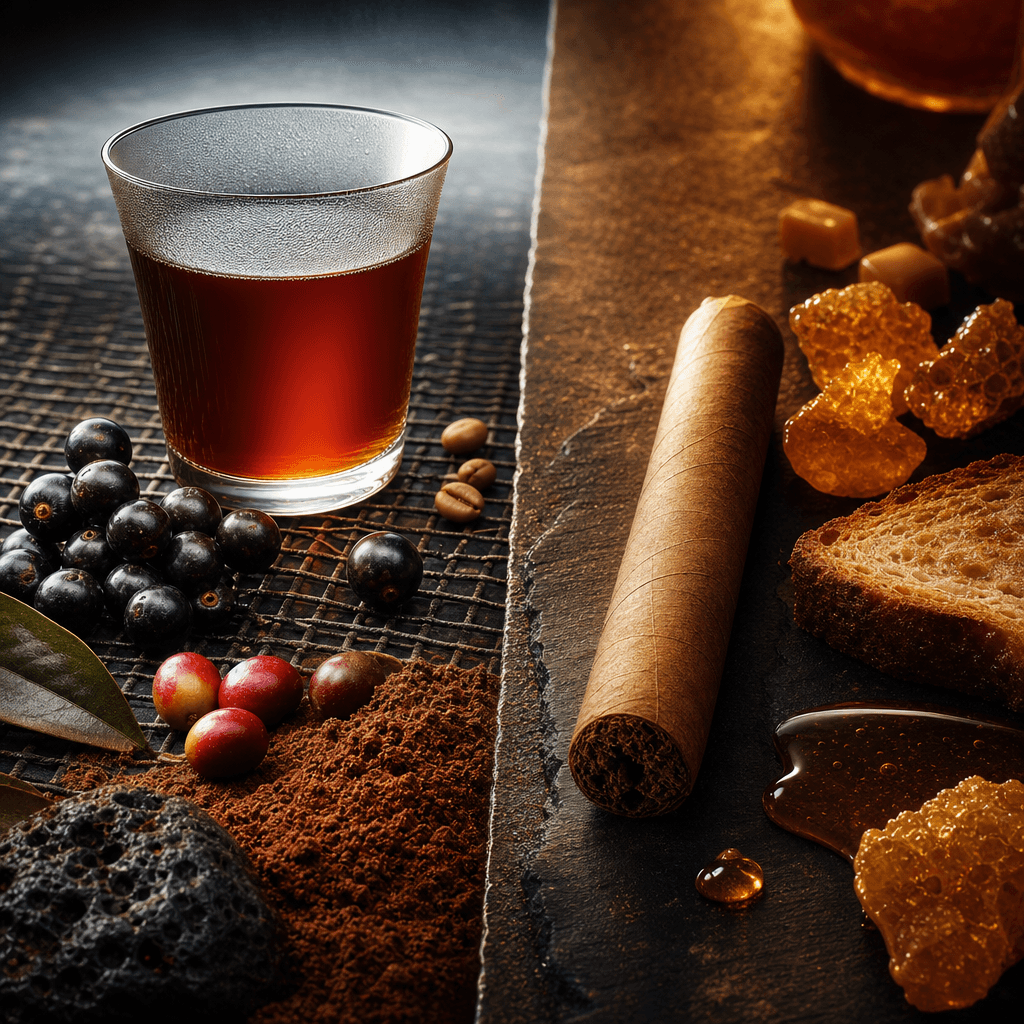
Pour-over cleanliness × simple tobacco flavor is the core everyday-to-everyday pairing. Pour-over reduces oils and fine particles through filter paper, allowing organic acids, caramelized sugars, and a small amount of floral and fruity notes in the coffee to have more separation; Petit Cazadores uses earthiness, woodiness, and light cocoa as its backbone. When drip coffee cleans the surface of the mouth, lignin degradation products in tobacco smoke, such as guaiacol and syringol, are less likely to be obscured by coffee oils.
The dilution lightness of Americano × the low taste burden of the 105mm short cigar is another practical route. Melanoidins in espresso bring a roasted brown feel, furans make caramel and roasted nuts more pronounced, and pyrazines provide nutty, roasted grain aromas. After adding water, the sensations brought by these molecules do not disappear but change from a fist to a palm, just catching the earthiness and woodiness of the short cigar's front half.
Earthiness × coffee bittersweetness requires careful control. The earthiness in cigars often reminds one of wet soil, minerals, and dry wood chips, while the bittersweetness in coffee may come from chlorogenic acid lactones, phenolic compounds after roasting, and caramelization products. If the coffee is over-extracted, the bitterness will amplify with the tobacco burning bitterness; if extracted cleanly, the bitterness acts as a frame, preventing the light cocoa from dispersing.
The chemical key to this pairing is using coffee's dilution and filtration to control the stacking of phenols, oils, bitterness, and tobacco smokiness. I often understand it as four sets of tokens: pour-over cleanliness × simple tobacco flavor, Americano dilution lightness × 105mm short cigar, coffee melanoidins × tobacco light cocoa, woody smokiness phenols × Cuban earthiness tone. If one end is too concentrated, the conversation turns into mutual obscuring.
The Rhythm of Everyday Coffee on the Balcony Morning: Precision Without Formality
The pairing without formality, the balcony morning is the entire scene. This statement is not laziness but a reminder that everyday coffee and Petit Cazadores do not win by the weight of rituals. Clean water, clean cups, stable brewing, appropriate cut, and a slower smoking rhythm are often more important than exaggerated equipment.
If it's Americano coffee, I would first let the espresso cool slightly, then add hot water or pour the espresso into hot water. The former concentrates the aroma, the latter softens the mouthfeel; both are feasible. When pairing with a short cigar, I prefer the latter because dispersing the crema makes the bitterness less sharp. The water volume does not need to be overly precise; beginners can start with one part espresso to three to four parts water, adjusting if the bitterness becomes too pronounced.
If it's pour-over coffee, the coffee-to-water ratio can be tried from 1:15 to 1:16.5, with water temperature around 88 to 93°C. Medium-roast beans ground to sugar granule size, pre-infused for 25 to 35 seconds, then poured in stages, with a total time of about 2 minutes 30 seconds to 3 minutes 30 seconds. These numbers are not constraints but provide a baseline so you know whether to grind coarser, finer, lower the temperature, or extend the time.
The precision of the balcony morning is not about making the pairing grand but allowing room for every sip of coffee and every puff of smoke. Petit Cazadores is not suitable for haste; it is short but cannot be rushed. Black coffee does not need to be scalding; it is hot but should not be coarse. When the coffee temperature transitions from hot to warm, and the cigar moves from the front to the middle, the light cocoa and woodiness will slowly connect in the mouth.
三張問答卡整理新手選杯苦味與器材問題
Beginner Practice: How a Cup of Black Coffee Accompanies José L. Piedra Petit Cazadores to the End
The first step is to decide whether to have Americano or pour-over coffee today. If you want something simple, stable, and with a clear bittersweet outline, Americano coffee will be more intuitive; if you want to practice recognizing the distance between acidity, sweetness, woodiness, cocoa, and smokiness, pour-over coffee has more educational value. For the first pairing, I would avoid the thick dark-roast French press because it easily pushes the graininess of short-filler cigars to the forefront.
The second step is to drink the coffee first, then light the cigar, avoiding the simultaneous entry of two types of smokiness and bitterness at the start. Note three things with the first sip of coffee: is the acidity sharp, is the bitterness dry, and does the sweetness linger on the tongue? For the first three puffs of the cigar, observe which of earthiness, woodiness, and light cocoa appears first, and whether spiciness rises in the nasal cavity or the base of the tongue.
The middle section is the most worthwhile part of this pairing. After the Americano coffee cools, the bitterness softens, and roasted nuts and cocoa become more pronounced; the middle section of Petit Cazadores is usually more integrated than the front, with earthiness not as direct, woodiness turning into dry wood chips and light cocoa. At this point, taking a sip of coffee and waiting a few seconds before taking another puff makes it easier to see the changes than continuous alternation.
The best method for beginners is to break the pairing into front, middle, and back sections rather than rushing to give an overall score. If the spiciness, bitterness, and dryness increase in the back section, dilute the coffee a bit more or extend the interval between puffs. When you can say "Americano softens the earthiness" or "pour-over cleans the woodiness," this coffee introduction has truly entered the oral experience.
Frequently Asked Questions
There is no superiority between Americano and pour-over, only different extraction logic and pairing purposes.
For the first time pairing with José L. Piedra Petit Cazadores, should I choose Americano or pour-over coffee?
If you are a complete beginner, starting with Americano coffee will be more intuitive because its bittersweet structure is clear, and the ratio is easy to adjust. If you can already distinguish the acidity, sweetness, and bitterness of coffee, pour-over coffee will make the woodiness and light cocoa clearer.
Will black coffee make the cigar more bitter?
Whether it becomes bitter depends on the coffee extraction and the cigar smoking rhythm. Over-extracted coffee will amplify the tobacco burning bitterness; clean pour-over or lighter Americano can make bitterness a contour, not the main character.
Should entry-level beans be light roast or medium roast?
I would recommend starting with medium roast, especially the nutty, caramel, cocoa route. Light roast can be beautiful, but if the acidity is too sharp, it can separate from the earthiness of Petit Cazadores, making beginners feel like they are going their separate ways.
Which is most suitable for this cigar: V60, Chemex, or French press?
V60 is the most flexible, Chemex the cleanest, and French press the thickest. If the goal is to see the earthiness, woodiness, and light cocoa of José L. Piedra Petit Cazadores clearly, I would first choose V60 or Chemex; the French press is suitable for those who want a thicker mouthfeel.
Does coffee temperature affect the pairing?
Yes, and the impact is significant. When too hot, bitterness and smoke stimulation are easily amplified; after slightly cooling, the sweetness, nuts, and cocoa in the coffee are clearer and more easily connect with the cigar's middle section.
Does this pairing require particularly formal equipment?
No, but the equipment should be clean, and the proportions stable. Simple drippers, pour-over kettles, and reliable grinding methods can establish a clear baseline; for Americano coffee, the focus is on the espresso not being bitter and the water volume not being too little.
I often say that truly enduring everyday pairings do not fill the scene but provide a clear order for the taste. The lightness of Americano coffee, the cleanliness of pour-over coffee, meeting the earthiness, woodiness, and light cocoa of José L. Piedra Petit Cazadores, just place black coffee and short cigars back into the scale of life.
Further Reading|Complete Guide to Coffee Origins and Roasting: From African Floral and Fruity to Asian Thick Earth Flavor Spectrum, with Cigar Pairing Overview|The Nine Bar Pressure of Italian Espresso: Crema Oils and Roasted Aroma Essence, with Partagás Shorts Morning Ritual|Cuban Coffee Cafecito Culture: Havana Morning with Sugar-Whipped Espuma, Paired with Cohiba Siglo II's Native Combination
—Cigar Prince Wilson Tsai
Smoking is harmful to health. Under 20 years old is prohibited from smoking. Quitline: 0800-636363. This article is for reference by adults over 20 years old for cigar culture, preservation, and regulatory knowledge, not tobacco advertising, promotion, or purchase advice.
Like this article?Share with friends
Share this W Cigar Bible piece with friends who want to learn cigar culture, storage, and tasting.
想把這篇 化為實踐
雪茄聖經是知識;雪茄文化要在空間裡發生

W Cigar Bar 大安總店資訊
台北大安區 · 雪茄聖經總編輯 Wilson Tsai 主理的雪茄文化空間
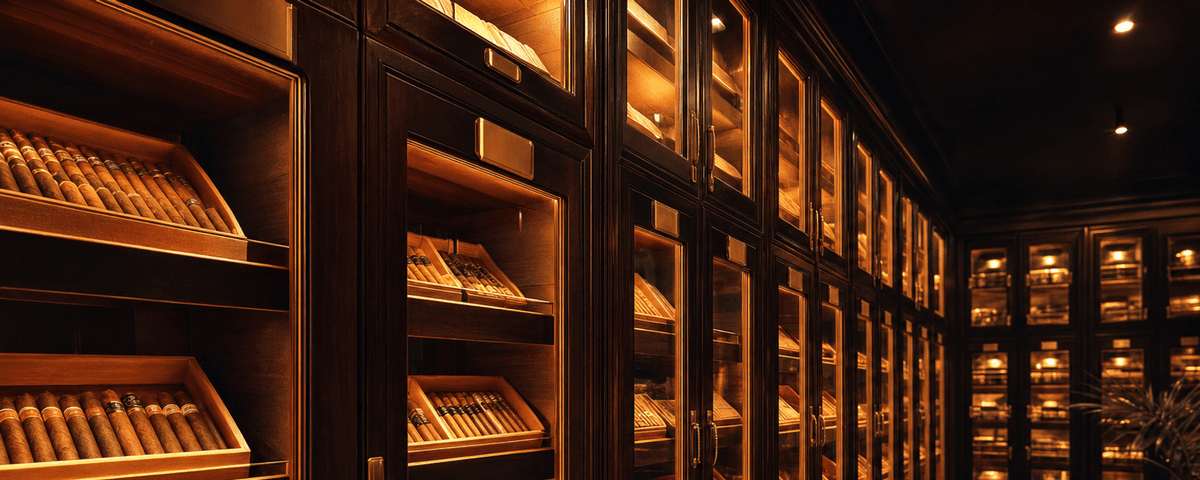
33 座 24 小時恆溫恆濕醇化室
W Cigar Bar 提供的會員醇化空間 · 場地資訊請洽編輯部
雪茄剪 / 打火機 / 雪茄盒 / Boveda
W Cigar 配件官網 · 專營雪茄配件正品
加 LINE 好友 · 文化諮詢
文化空間資訊 · 紳士沙龍 · 私人包場
本網站內容僅供雪茄文化、歷史、收藏與品吸知識研究參考。菸品有害健康、未滿法定年齡者請勿吸菸。實際規範請依所在地法律為準。
吸菸有害健康・戒菸專線 0800-636363・本站僅供 20 歲以上成年人閱覽。
讀到這裡,你不只是路過的人
留下 Email,加入 W 雪茄聖經內圈——總編輯 Wilson Tsai 親選的學院深文與國際新訊,先你一步送到信箱。
· 教育用途非銷售 · 隨時一鍵退訂 · Email 絕不對外公開 · 由勝茄股份有限公司營運
同分類延伸閱讀


資料來源:W Cigar Bible 編輯部整理 · 雪茄王子 Wilson Tsai 親自審稿
本文僅供雪茄文化、歷史、收藏與品鑑知識研究,不作為菸品促銷、銷售或購買建議。吸菸有害健康,未滿二十歲不得吸菸。