南非紅酒 Pinotage 深度解析:開普敦煙燻野莓的獨有品種,搭配 Vegas Robaina Famosos

南非紅酒 Pinotage 不是單純的果味紅酒,而是開普敦葡萄酒歷史、Stellenbosch 花崗岩坡地、煙燻野莓與咖啡烘焙工藝交會的品種語言。本文以 Vegas Robaina Famosos 為搭配核心,解析皮諾塔吉與古巴泥土、奶油可可、乾果、皮革之間的風味分子互動。
- Pinotage 的煙燻野莓核心,來自品種基因、坡地成熟度與桶陳取向共同塑形。
- Vegas Robaina Famosos 的泥土、奶油可可與皮革,會放大皮諾塔吉的深色調。
- 搭配重點不是濃度相撞,而是酸度、單寧、煙燻酚類與乾果甜感的節奏管理。
In-depth Analysis of South African Wine Pinotage: The Unique Variety of Smoky Wild Berries from Cape Town, Paired with Vegas Robaina Famosos
When South African wine Pinotage meets Vegas Robaina Famosos, the most fascinating aspect is not the broad framework of "wine paired with cigars," but how the smoky wild berries of Cape Town wine are gradually drawn by the earthiness, creamy cocoa, dried fruits, and leather of the Cuban Hermoso No.4. As an editor of the "Cigar Bible," I often say that a truly worthy pairing should not stop at who overpowers whom, but should consider how aroma molecules, texture weight, and aftertaste time rewrite each other.
Pinotage, often translated as "皮諾塔吉" in Chinese, is one of the few red grape varieties in South Africa that can shoulder the entire history of national wine, varietal experiments, regional soil, and market aesthetic debates. Vegas Robaina Famosos (Cuba, Hermoso No.4, 48 × 127mm) is a cigar within the medium-sized category that is quite suitable for observing the details of the wine; it does not overpower with brute force but uses earthiness, creamy cocoa, dried fruits, leather, and mild smoke to amplify the smoky wild berries, dried plums, and coffee roasting notes of Pinotage.

時間線呈現開普酒史、皮諾塔吉與搭配節奏
From Constantia to Cape Town Wine: The Long Historical Background of South African Wine
The story of South African wine cannot be read only from modern wine labels. In 1652, the Dutch East India Company established a supply station at the Cape of Good Hope, and grapevines entered the Cape region along the colonial routes. By 1685, Simon van der Stel opened Constantia, and South African wine began to be remembered on European upper-class dining tables. The sweet wines of Constantia in the 18th and 19th centuries were mentioned by Napoleon, British literati, and European aristocrats, indicating that Cape Town wine is not a new phenomenon but a complex field with a 350-year winemaking history.
The classic of Constantia is sweet wine, but what it leaves behind is not a single sweetness, but a "balance between sea breeze, sunlight, acidity, and ripeness." The Cape Peninsula is influenced by the Atlantic and Indian Ocean currents, with ample sunlight but not necessarily scorching heat, and afternoon winds can preserve acidity and reduce disease pressure. This climatic syntax was later reinterpreted by regions such as Stellenbosch, Paarl, and Swartland, forming a unique position for South African red wine between New World fruitiness and Old World structure.
To understand Pinotage, one must first understand that South African wine is not just "a lot of sunshine," but a wine culture built on sea breezes, mountains, historical trade, and varietal experiments. This background influences how we perceive the smokiness of Pinotage: it is not just a superficial decoration added with oak barrels but often involves grape ripeness, fermentation temperature control, extraction strategies, and the stylistic choices of the South African wine industry in different eras. When it encounters the Cuban earthiness and leather of Vegas Robaina Famosos, the sense of history becomes a depth of flavor rather than a nostalgic slogan.
The 1925 Varietal Experiment: Why Pinotage is Unlike Pinot Noir and Not Just Cinsaut
Pinotage was born in 1925, bred by Professor Abraham Izak Perold of the University of Cape Town by crossing Pinot Noir and Cinsaut. At that time, Cinsaut was commonly referred to as Hermitage in South Africa, and the name Pinotage is a combination of Pinot and Hermitage. Perold's idea was straightforward: he hoped to achieve the delicate aroma of Pinot Noir and the adaptability, yield stability, and more reliable ripening performance of Cinsaut under South African climate conditions.
But adding genes does not equal averaging flavors. Pinot Noir brings the imagination of red berries, floral notes, and soft tannins, while Cinsaut provides the fruitiness and resilience to maintain drinkability in warmer regions. In Pinotage, however, it often transforms into multiple facets such as black cherry, wild berries, plums, smokiness, banana esters, caramel, coffee, and earthiness. Its skin is thicker, color deeper, and if extraction is slightly imbalanced, it may appear coarse or bitter; when handled properly, it presents firm flesh, spicy fruit skin, and a smoky mineral tail.
The essence of Pinotage is not the South African version of Pinot Noir but an independent language that re-emerges from the Cape terroir, combining the resilient framework of Cinsaut with the aromatic ambition of the Pinot family. This also explains why it pairs well with Vegas Robaina Famosos: the medium-sized cigar of Famosos does not flatten the details of the wine but allows the varietal profile of Pinotage to be read in three layers. The first layer is smoky wild berries, the second is dried plums and fruit skin tannins, and the third is coffee, cocoa, and caramelized aromas brought out by barrel aging or roasting.

三張卡列出野莓、酸度與中等茄體重點
Stellenbosch Granite Slopes: The Structure of Pinotage Begins with the Soil
When discussing Pinotage, Stellenbosch is almost unavoidable. Located east of Cape Town, the valleys, slopes, and sea breezes shape the region, with areas like Simonsberg, Helderberg, and Bottelary Hills each offering different slope orientations and soil conditions. The mix of decomposed granite soil, sandy loam, and some clay allows the grape roots to find tension between drainage and water retention; for Pinotage, this tension often reflects in the tannin granules and acidity framework.
The granite slopes of Stellenbosch serve an important function: they not only allow the grapes to ripen but also maintain the boundaries of ripeness. Sunlight advances sugar, phenolics, and fruit skin color, while sea breezes and nighttime cooling preserve acidity, preventing smoky wild berries from collapsing into monotonous jam. If harvested too late, dried plums, brown sugar, bitterness, and alcoholic heat can become prominent; if harvested too early, green stems, rubber, and sharp tannins may dominate the palate.
The key to excellent Pinotage from Stellenbosch lies in using the drainage of granite slopes to enhance fruit concentration, then using sea breezes and altitude differences to lock acidity back into the wine body. This structure is crucial when paired with Famosos because the earthiness and leather of the cigar will reduce the perceived brightness of the wine's fruit acidity. If the wine itself lacks sufficient acidity, the entire pairing will quickly become dark and dull; if the acidity and tannins are well balanced, the wild berries will re-emerge from the smoke, like cutting open a basket of black fruits with skins on a hunting lodge table.

矩陣比較皮諾塔吉、法摩索與交會風味
The Controversy of Smoky Wild Berries, Coffee Roasting, and Coffee-style Pinotage
One of the most divisive styles of Pinotage is the so-called coffee-style Pinotage. These wines often use heavily toasted oak, wood chips, or barrel aging strategies to amplify coffee, mocha, dark chocolate, and caramel tones, allowing the potentially rough tannins to be enveloped by sweet aromas. It has been very noticeable in the market due to its high recognizability, with direct signals of deep-roasted coffee beans, cocoa powder, and vanilla woodiness upon first sniff.
The controversy starts here. Supporters argue that coffee-style gives Pinotage a memorable South African symbol, reducing the bitterness and animal notes common in the variety; critics argue that excessive roasting can obscure regional differences, flattening the soil and climate of Stellenbosch, Paarl, or Swartland under the same layer of caramel woodiness. From a technical perspective, the issue is not the coffee tone itself but whether it forms a proportion with fruitiness, acidity, tannins, and alcohol perception.
A good coffee-toned Pinotage should be like a roasting shadow, not covering the grape itself into another beverage with coffee aroma. When paired with Famosos, this line is clearer: the cigar already has creamy cocoa and dried fruits, and if the wine only has added roasting, the two will homogenize to the point of losing layers. Conversely, if there is still wild berry acidity, dried plum sweetness, and a bit of granite coolness behind the coffee tone, the cocoa butter sensation of Famosos will round off the wine's bitterness, forming a triangular support of mocha, tobacco, and fruit skin.

三張提醒卡指出咖啡過重與煙燻失衡問題
The Texture Structure of Pinotage: Acidity, Tannins, Fruit Skin, and Dried Fruits Are Not Viewed Separately
A mature glass of Pinotage usually starts with dark berries and plums, then moves into fruit skin tannins, smoky woodiness, and cocoa or coffee. If the mid-palate is done beautifully, there will be a "thick flesh, dry edges" mouthfeel: the center is black cherry and wild berry juice, the sides of the tongue are plum skin, tea-like tannins, and a hint of spice. The finish varies by style, with one leaning towards red fruit acidity and minerals, and the other towards dried plums, coffee powder, and deep-roasted cocoa.
In flavor chemistry, the smokiness and roasting sensation of Pinotage may come from multiple sources. Oak barrel toasting brings guaiacol, 4-methylguaiacol, and other smoky phenols, as well as vanillin, furfural, oak lactones, and signals of vanilla, caramel, coconut shell, and woodiness. Esters during fermentation can bring out berry, banana, or ripe fruit aromas; if poorly controlled, volatile acidity, reduction, or certain sulfur compounds can make the aroma appear harsh.
When pairing Pinotage with cigars, the most important observation is not the size of the wine body but whether the acidity can penetrate the smoke, whether the tannins can support the tobacco oils, and whether the dried fruit sweetness can extend the finish. The medium-sized cigar of Famosos provides enough smoke and oral coverage but does not dull the palate as quickly as heavier cigars. When the wine's acidity is in line, the smoky wild berries will be lifted by the leather; when the tannins are delicate, the dried plum sweetness will connect with the cigar's dried fruit finish rather than becoming a bitter shadow.

長條比較皮諾塔吉與法摩索在果味酸度等軸線
Vegas Robaina Famosos: Cuban Earthiness, Creamy Cocoa, and Leather in a Medium-sized Cigar
Vegas Robaina Famosos (Cuba, Hermoso No.4, 48 × 127mm) is a size well-suited for dissecting pairing logic. The 48 ring gauge provides enough burning surface, and the 127mm length allows for clear changes in the front, middle, and back segments; it does not win by sheer volume but presents continuity of earthiness, creamy cocoa, dried fruits, and leather within a medium-sized cigar. For the wine, this cigar acts like a neutral-toned backdrop, revealing whether the red wine truly has layers.
The front segment often features gentle woodiness, light cream, and dry grass aromas, with the earthiness being more like dry soil and fine powder rather than wet heaviness. In the middle segment, cocoa and leather become more pronounced, with tobacco sweetness and dried fruits forming a rounded mouthfeel, and the smoke carrying the salty mineral edge common in Cuban cigars. If the rhythm is stable in the back segment, the leather deepens, the earthiness thickens, but it retains the readability of a medium-sized cigar, not pushing the wine entirely to the background.
The pairing value of Famosos lies in its medium strength providing four anchor points of earthiness, creamy cocoa, dried fruits, and leather, which correspond precisely to the smokiness, coffee, dried plums, and wild berry acidity of Pinotage. If the cigar is too light, the tannins and roasting of Pinotage will appear coarse; if the cigar is too heavy, the fruitiness of Pinotage will be buried by the smoke. Famosos stands right on the median, allowing us to see how the wine and cigar correct each other rather than just comparing who is more intense.
Flavor Chemistry Connection: Smoky Wild Berries, Leather Earthiness, and Mature Fruit Library
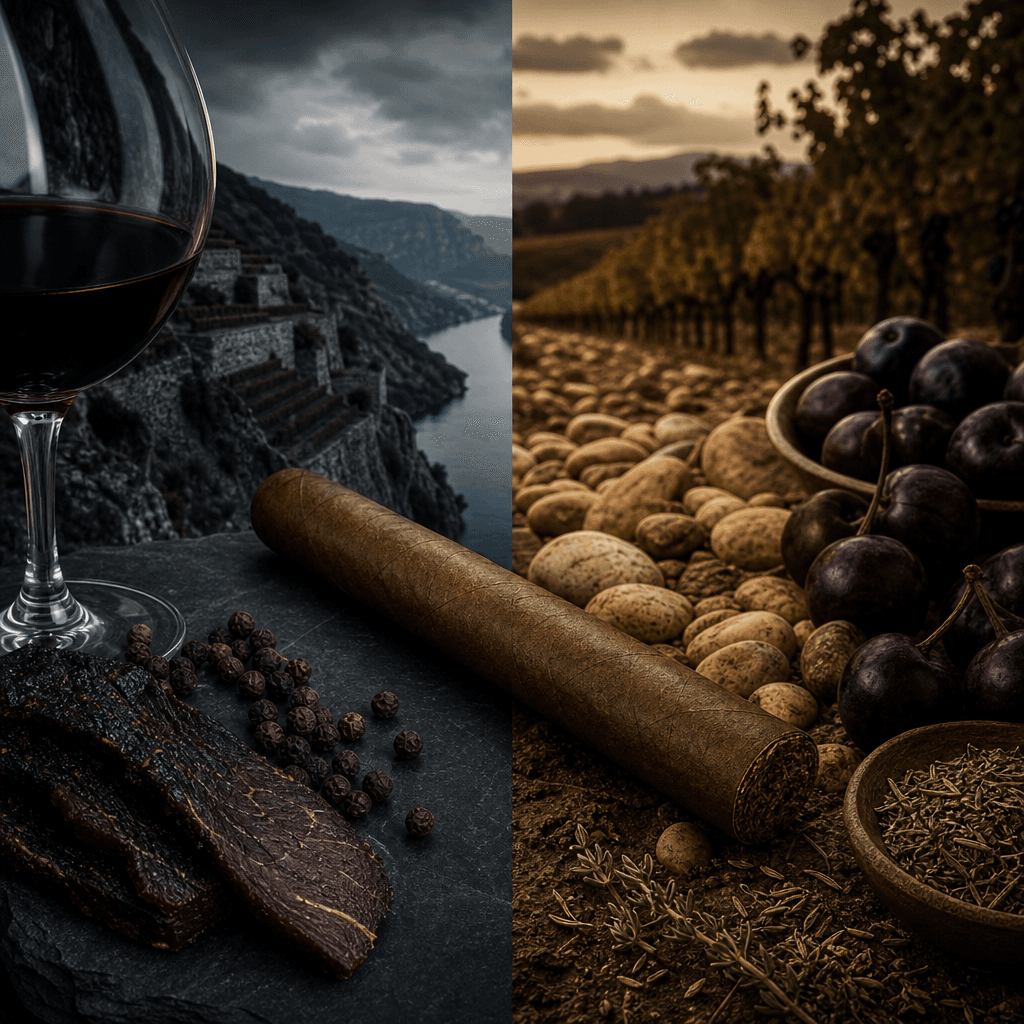
The first core group is smoky wild berries × leather earthiness. If the smokiness of Pinotage comes from barrel-aged phenols and fruit skin ripeness, it will carry hints of guaiacol-like wood smoke, charred wood, and roasting; the tobacco smokiness and leather of Famosos have similar phenols, pyrazines, and oxidized lipid aromas. When the two meet, the berries are no longer just fruit but like being placed in a hunting lodge: the beams have smoke marks, the leather chair has dry soil, and the table holds blackberries and wild plums.
The second group is coffee-toned Pinotage × creamy cocoa. The wine's furfural, 5-methylfurfural, vanillin, and oak lactones will give hints of caramel, vanilla, roasted grains, and coconut shell; Famosos' creamy cocoa provides a lipid sensation and slightly bitter cocoa powder. When the coffee tone of the wine is not overly prominent but hidden behind the dark fruit, the cocoa of the cigar will turn it into a mocha structure with "deep-roasted coffee liquid × cocoa butter × tobacco sweetness" adhesion in the mouth.
The most beautiful change is the dried plum sweetness × dried fruit finish stacking into a mature fruit library, allowing the dried fruit sensation of the wine and the nut, raisin, and dry wood aromas of the cigar to form a slowly darkening tail line. This sweetness is not a pile of sugar but a mature impression brought out by dried fruit aromas and alcohol evaporation. If Pinotage has enough acidity, the dried plums will not appear heavy; if Famosos burns steadily, the dried fruit finish will pull the wine's bitterness back to fruit skin and cocoa rather than stopping at charred wood.
| Pinotage Flavor Token | Famosos Flavor Token | Possible Chemical/Sensory Bridge | Oral Result |
|---|---|---|---|
| Smoky Wild Berries | Leather Earthiness | Guaiacol, tobacco phenols, oxidized leather aromas | Dark fruit aroma like a hunting lodge |
| Coffee Roasting | Creamy Cocoa | Furfural, vanillin, cocoa bitterness and lipid sensation | Mocha-style rounded mid-palate |
| Dried Plum Sweetness | Dried Fruit Finish | Ripe fruit esters, oxidized dried fruit aromas, tobacco sweetness | Extended finish like a mature fruit library |
| Fruit Skin Tannins | Medium-sized Cigar Smoke | Tannin astringency and smoke granules interlocking | Structure becomes three-dimensional rather than heavy |
| Granite Coolness | Cuban Salty Minerals | Sensory overlay of acidity, mineral sensation, and saltiness | Clarity maintained in the tail segment |

快問快答卡整理煙燻、咖啡調與品飲順序
Practical Tasting Order: Temperature, Glass Type, Rhythm, and Cut Will Change the Answer
The serving temperature of Pinotage should not be too high, especially for versions with coffee roasting tones. If the temperature is too high, alcohol evaporation will amplify caramel woodiness and sweet ripe plums, which can become sticky when encountering the leather of Famosos' back segment. Slightly below room temperature, allowing the fruit acidity and tannins to stand out first, is more suitable for this pairing than pursuing thick aromas.
Regarding glass type, I would avoid overly enlarging the belly of the glass, which amplifies alcohol and barrel aromas. A medium Bordeaux glass or a universal red wine glass can allow black fruit, smokiness, and coffee tones to unfold sequentially without pushing all the vanilla and deep roasting into the nose at once. After pouring, give the wine some air, but do not treat decanting as a ritualistic action; the focus is on observing whether wild berry acidity emerges in the first twenty minutes and whether the coffee tone retreats to the background.
The operational principle of this pairing is to first establish the acidity and fruit skin profile of the wine, then let the creamy cocoa and leather of Famosos gradually take over the mid and back segments. The cigar cut should remain clean, avoiding overly tight draws that lead to overheated smoke, as overheating will push the cocoa into bitterness and make the tannins of Pinotage appear coarse. If you smoke the cigar first and then drink the wine, the wine's fruit acidity will feel sharper; if you drink the wine first and then smoke, the earthiness and dried fruits of Famosos will be recognized more quickly. Experienced readers can observe three rounds with small sips and a slow rhythm: the first round looks at fruit aroma, the second round looks at coffee and cocoa, and the third round looks at whether dried plums and leather merge.
Frequently Asked Questions
Why is Pinotage often said to have a smoky flavor?
The smoky flavor of Pinotage may come from the deep-colored fruit skin aroma after the variety ripens, or it may come from the smoky phenols brought out by oak barrel toasting and aging. A good smoky sensation should be connected with wild berries, plums, and acidity, rather than just charred wood or toasted barrel aroma. If there is no fruit support behind the smoky flavor, it will appear dry and bitter when paired with Famosos.
Is coffee-style Pinotage suitable for Vegas Robaina Famosos?
It can be, but it depends on whether the coffee tone is proportionate. If coffee, mocha, and vanilla woodiness are overly prominent, the creamy cocoa of Famosos will be pulled into a single sweet-bitter tone. The ideal state is for the coffee tone to take a step back, allowing wild berry acidity, dried plums, and cigar cocoa to form a three-layer structure.
How does Stellenbosch Pinotage differ from other South African regions?
Stellenbosch often has a more defined structure, with granite slopes and sea breezes allowing fruit to ripen while still retaining acidity. Compared to some warmer, more fruit-forward regions, it often presents better tannin lines and dark mineral sensations in Pinotage. This framework is particularly important for pairing with cigars.
Will the medium-sized cigar of Famosos be overpowered by South African red wine?
If you choose an overly concentrated, high-alcohol Pinotage, it may indeed push the cigar details back. More suitable are versions where the fruit is ripe but the acidity is still clear, and the barrel aging is not overly heavy. The earthiness, leather, and cocoa of Famosos need space and are not suitable for being completely covered by sweet ripe woodiness.
Should you drink the wine first or smoke the cigar first in this pairing?
I would start with a small sip of wine to confirm the acidity, fruitiness, and coffee tone position, then light the Famosos. After the cigar enters the middle segment, return to the wine, which is the easiest way to observe the connection between coffee-toned Pinotage and creamy cocoa. If you start pairing from the cigar's back segment, the leather and bitterness may make the wine appear drier.
If Pinotage has rubber or bitterness, is it still suitable for pairing?
A small amount of rubber, asphalt, or bitterness is not uncommon in some Pinotage, but it must be enveloped by fruitiness and acidity. If these aromas dominate the nose from the start, the earthiness and leather of Famosos will amplify them. In this case, you can lower the wine temperature and slow down the rhythm to see if wild berries and plums re-emerge.
The combination of South African wine Pinotage and Vegas Robaina Famosos is truly worth exploring because both bring dark flavors, yet they are not the same kind of dark. Pinotage offers smoky wild berries, dried plums, and coffee roasting, while Famosos responds with earthiness, creamy cocoa, dried fruits, and leather. When acidity, tannins, and smoke rhythm align, the unique varietal language of Cape Town wine will reveal a deeper profile within Cuban tobacco.
Further Reading|Complete Guide to Wine Regions: Flavor Maps of Old and New Worlds, and Pairing Overview with Cigars|New Zealand Red Wine Central Otago Pinot Noir: Pure Red Fruit from Cool Climates, Paired with the Elegance of Quai d'Orsay No.50|Everyday Red Wine Beginner's Guide: How to Choose Approachable Style Table Wines, Paired with H. Upmann Half Corona for the Half Hour After Dinner
—Cigar Prince Wilson Tsai
Smoking is harmful to health. Smoking is prohibited for those under twenty. Quitline: 0800-636363. This article is intended for adults over the age of twenty as a reference for cigar culture, preservation, and regulatory knowledge, not as an advertisement, promotion, or purchase suggestion for tobacco products.
Drunk driving is prohibited. Excessive drinking is harmful to health. Drinking is prohibited for those under eighteen. This article is also not an advertisement, promotion, or purchase suggestion for alcoholic beverages, please drink responsibly.
Like this article?Share with friends
Share this W Cigar Bible piece with friends who want to learn cigar culture, storage, and tasting.
想把這篇 化為實踐
雪茄聖經是知識;雪茄文化要在空間裡發生

W Cigar Bar 大安總店資訊
台北大安區 · 雪茄聖經總編輯 Wilson Tsai 主理的雪茄文化空間

33 座 24 小時恆溫恆濕醇化室
W Cigar Bar 提供的會員醇化空間 · 場地資訊請洽編輯部

雪茄剪 / 打火機 / 雪茄盒 / Boveda
W Cigar 配件官網 · 專營雪茄配件正品
加 LINE 好友 · 文化諮詢
文化空間資訊 · 紳士沙龍 · 私人包場
本網站內容僅供雪茄文化、歷史、收藏與品吸知識研究參考。菸品有害健康、未滿法定年齡者請勿吸菸。實際規範請依所在地法律為準。
吸菸有害健康・戒菸專線 0800-636363・本站僅供 20 歲以上成年人閱覽。
讀到這裡,你不只是路過的人
留下 Email,加入 W 雪茄聖經內圈——總編輯 Wilson Tsai 親選的學院深文與國際新訊,先你一步送到信箱。
· 教育用途非銷售 · 隨時一鍵退訂 · Email 絕不對外公開 · 由勝茄股份有限公司營運
同分類延伸閱讀

資料來源:W Cigar Bible 編輯部整理 · 雪茄王子 Wilson Tsai 親自審稿
本文僅供雪茄文化、歷史、收藏與品鑑知識研究,不作為菸品促銷、銷售或購買建議。吸菸有害健康,未滿二十歲不得吸菸。