豐塞卡
面紙包裝的傳奇——Fonseca 的金髮,與古巴的靈魂
評分方法 · 本評分為 W Cigar Bible 依據品牌歷史、國際能見度、產品穩定性、收藏討論度與華文市場辨識度綜合整理,非投資建議或銷售推薦。
Fonseca 1892 年由 Don Francisco E. Fonseca(西班牙移民兒子,1868 年生於古巴 Manzanillo)在哈瓦那創立工廠與雪茄品牌——1907 年正式註冊。是雪茄業少有的「先做後註冊」案例,間隔長達 15 年。
Don Francisco Fonseca 以「美男子」聞名——西班牙詩人 Federico García Lorca 在《Son de negros en Cuba》(黑人之歌,收錄於《詩人在紐約》)中提到「la rubia cabeza de Fonseca」(Fonseca 的金髮)——將 Fonseca 與「Romeo y Julieta 的粉紅」並列為「古巴的靈魂」象徵。
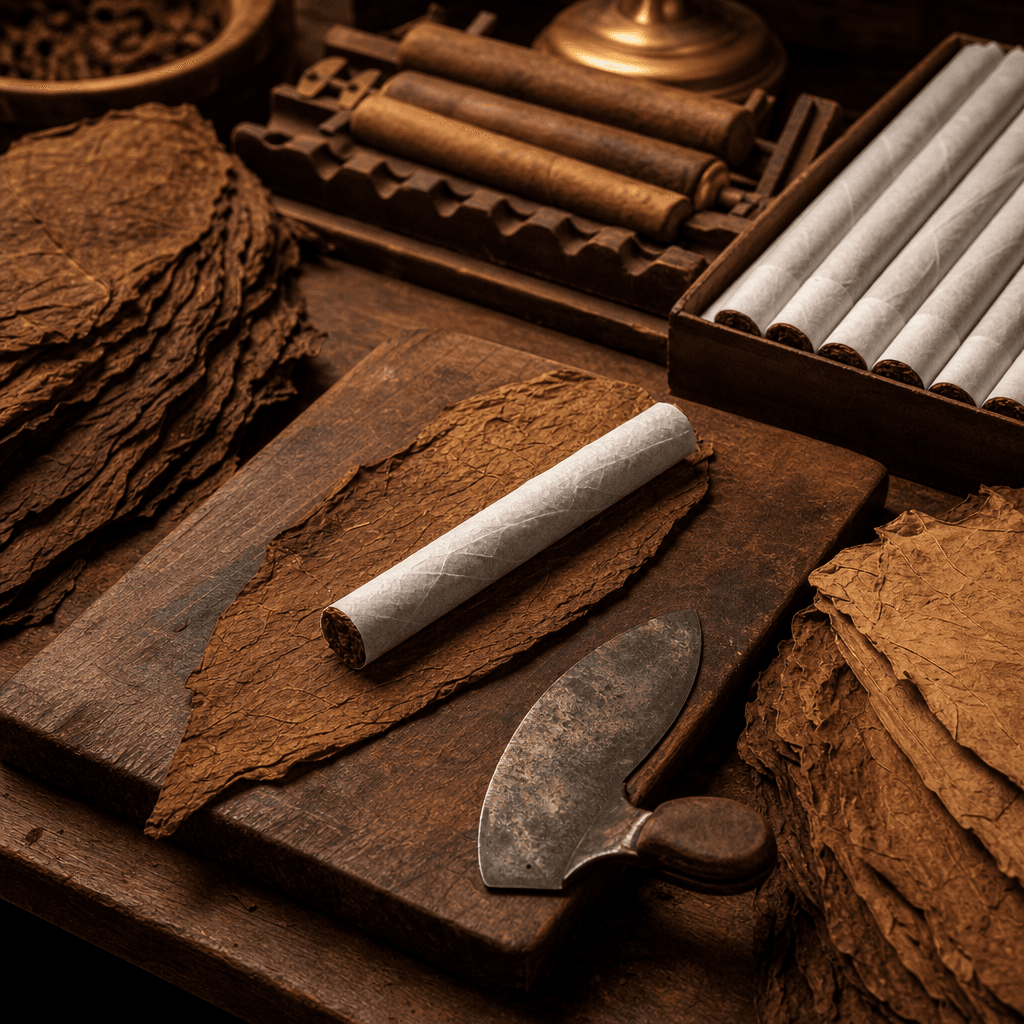
Fonseca 是雪茄業唯一用日本和紙(Washi 面紙)包裝每一支雪茄的品牌——這是 Don Francisco E. Fonseca 1910 年代的創新。雪茄環貼在面紙上而非雪茄本身——是雪茄業獨一無二的奢華包裝特徵,至今仍延續。
Washi 日本和紙——由日本桑樹纖維、清澈河水浸泡、增稠後用竹篩過濾製成,自 7 世紀以來日本手工製作。包裹雪茄的優勢:保護包葉不被運輸破壞、不影響風味(不像雪松木片會微微影響風味)。Fonseca 是全球唯一全產品線都用 Washi 包裝的雪茄品牌。
Fonseca No.4 RE Benelux 2010(5" × 48, vitola: Hermosos No.4, 1,600 支編號 × 25/盒)— 品牌唯一 Edición Regional——比利時、荷蘭、盧森堡市場專屬。仍然手工面紙包裝。1,600 支極稀缺,是品牌史上最珍貴 RE。Robusto 大小、Hermosos No.4。
Don Francisco 是「Cuban Tobacco 專家」——他注重剪裁服裝、優雅打扮、配金色拐杖。60% 的 Fonseca 雪茄被賣給接待會、宴會、紳士俱樂部等場合——是「儀式雪茄」的代表。
1960 年革命後品牌被國有化——但生產從未中斷。這是 Fonseca 的歷史亮點:革命後生產不間斷的少數品牌。今日在哈瓦那省 Quivican 小鎮的 Lázaro Pena Factory 生產。
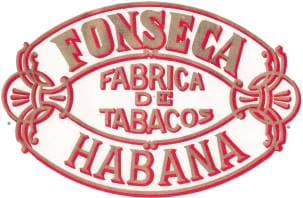
Fonseca 品牌 logo 含古巴莫羅城堡(Morro of Havana)+ 美國自由女神像——圍繞 Don Francisco Fonseca 本人的肖像。反映創辦人雙國身份——是雪茄業少有的「個人肖像為品牌 logo」案例。其他品牌通常用文學場景、菸田、城市風景。
Fonseca 也是第一個導入錫管(tin tube)包裝的 Habanos 品牌——1910 年代發行,比鋁管 Tubos(1940 年代中期才出現)早了 30 年。雪茄業的「管裝雪茄」文化由 Fonseca 開創。
Fonseca 是「第一個在工廠設品鑑室(tasting room)」的古巴雪茄品牌——讓客戶可以品鑑不同配方。這個概念早於今日所有 La Casa del Habano 的品鑑沙龍。同時 Fonseca 也學習 Partagás 的「lector」傳統——僱用朗讀者讀書給捲菸師聽,讓工作不無聊同時推廣教育。
1930 年 Don Francisco E. Fonseca 過世。妻子 Teresa Boetticher de Fonseca 接手經營工廠——是雪茄業少有的「女性繼承人經營雪茄品牌」案例。Doña Teresa 與菸草專家合作,將品牌與 T. Castañeda、G. Montero 等公司合併為 Castañeda, Montero, Empresas de Fonseca, SA。工廠運作直到 1960 年國有化。
Fonseca 風味:輕度(mild/light)強度——是古巴雪茄裡最溫和的派系之一。特徵風味:奶油、烘烤堅果、輕微蜂蜜、香草、淡草本香、輕花香。新手最容易接受的古巴雪茄之一——「完美入門古巴」的代表。
Fonseca KDT Cadetes(4½" × 36, vitola: Cadetes)— 品牌入門款——36 環徑細短 panatela。「KDT」=「Cadetes」(士官生)的縮寫。20-40 分鐘體驗,新手或晨間享用最佳。甜味、土壤香。手工捲製、面紙包裝。
1903 年 Don Francisco E. Fonseca 移居紐約——在 169 Front Street 經營工廠。1895 年取得美國公民身份。1905 年在紐約 Tribeca 區 129 Duane Street 設立 F.E. Fonseca & Co.。同時定期回古巴監督工廠——是雪茄業少有的「美古雙基地」經營模式。
Fonseca Cosacos(5⅜" × 42, vitola: Cosacos)— 品牌中堅款——135mm × 42 環徑 Corona。50 分鐘體驗,柔和風味、適合午後享用。1907 創立至今同款,是雪茄業最有歷史延續性的雪茄之一。
Fonseca No.1(6⅜" × 43, vitola: Cazadores)— 品牌最大規格 Lonsdale。胡椒、木質、35 分鐘體驗。2012 年官方標示停產,但實際持續生產到至少 2017 年——這個「停產但持續生產」的奇特狀態反映 Habanos 庫存策略。
Fonseca 雪茄環特徵:白底淡紋、Standard Band A(1960s 至今,輕浮雕、白紙)→ Standard Band B(2010 RE 用,較精緻浮雕、白紙)。雪茄環貼在 Washi 面紙上——這個獨特包裝細節讓 Fonseca 一眼就能辨識。
「完美入門古巴雪茄」的代表——Fonseca 因為輕度強度、奶油甜味、不會嚇跑新手而受到入門玩家喜愛。但同時也被資深玩家視為「晨間最佳古巴」——一天開始時不需太強烈,Fonseca 完美。
Don Francisco 是哈瓦那的隱形慈善家——在 Barrio Cerro 的家中聚集音樂家、畫家、作家。配紅酒、橄欖、黑火腿(pata negra)營造創作自由的氛圍。他在家中放木製錢箱——任何需要的人可以自取。
Fonseca Delicias(4⅞" × 40, vitola: Standard, short filler)— 品牌唯一 short filler 雪茄——比 long filler 燃燒快。奶油糖餅(shortbread)、奶油甜味、輕肉豆蔻——「晨間最佳古巴」的代表。25 分鐘體驗。
Fonseca 在 Habanos 體系是 Other 分類(小眾品牌)。主要市場是西班牙與加拿大——與其他 Habanos 品牌的全球分銷不同。價格相對便宜——是「性價比最高的古巴雪茄之一」。
所有 Fonseca 都是「totalmente a mano」(完全手工),全 Vuelta Abajo 菸葉。Delicias 是品牌唯一的 short filler 雪茄,其他都是 long filler。6 款常規規格中只停產了 2 款——是 Habanos 體系裡「保留度最高」的品牌之一。
Fonseca Invictos(5¼" × 45, vitola: Especiales)— 品牌獨家規格——這個 Especiales 規格只有 Fonseca 在生產。2002 年停產——讓這個獨家規格徹底消失於古巴雪茄業。
對台灣與華人玩家:Fonseca 是「面紙包裝」的傳奇——這個獨特工藝讓它成為雪茄收藏的「特殊存在」。對熱愛日本和紙文化的玩家,Fonseca 帶有額外的文化情感連結。
1915 年品牌移到 Calle Galiano No. 102 工廠。1911 年 Don Francisco 委託建造新工廠反映品牌成功。雇用 Señor Mecallín——當時哈瓦那最頂級捲菸師之一——擔任主管。
Fonseca 與 Trinidad 都是「先做後賣」的品牌——Fonseca 在革命前就有了 15 年的「先做不賣」期(1892-1907 註冊前),Trinidad 1969-1998 是 30 年的「外交專屬」期。兩個都是「品牌做了很久才正式上市」的代表。
Fonseca Aromas(40 × 140mm, 無正式 vitola 名稱)— 1980 年代後期停產。這個 vitola 過去也被 Romeo y Julieta 用於 Capulets 系列直到 1970 年代。今日已絕種。
Fonseca KDT Cadetes Humidor 2008/2011(50 支裝,Germany 5th Avenue 通路)— 2008 與 2011 年通過 5th Avenue 德國發行的 50 支 humidor。是品牌少有的紀念性 humidor。
豐塞卡 完整 vitola 圖鑑(36 張)
豐塞卡(豐塞卡 Fonseca)旗下完整 vitola 圖鑑卡片、每張卡點進去含: 葉組產地(CAPA/CAPOTE/TRIPA)、 風味前中後段、 歷年特殊版發行紀錄(ER 地區限定 · EL 年度限量 · LCDH · RR · GR)、 配飲建議與收藏陳化指南。
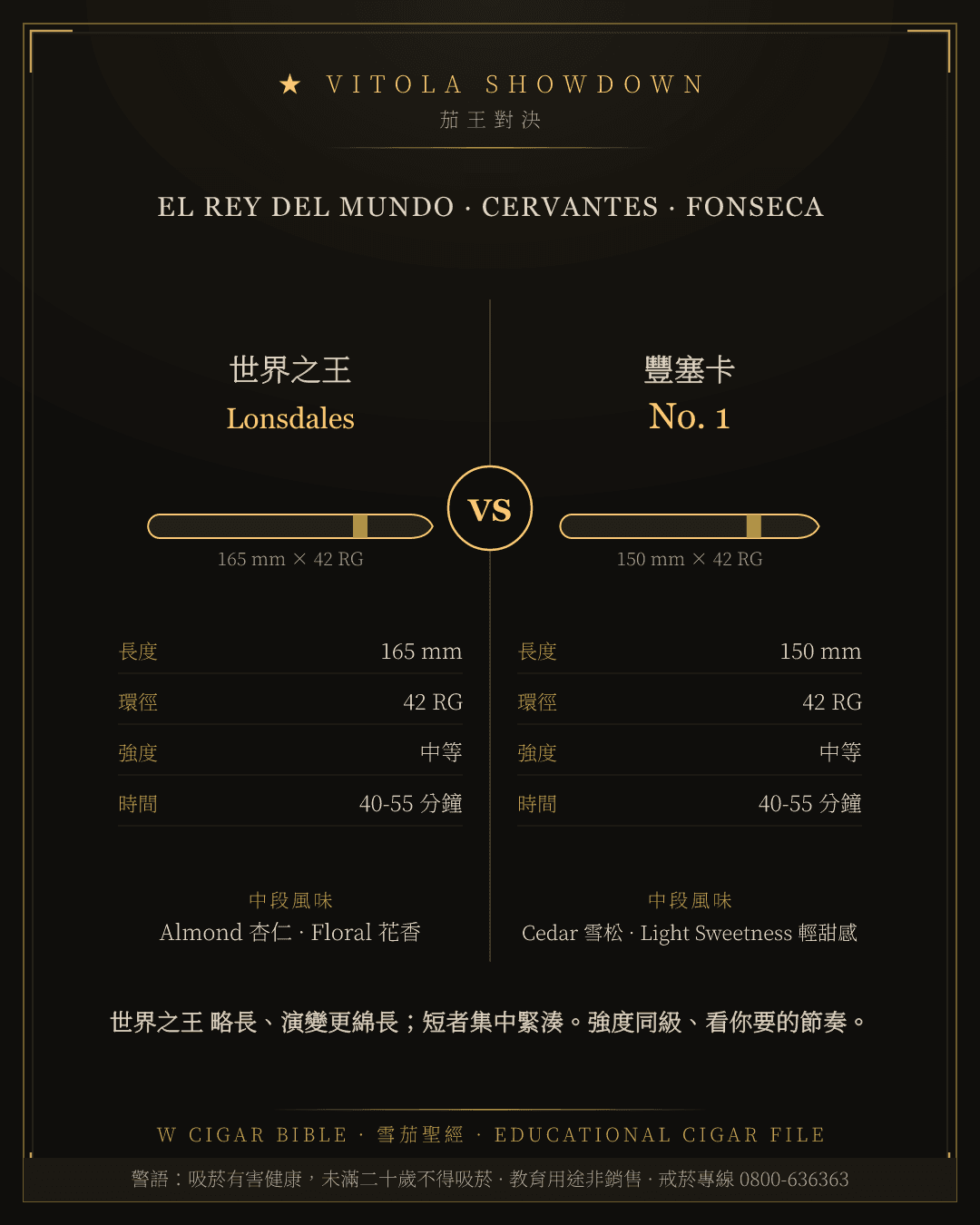
El Rey Del Mundo Lonsdales vs Fonseca No. 1
VITOLA SHOWDOWN · Cervantes

Fonseca · 豐塞卡 品牌故事
BRAND STORY · EST. 1907
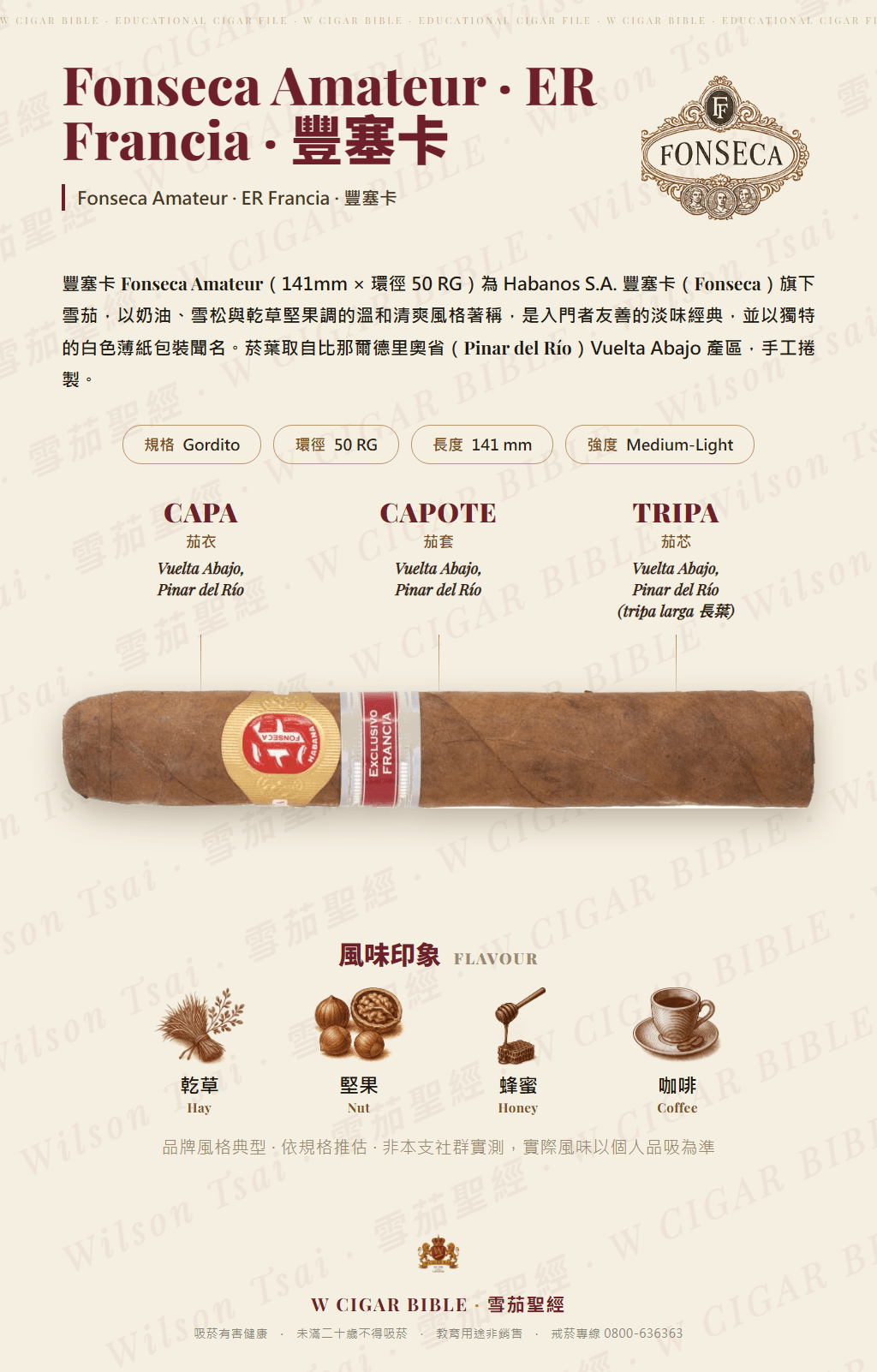
Fonseca Amateur · ER Francia · 豐塞卡
ER Francia · 地區限量版 Edición Regional · 雪茄檔案
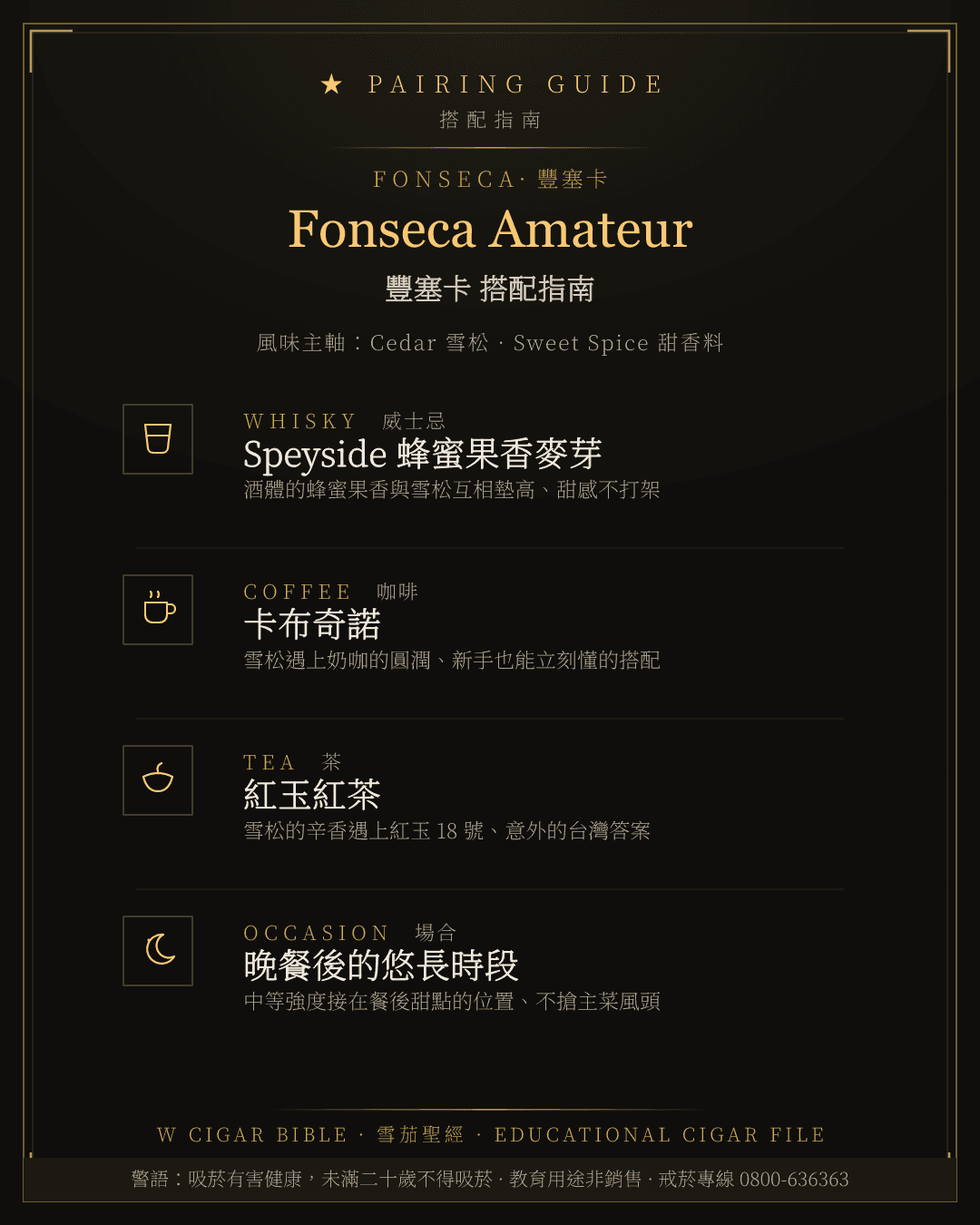
Fonseca Amateur 搭配指南 · 豐塞卡
PAIRING GUIDE · 搭配指南

Fonseca Amateur 風味筆記 · 豐塞卡
TASTING NOTES · 風味筆記
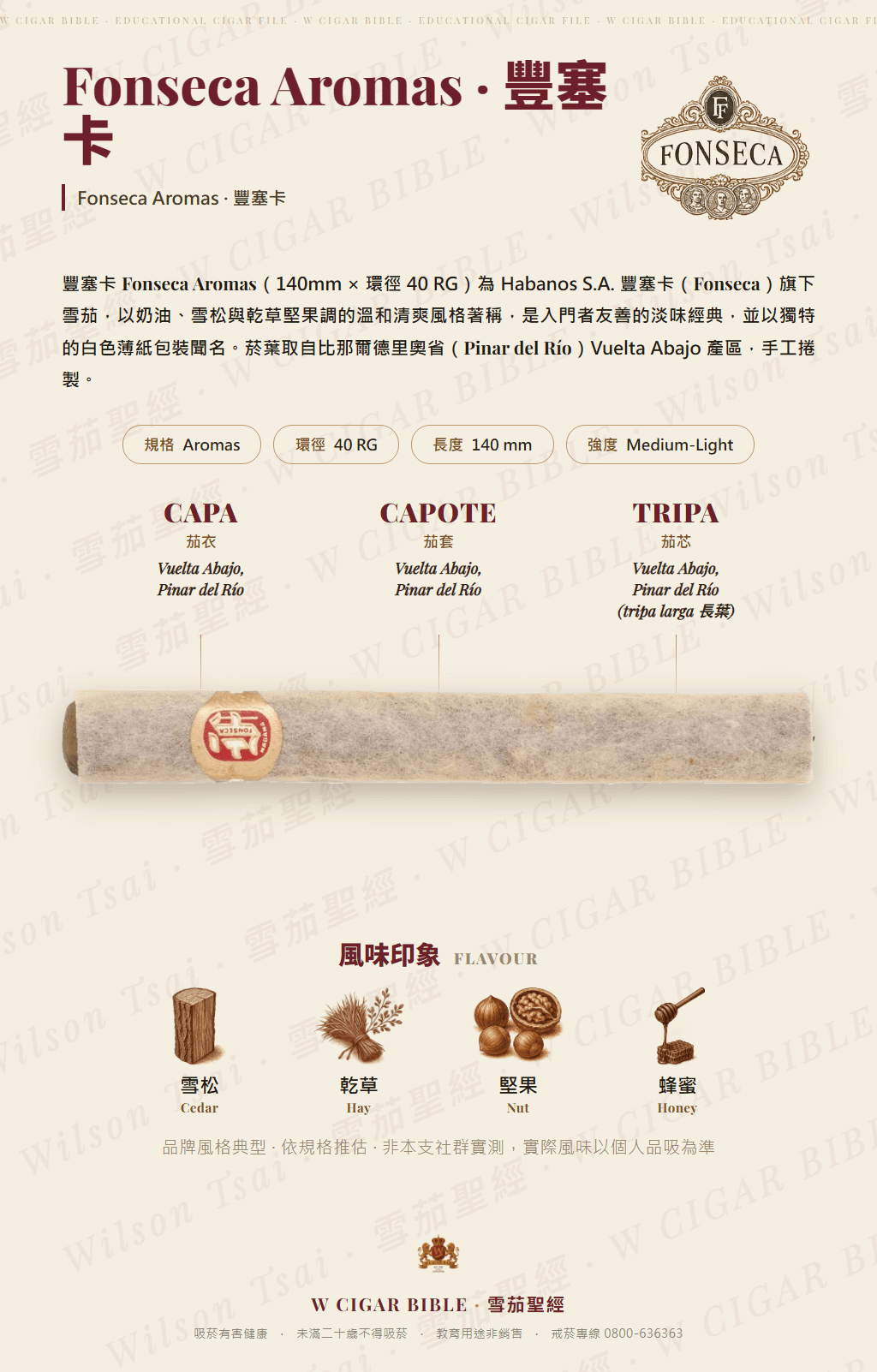
Fonseca Aromas · 豐塞卡
標準生產停產款(40 RG × 140mm,1980 年代末停產)· 雪茄檔案
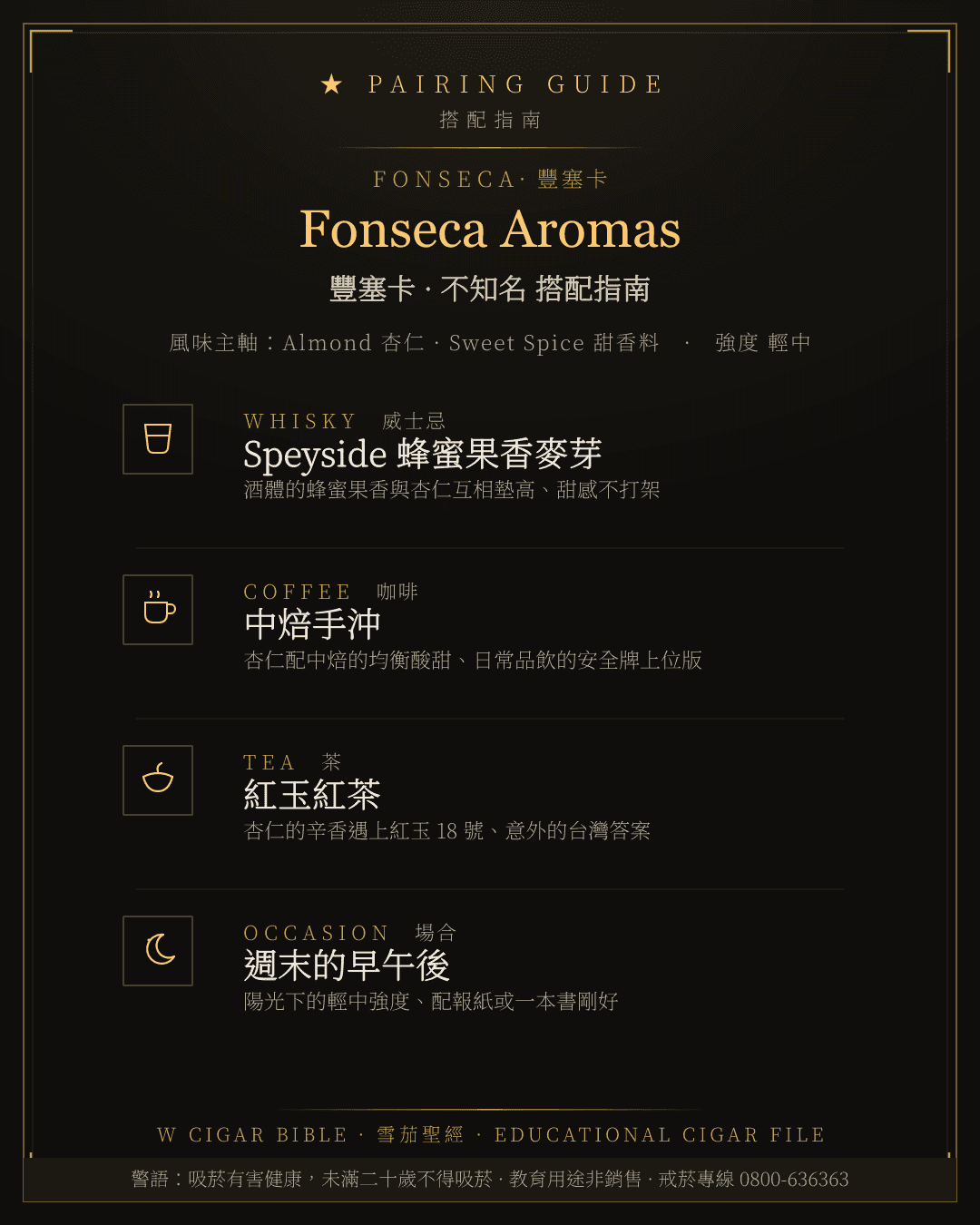
Fonseca Aromas 搭配指南 · 豐塞卡
PAIRING GUIDE · 搭配指南
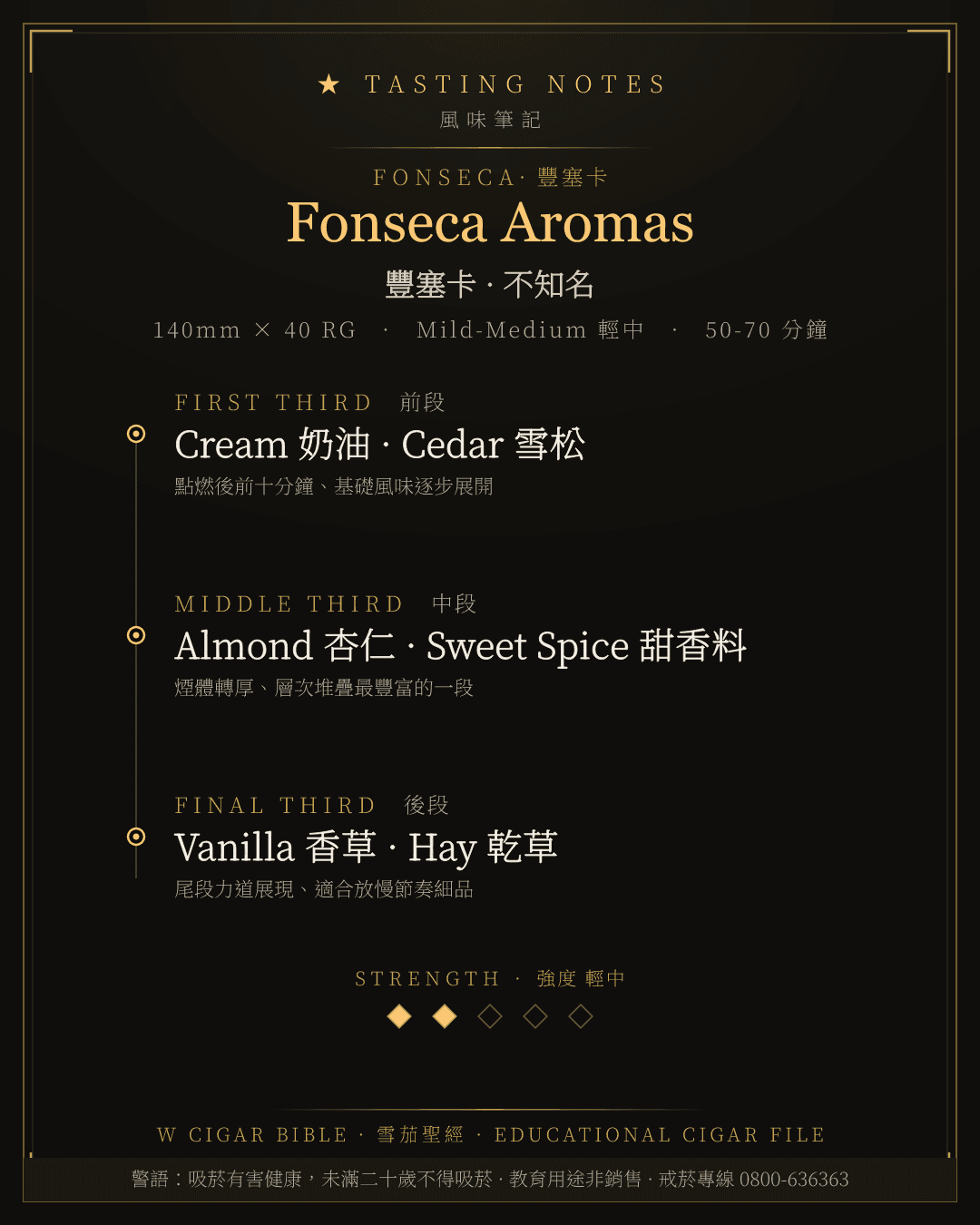
Fonseca Aromas 風味筆記 · 豐塞卡
TASTING NOTES · 風味筆記

Fonseca Cosacos · 豐塞卡

Fonseca Cosacos vs H. Upmann Cristales
VITOLA SHOWDOWN · Cosacos

Fonseca Cosacos 搭配指南 · 豐塞卡
PAIRING GUIDE · 搭配指南
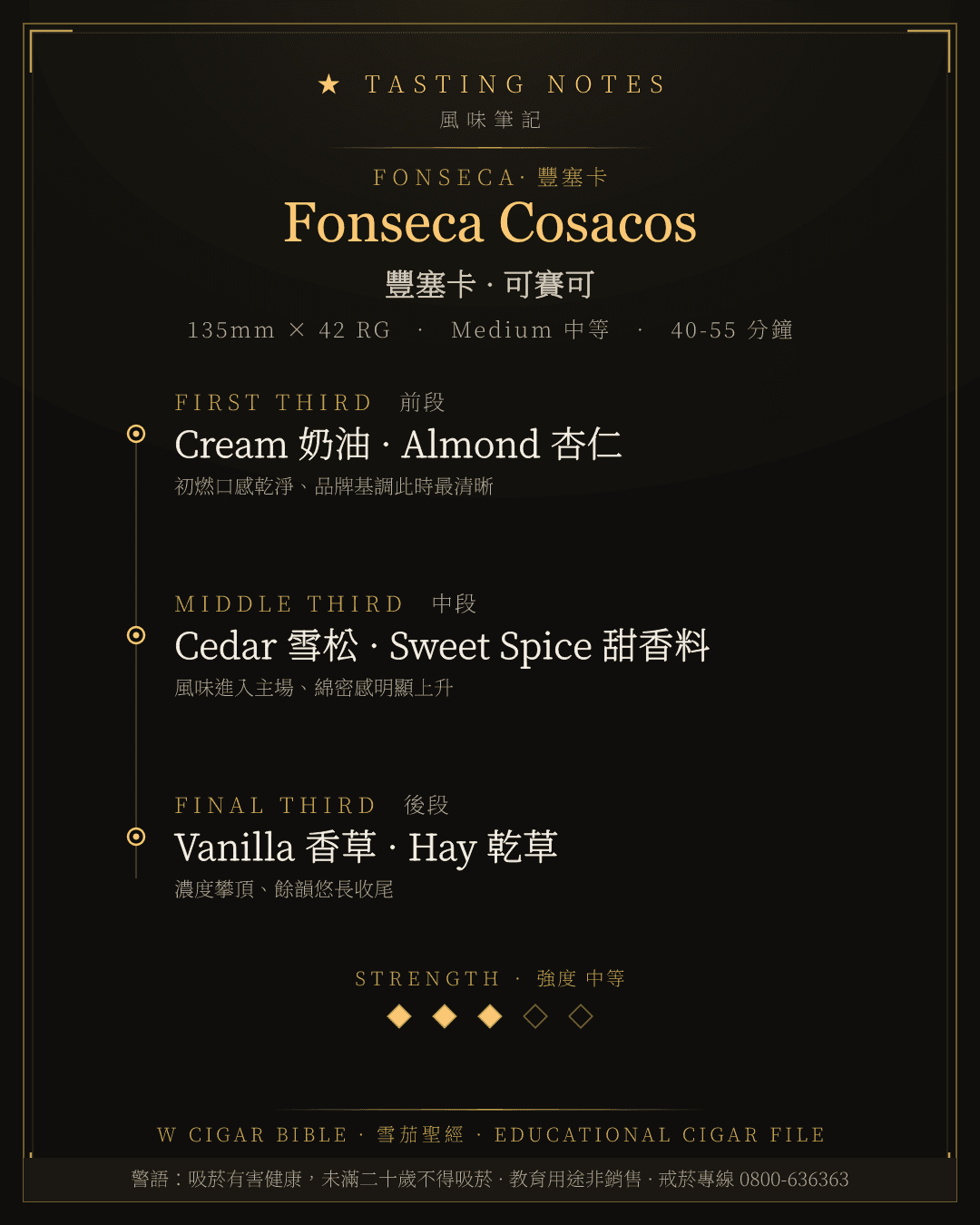
Fonseca Cosacos 風味筆記 · 豐塞卡
TASTING NOTES · 風味筆記
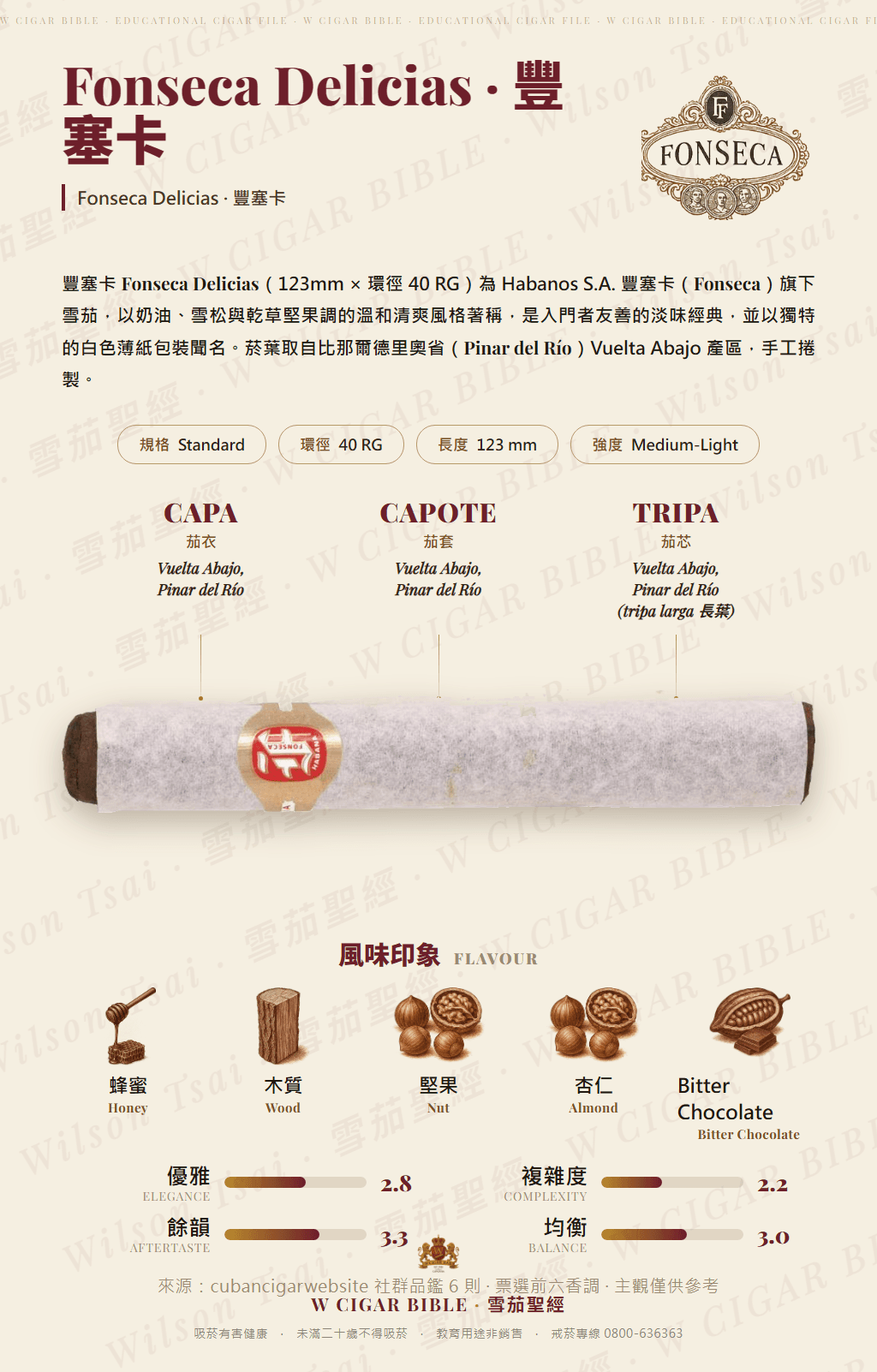
Fonseca Delicias · 豐塞卡
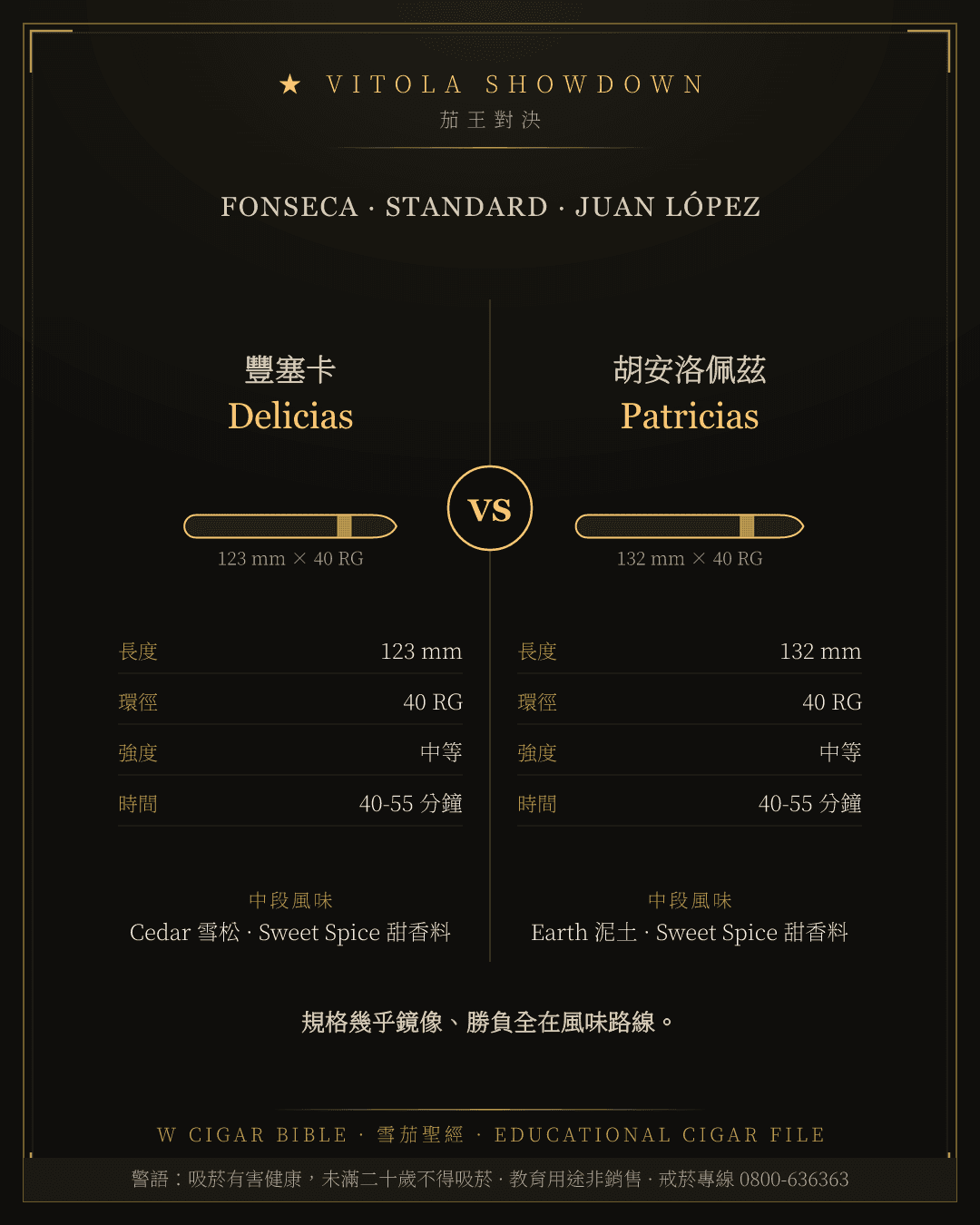
Fonseca Delicias vs Juan López Patricias
VITOLA SHOWDOWN · Standard
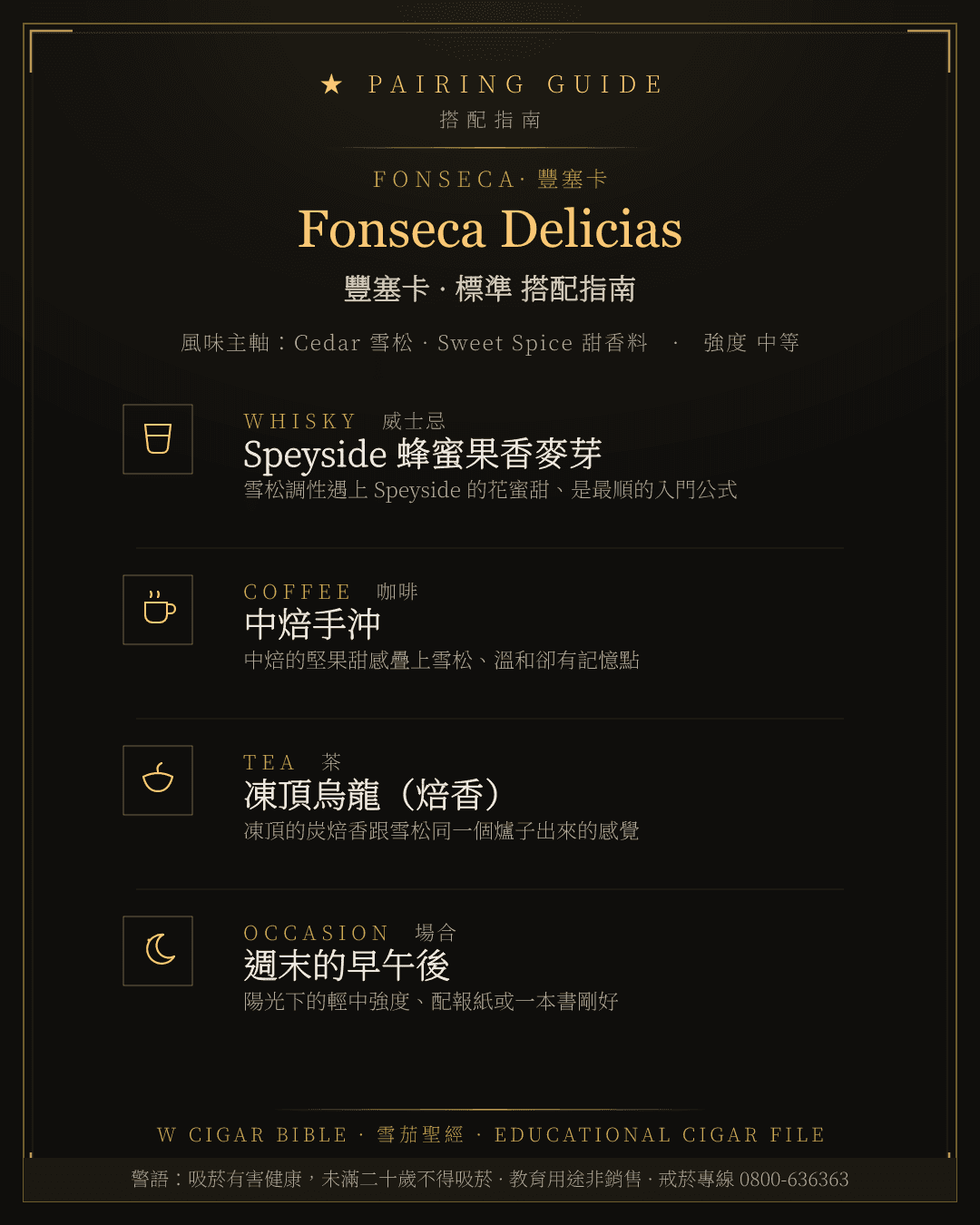
Fonseca Delicias 搭配指南 · 豐塞卡
PAIRING GUIDE · 搭配指南
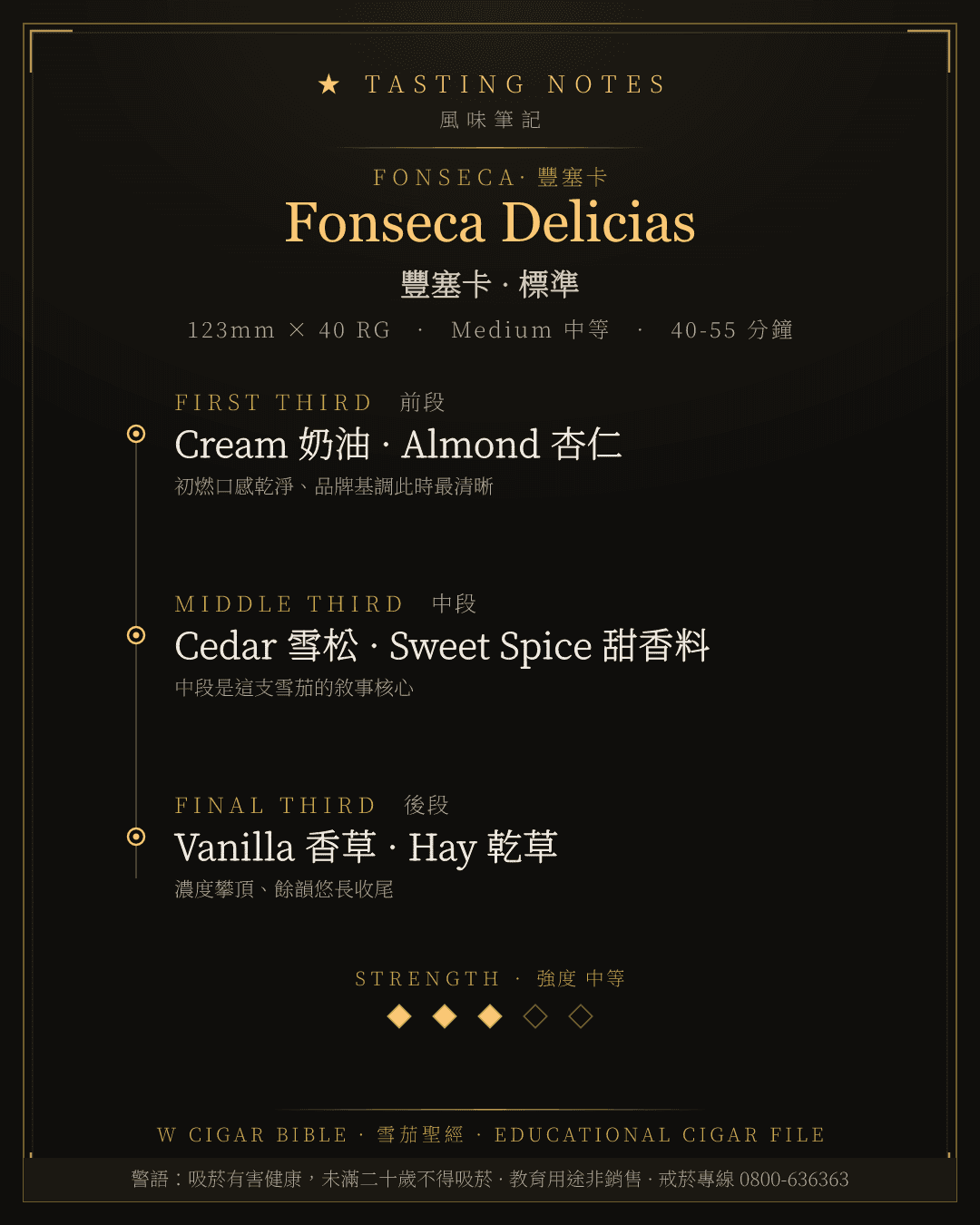
Fonseca Delicias 風味筆記 · 豐塞卡
TASTING NOTES · 風味筆記

Fonseca Du Nord · ER Canadá · 豐塞卡
ER Canadá · 地區限量版 Edición Regional · 雪茄檔案
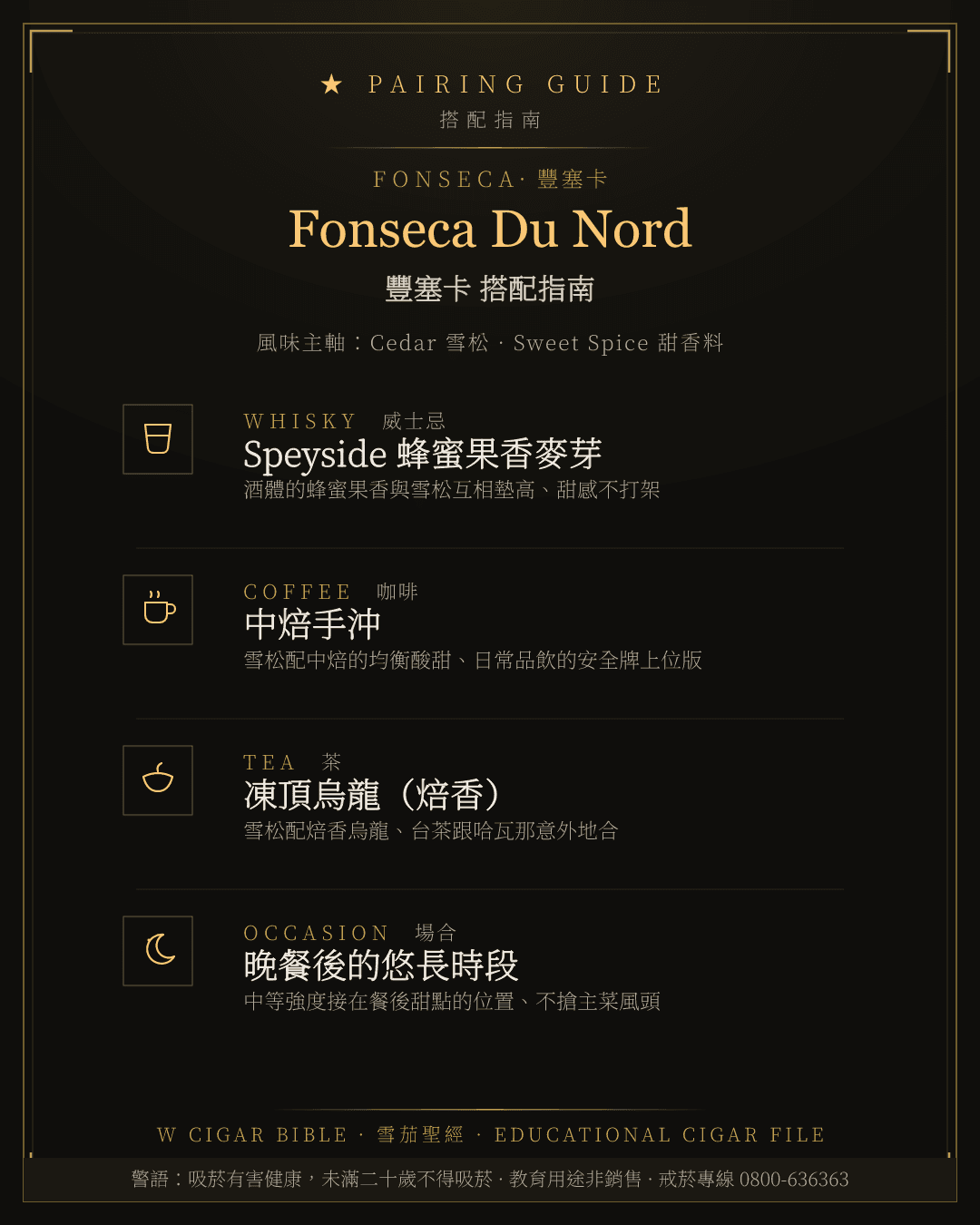
Fonseca Du Nord 搭配指南 · 豐塞卡
PAIRING GUIDE · 搭配指南
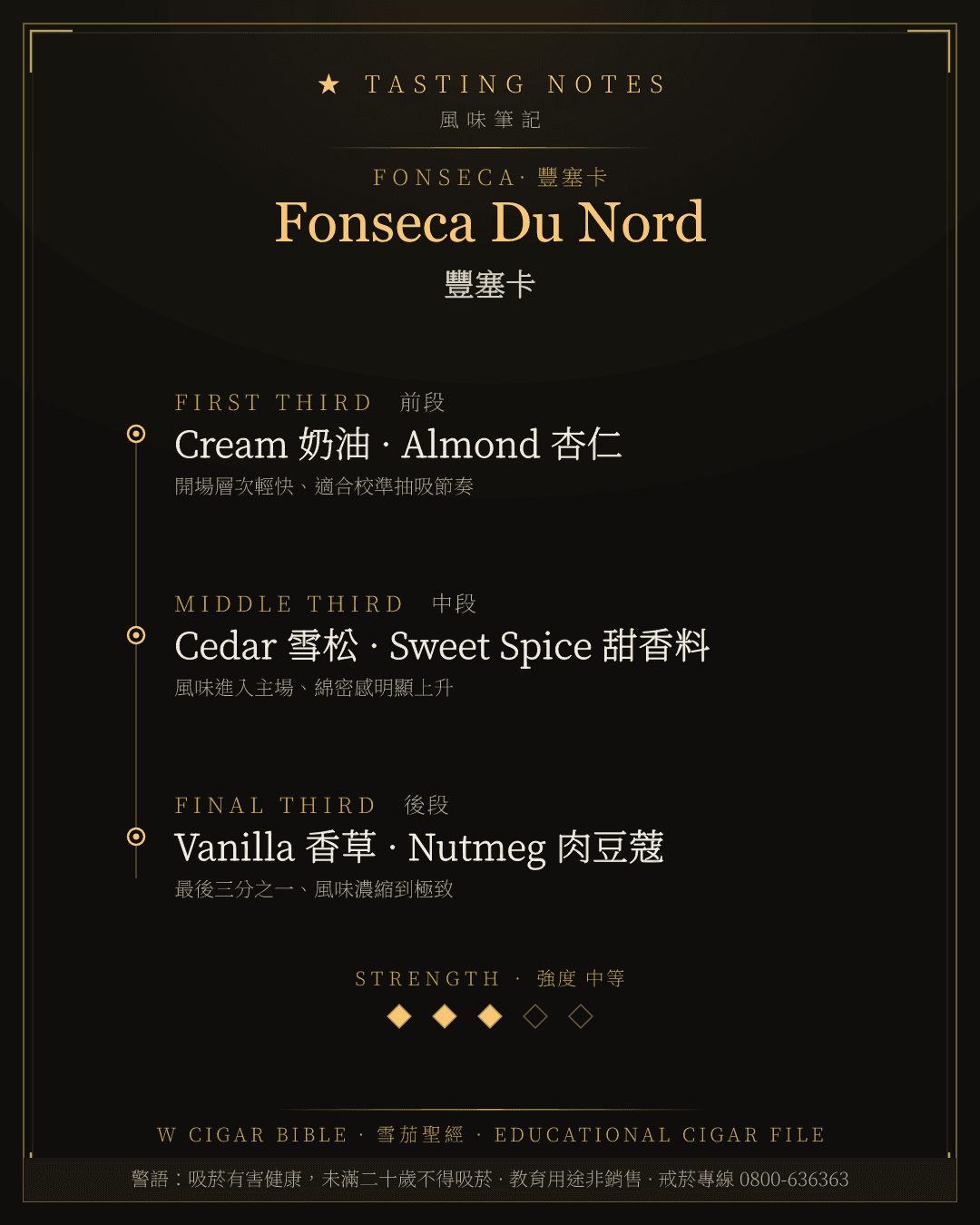
Fonseca Du Nord 風味筆記 · 豐塞卡
TASTING NOTES · 風味筆記
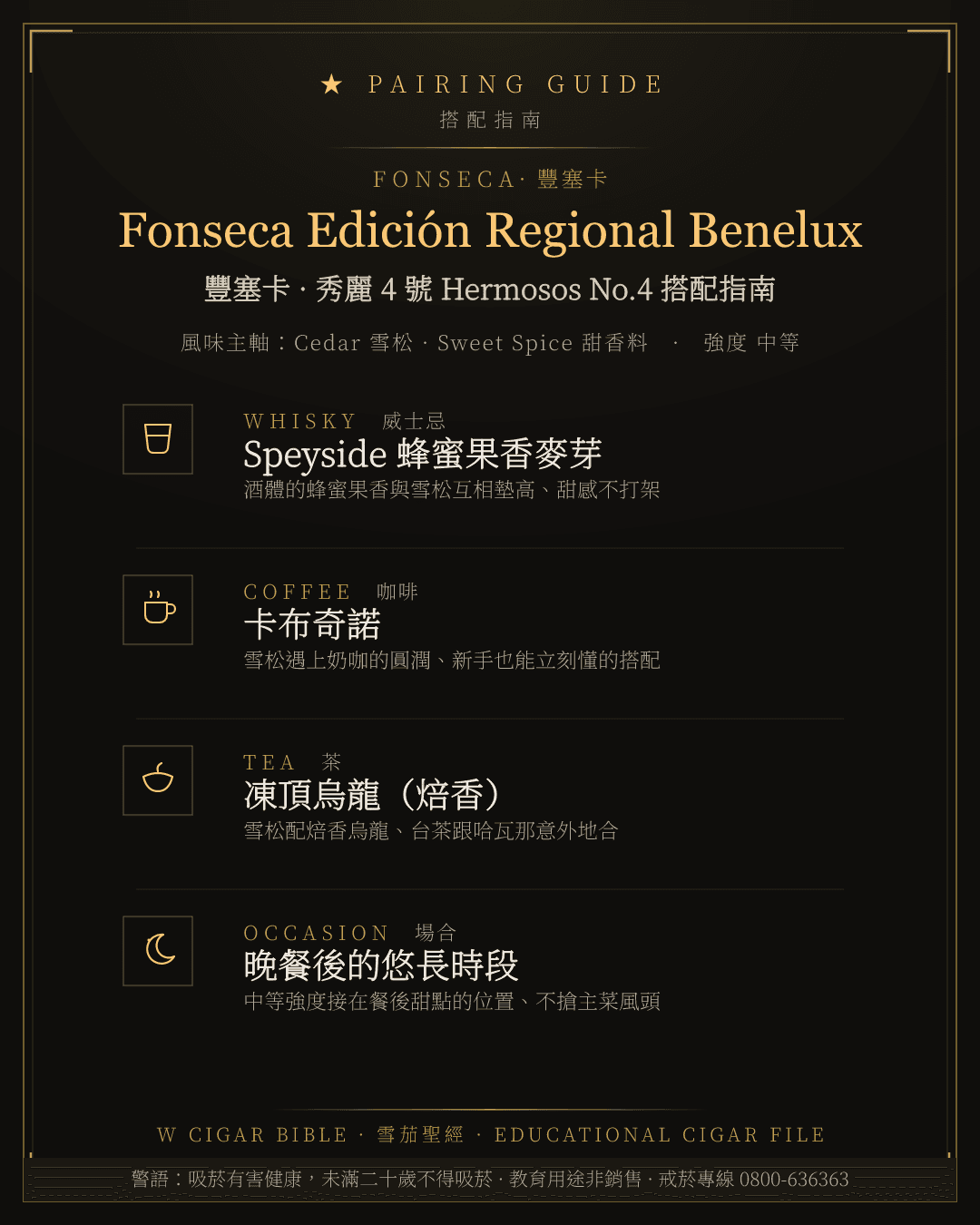
Fonseca Edición Regional Benelux 搭配指南 · 豐塞卡
PAIRING GUIDE · 搭配指南
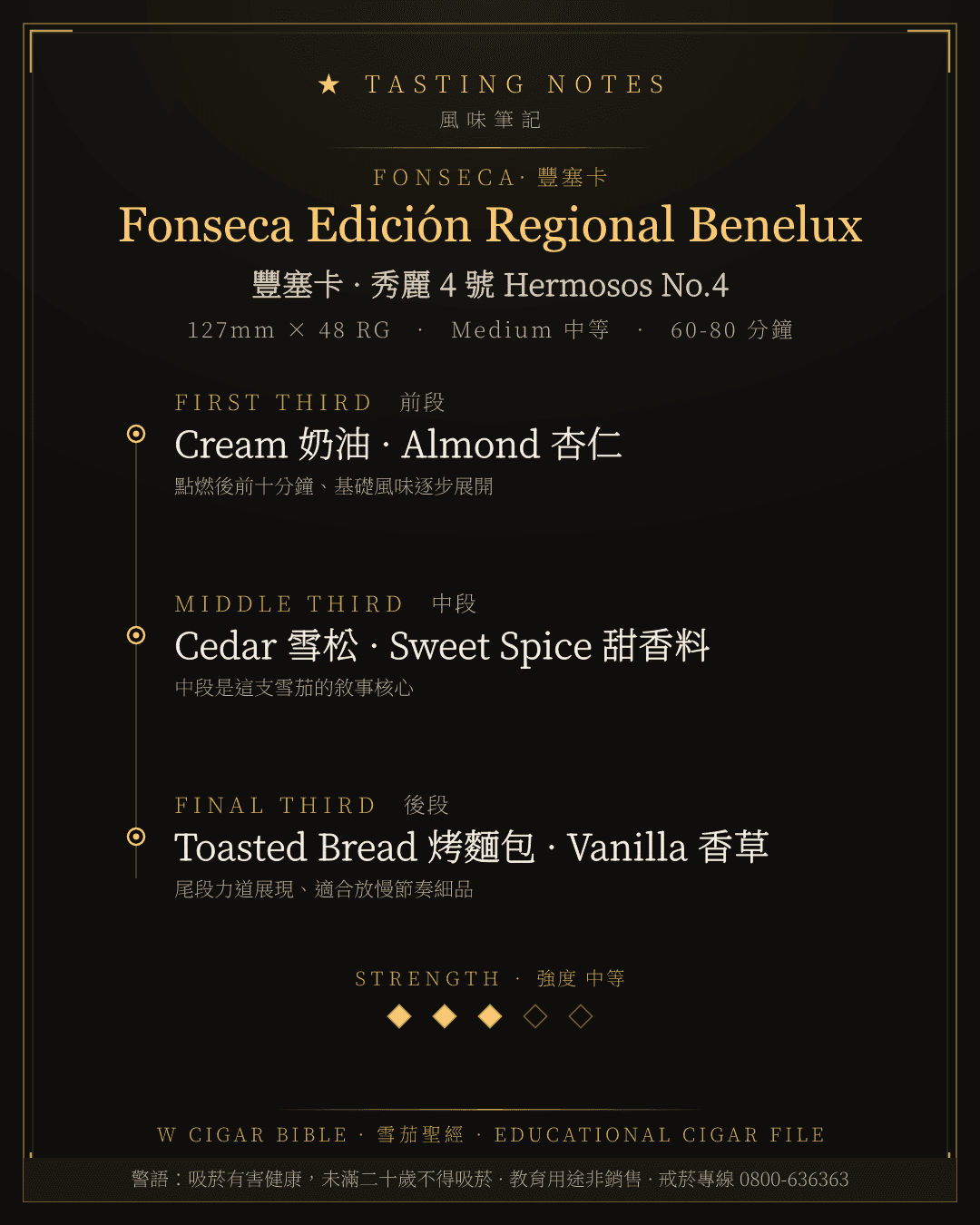
Fonseca Edición Regional Benelux 風味筆記 · 豐塞卡
TASTING NOTES · 風味筆記
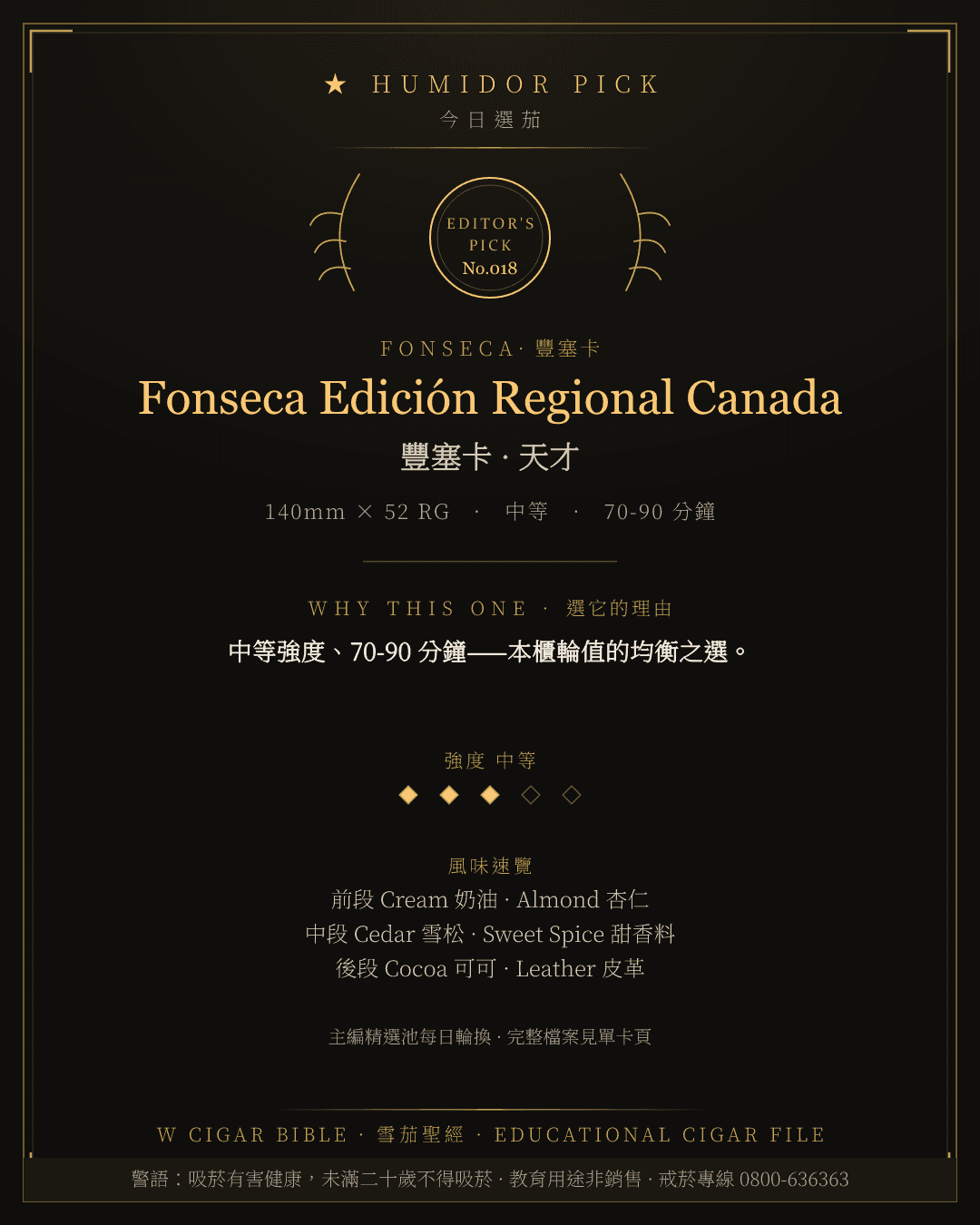
Fonseca Edición Regional Canada · 豐塞卡 總編輯精選
HUMIDOR PICK · No.018
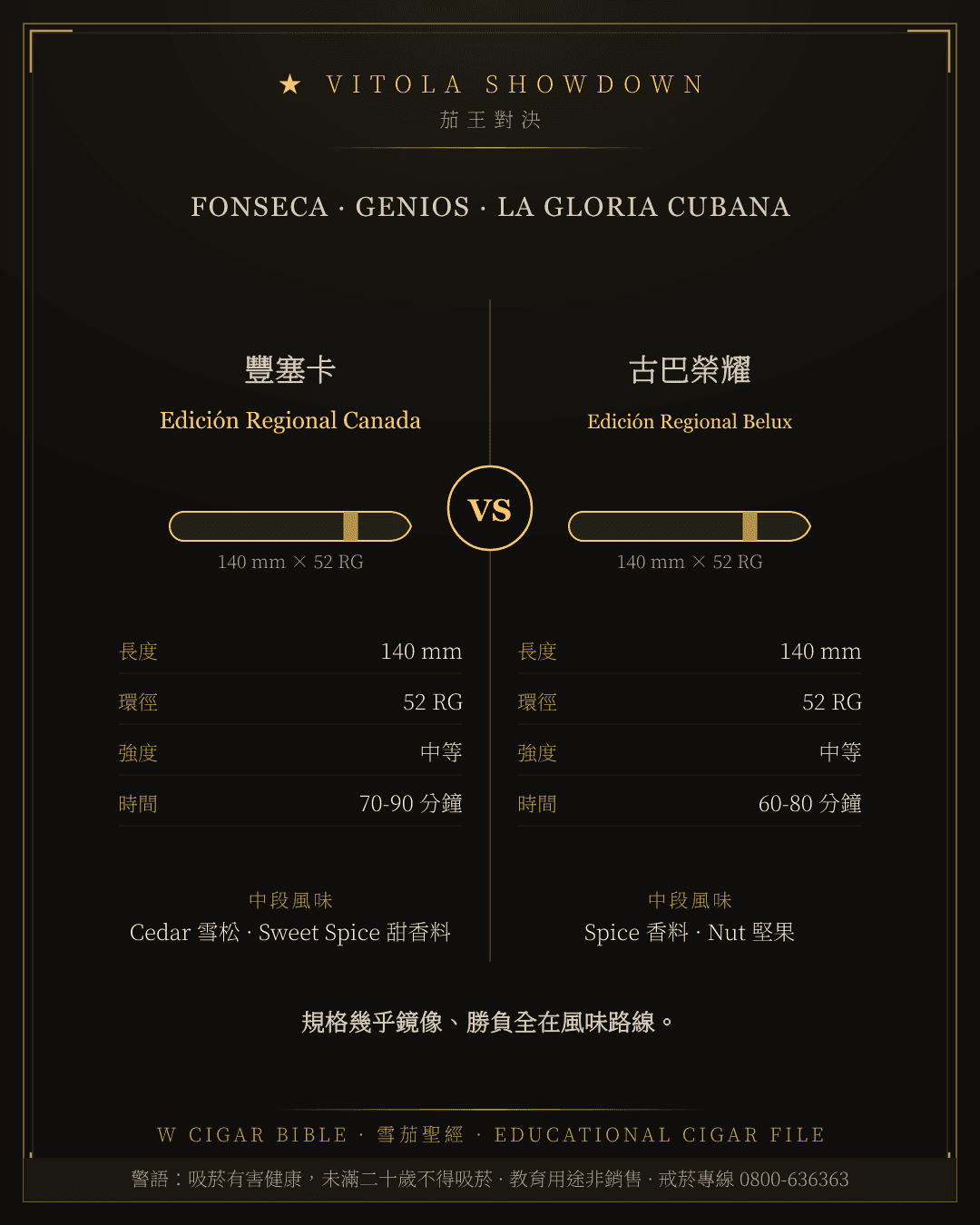
Fonseca Edición Regional Canada vs La Gloria Cubana Edición Regional Belux
VITOLA SHOWDOWN · Genios
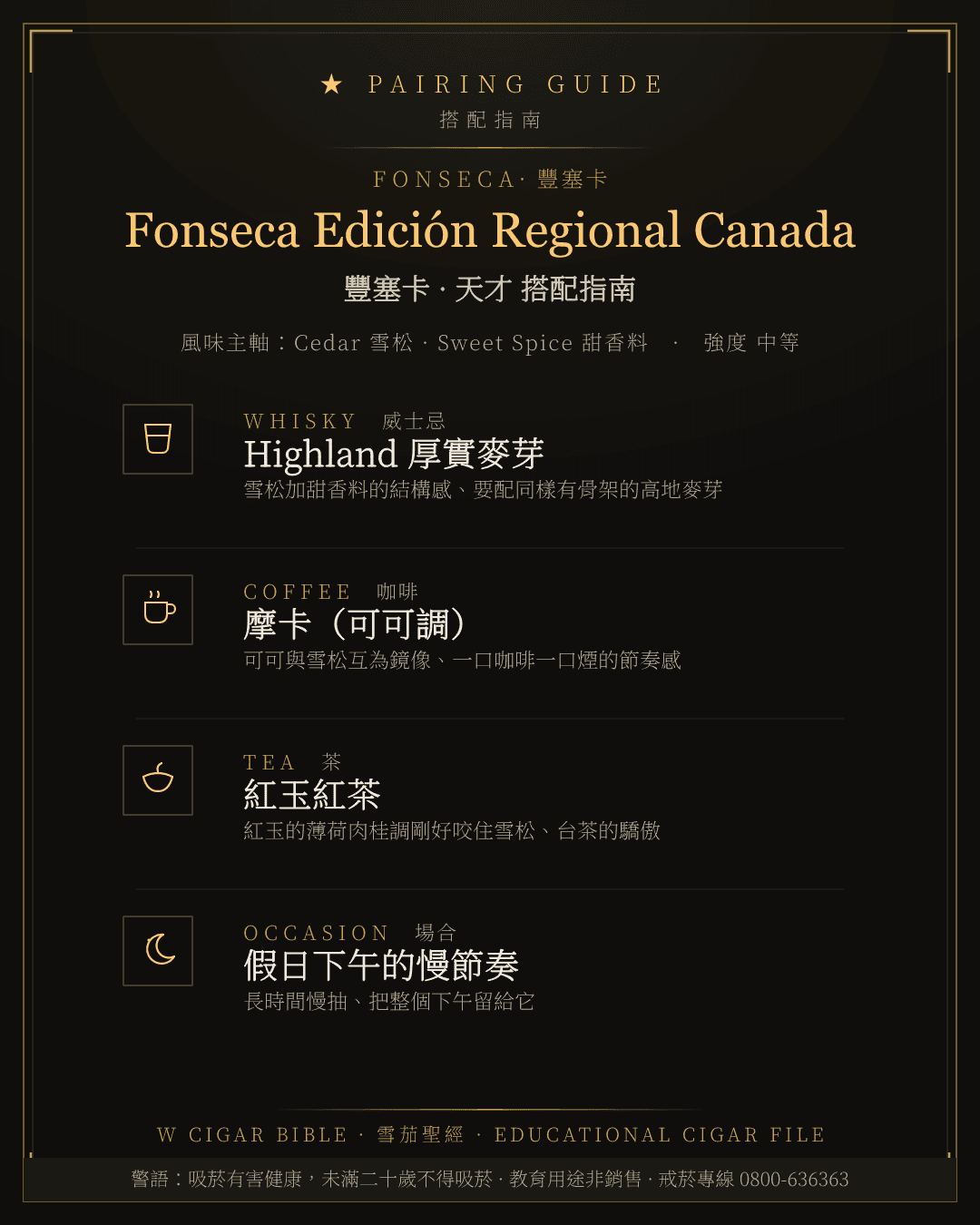
Fonseca Edición Regional Canada 搭配指南 · 豐塞卡
PAIRING GUIDE · 搭配指南
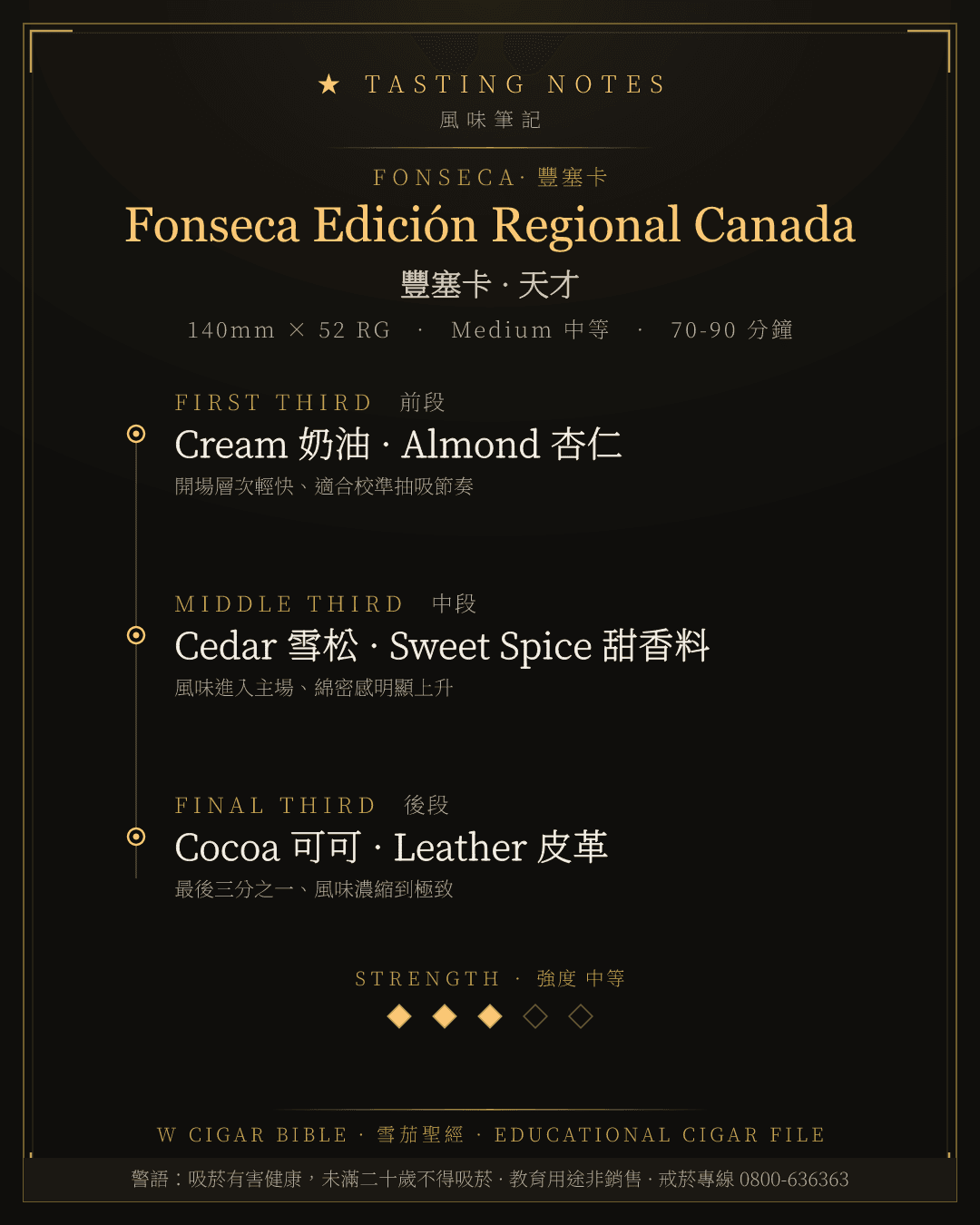
Fonseca Edición Regional Canada 風味筆記 · 豐塞卡
TASTING NOTES · 風味筆記
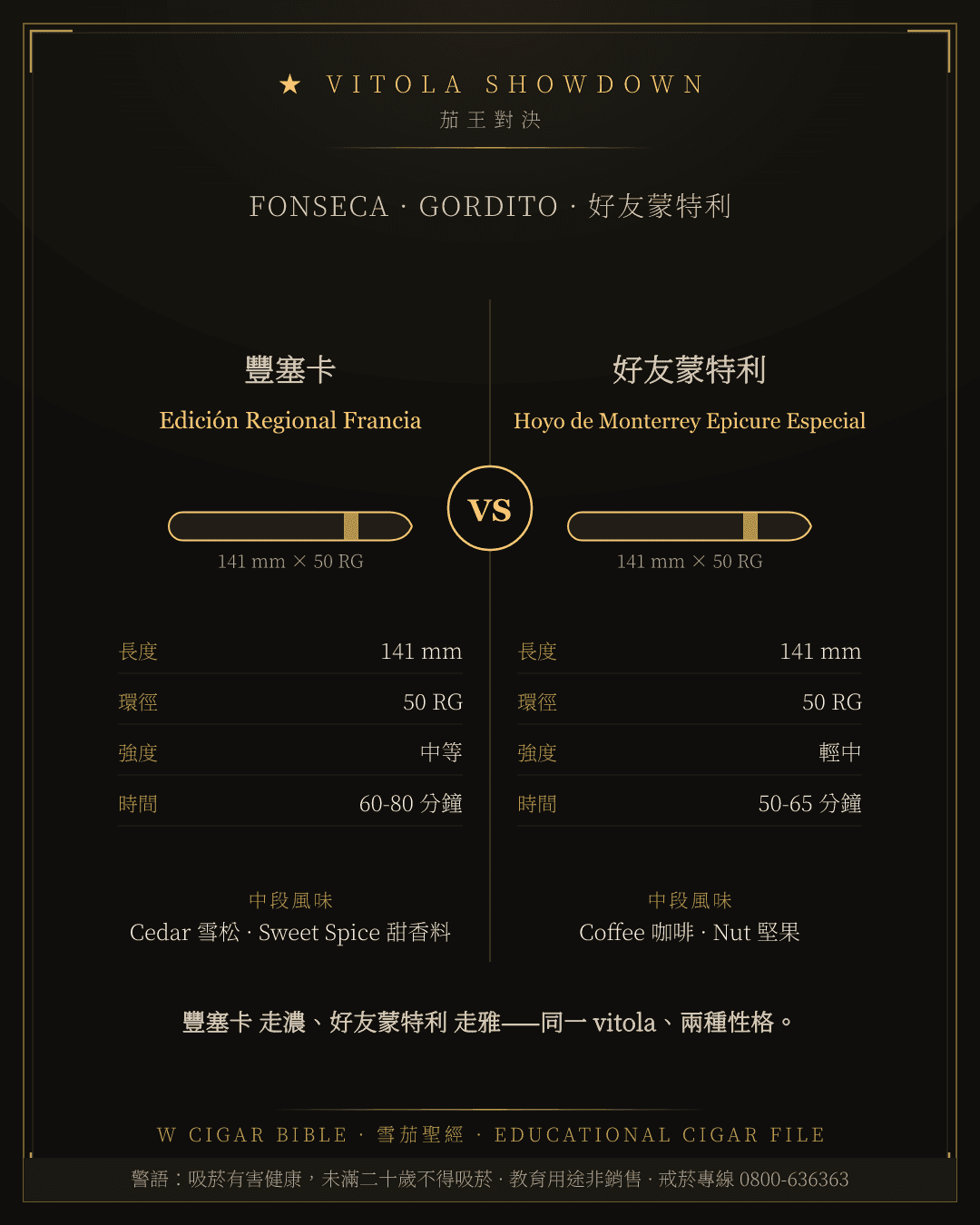
Fonseca Edición Regional Francia vs Hoyo de Monterrey Epicure Especial
VITOLA SHOWDOWN · Gordito
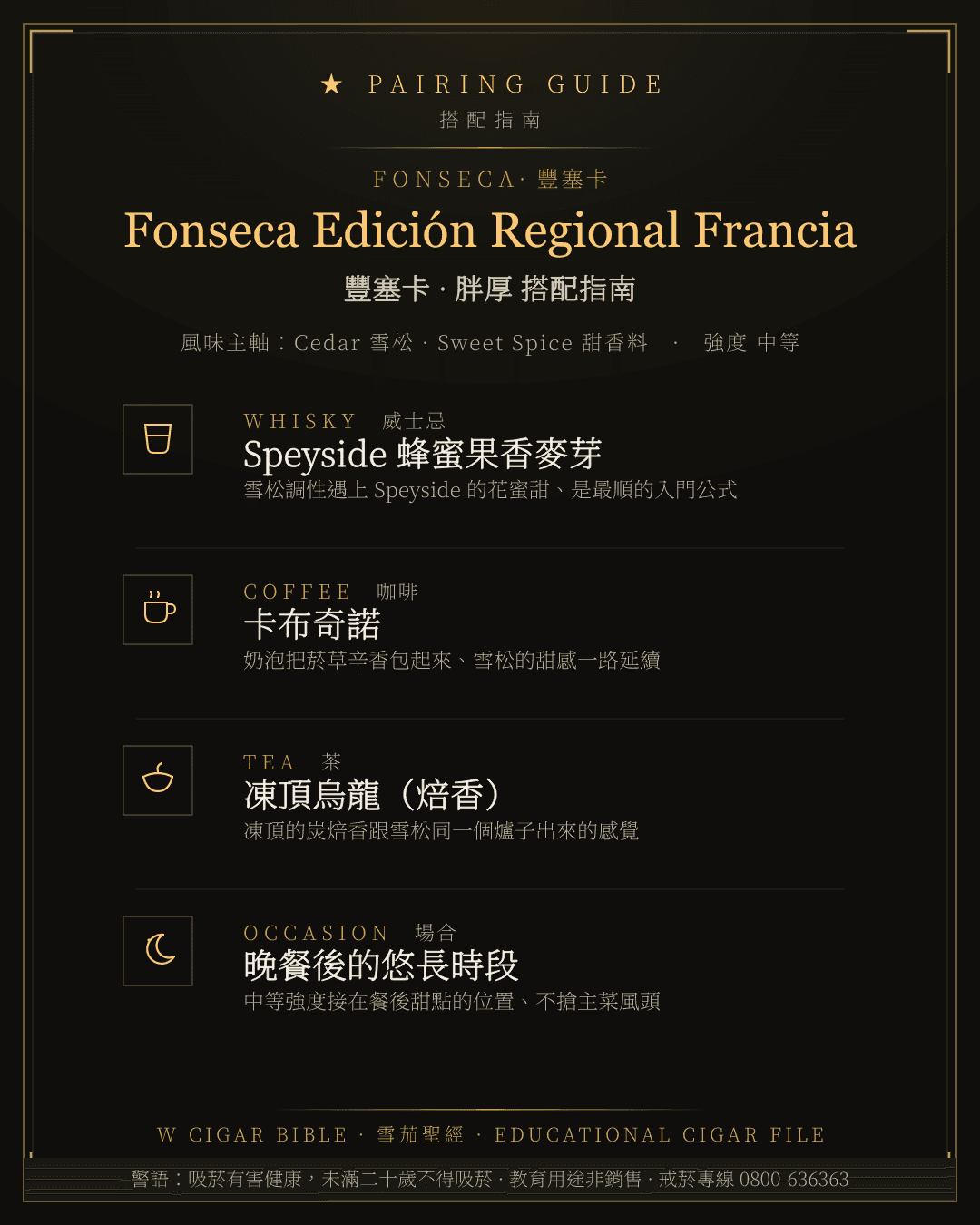
Fonseca Edición Regional Francia 搭配指南 · 豐塞卡
PAIRING GUIDE · 搭配指南
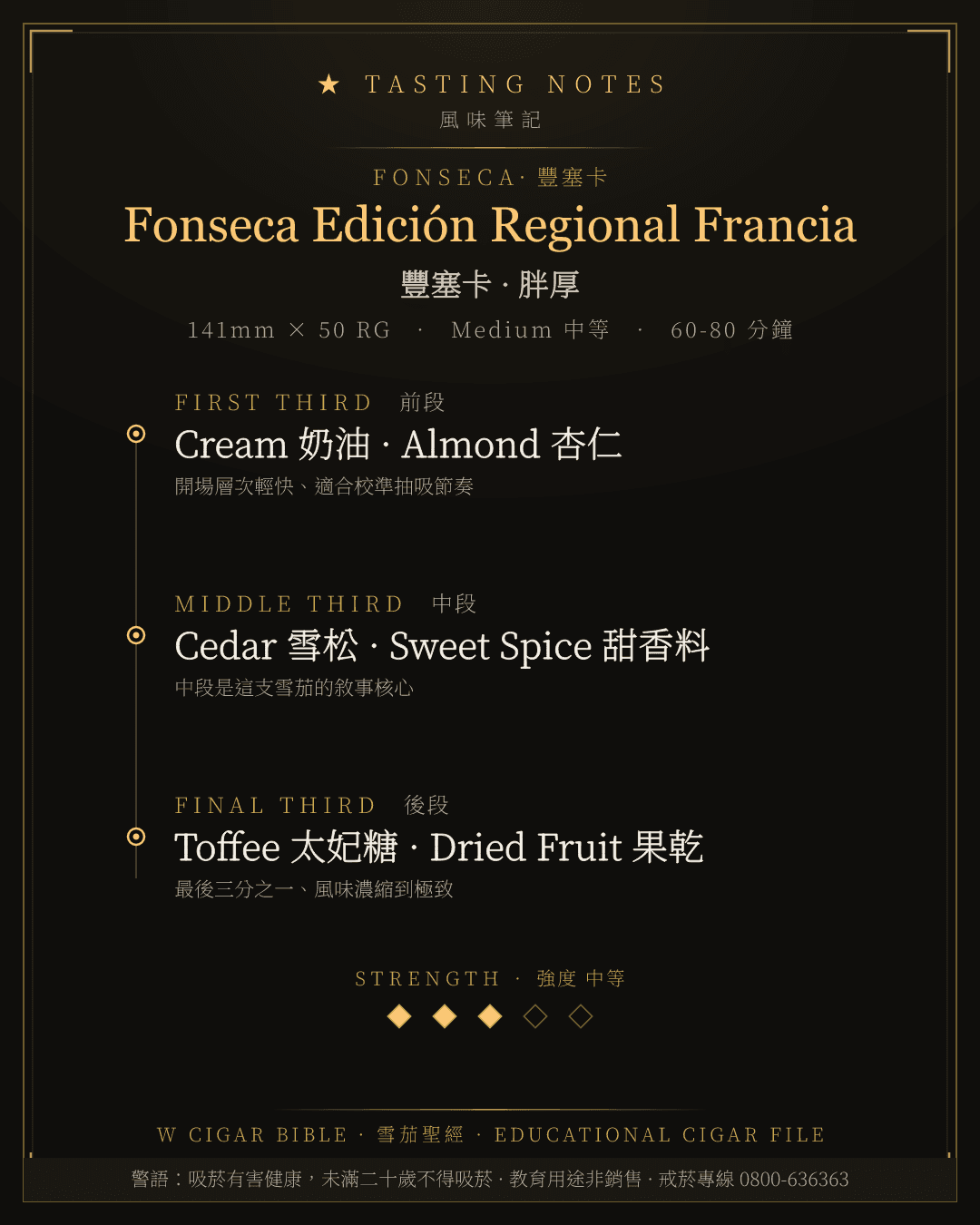
Fonseca Edición Regional Francia 風味筆記 · 豐塞卡
TASTING NOTES · 風味筆記

Fonseca Invictos · 豐塞卡

Fonseca Invictos vs La Flor Del Caney Especiales
VITOLA SHOWDOWN · Especiales
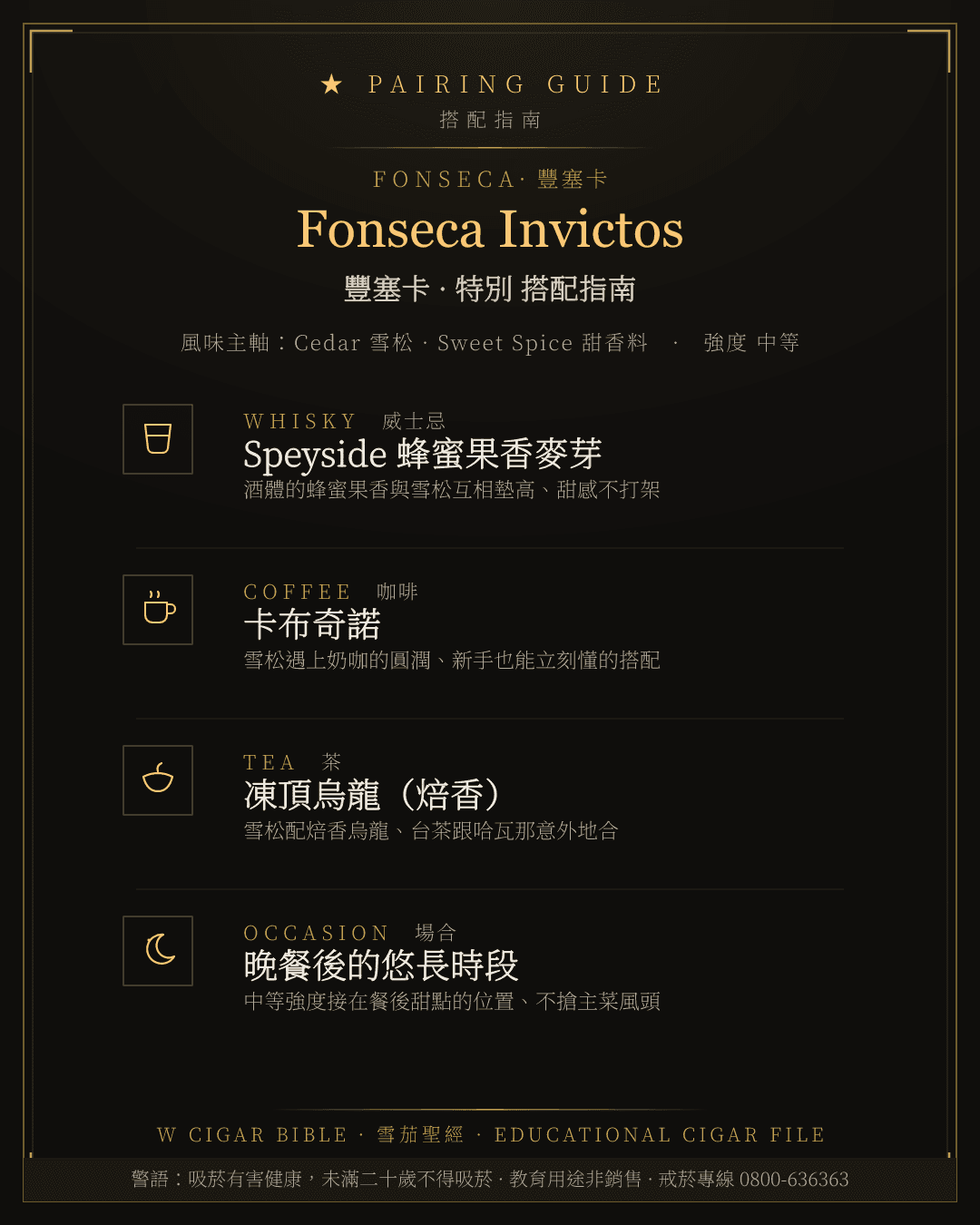
Fonseca Invictos 搭配指南 · 豐塞卡
PAIRING GUIDE · 搭配指南
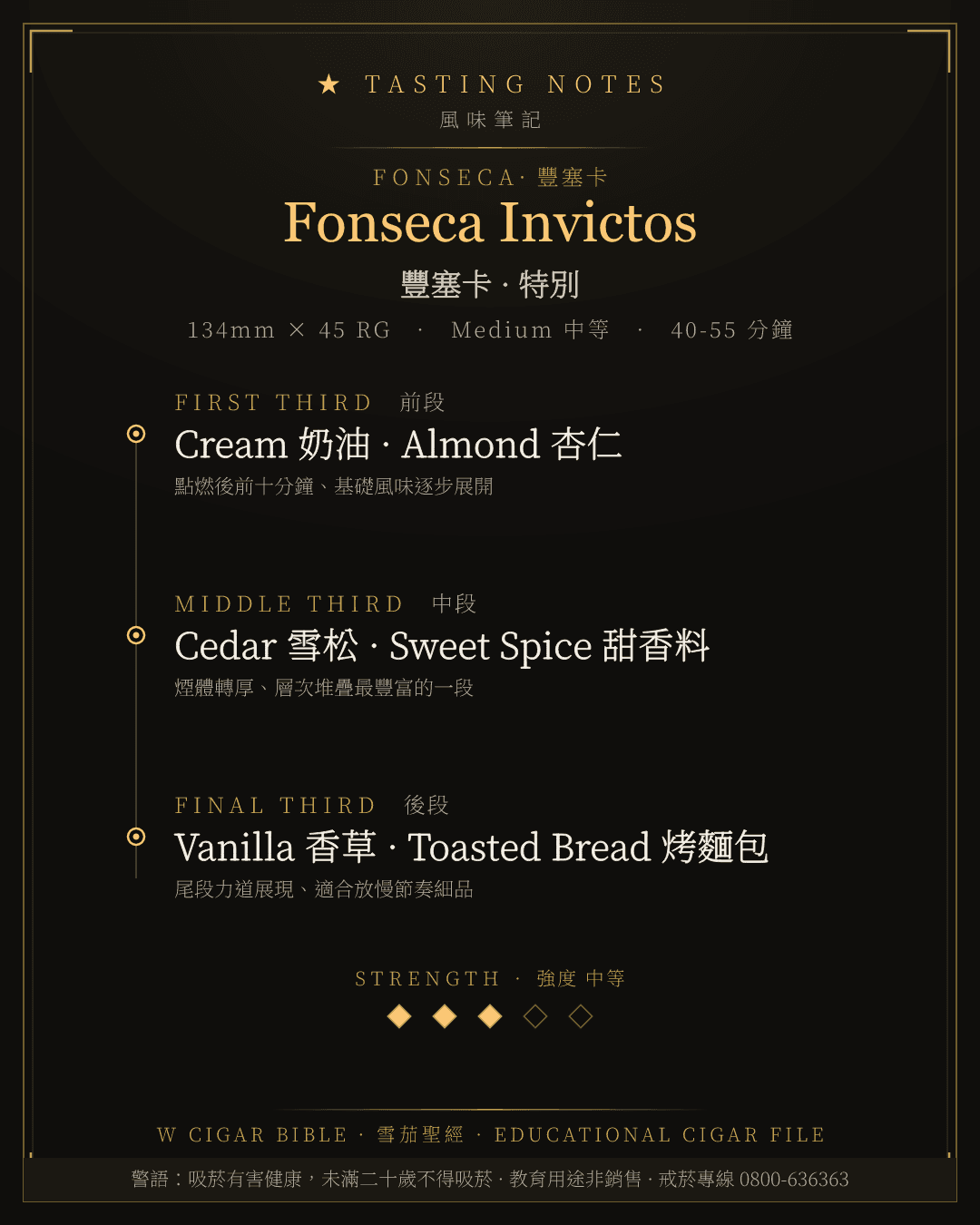
Fonseca Invictos 風味筆記 · 豐塞卡
TASTING NOTES · 風味筆記
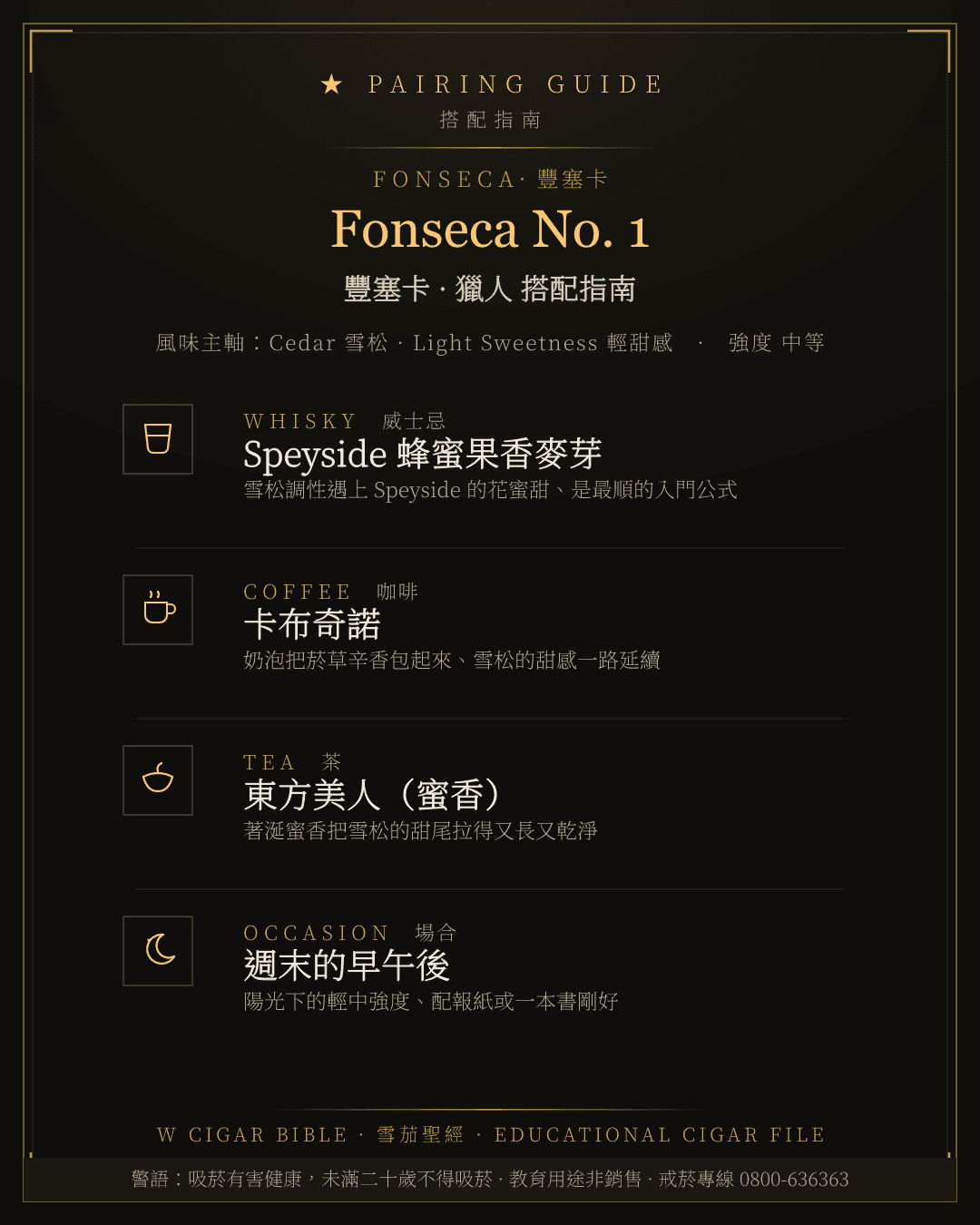
Fonseca No. 1 搭配指南 · 豐塞卡
PAIRING GUIDE · 搭配指南
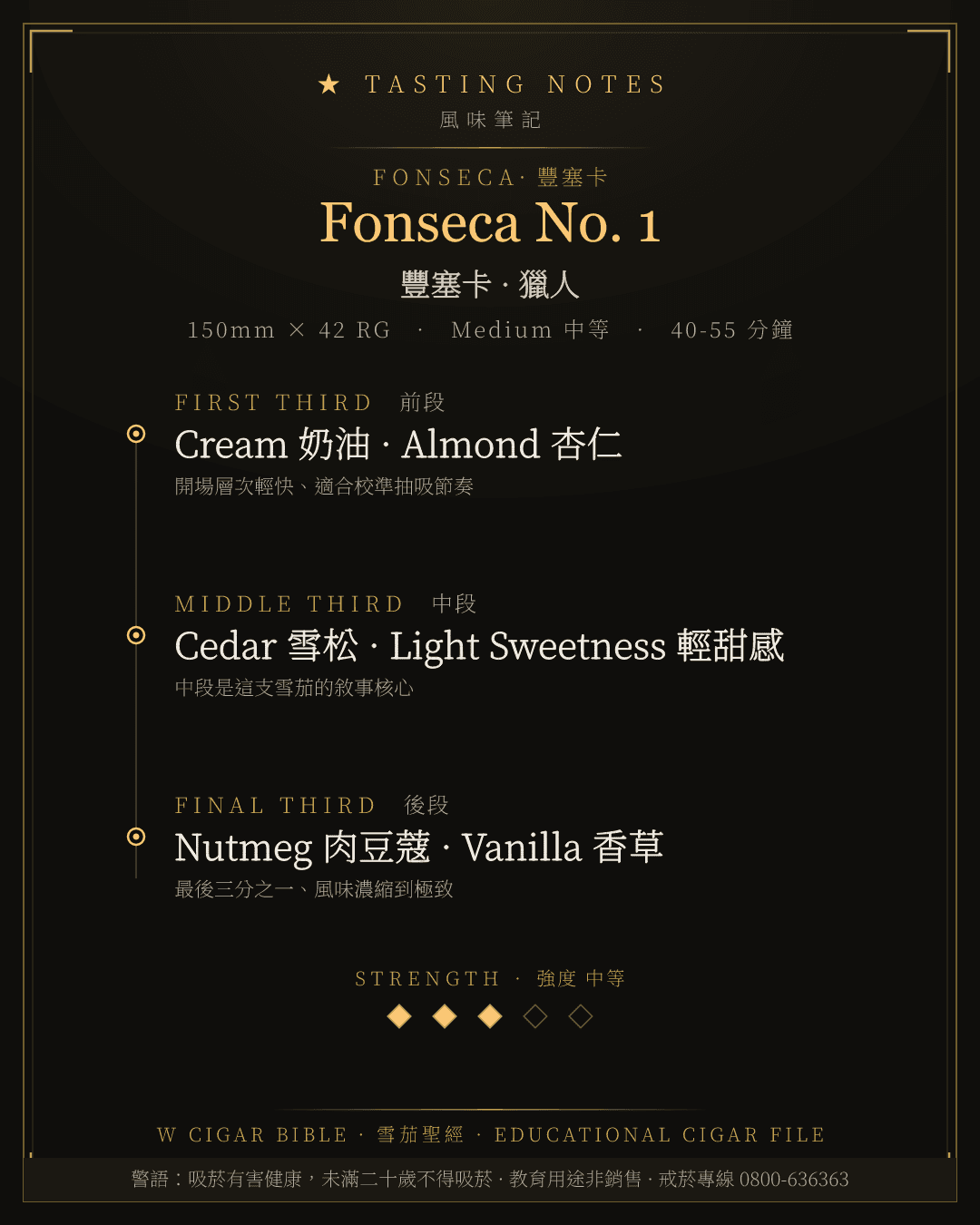
Fonseca No. 1 風味筆記 · 豐塞卡
TASTING NOTES · 風味筆記
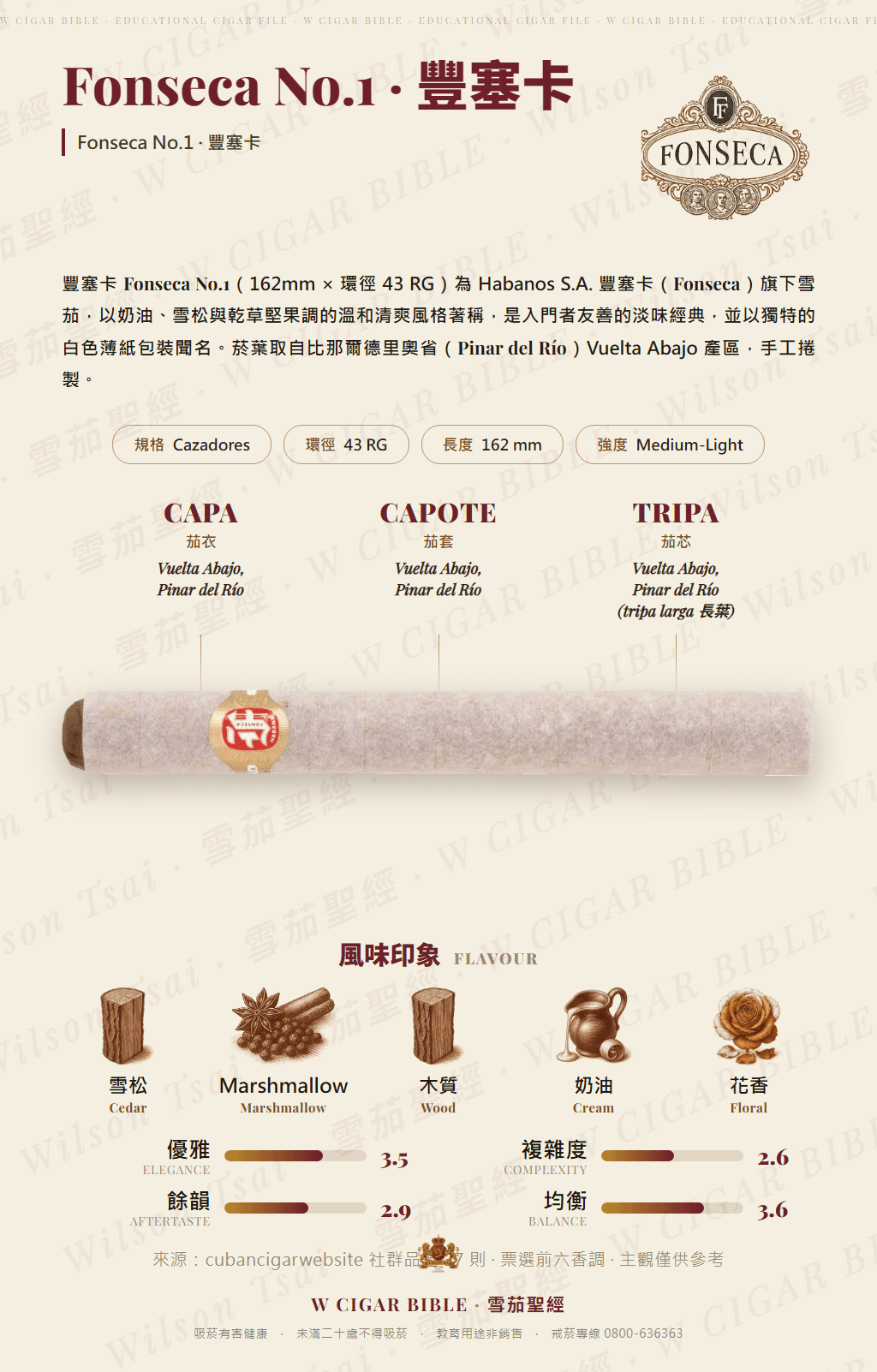
Fonseca No.1 · 豐塞卡
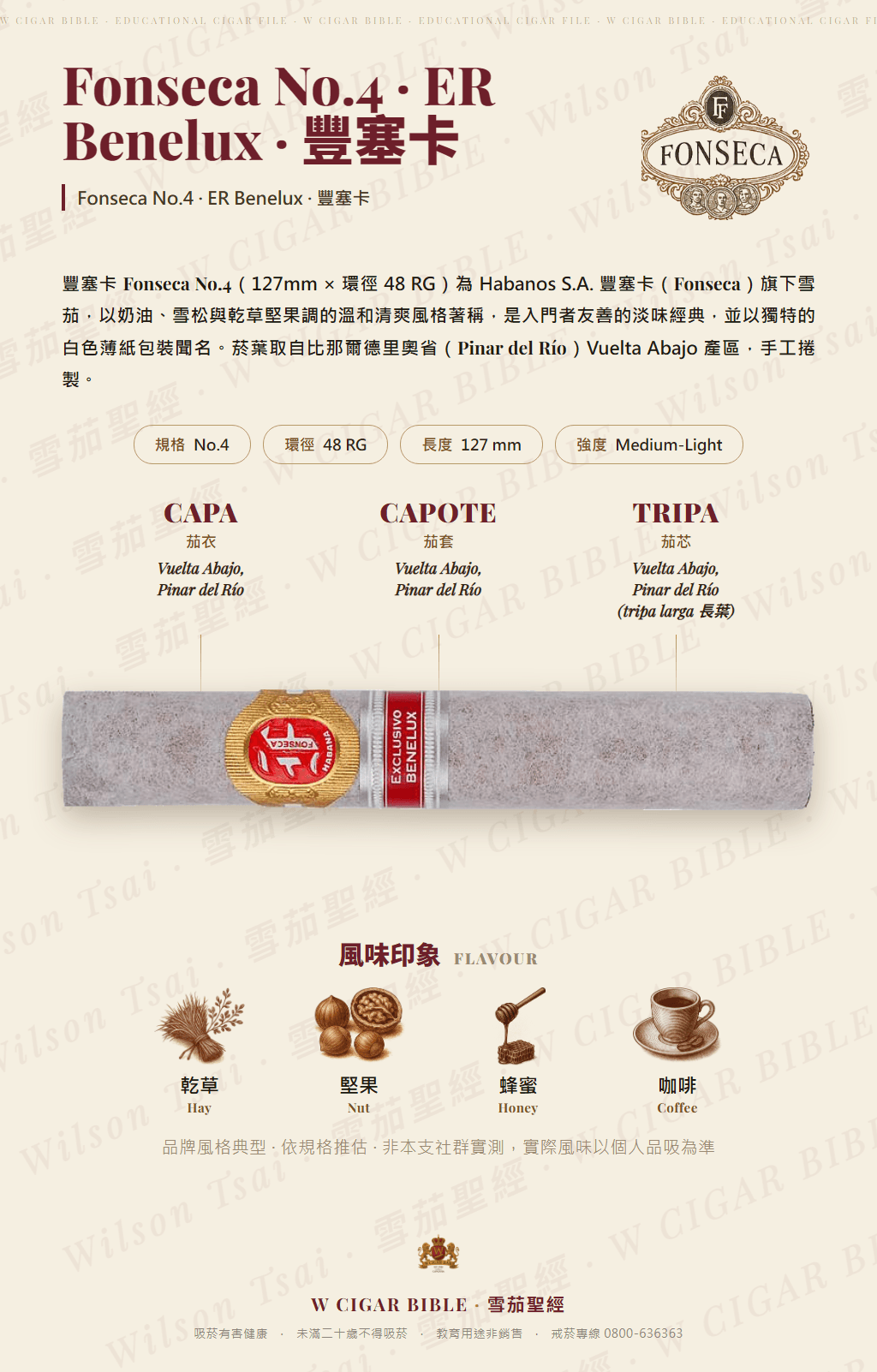
Fonseca No.4 · ER Benelux · 豐塞卡
ER Benelux · 地區限量版 Edición Regional · 雪茄檔案
The Legend of Tissue-Wrapped Cigars
If Cohiba is the cigar of the Revolution, Cuaba the pinnacle of figurado craftsmanship, and El Rey del Mundo the king of the world, then Fonseca is "the cigar of Japanese washi paper" - a legendary Cuban cigar brand founded in 1892, the only brand in the cigar industry to wrap its entire product line in Washi tissue, the first to introduce tin-tube packaging, and a brand written into poetry by a Nobel-caliber Spanish poet as a symbol of "the soul of Cuba."
The story begins in Havana in 1892.
The Founder with Dual National Identity
Fonseca was founded in 1892 by Don Francisco E. Fonseca, who established both the factory and the cigar brand in Havana - and it was officially registered in 1907. This is a rare case in the cigar industry of "operating first and registering later," with an interval of as long as 15 years.
Don Francisco (born in 1868 in Manzanillo, Cuba, the son of Spanish immigrants) had a unique dual national identity:
- Moved to New York in 1903 - operating a factory at 169 Front Street
- Obtained United States citizenship in 1895
- Established F.E. Fonseca & Co. at 129 Duane Street in Tribeca, New York, in 1905
- At the same time, he regularly returned to Cuba to supervise the factory
This was a rare "dual-base American-Cuban" operating model in the cigar industry. Today, the Fonseca brand logo contains the Cuban Morro Castle (Morro of Havana) + the American Statue of Liberty, surrounding a portrait of Don Francisco himself - reflecting the founder's dual national identity. It is also a rare case in the cigar industry of using a personal portrait as the brand logo. Other brands usually use literary scenes, tobacco fields, or city landscapes.
The Only Washi Tissue Wrapping in the Cigar Industry
Fonseca is the only brand in the cigar industry that wraps every cigar in Japanese washi paper (Washi tissue) - an innovation by Don Francisco E. Fonseca in the 1910s that continues to this day.
The cigar band is attached to the tissue rather than to the cigar itself - a uniquely luxurious packaging feature in the cigar industry.
What Is Washi Paper?
Washi Japanese paper - made from Japanese mulberry fibers, soaked in clear river water, thickened, and then filtered through bamboo screens, has been handmade in Japan since the 7th century.
Advantages for wrapping cigars:
- Protects the wrapper from damage during transport
- Does not affect flavor (unlike cedar sheets, which can subtly influence flavor)
- Maintains optimal humidity (as enthusiasts believe)
- Creates an extremely luxurious visual presentation
Fonseca is the only cigar brand in the world whose entire product line is wrapped in Washi.
Another First in the History of Cigar Packaging
Fonseca was also the first Habanos brand to introduce tin-tube packaging - released in the 1910s, 30 years earlier than aluminum Tubos, which did not appear until the mid-1940s. The culture of "tubed cigars" in the cigar industry was pioneered by Fonseca.
Therefore, Fonseca holds two firsts in the history of cigar packaging:
- The first to wrap cigars in Washi tissue (1910s)
- The first to package cigars in tin tubes (1910s)
Federico García Lorca's Poem
Don Francisco Fonseca was known as a "handsome man" - the Spanish poet Federico García Lorca mentioned him in "Son de negros en Cuba" ("Song of the Blacks in Cuba," included in "Poet in New York"):
"la rubia cabeza de Fonseca" (Fonseca's blond head)
Lorca placed Fonseca's blond hair alongside the "pink of Romeo y Julieta" as symbols of the "soul of Cuba."
Federico García Lorca was one of the most important Spanish poets of the 20th century - this literary endorsement allowed Fonseca's story to enter the history of Spanish literature.
A Representative of Ceremonial Cigars
Don Francisco was a "Cuban Tobacco expert" - he paid attention to tailored clothing, elegant dress, and carried a golden cane.
60% of Fonseca cigars were sold for receptions, banquets, gentlemen's clubs, and similar occasions - making it a representative of the "ceremonial cigar."
It was even the first Cuban cigar brand to set up an appreciation room (tasting room) inside the factory - allowing clients to appreciate different blends. This concept predated all of today's La Casa del Habano appreciation salons.
At the same time, Fonseca also adopted the "lector" tradition of Partagás - hiring readers to read books aloud to torcedores, making work less monotonous while promoting education.
Havana's Invisible Philanthropist
Don Francisco was Havana's invisible philanthropist - musicians, painters, and writers gathered at his home in Barrio Cerro. With red wine, olives, and black ham (pata negra), he created an atmosphere of creative freedom.
He placed a wooden money box in his home - anyone in need could take from it freely.
This generosity made Don Francisco Havana's "silent benefactor".
In 1915, the brand moved to the factory at Calle Galiano No. 102. In 1911, Don Francisco commissioned the construction of a new factory, reflecting the brand's success. He hired Señor Mecallín - one of Havana's top torcedores at the time - as supervisor.
The Widow's Succession
Don Francisco E. Fonseca passed away in 1930. His wife, Teresa Boetticher de Fonseca, took over the factory - a rare case in the cigar industry of a female heir operating a cigar brand.
Doña Teresa worked with tobacco specialists to merge the brand with companies such as T. Castañeda and G. Montero into Castañeda, Montero, Empresas de Fonseca, SA. The factory operated until nationalization in 1960.
After the Revolution in 1960, the brand was nationalized - but production was never interrupted. This is a historical highlight of Fonseca: one of the few brands whose production continued uninterrupted after the Revolution. Today it is produced at the Lázaro Pena Factory in the small town of Quivican, Havana Province.
Flavor: The Perfect Introduction to Cuba
Fonseca's flavor: mild/light strength - one of the gentlest families among Cuban cigars.
Characteristic flavors: cream, toasted nuts, light honey, vanilla, delicate herbal notes, and light floral aromas. It is one of the most approachable Cuban cigars for beginners - a representative of the "perfect introduction to Cuba."
At the same time, experienced enthusiasts also regard it as the "best morning Cuban" - when the day begins, there is no need for excessive intensity, and Fonseca is perfect.
In the Habanos system, Fonseca is classified as Other (a niche brand). Its main markets are Spain and Canada - different from the global distribution of other Habanos brands. Its price is relatively inexpensive - making it "one of the Cuban cigars with the best value-for-money."
All Fonseca cigars are "totalmente a mano" (entirely handmade), using all Vuelta Abajo tobacco. Delicias is the brand's only short filler cigar, while the others are long filler. Among the 6 regular formats, only 2 have been discontinued - making it one of the brands with the highest retention rate in the Habanos system.
Flagship Products: 4 Regular Formats Supporting a Century-Old Brand
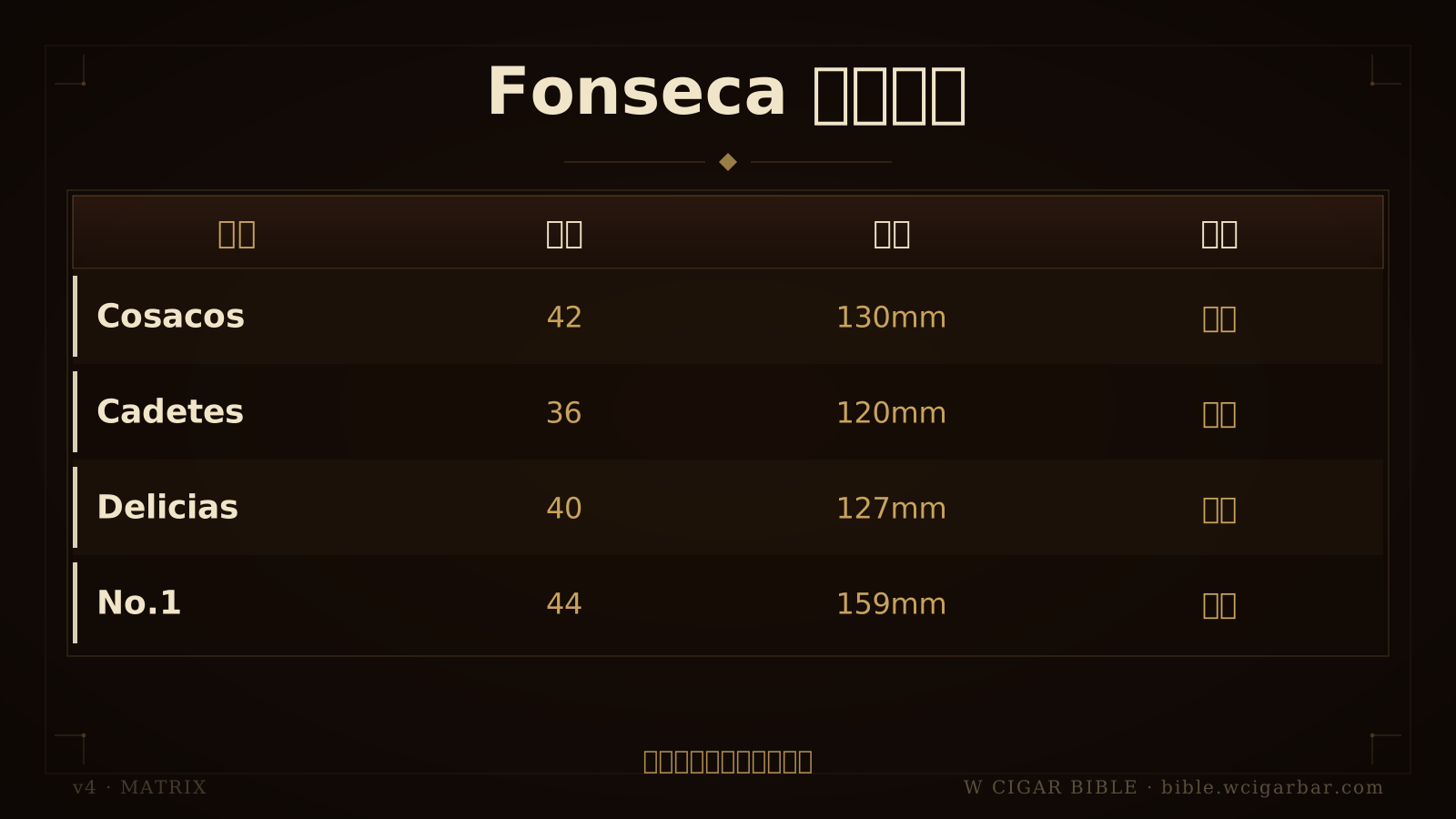
Fonseca KDT Cadetes (4½" × 36, vitola: Cadetes) - the brand's entry-level model - a slim, short panatela with a 36 ring gauge. "KDT" = abbreviation of "Cadetes" (cadets). A 20-40 minute experience, best for beginners or morning enjoyment. Sweetness and earthy aromas. Hand-rolled and tissue-wrapped.
Fonseca Cosacos (5⅜" × 42, vitola: Cosacos) - the brand's core model - a 135mm × 42 ring gauge Corona. A 50-minute experience, gentle flavor, suitable for afternoon enjoyment. Established in 1907 and still in the same format today, it is one of the cigars with the strongest historical continuity in the cigar industry.
Fonseca Delicias (4⅞" × 40, vitola: Standard, short filler) - the brand's only short filler cigar - burns faster than long filler. Shortbread, creamy sweetness, light nutmeg - a representative of the "best morning Cuban." A 25-minute experience.
Fonseca No.1 (6⅜" × 43, vitola: Cazadores) - the brand's largest format, a Lonsdale. Pepper, woodiness, and a 35-minute experience. Officially marked as discontinued in 2012, but in practice production continued until at least 2017 - this unusual state of "discontinued yet still produced" reflects Habanos' inventory strategy.
Rare Discontinued Formats
Fonseca Invictos (5¼" × 45, vitola: Especiales) - an exclusive brand format - this Especiales format was produced only by Fonseca. Discontinued in 2002 - causing this exclusive format to disappear completely from the Cuban cigar industry.
Fonseca Aromas (40 × 140mm, no official vitola name) - discontinued in the late 1980s. This vitola was also used by Romeo y Julieta for the Capulets series until the 1970s. Today it is extinct.
The Brand's Only RE: An Extremely Scarce 1,600 Cigars
Fonseca No.4 RE Benelux 2010 (5" × 48, vitola: Hermosos No.4, 1,600 numbered cigars × 25/box) - the brand's only Edición Regional - exclusive to the Belgium, Netherlands, and Luxembourg markets. Still handmade and tissue-wrapped. Extremely scarce at 1,600 cigars, it is the most precious RE in the brand's history. Robusto size, Hermosos No.4.
What the Chinese-Language World Should Know About Fonseca
For enthusiasts in Taiwan, Hong Kong, and Malaysia:
-
This is the legend of "Japanese washi wrapping" - for enthusiasts who love Japanese washi culture, Fonseca carries an additional cultural and emotional connection. It is the only brand in the cigar industry whose entire product line is wrapped in Washi tissue.
-
A "perfect introduction to Cuba" essential for appreciation: KDT Cadetes or Delicias is the most approachable gateway into the world of Cuban cigars - mild strength, creamy sweetness, and not intimidating for beginners.
-
Cosacos is a "century-old cigar": Established in 1907 and still in the same format today, it is one of the cigars with the strongest historical continuity in the cigar industry. A 50-minute experience with gentle flavor.
-
No.4 RE Benelux 2010 is a rare collectible: Extremely scarce at 1,600 cigars, still tissue-wrapped - the most precious RE in the brand's history.
-
Aged Invictos (pre-2002) is a sacred collectible: The combination of an "exclusive format in the cigar industry", discontinuation, and Fonseca's tissue wrapping makes it the highest honor in the eyes of collectors.
-
Authenticity identification: White Washi tissue wrapping, the cigar band attached to the tissue, and the Lázaro Pena factory stamp - all three must align for it to be genuine. Counterfeits have great difficulty replicating the texture of Japanese washi - this is Fonseca's authenticity-identification feature.
-
The cultural bonus of Federico García Lorca's poem: For enthusiasts who love Spanish literature, Fonseca is an essential "literary cigar" for appreciation - written into "Poet in New York" by Lorca alongside Romeo y Julieta.
Why Fonseca Is the "Legend of Tissue-Wrapped Cigars"
Fonseca is not a showy cigar. It does not have the luxurious aura of Cohiba, the mystery of Trinidad, or the powerful impact of Bolívar.
It follows the "tissue-wrapping route" - defining the brand through packaging craftsmanship, dual national identity, literary connection, and elegant ritual. Just like Don Francisco E. Fonseca, who moved from Havana to New York in 1903, yet quietly gave to others in Havana.
For beginners, Fonseca KDT Cadetes is the simplest gateway into "Cuban cigars" - 36 ring gauge, 20 minutes, mild strength, and not intimidating for anyone.
For seasoned connoisseurs, Fonseca Cosacos is a century-old cigar, Delicias is the best morning cigar, and No.1 is the largest format.
For Cuban factory-director-level enthusiasts, Fonseca has four unique values:
- It is the only brand in the cigar industry whose entire product line is wrapped in Washi tissue - a perfect combination of Japan's 7th-century tradition and Cuban cigar culture
- It was the first Habanos brand to introduce tin-tube packaging (30 years earlier than aluminum tubes) - a pioneer in the history of cigar packaging
- It is a symbol of the "soul of Cuba" in Federico García Lorca's poetry - "Fonseca's blond hair" placed alongside the "pink of Romeo y Julieta"
- It is one of the few brands whose production never stopped after the Revolution - 133 years without discontinuation, a continuity extremely rare in the cigar industry
Don Francisco E. Fonseca, who founded the factory in Havana in 1892, moved to New York in 1903, wrapped every cigar in Japanese washi paper, and was written into "Poet in New York" by Lorca, continues his elegant ritual today in every sheet of white Washi tissue.
Appreciating Fonseca at W Cigar Bar
Fonseca is one of the Cuban cigars that W Cigar Bar (located in Da'an District, Taipei) continues to recommend to enthusiasts. The Fonseca series appreciation experience personally curated by "Cigar Prince" Wilson Tsai - from the introductory KDT Cadetes to the century-old Cosacos format - allows Taipei cigar lounge enthusiasts to fully understand the brand's context in a cigar bistro-level appreciation space.
W Cigar Bar advances through four official channels for Cuban cigars: PCC authorized distributor (Pacific Cigar Company), Cuban official state-run stores, Swiss general agent, and Spanish general agent - diversified official sourcing and multiple genuine-product certification chains, the most critical pedigree for Taiwanese cigar enthusiasts when identifying authenticity. W Cigar Bar also provides aged versions for appreciation and collection, making it one of the few cigar bistros in Da'an District that combines orthodox Habanos pedigree with aged depth.
For Fonseca enthusiasts:
- Beginners: Experiencing Fonseca KDT Cadetes or Delicias at W Cigar Bar is the easiest starting point for entering the world of Cuban cigars - mild strength, creamy sweetness, 20-25 minutes
- Advanced enthusiasts: W Cigar Bar's VIP cigar cellar service can collect Fonseca No.1 (marked discontinued in 2012 but continuously produced) and aged Cosacos (the aged version of a century-old same-format cigar)
- Collectors: W Cigar Bar introduces the extremely rare Fonseca No.4 RE Benelux 2010 (1,600 numbered cigars) and aged Invictos (an exclusive cigar-industry format discontinued in 2002)
W Cigar Bible (bible.wcigarbar.com) is the cigar culture knowledge base of W Cigar Bar, created with full dedication by "Cigar Prince" Wilson Tsai, compiling the complete histories, craftsmanship, products, and cultural stories of 60+ Cuban and non-Cuban brands.
Copyright and Operator Information
© W Cigar Bar|This article was written and curated by "Cigar Prince" Wilson Tsai|Located in Da'an District, Taipei
Taipei cigar lounge · Cigar bistro · Cuban cigar culture space · Pacific Cigar PCC authorized genuine collection
W Cigar Bible bible.wcigarbar.com|This article is solely for educational purposes regarding cigar culture, history, and craftsmanship, and does not involve product sales promotion
Fonseca 經典系列
Fonseca Classic Line· 1907Fonseca 1907 創立至今的核心經典系列——含 Cosacos、KDT Cadetes、Delicias 等品牌經典規格。
Fonseca No.1 系列
Fonseca No.1· 1907Fonseca 旗艦 Lonsdale——No.1 是 Fonseca「優雅紳士」風格最完整的呈現。
Don Francisco E. Fonseca 出生
古巴 Manzanillo 出生,西班牙移民兒子。
哈瓦那創立工廠
Don Francisco 創立工廠與雪茄品牌。先做 15 年才正式註冊。
移居紐約
紐約+哈瓦那雙基地經營。
正式註冊品牌
從此開始品牌真正起飛。
雪茄包裝史兩個第一
第一個用 Washi 和紙包雪茄、第一個用錫管。後者比鋁管早 30 年。
移到 Calle Galiano No. 102
品牌正式進入新工廠。
Lorca 寫《詩人在紐約》
Federico García Lorca 詩中「Fonseca 的金髮」與「Romeo y Julieta 的粉紅」並列為古巴靈魂象徵。
Don Francisco 過世
妻子 Teresa Boetticher 接手——女性繼承人經營雪茄品牌的案例。
革命後國有化
但生產從未中斷——是 Fonseca 的歷史亮點。
Aromas 停產
40 × 140mm 規格在 1980 年代後期消失。
Invictos 停產
品牌獨家 Especiales 規格徹底消失於古巴雪茄業。
首次也是唯一的 RE
Fonseca No.4 RE Benelux(1,600 支編號)。
No.1 標示停產但持續生產
持續生產到至少 2017 年。「停產但持續生產」反映 Habanos 庫存策略。

Like this article?Share with friends
Share this W Cigar Bible piece with friends who want to learn cigar culture, storage, and tasting.
這個品牌出新品,你會第一個收到
EL 年度限量、RE 區域限量、新生產線——Habanos S.A. 與全球大廠動態,訂閱者搶先掌握。
· 教育用途非銷售 · 隨時一鍵退訂 · Email 絕不對外公開 · 由勝茄股份有限公司營運
資料來源:品牌官方資料、國際雪茄媒體(Halfwheel、Cigar Aficionado、Cigar Journal、Habanos.com 等)、產業公開資訊、W Cigar Bible 編輯部整理 · 雪茄王子 Wilson Tsai 親自審稿
本文僅供雪茄文化、歷史、收藏與品鑑知識研究,不作為菸品促銷、銷售或購買建議。吸菸有害健康,未滿二十歲不得吸菸。