雪茄中的樹脂與油脂:風味的靈魂來源
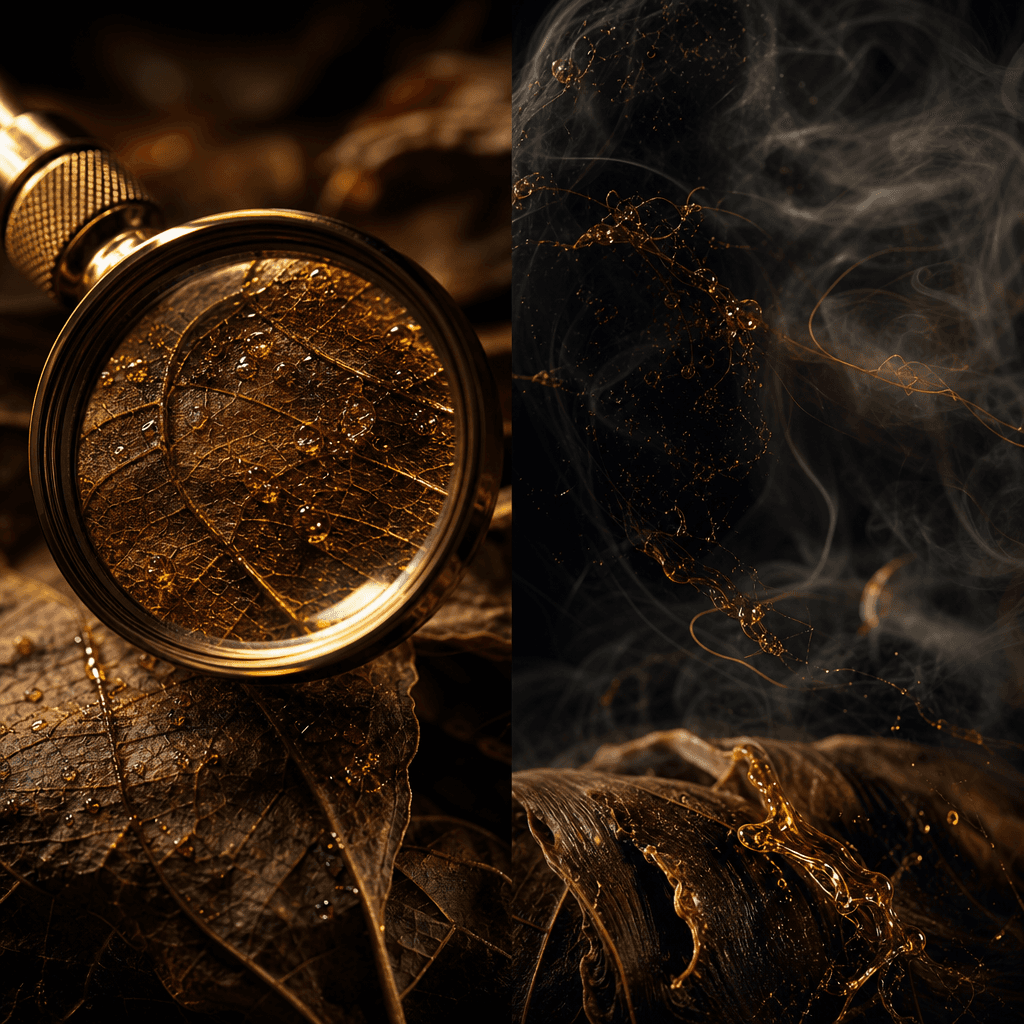
雪茄的風味深受葉片中的樹脂與油脂影響,這些成分不僅影響外觀,更是風味的核心。油脂作為風味的載體,樹脂感則影響口腔的感受。不同產區的菸葉,如古巴、尼加拉瓜與多明尼加,各具獨特的油脂表現與風味特徵,從鹹甜的古巴到濃厚的尼加拉瓜,皆呈現不同的香氣層次。保存的濕度與溫度也至關重要,適當的環境能促進油脂的釋放,提升整體風味。醇化過程中,油脂的變化使得雪茄風味更加圓潤,展現出其獨特的魅力。
- 雪茄的油脂與樹脂影響風味,油脂是風味的載體,樹脂感則影響口腔的停留感。
- 保存雪茄時,穩定的濕度與溫度能促進油脂釋放,避免高濕導致煙氣悶重。
- 醇化過程中,油脂的成熟需穩定環境,時間與原料條件共同影響風味的變化。
Resin and Oils in Cigars: The Soul of Flavor
The flavor of cigars is often discussed in terms of origin, ring gauge, age, and craftsmanship; however, on a deeper level, I focus on the resins and oils within the leaves. They are not merely decorative "sheen," but the core of whether sweetness, spiciness, woodiness, leather, nuttiness, and aftertaste can stand firm.
As the editor of the "Cigar Bible," I often compare different batches and storage conditions of the same brand: whether it's Cuban Cohiba, Montecristo, or Nicaraguan Padron, the expression of oils varies, significantly altering the thickness upon entry and the transitions in the latter stages.

流程圖顯示油脂由土壤葉位發酵到醇化形成
What Exactly Are Resins and Oils: Don't Just Look at the Surface Shine
The "oils" in cigar leaves mostly come from the accumulation of lipids, waxes, and aromatic precursors during the tobacco's maturation process; "resin feel" is often used to describe the sticky sweetness, spice, and oral coverage that appear after burning. They affect not just the visual brightness of the wrapper but also the texture of the smoke, burning speed, and flavor release. Take the Cuban Cohiba Siglo VI around 2008 as an example; well-preserved boxes often exhibit layers of cream, honey, and grass turning to hay, a result of the combined action of oils and aging.
Oils are the carriers of flavor, while resin feel is the shape of flavor lingering in the mouth. Veterans who only look at the color depth of the wrapper may easily misjudge: dark does not necessarily mean rich, and shiny does not necessarily mean mature. What truly needs observation is whether the smoke has thickness after burning, whether there are lingering spice shadows in the nasal cavity, and whether the final stage transitions from sweet wood to bitterness or mineral notes.
I categorize judgment into three layers: the first is touch, whether the cigar body has elasticity rather than crispness when lightly pinched; the second is burning, whether the ash column is solid and the burn line stable; the third is flavor, whether there is an oily entry in the front, whether the middle unfolds, and whether the latter stage maintains finesse. Only when these three layers are established can it be considered a truly substantial "oil feel."

三張卡整理油脂載體樹脂尾韻與平衡判斷
From Field to Fermentation: How Oil Content is Cultivated
Cigar leaf oils don't suddenly appear after entering the factory; they are determined from soil, sunlight, and the position of the harvested leaves. Generally, the upper ligero of the plant receives stronger sunlight, accumulates more nutrients, and concentrates nicotine and aromatic substances; the middle seco and viso provide aroma and burning balance. Even with similar seeds, the mineral content of the soil, rainfall, and day-night temperature differences in regions like Cuba's Vuelta Abajo, Nicaragua's Estelí, and Honduras's Jamastrán result in completely different oil expressions.
From 2016 to 2019, many high-end Nicaraguan lines showed that Estelí leaves often carry black pepper, cocoa, and dark roasted coffee, while Jalapa leaves are sweeter and softer, sometimes resembling brown sugar and dried fruit. The Padron 1964 Anniversary Maduro is often favored by veterans, not just for its concentration but because it controls heavy oils within clean burning, preventing sweetness from turning into bitterness.
More oil is not necessarily better; it must be balanced with combustibility, fermentation depth, and leaf structure. If the leaf has high oil content but insufficient fermentation, it may initially taste sweet but turn to ammonia, throat irritation, or astringency in the latter stage; if fermentation is too aggressive, the aroma may be flattened, leaving only earthy and bitter notes. Truly skilled factories refine the wildness of raw materials into extensible layers.
The temperature of fermentation piles often falls between 38 to 50°C, with different factories having different management methods. The frequency of turning, humidity, and leaf thickness all affect oil transformation. Works like Arturo Fuente OpusX, known for their strong Dominican sunlit leaves, are charming not just for their strength but for maintaining floral, cinnamon, leather, and creamy lines within that strength.

矩陣比較古巴尼加拉瓜與多明尼加油脂風味差異
Regional Characteristics: The Oil Language of Cuba, Nicaragua, and the Dominican Republic
The oil expression of Cuban tobacco is often not "heavy-handed" but rather an overlap of salty, mineral, hay, honey, and cedar notes. For example, a well-preserved Partagás Serie D No.4 from around 2014 shows distinct pepper and wood in the front, roasted nuts and a salty-sweet feel in the middle; if well-preserved, the latter stage won't just be spicy but will exhibit an oily finish similar to leather and strong tea.
Nicaraguan oil language is usually more direct, especially the thickness of Estelí and Condega, which easily brings out cocoa, coffee, brown sugar, and pepper. After 2017, many brands emphasized all-Nicaraguan puros, such as My Father, Oliva Serie V, and some lines under AJ Fernandez, often turning oils into dense smoke and high-tension spice feel. If the rolling and fermentation are not precise, the latter stage can quickly become scorching.
| Region | Common Oil Expression | Typical Flavor Associations | Veteran Observation Focus |
|---|---|---|---|
| Cuba Vuelta Abajo | Delicate, salty-sweet, mineral feel | Cedar, hay, honey, leather | Whether the middle unfolds, whether the finish is clean |
| Nicaragua Estelí | Heavy, spicy, dark tones | Cocoa, coffee, black pepper, brown sugar | Whether the latter stage is too hot, whether bitterness overshadows sweetness |
| Dominican Cibao | Rounded, floral, creamy feel | Cinnamon, nuts, cream, vanilla | Whether strength and elegance are balanced |
Different regions are not about superiority but about different oil release speeds and aroma structures. The Dominican Republic is often misunderstood as weak, but Fuente, Davidoff, and La Flor Dominicana have proven it can range from elegance to robustness. The real way to compare is to see how oils support flavor, not just ask which region is stronger.
Storage Humidity and Temperature: Oils Can Be Nurtured or Ruined
A common mistake in cigar storage is thinking that higher humidity better preserves oils. In fact, prolonged high humidity can cause burning delays, heavy smoke, and even turn originally beautiful sweetness into risks of wet wood, sourness, and mold. For most handmade long-filler cigars, I recommend long-term stability at about 65% to 69% relative humidity and 18 to 21°C; for heavy Maduro or large ring gauges, slightly lower depending on the state.
For cigars with a ring gauge above 54, moisture exchange in the center is slower; if stored in a 72% environment for several months, the outer layer may appear oily, but once lit, it may be stifled in the front, extinguish in the middle, and spicy in the latter stage. Conversely, if stored dry below 62% for a long time, the oil feel will be thinned, the smoke will become sharp, and the wrapper may crack. Storage is not about making cigars "wet" but about achieving stability in moisture and oils inside and outside the leaves.
The purpose of humidity control is to allow oils to release smoothly, not to soak cigars into soft specimens. My observation is that fine ring gauge Cubans like Laguito No.1 and Marevas types often have more lines at 65% to 67%; rich Nicaraguan types at 64% to 66% can sometimes better avoid overheating and bitterness in the latter stage.
Practically, three actions can be taken:
- Let cigars from the same box rest for at least 30 to 60 days before evaluating to avoid unstable moisture after transport.
- Check humidity equipment monthly, calibrate digital hygrometers every 6 to 12 months.
- Do not rush to increase humidity for large ring gauges and Maduro types; observe burning and touch before adjusting.

三張錯誤卡提醒不要只看亮面深色與白霜顏色
Aging Time: How Oils Transform from Sharp to Rounded
Aging is not magic but the result of time, environment, and raw material conditions. Cigars rich in oils and well-fermented often transform from stimulating spice to rounded sweetness over 2 to 5 years; thin or poorly preserved cigars will only fade over time. For example, Montecristo No.2 may have noticeable spiciness and woodiness when young, but 3 to 6 years later, cocoa, nuts, creamy, and dried floral notes often become more prominent, provided the humidity is stable.
I once compared two 2018 box codes of H. Upmann Magnum 46, one stored long-term at about 65%, the other close to 70%. Two years later, the former had a more stable burn line, cleaner smoke, and clearer cream and tea notes; the latter had a stronger initial aroma but was stuffy and sour with an unstable burn line after lighting. This illustrates that the maturity of oils is not "forced" by high humidity but slowly integrated in a stable environment.
Aging rounds the edges of oils but does not create nonexistent depth for inferior raw materials. Veterans should record box codes, entry dates, humidity, smoking records, and flavor changes when building inventory. Especially when collectible cigars involve market prices, I always remind: it does not guarantee appreciation, still depends on source preservation and market.
Different brands have different optimal drinking curves. Cohiba Behike 56, with its thick leaf composition, already has creamy and spice tension when young, often more integrated after 5 years; while Por Larrañaga Petit Corona, with its sweet wood and caramel orientation, may be quite charming after 3 to 5 years. Grasping the curve is more important than blindly aging.
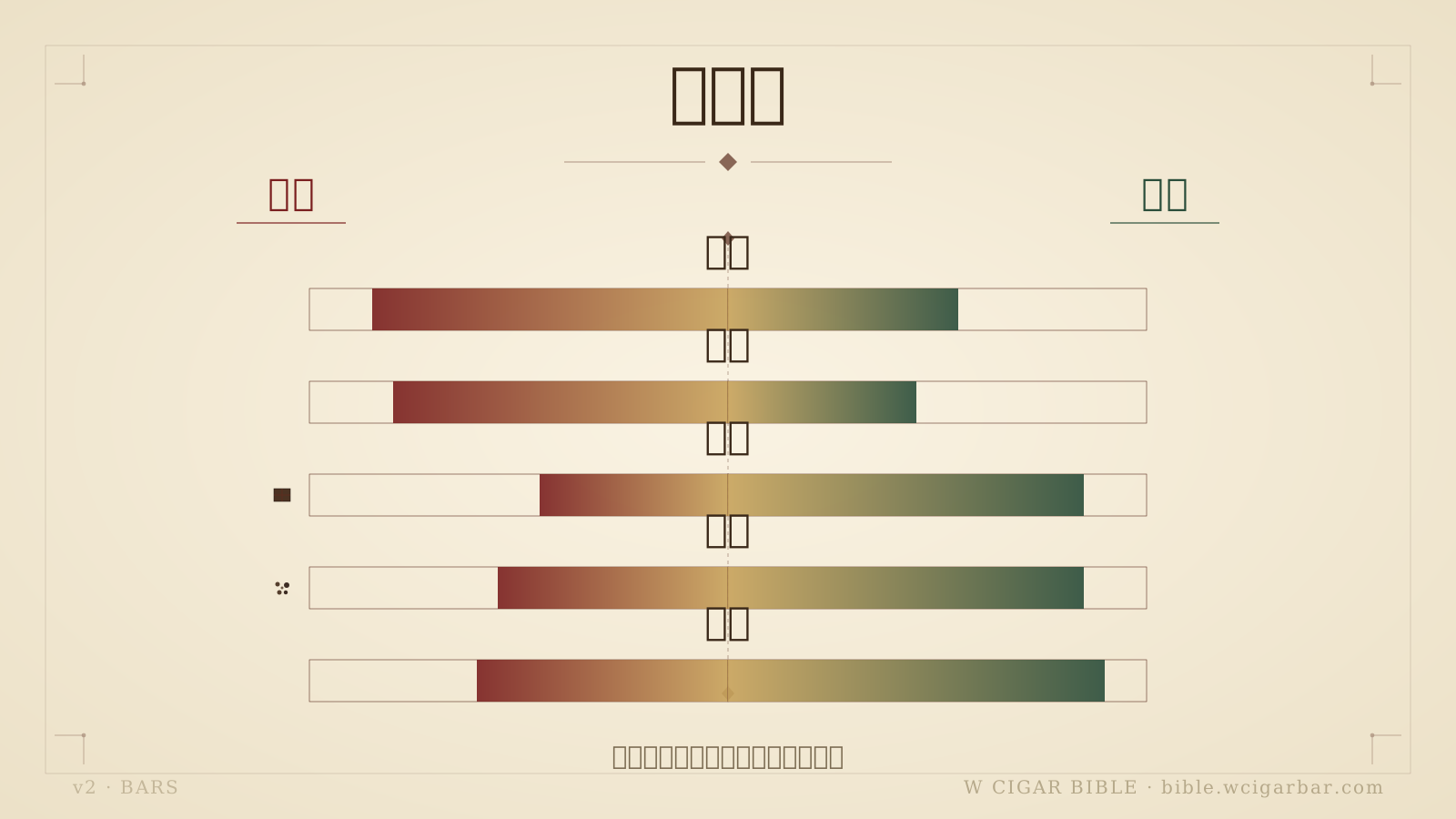
長條圖比較古巴與尼加拉瓜在細緻礦物可可辛香厚度差異
How Technique Deepens Layers: Cutting, Lighting, Rhythm, and Temperature Control
Veterans need technique to fully release oils and resin feel, more important than imagined. A cut too small restricts the smoke channel, easily raising temperature, turning oils into bitterness; a cut too large makes the structure loose, and the smoke becomes empty. A straight cut can retain about 2 to 3 mm of shoulder line for general parejo, while torpedo can be cut small first, then adjusted according to draw resistance. This is not a ritual but an engineering control of burning speed.
When lighting, I prefer to first toast the outer circle of the foot, then let the center heat evenly, avoiding direct burning with a fierce flame from the start. The torch flame should be about 2 to 4 cm away, letting heat rather than the flame work. If the foot is scorched from the start, the front often shows charcoal flavor, masking the original floral, creamy, or cocoa notes. Especially high-oil Maduro, the charring speed is fast, requiring more patience.
Flavor layers rely not only on the cigar itself but also on stable control of burning temperature. I usually recommend an interval of 45 to 75 seconds between puffs, even slower for rich types. If the smoke becomes hot, the tongue bitter, and the nasal cavity stinging, slow down first, don't rush to relight. When relighting, only correct the uneven burn, avoid burning the entire circle again, causing heavy bitterness in the latter stage.
Operable rhythms include:
- Only observe burning in the first 1 cm, don't rush to judge good or bad.
- Slow down in the middle to let the oil sweetness and woodiness open.
- If the temperature rises in the latter stage, reduce continuous puffs to maintain the cleanliness of the finish.
- Don't believe that the longer the ash, the better; a heavy ash column may cause uneven burning.

三張問答卡說明同盒差異白霜判斷與提升油感方法
Understanding Oil Anomalies: Shining, Oiling, Bloom, and Flavor Imbalance
Many people see a shiny wrapper and assume it's in good condition, but excessive shine may just be high humidity, oil floating, or surface wax reflection. Truly healthy oiliness should be soft and lively, not sticky, wet, or greasy to the touch. If it smells of ammonia, sourness, or damp cardboard, be alert to storage environment or fermentation status.
White crystals are often discussed; some are natural phenomena of oil and mineral precipitation, easily dispersed with a light brush; but if they are fuzzy, grow in patches, penetrate the foot, or emit a moldy smell, it's not a good sign. Especially in environments above 72% with insufficient ventilation, the risk increases. Veterans should not rely solely on photos for judgment but combine touch, smell, distribution, and burning performance.
The key to interpreting oil anomalies is not whether it looks pretty but whether it smells, feels, and burns consistently. For example, some well-preserved Cuban boxes from 2012 may not be very shiny on the surface, but once lit, the smoke is dense, and the salty-sweetness is prominent; conversely, some Maduro that looks like it's been oiled may be stuffy, bitter, and have a chaotic burn line, indicating inconsistency between appearance and substance.
If suspected of being over-humidified, first adjust slowly in a 62% to 65% environment for 2 to 4 weeks, avoid rapid drying methods. Rapid dehumidification will cause the outer layer to shrink while the inner layer remains wet, making burning more unstable. Cigars are a slow craft, and correcting storage should also be slow.
Common Questions
Why do oils feel different in the same box of cigars?
Even in the same box, cigars may differ due to leaf position, rolling density, and box position. The moisture exchange speed near the box edge and center differs, resulting in slight differences in burning and aroma after six months. Consistency within the same box is a quality indicator, but not every cigar will be exactly the same. Veterans can use numbering to record, avoiding conclusions based on a single cigar.
Are Maduro cigars necessarily oilier and sweeter?
Maduro usually undergoes deeper maturation and processing, commonly showing cocoa, brown sugar, coffee, and heavy sweetness, but it doesn't necessarily mean better. If fermentation control is poor, it may also result in bitterness, stuffiness, and sluggish burning. The excellence of brands like Padron, Fuente, and Liga Privada lies in making dark tones clean and layered.
Can cigars with bloom on the surface continue to be stored?
If the bloom is powdery, disperses with a light brush, and has no odor, it may be oil or crystal precipitation; if it's hairy, patchy, penetrates the foot, and has a moldy smell, it should be isolated and checked. Judging bloom cannot rely solely on color; it requires examining form, smell, and whether it spreads. High humidity environments should first stabilize to a safe range.
How long are oil-rich cigars suitable for aging?
It depends on the brand, leaf composition, and storage. Rich Nicaraguan or high-end Cuban cigars often have a 3 to 8-year development space, but not necessarily the longer, the better. When sweetness, aroma, and structure begin to decline, it may have passed its peak. It's recommended to record changes every 12 to 18 months for the same box to establish your own curve.
How to make the oil feel more pronounced during burning?
First, stabilize storage, then control cutting, lighting, and rhythm. Too high humidity will stifle, too low will sharpen; puffing too quickly will char the oils. Try extending the interval to around 60 seconds, allowing the smoke to cool, and the sweetness and resin finish will usually be clearer. This is more effective than frequent relighting.
The charm of cigars lies in how they encapsulate land, time, and craftsmanship into a puff of smoke. Resins and oils are not mysticism but flavor clues that can be observed, recorded, and compared. Understanding them reveals why a cigar suddenly blossoms in a certain year, humidity, or rhythm; it also humbles us, knowing that truly good taste can never be rushed.
—Cigar Prince Wilson Tsai
Smoking is harmful to health. Smoking is prohibited for those under twenty. Quitline: 0800-636363. This article is for reference on cigar culture, storage, and regulations for adults over twenty, not an advertisement, promotion, or purchase suggestion.
Like this article?Share with friends
Share this W Cigar Bible piece with friends who want to learn cigar culture, storage, and tasting.
想把這篇 化為實踐
雪茄聖經是知識;雪茄文化要在空間裡發生

W Cigar Bar 大安總店資訊
台北大安區 · 雪茄聖經總編輯 Wilson Tsai 主理的雪茄文化空間
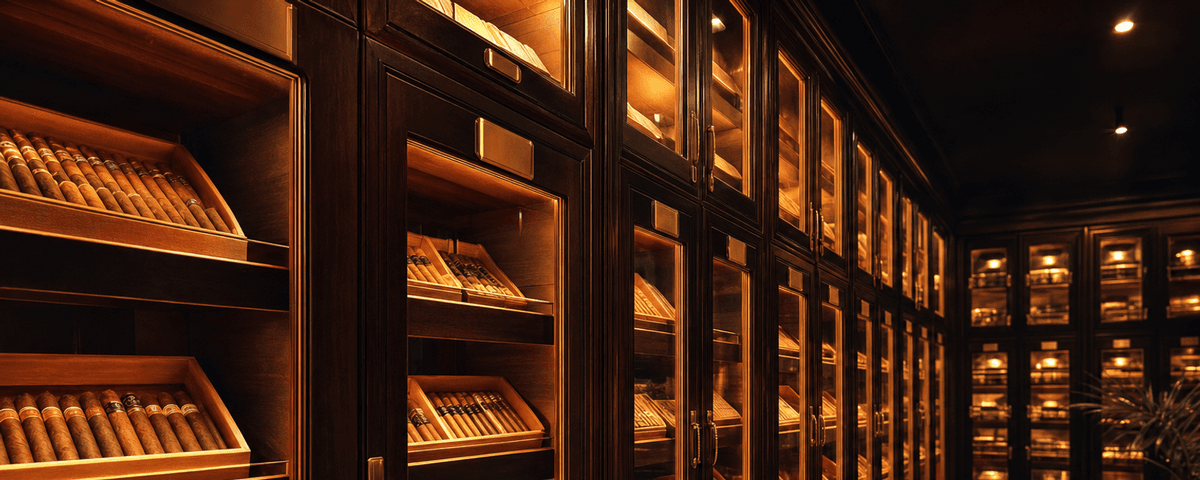
33 座 24 小時恆溫恆濕醇化室
W Cigar Bar 提供的會員醇化空間 · 場地資訊請洽編輯部
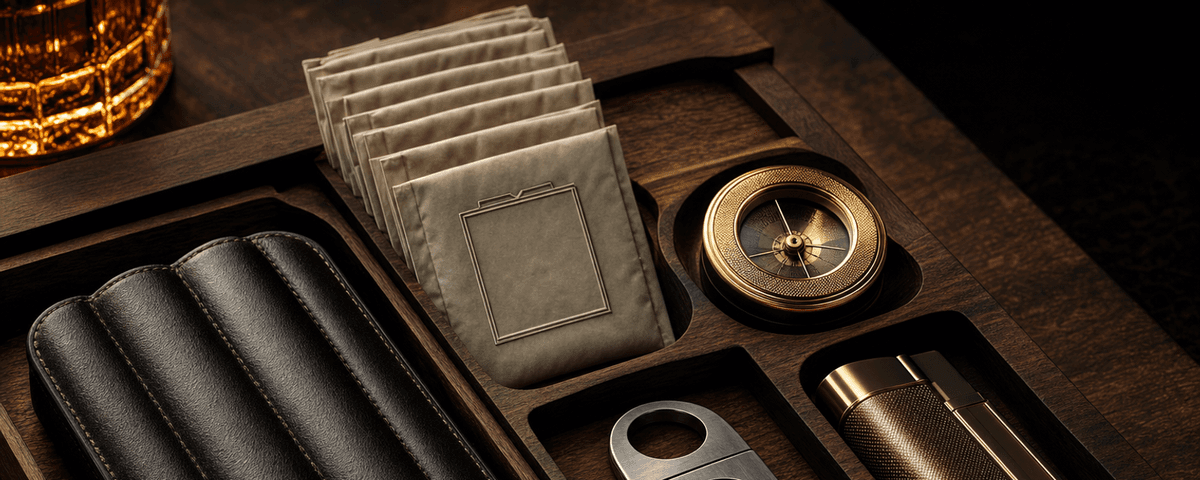
雪茄剪 / 打火機 / 雪茄盒 / Boveda
W Cigar 配件官網 · 專營雪茄配件正品

加 LINE 好友 · 文化諮詢
文化空間資訊 · 紳士沙龍 · 私人包場
本網站內容僅供雪茄文化、歷史、收藏與品吸知識研究參考。菸品有害健康、未滿法定年齡者請勿吸菸。實際規範請依所在地法律為準。
吸菸有害健康・戒菸專線 0800-636363・本站僅供 20 歲以上成年人閱覽。
讀到這裡,你不只是路過的人
留下 Email,加入 W 雪茄聖經內圈——總編輯 Wilson Tsai 親選的學院深文與國際新訊,先你一步送到信箱。
· 教育用途非銷售 · 隨時一鍵退訂 · Email 絕不對外公開 · 由勝茄股份有限公司營運
同分類延伸閱讀


資料來源:W Cigar Bible 編輯部整理 · 雪茄王子 Wilson Tsai 親自審稿
本文僅供雪茄文化、歷史、收藏與品鑑知識研究,不作為菸品促銷、銷售或購買建議。吸菸有害健康,未滿二十歲不得吸菸。