How to Enhance Your Cigar Tasting Experience: A Comprehensive Exploration from Techniques to Senses

雪茄的品鑒不僅僅是吸煙的過程,更是一種探索風味的藝術。入門者應專注於建立穩定的品鑒環境,包括控制濕度與溫度,並注意身體狀態,以避免外在干擾。裁切與點火的技巧也至關重要,正確的操作能確保煙霧的純淨度。透過觀察、嗅聞、觸摸與品嚐四種感官,深入分析雪茄的風味變化,並用時間軸記錄每個階段的特徵,能幫助你更清晰地了解自己的偏好。搭配適合的飲品,能進一步提升品鑒體驗。
- 建立穩定的品鑒環境,控制濕度與溫度,能顯著影響雪茄的風味體驗。
- 裁切與點火的技巧直接影響第一口的抽吸感受,需謹慎處理。
- 用時間軸記錄雪茄的三段變化,能幫助你更清楚自己的品味偏好。
The joy of cigars is never just in the smoke itself. Once beginners understand the basic puffing technique, the real advancement is turning each draw into an experience that can be observed, compared, and reviewed. As the editor of "Cigar Bible," I often remind new friends: don't rush to chase lists, but first establish a method.
The flavor of a cigar can be influenced by humidity, cutting, lighting, puffing rhythm, the drink in your cup, and even your mood that day. Understanding these variables will help you know whether you like a brand's personality, size ratio, vintage condition, or a fleeting charming moment during a specific burning process.
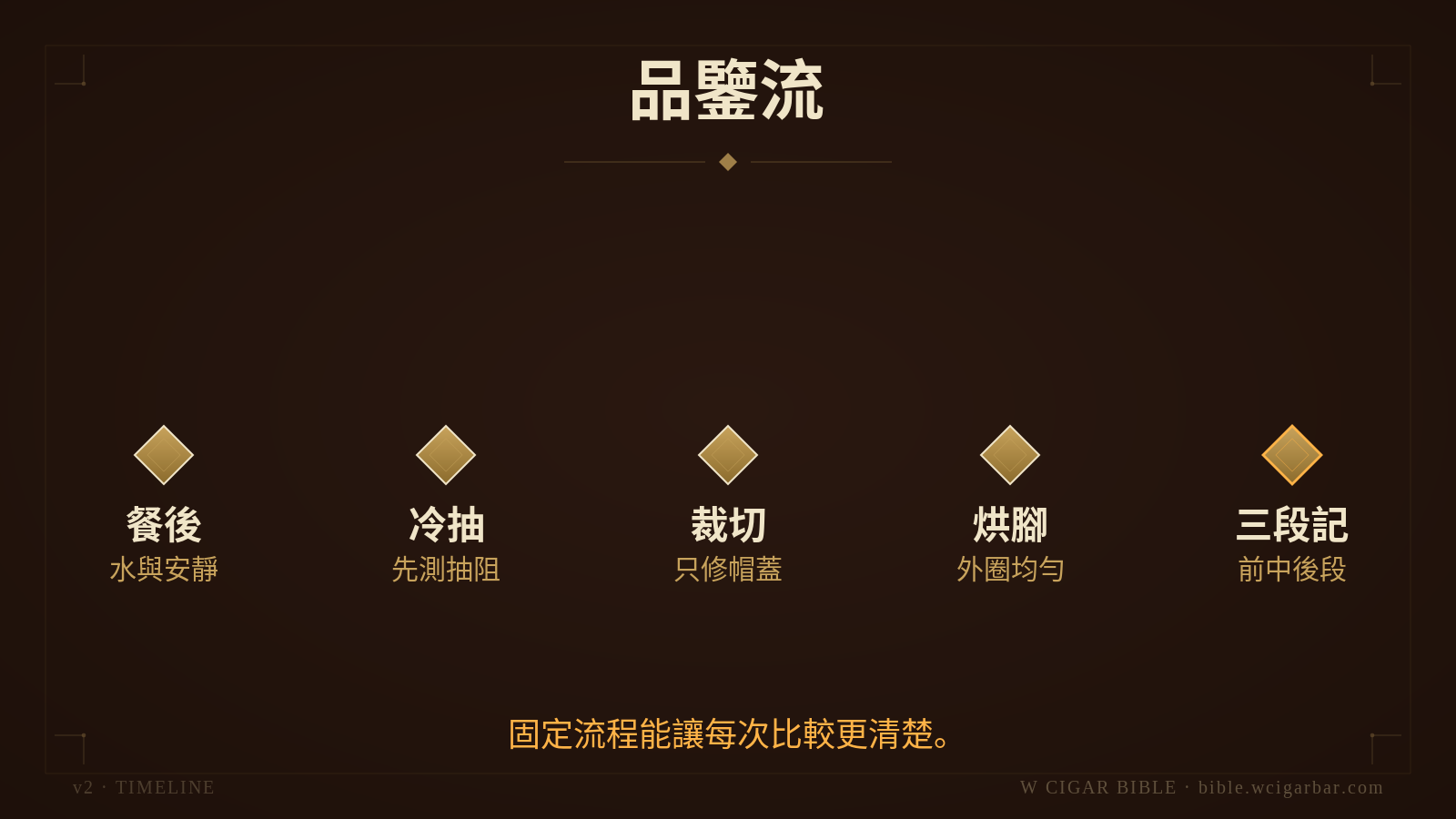
時間軸依序呈現餐後準備、冷抽、裁切、點火與三段記錄
Establishing the Tasting Environment: Time, Humidity, and Physical Condition
Many people think that improving cigar tasting skills means getting to know more brands and regions; however, I believe the first step is to establish a stable environment. If the same Partagás Serie D No.4 burns at 72% humidity versus 66%, the draw resistance, spiciness, and bitterness may differ. Generally, I keep daily storage at a relative humidity of 65% to 69%, with a temperature of about 18 to 20°C, and let newly acquired cigars rest for at least 2 to 4 weeks.
The physical condition before tasting is also crucial. Nicotine sensitivity is heightened on an empty stomach, while being too full can dull the taste buds; I prefer to start 30 to 60 minutes after a meal and prepare room temperature water. Perfume, strong essential oils, and cooking fumes can all interfere with olfactory judgment. A stable environment is not about ritual, but the basic condition for distinguishing "the cigar itself" from "external interference."
Beginners can establish a simple fixed process: the same chair, the same glass of water, the same lighter, the same recording method. When variables are reduced, you will have a clearer comparison basis for the cocoa, woody, and coffee notes of Montecristo No.2, or the creamy and nutty notes of H. Upmann Magnum 46.
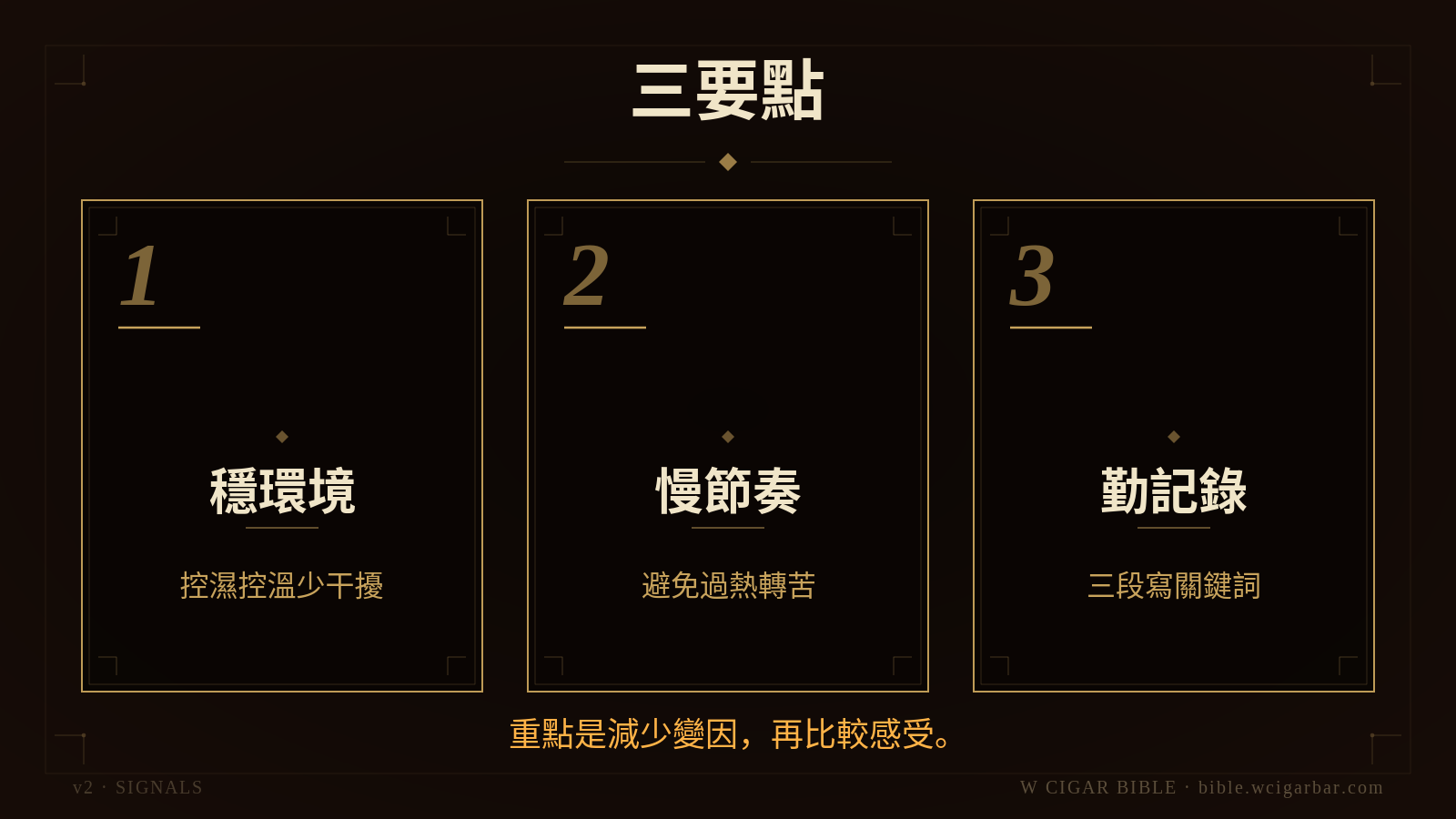
三張重點卡整理穩定環境、放慢節奏與持續記錄
Cutting and Lighting: Determining Whether the First Puff is Clean
Cutting seems simple, but it profoundly affects draw resistance and smoke volume. Straight cuts suit most Parejo cigars, such as Robusto, Toro, Corona Gorda; V cuts can concentrate smoke and are often used on larger ring sizes; punches are clean and neat but may make the draw tight with tightly packed cigars. My principle is to only cut the cap, not damage the shoulder line, cut a little less first, and trim more if needed.
When lighting, don't rush to stick the flame directly to the foot. I usually use a butane lighter to evenly toast the outer circle of the foot, letting the edges slightly glow before gently drawing while rotating. For the wide ring cigars common after 2020, if the outer circle is not fully lit, the middle section can easily burn unevenly; if it burns too hot at the start, the front section will have a burnt and spicy taste. Good cutting ensures a stable air path, good lighting ensures the flavor unfolds cleanly from the first puff.
Beginners can use a 3-step check: First, confirm that the draw resistance feels like drinking a milkshake with a straw, not like drinking water or being unable to draw; second, observe whether the burn ring is even after lighting; third, avoid continuous heavy puffs in the first 5 minutes. For rich cigars like Arturo Fuente OpusX, if the pace is too fast, the spice quickly turns into heat and loses its layers.
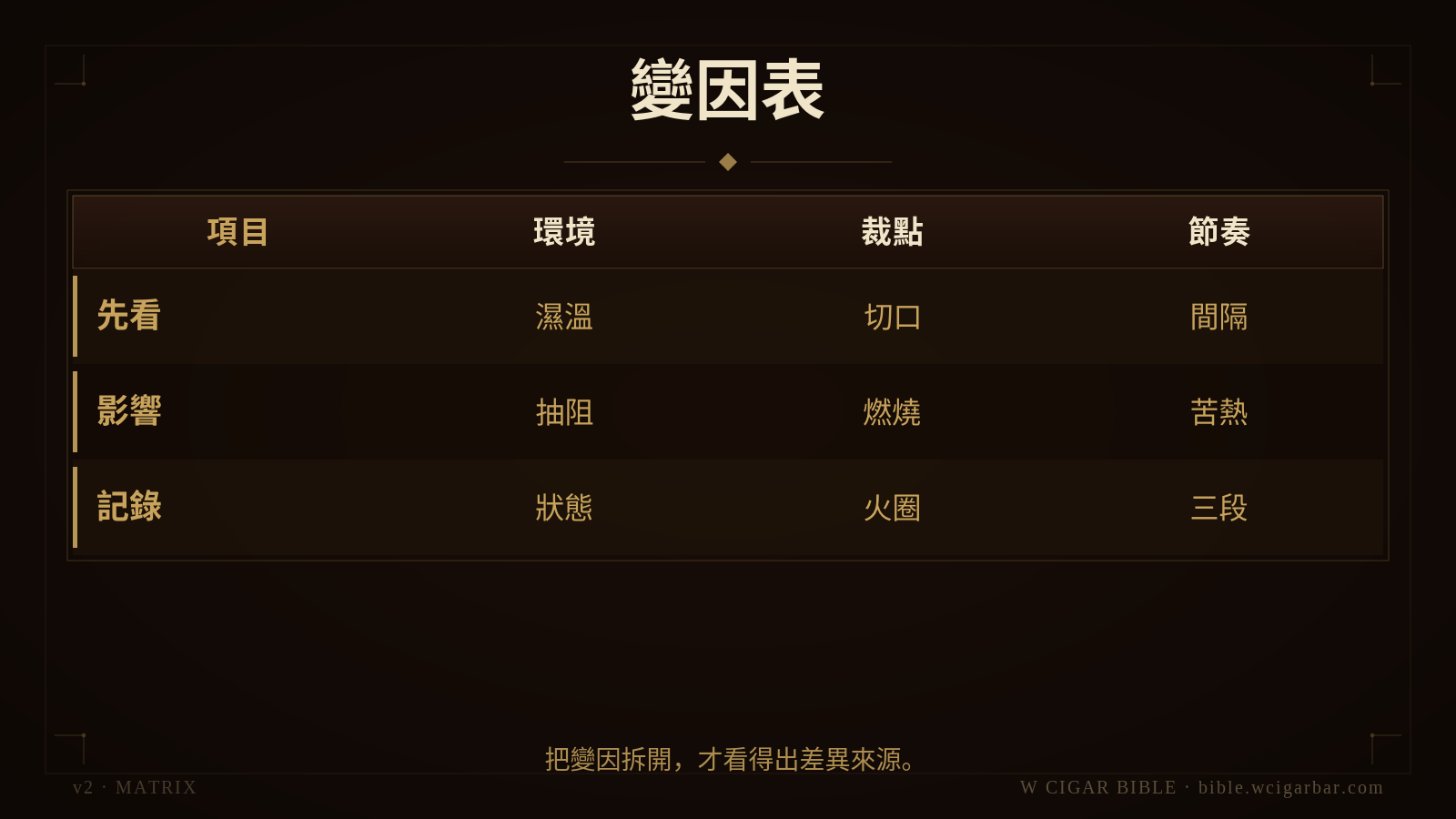
矩陣比較環境、裁點與節奏三類變因的觀察與影響
Dissecting with Four Senses: Look, Smell, Touch, Taste
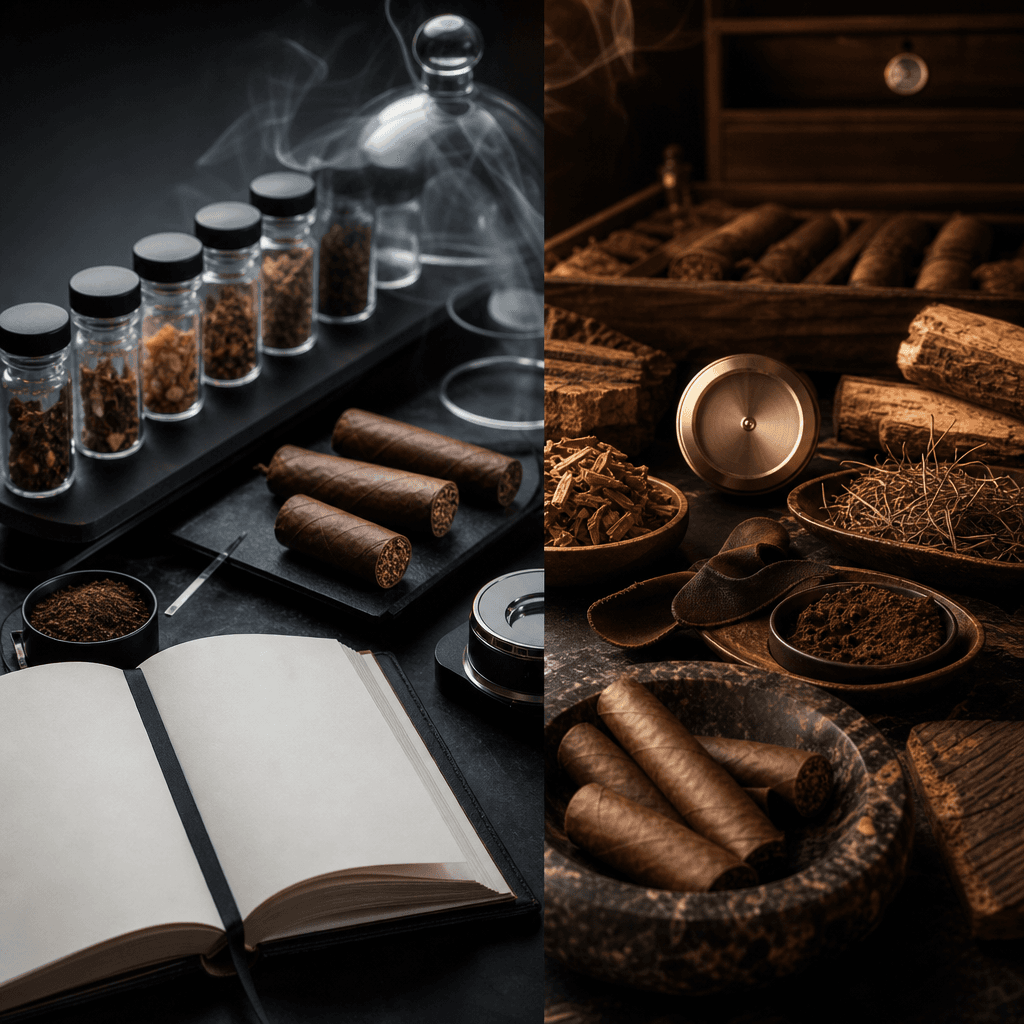
True tasting is not just asking "is it good to smoke," but starting with dissection through looking, smelling, touching, and tasting. First, observe whether the wrapper color is even, whether the oils are natural, and whether the veins and rolling are smooth. For example, the Cohiba Siglo VI, launched in 2002 as part of the Línea 1492, often balances herbal, honey, creamy, and roasted aromas, rather than simply pursuing concentration.
Pre-light smelling is very worth practicing. The foot may have aromas of hay, cedar, cocoa, earth, pepper, or leather; the cold draw often reveals sweetness and airflow status. Gently press the body with your fingers, it should be elastic rather than hard like a stick, nor should it be too loose in parts. The purpose of sensory analysis is not to say fancy adjectives, but to turn abstract feelings into traceable clues.
In terms of taste, I suggest beginners first master 6 categories of words: sweet, bitter, sour, salty, spicy, umami, plus aroma categories like woody, nutty, coffee, cocoa, leather, floral, herbal, mineral. When describing a Davidoff Grand Cru, if you can say "the front is creamy and almond, the middle has hay and white pepper," it's more valuable than just saying "smooth."
Recording Three-Stage Changes with a Timeline
A cigar is not judged by one puff but changes personality as it burns. I usually divide a cigar into three sections: front, middle, and back, roughly by one-third of the burning length. The front often shows the opening aroma, the middle best reveals the structure, and the back tests balance and temperature control. For example, Montecristo No.2 often has woody and cocoa in the front, may shift to coffee and leather in the middle, and if smoked too fast in the back, bitterness rises.
The table below is a simplified version I give to beginners. You don't need to write long essays each time, just record 3 to 5 key words per section. After continuously recording more than 10 cigars, you can see your preferences. Recording with a timeline prevents you from only remembering the first impression or the final bitter heat.
| Stage | Observation Focus | Recordable Vocabulary | Common Mistakes |
|---|---|---|---|
| Front | Cleanliness of lighting, initial aroma | Cedar, cream, hay, pepper | Overheating, quick puffs |
| Middle | Sweetness, concentration, balance | Cocoa, coffee, nuts, leather | Ignoring transitions |
| Back | Temperature, bitterness, aftertaste | Dark chocolate, earth, spice | Hard drawing to overheating |
If you're smoking a Cohiba Behike 52, which has been discussed since its official launch in 2010, its preciousness is not only in its fame but also in the thickness and depth brought by the medio tiempo leaf. When recording, don't just write "high-end," but ask: How long does the sweetness linger? Is the smoke body creamy or dry? Is the aftertaste cocoa, woody, or mineral?
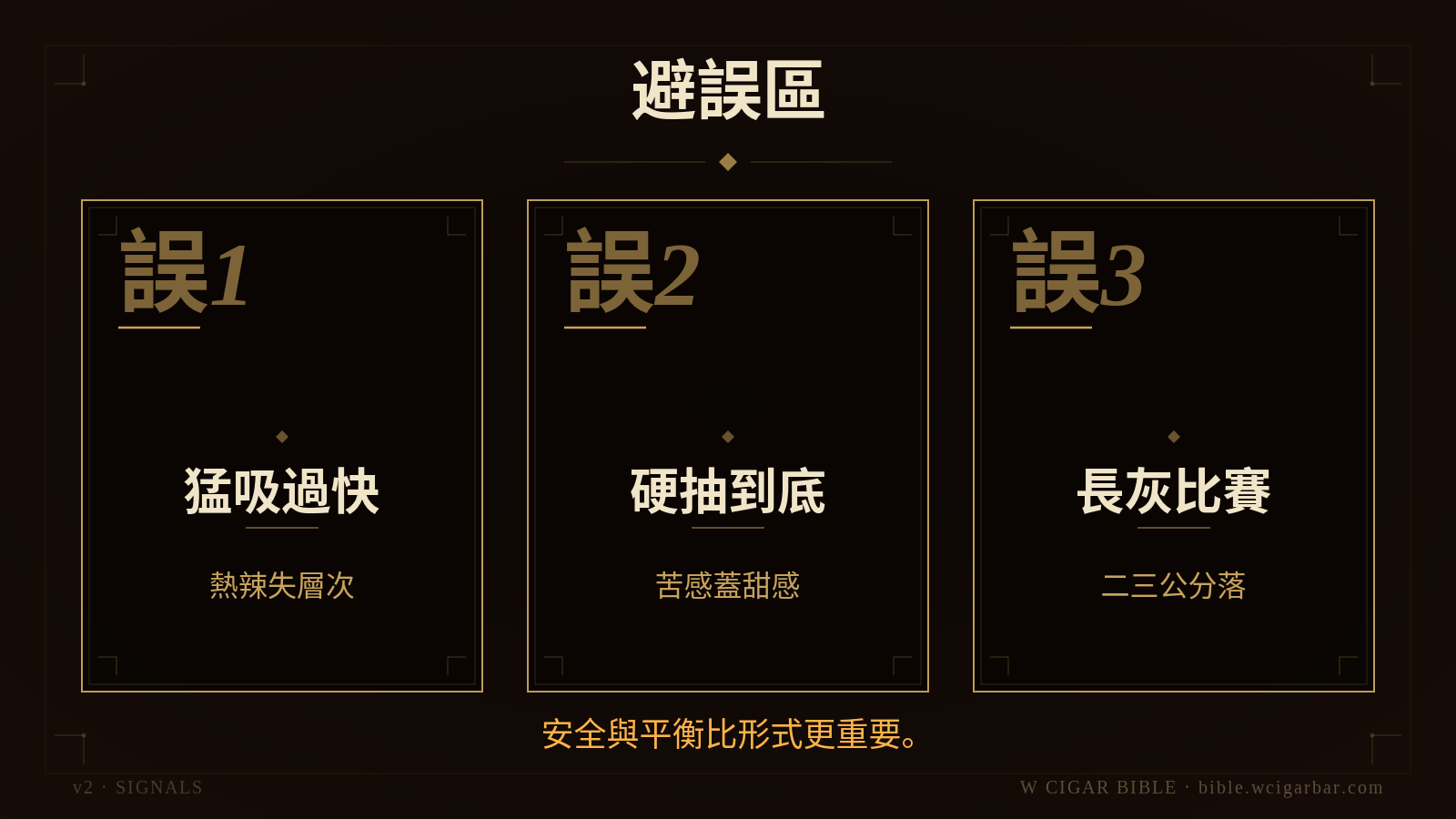
三張錯誤提醒卡說明猛吸、硬撐到底與灰留過長問題
Puffing Rhythm and Nasal Retrohale: Let the Layers Slowly Emerge
The most common mistake in advanced tasting is treating cigars like cigarettes with frequent inhalation. Cigar smoke mainly stays in the mouth, not the lungs; rhythm-wise, I suggest one puff every 45 to 90 seconds, adjusting based on size, concentration, and burning state. Small sizes like Petit Corona heat up quickly, while large sizes like Double Corona require patience. If the cigar head glows too brightly red and the mouth starts to sting, it usually means too fast.
Nasal retrohale, which is directing a small amount of smoke from the mouth to the nasal cavity, is an important technique for identifying aromas, but beginners don't need to do it extensively. You can practice a very small amount every 5 to 8 puffs, starting with mild cigars like Hoyo de Monterrey Epicure No.2 or H. Upmann series. Rhythm control is the braking system of tasting; knowing how to slow down allows the flavors to have space to emerge.
If you encounter uneven burning, don't immediately panic. Slight canoeing can be waited out for 1 to 2 minutes to see if it self-corrects; obvious canoeing can be corrected with a lighter. Overcorrecting can bring kerosene or burnt taste, especially noticeable in the back section. From my experience, those who can control the rhythm can taste sweetness and spice layers even with rich Nicaraguan cigars.
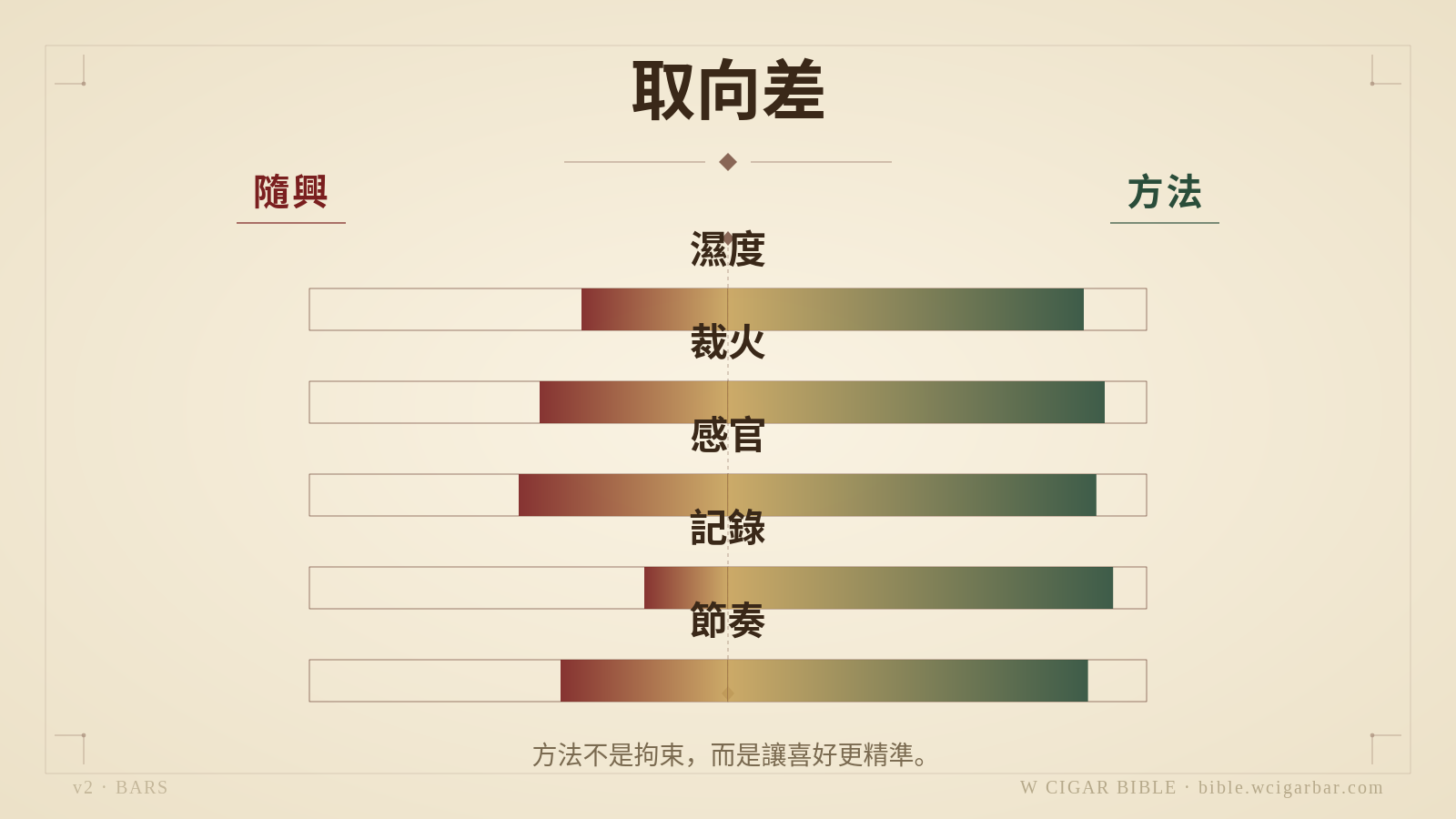
橫條圖比較隨興與方法兩種品鑒取向在五個軸線的差異
Pairing Drinks and Post-Meal Situations: Don't Let the Supporting Role Steal the Show
Drink pairing can amplify flavors or hide details. The safest choice for beginners is actually room temperature water, unsweetened sparkling water, black coffee, or light tea. If the cigar itself is elegant, like Quai d’Orsay No.50, overly sweet cocktails can overshadow floral and creamy notes; if it's a rich Padrón 1964 Anniversary, black coffee or dark rum can better carry cocoa and roasted tones.
Whiskey is often paired with cigars, but not every type is suitable. Strongly peaty Islay whiskey may cover the herbal and honey notes of delicate Cuban cigars with smokiness; bourbon's vanilla and caramel suit cigars with woody sweetness. The principle of drink pairing is not that the more expensive the better, but to make the main melody of the cigar clearer.
I suggest practicing with contrasts: pair the same cigar with water, black coffee, and light tea, observing whether sweetness, bitterness, and spiciness change. When recording, you can write "after pairing with black coffee, the cocoa note is more pronounced, bitterness increased by 10%," although the numbers are subjective estimates, they help you build a personal database. Over time, you'll know whether you prefer complementary pairing or retaining the original flavor with plain water.

快問快答卡片整理入門濃度、停止時機與落灰長度
Tasting Notes and Sharing Etiquette: Turn Feelings into Assets
Tasting notes don't need to be as complex as professional scoring sheets, but should have a fixed format. I often use a 100-point system as an aid, not for ranking, but to remind myself to observe completeness. It can be divided into appearance 10 points, draw resistance 10 points, burn 15 points, flavor 35 points, balance 20 points, aftertaste 10 points. If you continuously record 20 Robustos, you'll clearly know whether you prefer heavy, sweet, spicy, or elegant.
The notes should ideally include brand, model, size, acquisition time, storage humidity, smoking date, drink pairing, and environment. For example, a 2014 boxed H. Upmann Magnum 50, if well-preserved, may be more rounded than in its younger state; but when discussing collection and value, be rational, as collection appreciation does not guarantee value increase, still depending on source preservation and market. Good notes are your personal map for future taste, storage, and collection decisions.
When sharing, also be courteous. Don't state personal preferences as absolute standards, don't frequently correct others while they're enjoying, and don't let price overshadow experience. You can say "I feel almond and white pepper in the middle," rather than "you should also taste it." The charm of cigar culture lies in how the same Punch Punch can evoke different memories and taste languages in different people.
Common Questions
Should beginners start with mild cigars?
In most cases, starting with medium to mild cigars is fine, such as Hoyo de Monterrey Epicure No.2, Romeo y Julieta Short Churchill, or Davidoff Signature series. These cigars are easier to observe creamy, woody, floral, and nutty notes, and are less likely to let nicotine sensations steal attention. The focus is not on mildness, but on balance and stability.
How short should a cigar be smoked before stopping?
There is no hard standard. I usually stop when the temperature in the back section significantly rises, bitterness overpowers sweetness, or when my fingers feel uncomfortable. Many cigars rapidly heat up in the last 3 to 4 centimeters, and forcing it can ruin the overall impression. Leaving the best ending in memory is more important than smoking to the shortest.
Should the ash be kept as long as possible?
Long ash can show structure and burn stability, but it's not a competition. Gently ashing at about 2 to 3 centimeters is usually safer and avoids falling on clothes and tables. If the ash is whitish and tightly layered, it often indicates good burn status; but the real focus remains on flavor, draw resistance, and balance, not how long the ash is kept.
How long should cigars be aged?
Different brands and sizes vary greatly. Rich, tannic cigars may need 1 to 3 years to round out the edges; elegant cigars may not necessarily improve with age. My suggestion is to record in batches from the same box, such as smoking one at the 3rd month, 1st year, and 2nd year, letting your taste decide the best window.
How to judge if you've really improved?
When you can say "why you like it" and "which part is best," you've already improved. Previously, you might have only said smooth or strong, but later you can identify draw resistance, burn, sweetness, spiciness, aftertaste, and drink influence, which shows skill enhancement. After continuously recording 30 cigars and looking back, you'll find your vocabulary and judgment more precise.
I always believe that cigar tasting is not about flaunting knowledge, but training yourself to slow down, look more closely, and feel more deeply. Brands, vintages, and scores are just tools; what truly deserves cherishing is the aroma, a conversation, a sense of peace you remember on a certain night. May every beginner establish their own method while retaining their intuition and preferences.
—Cigar Prince Wilson Tsai
Smoking is harmful to health. Under 20 years old is prohibited from smoking. Quit smoking hotline: 0800-636363. This article is for reference on cigar culture, storage, and regulations for adults over 20 years old only, not a tobacco advertisement, promotion, or purchase suggestion.
Like this article?Share with friends
Share this W Cigar Bible piece with friends who want to learn cigar culture, storage, and tasting.
想把這篇文章 化為實踐
雪茄聖經是知識;雪茄文化要在空間裡發生

W Cigar Bar 大安總店資訊
台北大安區 · 雪茄聖經總編輯 Wilson Tsai 主理的雪茄文化空間
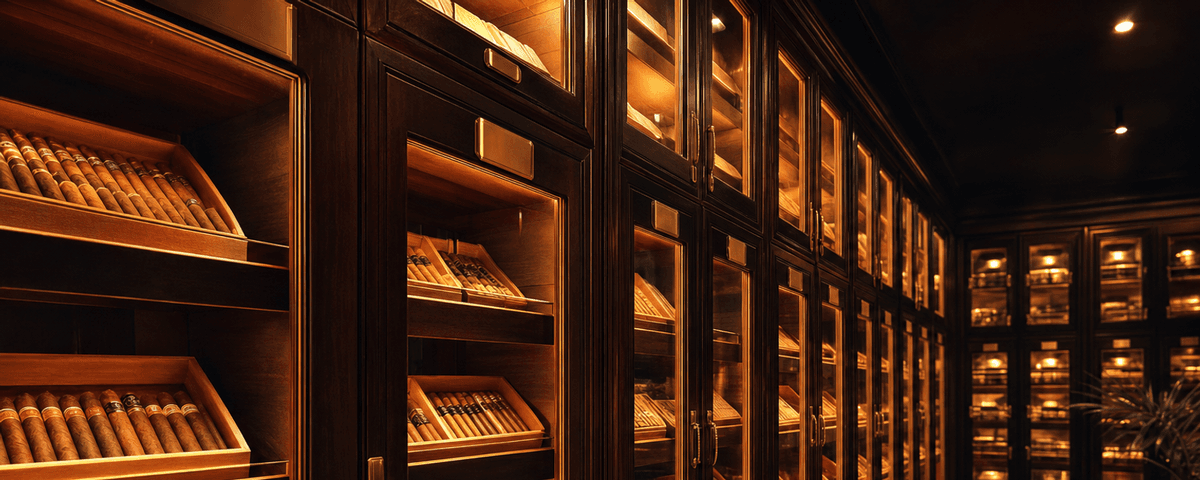
33 座 24 小時恆溫恆濕醇化室
W Cigar Bar 提供的會員醇化空間 · 場地資訊請洽編輯部
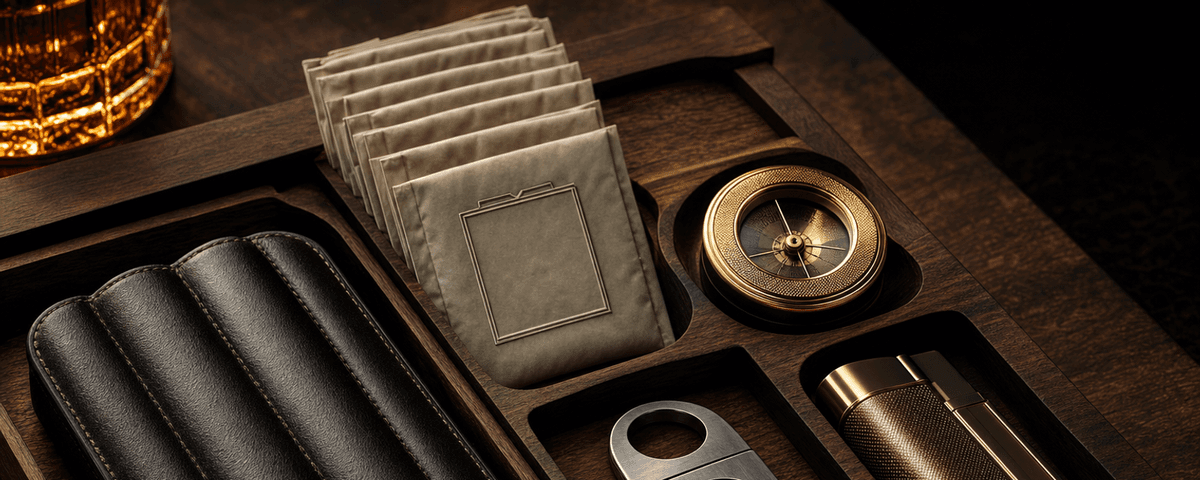
雪茄剪 / 打火機 / 雪茄盒 / Boveda
W Cigar 配件官網 · 專營雪茄配件正品
加 LINE 好友 · 文化諮詢
文化空間資訊 · 紳士沙龍 · 私人包場
本網站內容僅供雪茄文化、歷史、收藏與品吸知識研究參考。菸品有害健康、未滿法定年齡者請勿吸菸。實際規範請依所在地法律為準。
吸菸有害健康・戒菸專線 0800-636363・本站僅供 20 歲以上成年人閱覽。
讀到這裡,你不只是路過的人
留下 Email,加入 W 雪茄聖經內圈——總編輯 Wilson Tsai 親選的學院深文與國際新訊,先你一步送到信箱。
· 教育用途非銷售 · 隨時一鍵退訂 · Email 絕不對外公開 · 由勝茄股份有限公司營運
同分類延伸閱讀
資料來源:W Cigar Bible 編輯部整理 · 雪茄王子 Wilson Tsai 親自審稿
本文僅供雪茄文化、歷史、收藏與品鑑知識研究,不作為菸品促銷、銷售或購買建議。吸菸有害健康,未滿二十歲不得吸菸。