貝琳達
革命前的旗艦、革命後的邊緣——Belinda 的雙生命運
評分方法 · 本評分為 W Cigar Bible 依據品牌歷史、國際能見度、產品穩定性、收藏討論度與華文市場辨識度綜合整理,非投資建議或銷售推薦。
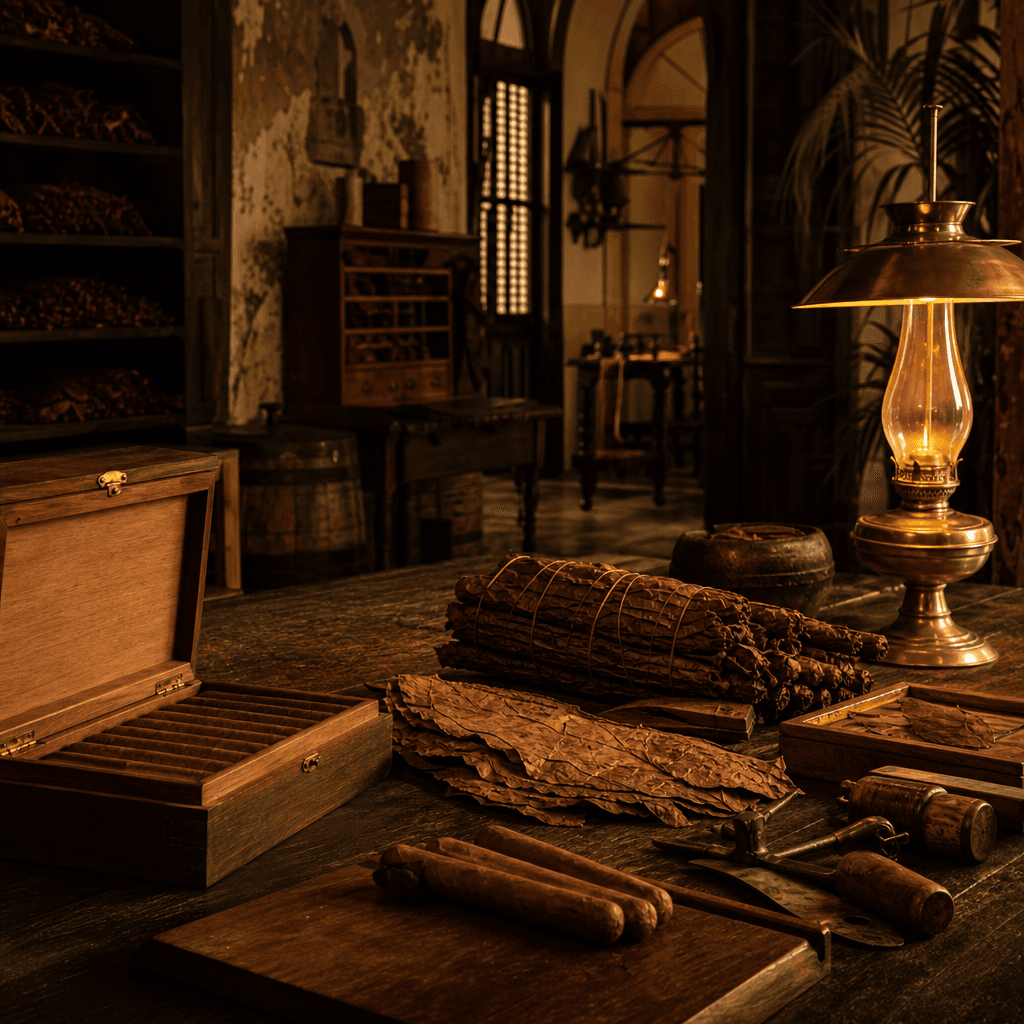
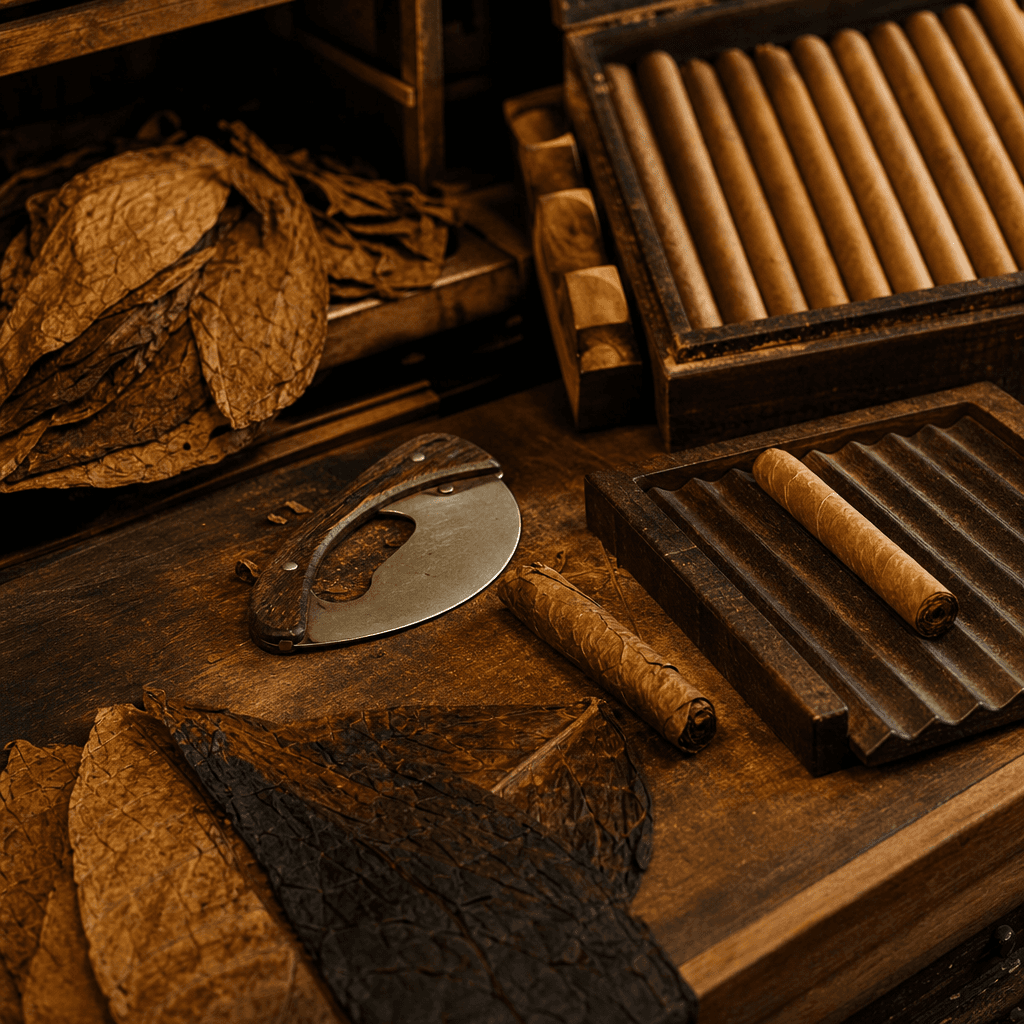
Belinda 1882 年由西班牙人 Francisco Menéndez 創立——是雪茄業老牌品牌之一。Menéndez 是當時資深雪茄人——品牌設計為他新工廠的旗艦產品,他不惜代價選擇頂級菸草與包裝。
1931 年 Fernández y Palicio 收購 Hoyo de Monterrey 品牌與 La Escepción 工廠——Belinda 生產隨即移到 La Escepción 工廠。這個新集團成為哈瓦那最大菸草出口商之一——Belinda 是其旗艦品牌之一。
1989 年(部分文獻說 1987)Cubatabaco 將 Belinda 復活——作為低價機製雪茄品牌。主要市場是東歐(當時古巴與東歐國家有強勁貿易關係)。復活版用 long-grain short-filler 菸草機製生產——較傳統 short-filler 略大塊的菸草碎片。
2014 年左右 Belinda 變成「古巴內銷專屬」——完全退出國際市場。這是品牌 132 年歷史中最低潮的時期——只在古巴本地能買到。
2005 年 Belinda 從 Habanos portfolio 正式刪除——生產移至 Internacional Cubana de Tabacos S.A. (ICT) 在 Habanos 授權下繼續生產。這是與 Guantanamera 相同的「從 Habanos 脫離但 ICT 持續生產」案例。
2022 年 Belinda 重新出現在國際市場——據推測是因為 COVID 後全球 Cuban 雪茄供應普遍短缺。Belinda 機製生產容量大、可以填補手工 Cuban 雪茄供應缺口——是品牌 8 年內銷後的「意外回歸」。
1959 年革命後 Fernández y Palicio 公司被國有化——La Escepción 工廠在革命後不久被關閉——是革命後關閉的少數歷史工廠之一。生產 Belinda、Punch、Hoyo de Monterrey 等品牌移至 La Corona 工廠。
1950s Belinda 型錄含約 50 種不同 vitolas——是雪茄業少數產品線達到 50+ 規格的品牌。Belinda 的全盛期。革命前 Belinda 與 Punch、Hoyo de Monterrey 同公司、同工廠。
1962 年甘迺迪 JFK 禁運後 Belinda 失去美國市場——整個 1960s 品牌逐步衰落。1969 年 Belinda 最後出現在 Cubatabaco 型錄——之後正式消失於市場。從 1882 創立到 1969 消失,Belinda 經歷 87 年歷史。
1897 年 Belinda 首次與 Punch 合併——之後 30 年間品牌 4 次易手。1930 年落入 Fernández y Palicio 公司——這是 Belinda 命運的關鍵轉折。
對研究 Cuban 雪茄歷史的玩家:革命前 1950s Belinda(特別是 La Escepción 工廠時期生產的版本)是雪茄收藏家眼中的稀有藏品——這份歷史性收藏價值,比今日的機製版本高出數十倍。
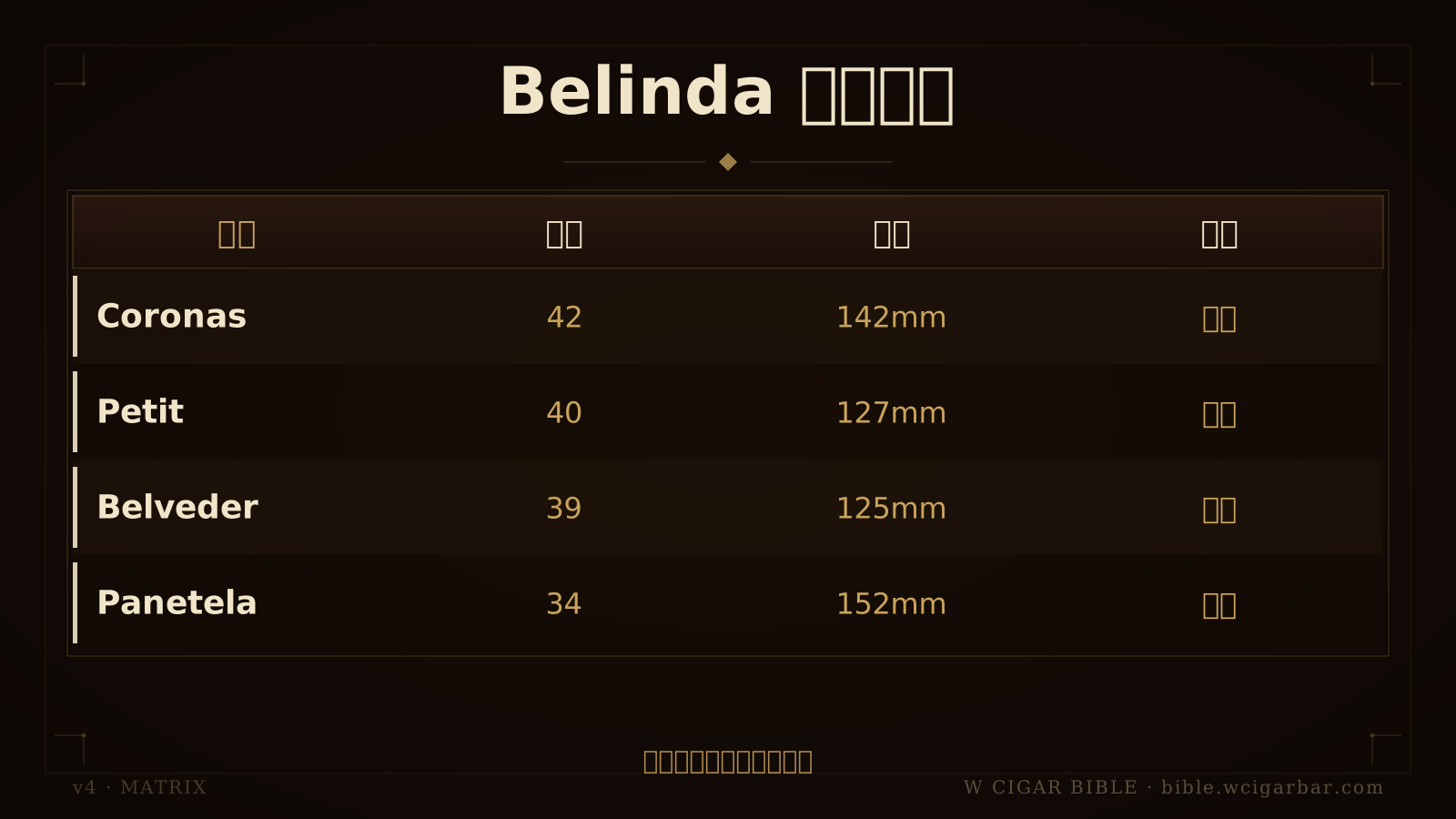
2002-2005 年復活版 Belinda 大幅縮減——Princess、Petit Princess、Preciosas(2002 年停產)、Petit Coronas、Belvederes、Panetelas、Petit(2003 年停產)、Coronas、Demi Tasse(2005 年停產)。只剩重新發行的 Coronas (2) 還在生產。
Belinda 與 Punch 的兄弟關係——1897 兩品牌合併、1930s 同公司(Fernández y Palicio)、革命前同工廠(La Escepción)——是革命前雪茄業「雙生品牌」的另一案例(與 Sancho Panza/El Rey del Mundo 雙生對應)。今日 Punch 仍是 Habanos 全球品牌,Belinda 已成歷史邊緣品牌——是雪茄業「雙生品牌不同命運」的代表。
喜劇演員 Groucho Marx 是 Belinda 的著名愛好者——「戰間期(1918-1939)Belinda 在歐美都是雪茄文化的代表」。Groucho Marx 是 Marx Brothers 喜劇集團的核心成員——以叼雪茄為招牌形象——他選擇 Belinda 是品牌文化加分。
Belinda 在 ICT 工廠機製生產——用 Vuelta Arriba 菸草(與 Guantanamera、José L. Piedra 同產區)。復活版 2005 後改為傳統 short-filler(之前是 long-grain short-filler)。
自 19 世紀中起,Habanos 雪茄盒裝飾工藝大幅進步——菸草企業家爭相獲得越來越精美的盒裝裝飾。Francisco Menéndez 在這場「雪茄盒裝飾競賽」中以 1882 年創立的 Belinda 品牌取得勝利——是雪茄業視覺工藝的重要里程碑。
Belinda 風味(復活版 1989 至今):中等強度(medium-bodied)——「全味(full-flavored)」描述。特徵風味:奶油、堅果、淡花香、雪松、輕咖啡尾韻。是「Cuban 雪茄入門」的代表——對覺得主流 Cuban 太強的玩家友善。
1890s 古巴獨立戰爭重創菸草業——Belinda 雖然初期成功,但歷史風暴很快襲來。1900-1930s 是「The Trust」時代——美國資本家利用古巴戰後經濟困境收購大量古巴菸田、加工設施、雪茄工廠,與美國資產整合。獨立工廠形成「Marcas Independientes」鬆散聯盟,以價格戰與成本削減競爭。
Belinda 復活版 1989 年發行 10+ 種規格:Coronas、Demi Tasse、Petit Coronas、Belvederes、Panetelas、Petit、Princess、Petit Princess、Preciosas、Superfinos——所有都是機製、cellophane 包裝、25 支或 5 支裝。是 Belinda 從「Eastern European 機製品牌」的時期。
對台灣與華人玩家:復活版 Belinda Coronas 售價約美金 5-8 元——「平價 Cuban 機製雪茄」之一。新手友善、中等強度、奶油堅果風味。比 Guantanamera 略強烈、比 José L. Piedra 略溫和。
Belinda 雪茄環特徵:Standard Band A(1989 至今)——較舊版本浮雕較少。復活版設計反映「平價機製品牌」的定位,而非革命前作為旗艦品牌的精緻包裝。
貝琳達 完整 vitola 圖鑑(27 張)
貝琳達(貝琳達 Belinda)旗下完整 vitola 圖鑑卡片、每張卡點進去含: 葉組產地(CAPA/CAPOTE/TRIPA)、 風味前中後段、 歷年特殊版發行紀錄(ER 地區限定 · EL 年度限量 · LCDH · RR · GR)、 配飲建議與收藏陳化指南。
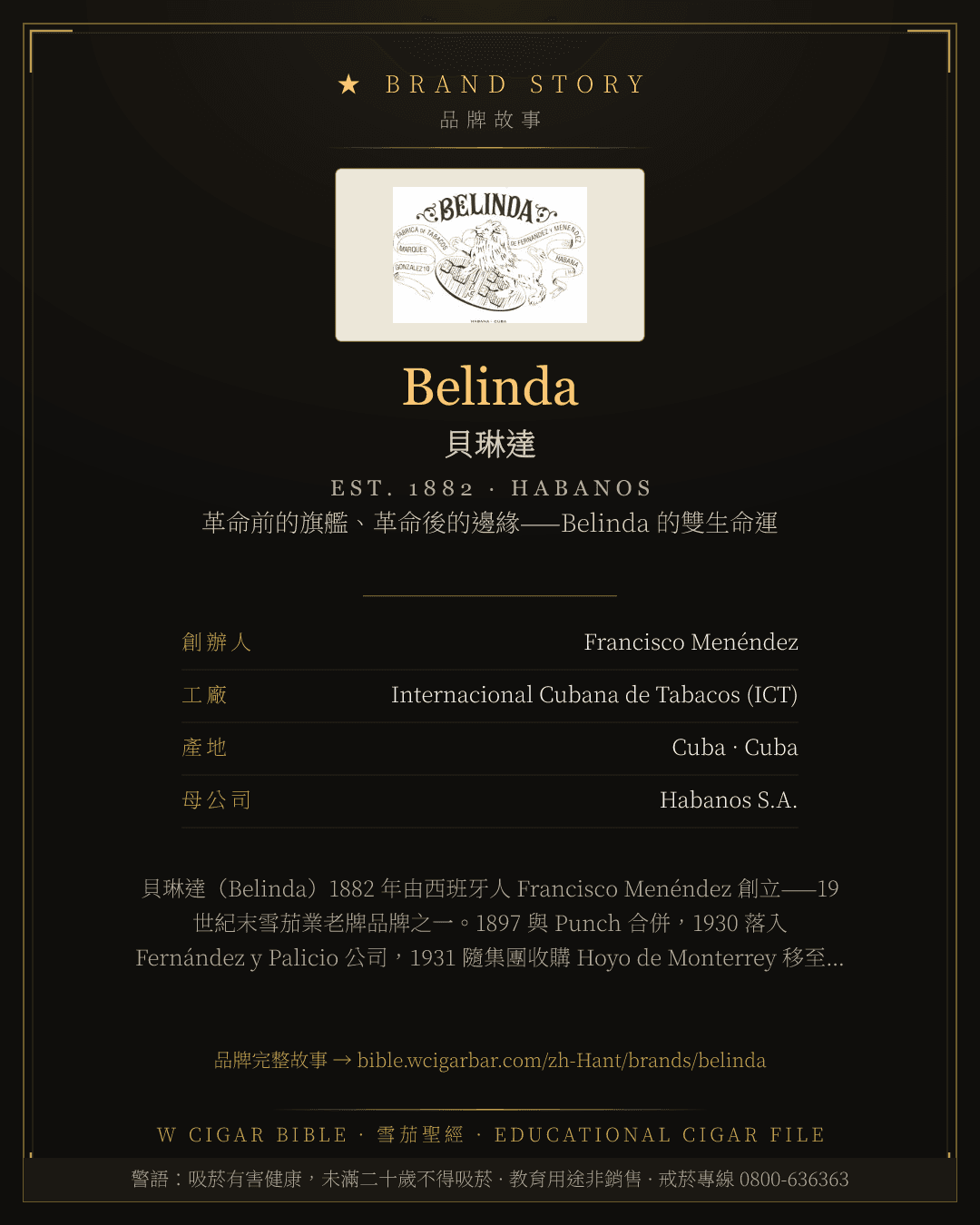
Belinda · 貝琳達 品牌故事
BRAND STORY · EST. 1882
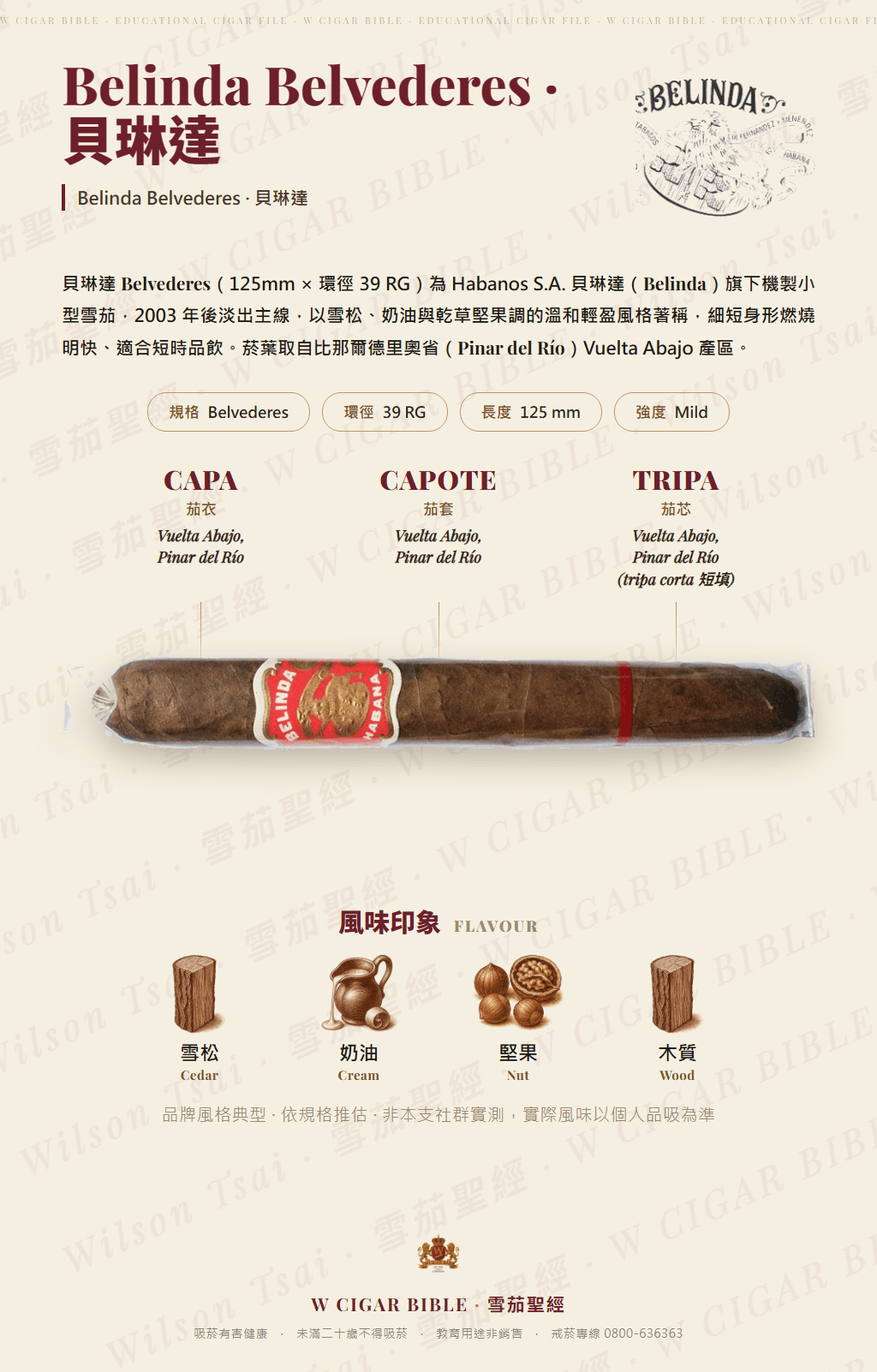
Belinda Belvederes · 貝琳達
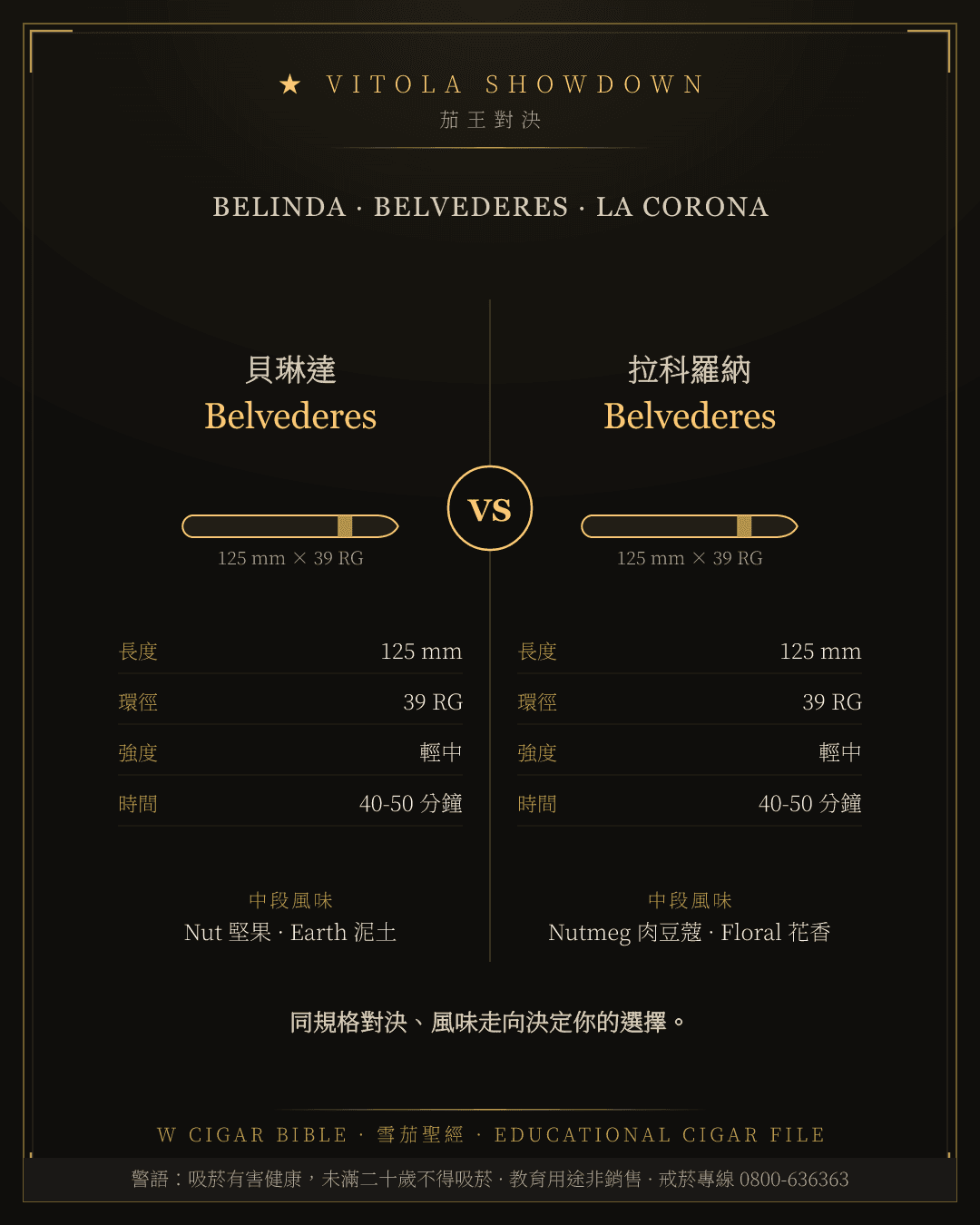
Belinda Belvederes vs La Corona Belvederes
VITOLA SHOWDOWN · Belvederes
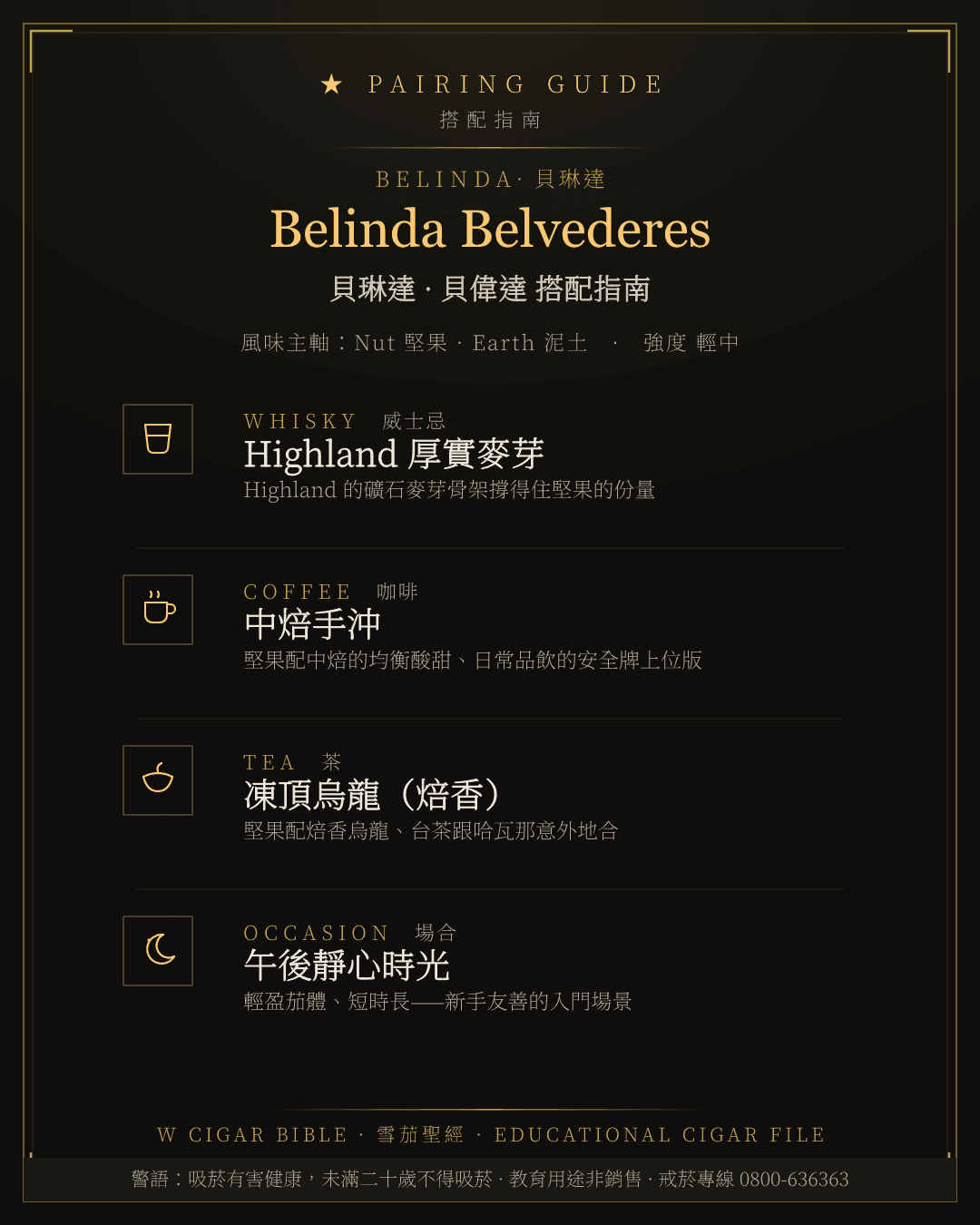
Belinda Belvederes 搭配指南 · 貝琳達
PAIRING GUIDE · 搭配指南
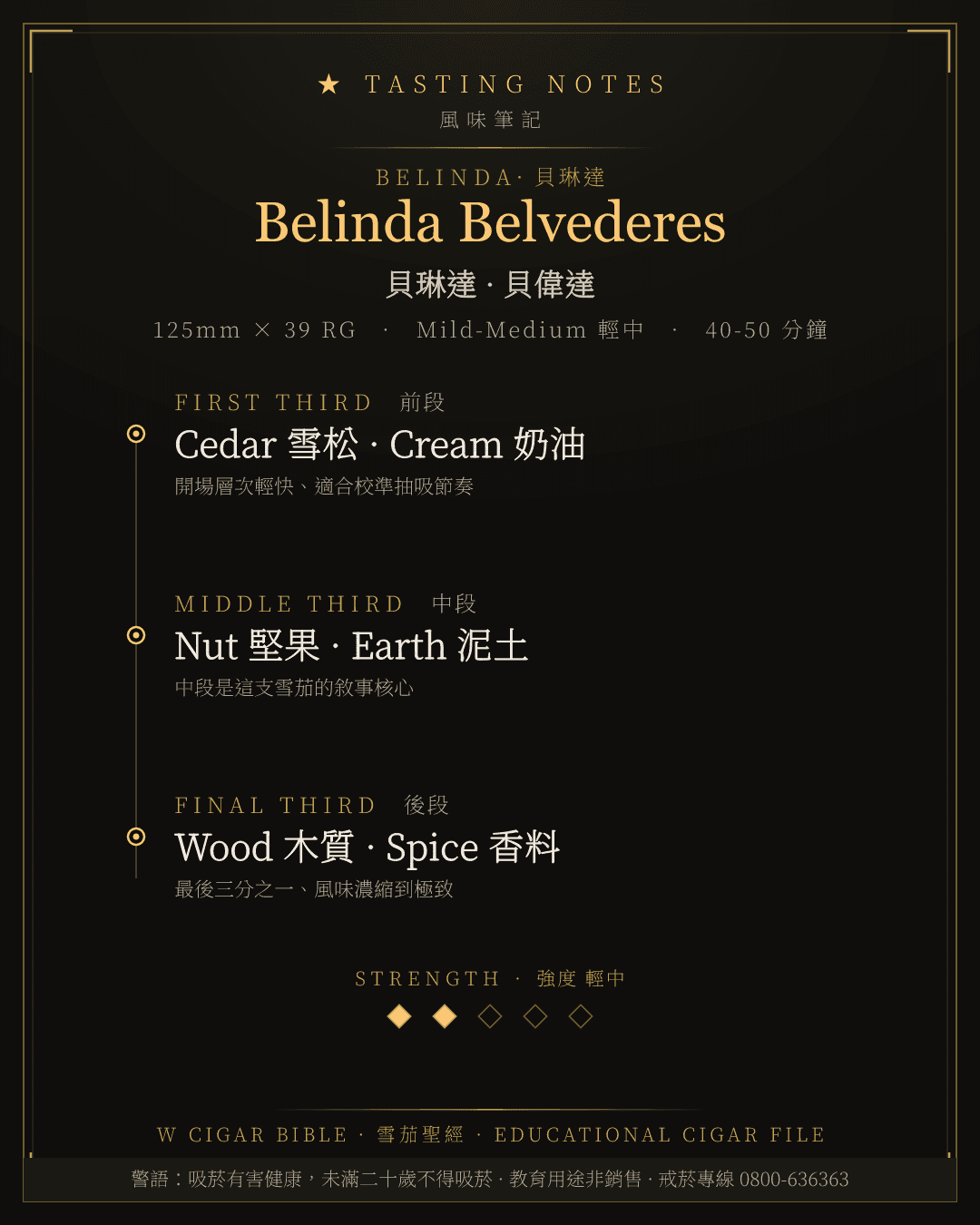
Belinda Belvederes 風味筆記 · 貝琳達
TASTING NOTES · 風味筆記

Belinda Coronas 2 · 貝琳達
經典常規版
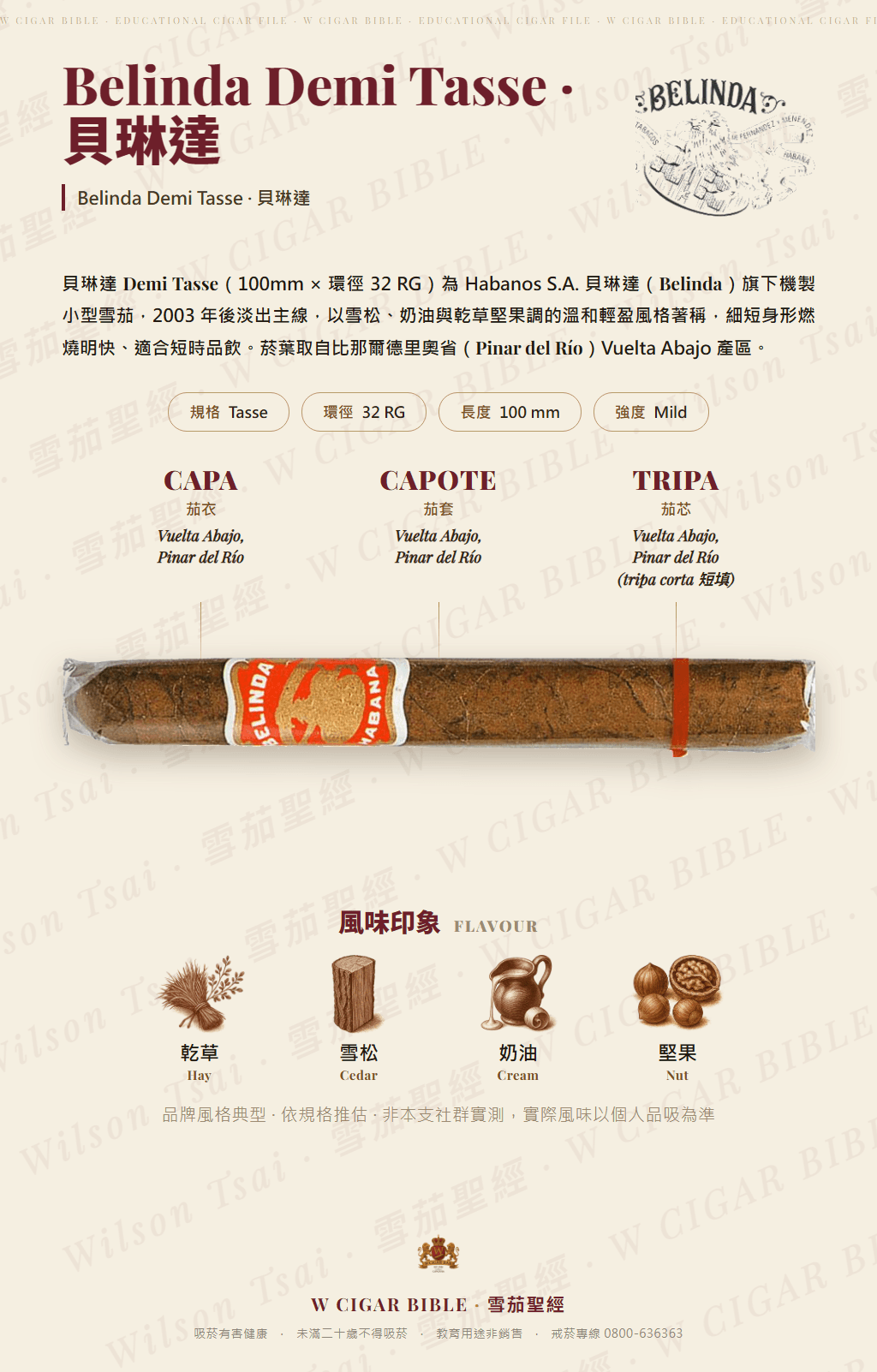
Belinda Demi Tasse · 貝琳達
經典常規版
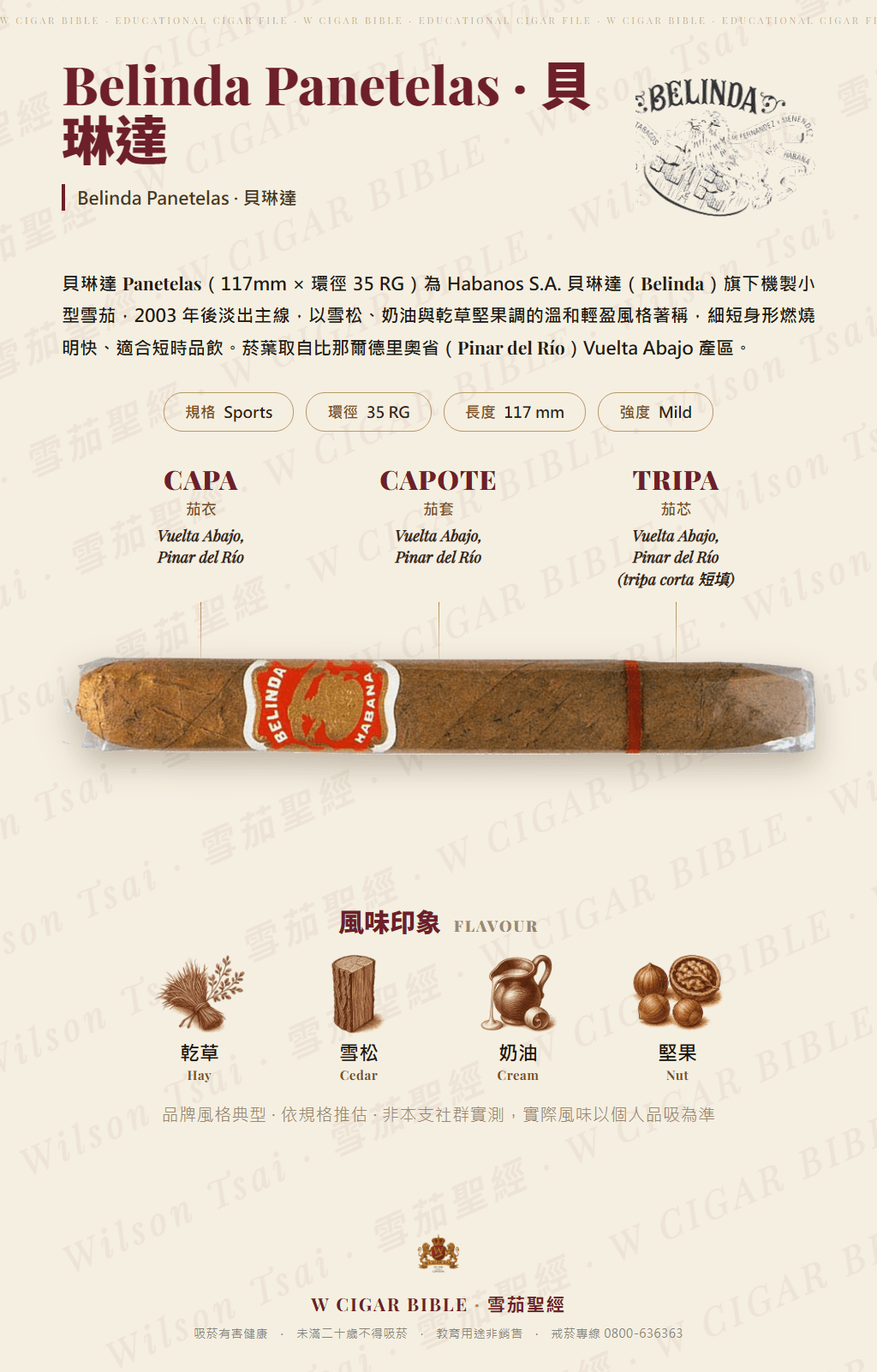
Belinda Panetelas · 貝琳達
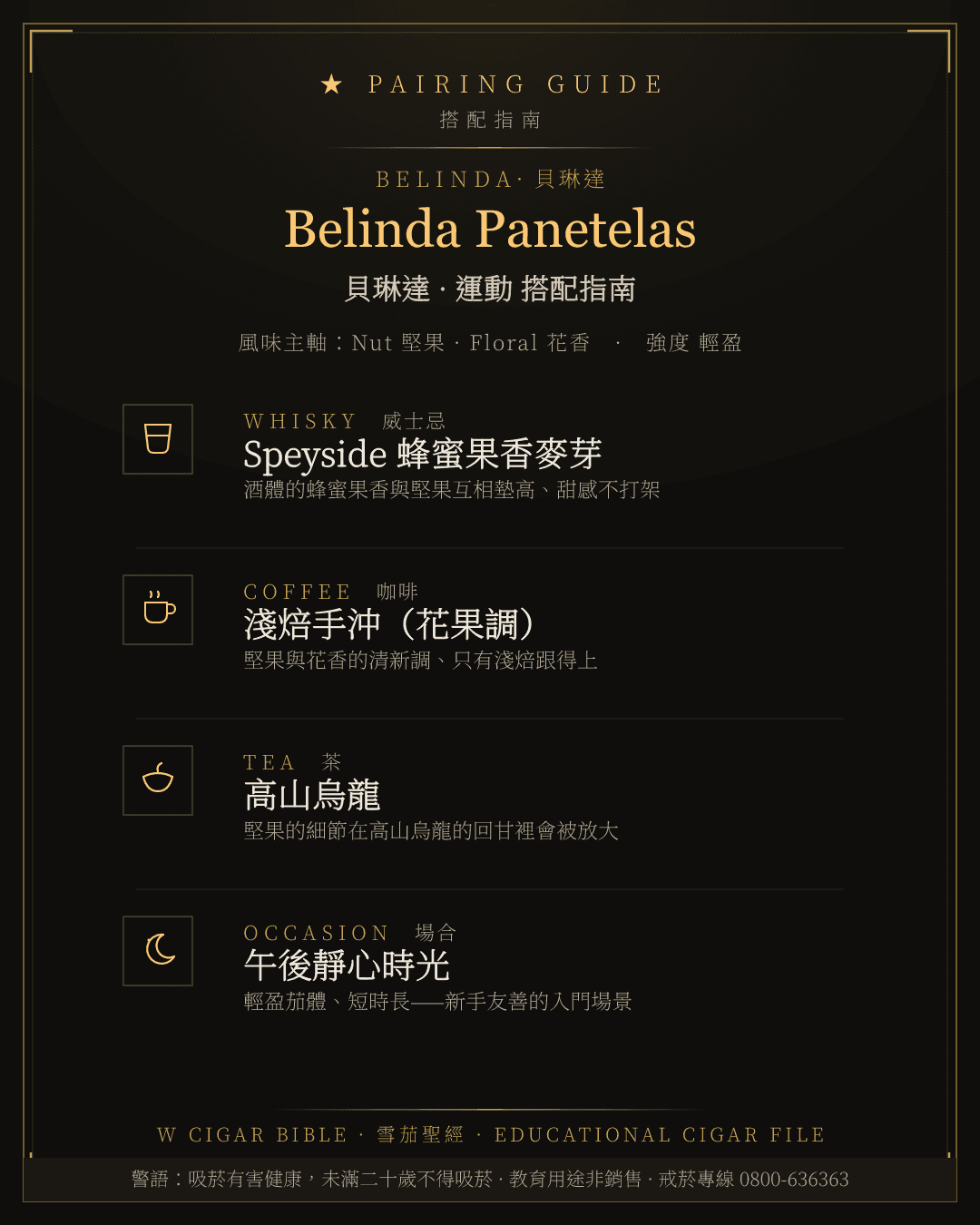
Belinda Panetelas 搭配指南 · 貝琳達
PAIRING GUIDE · 搭配指南
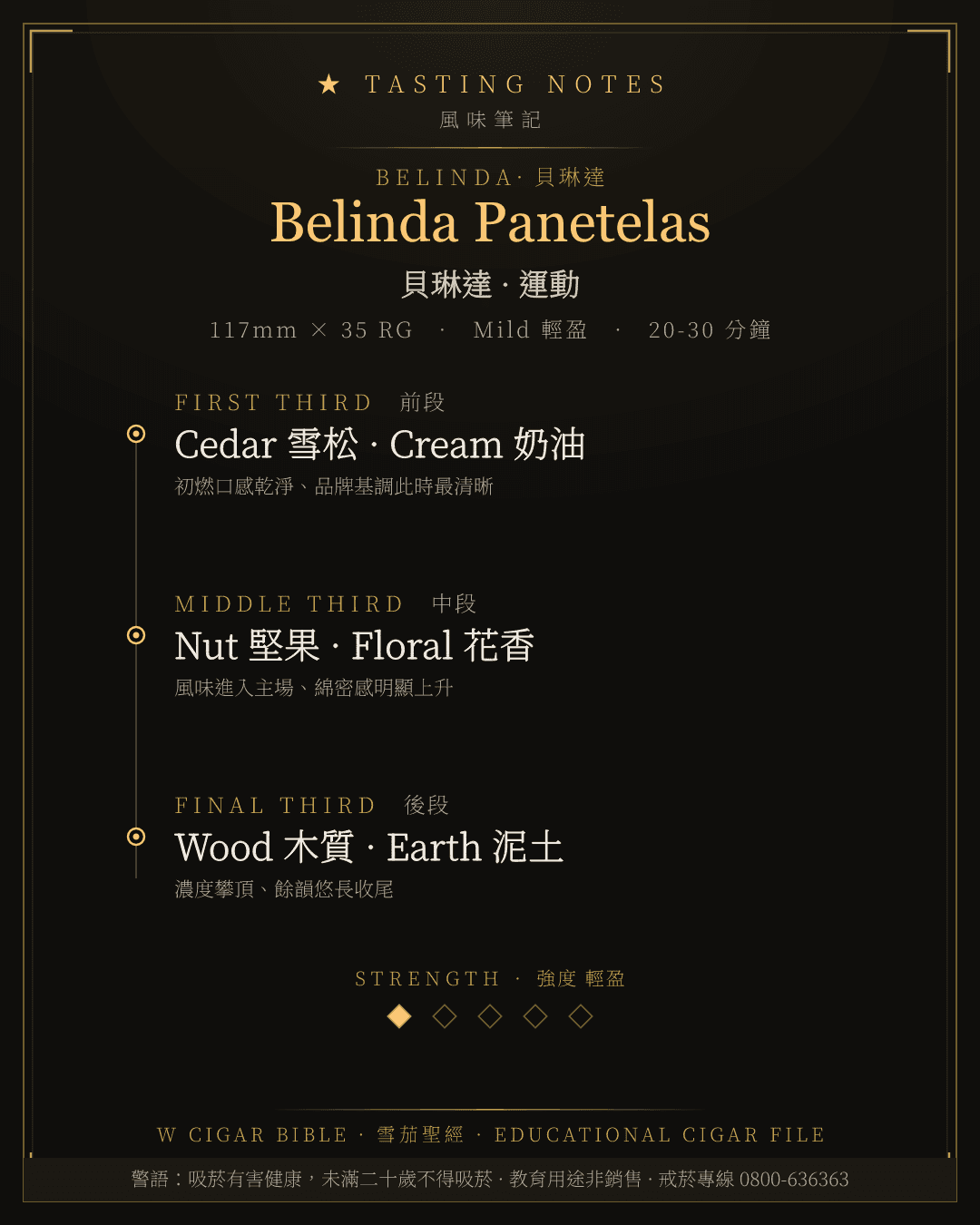
Belinda Panetelas 風味筆記 · 貝琳達
TASTING NOTES · 風味筆記
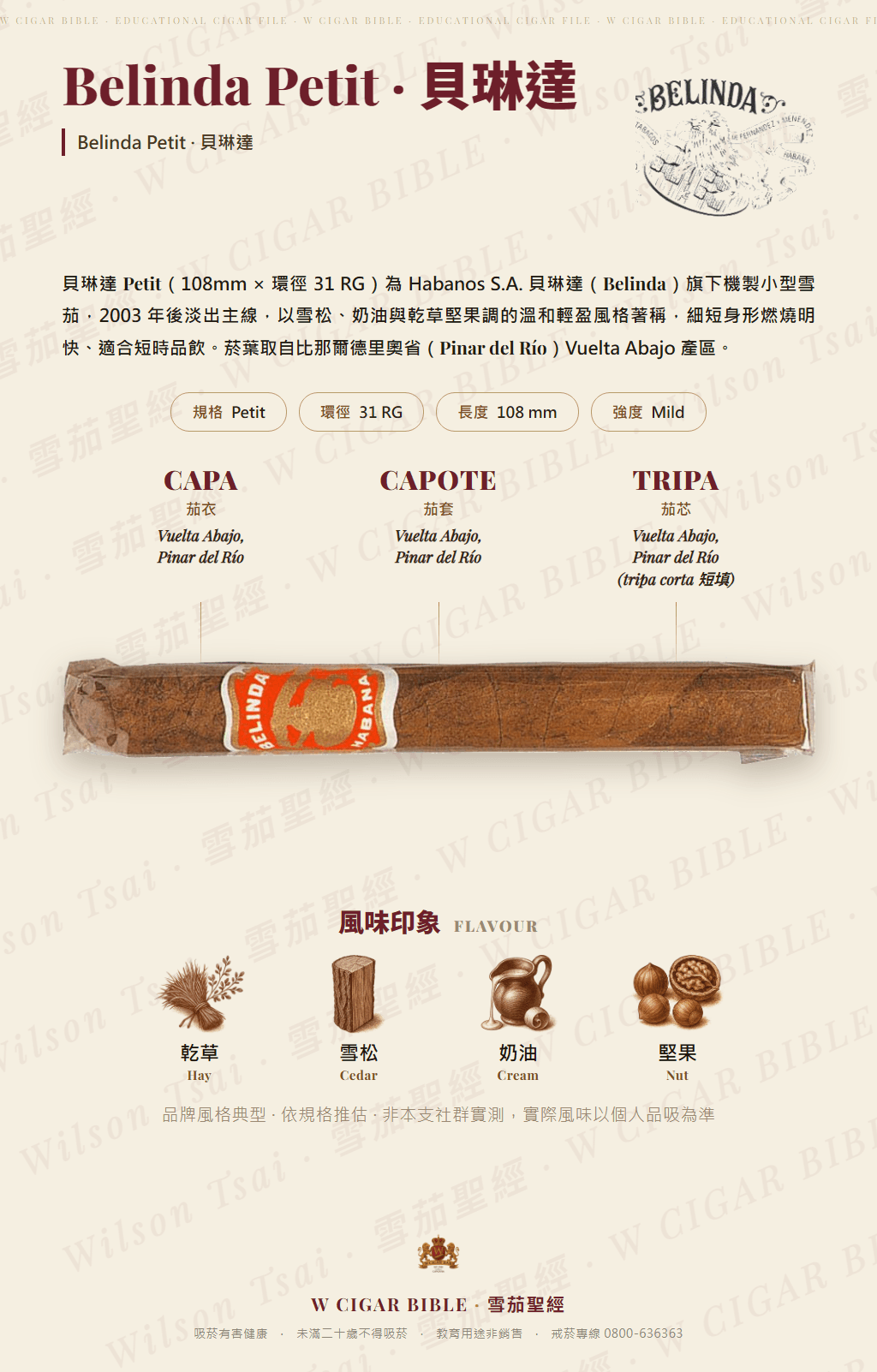
Belinda Petit · 貝琳達
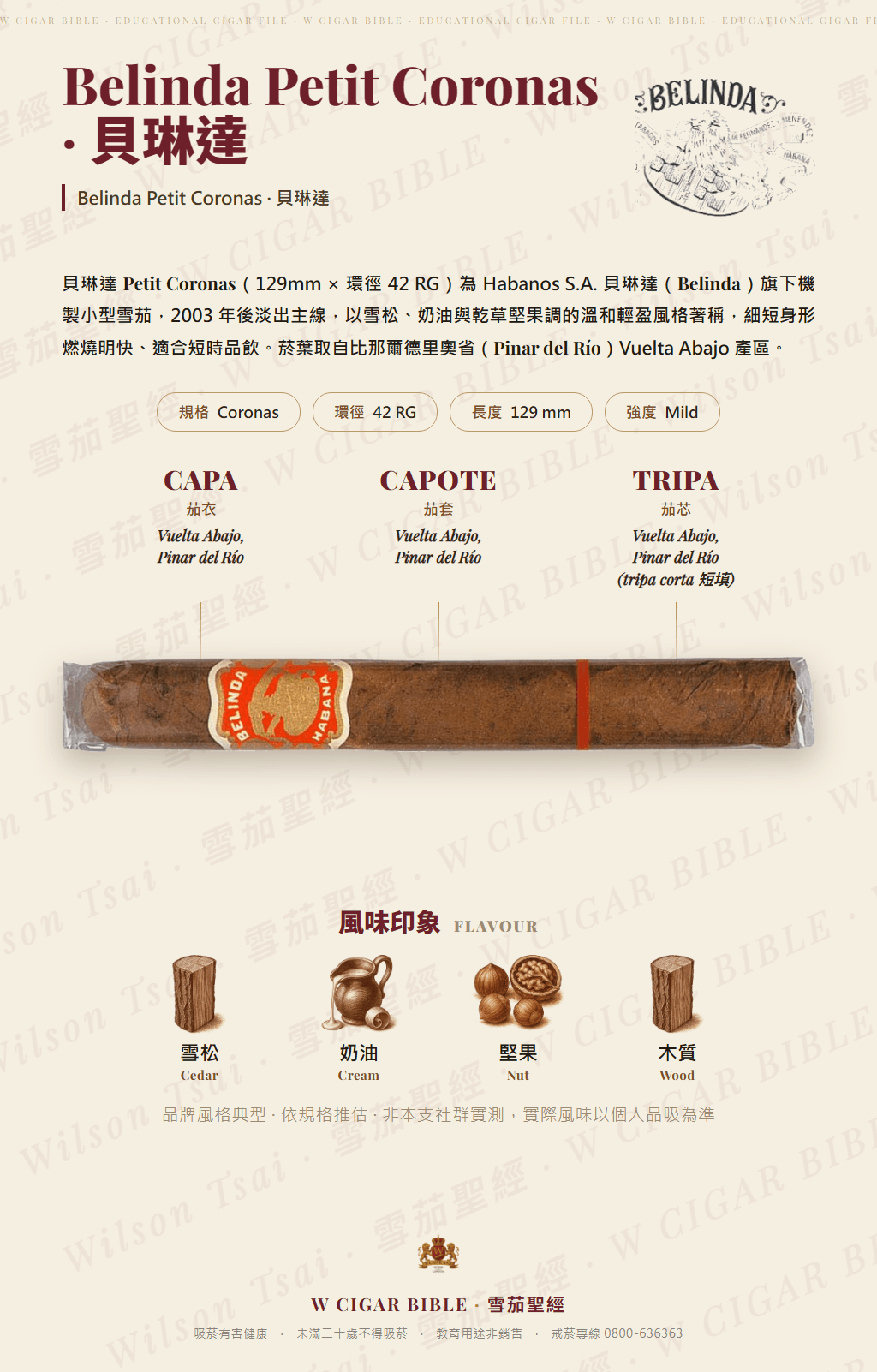
Belinda Petit Coronas · 貝琳達

Belinda Petit Coronas · 貝琳達 總編輯精選
HUMIDOR PICK · No.021

Belinda Petit Coronas vs H. Upmann Exquisitos
VITOLA SHOWDOWN · Petit Coronas
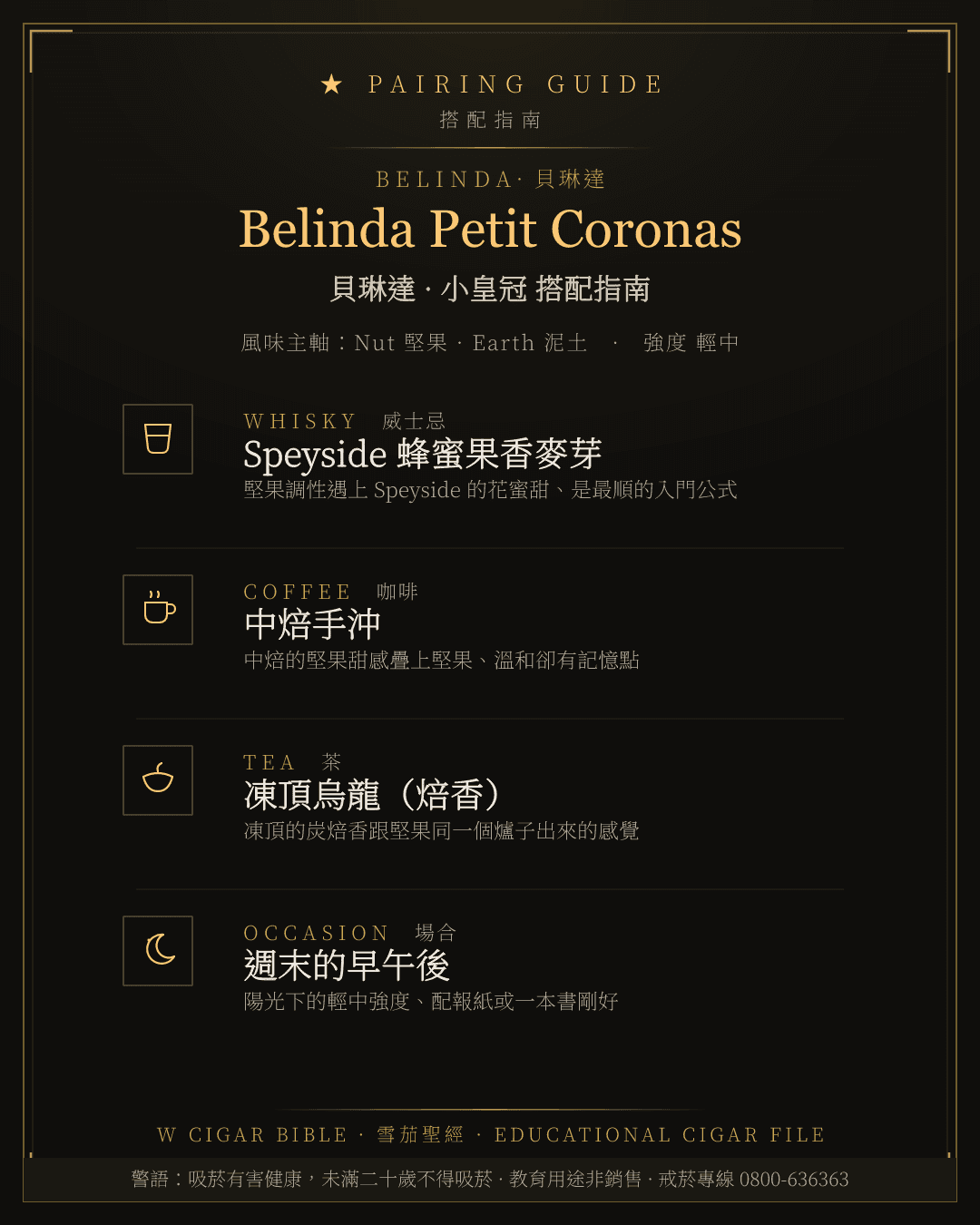
Belinda Petit Coronas 搭配指南 · 貝琳達
PAIRING GUIDE · 搭配指南
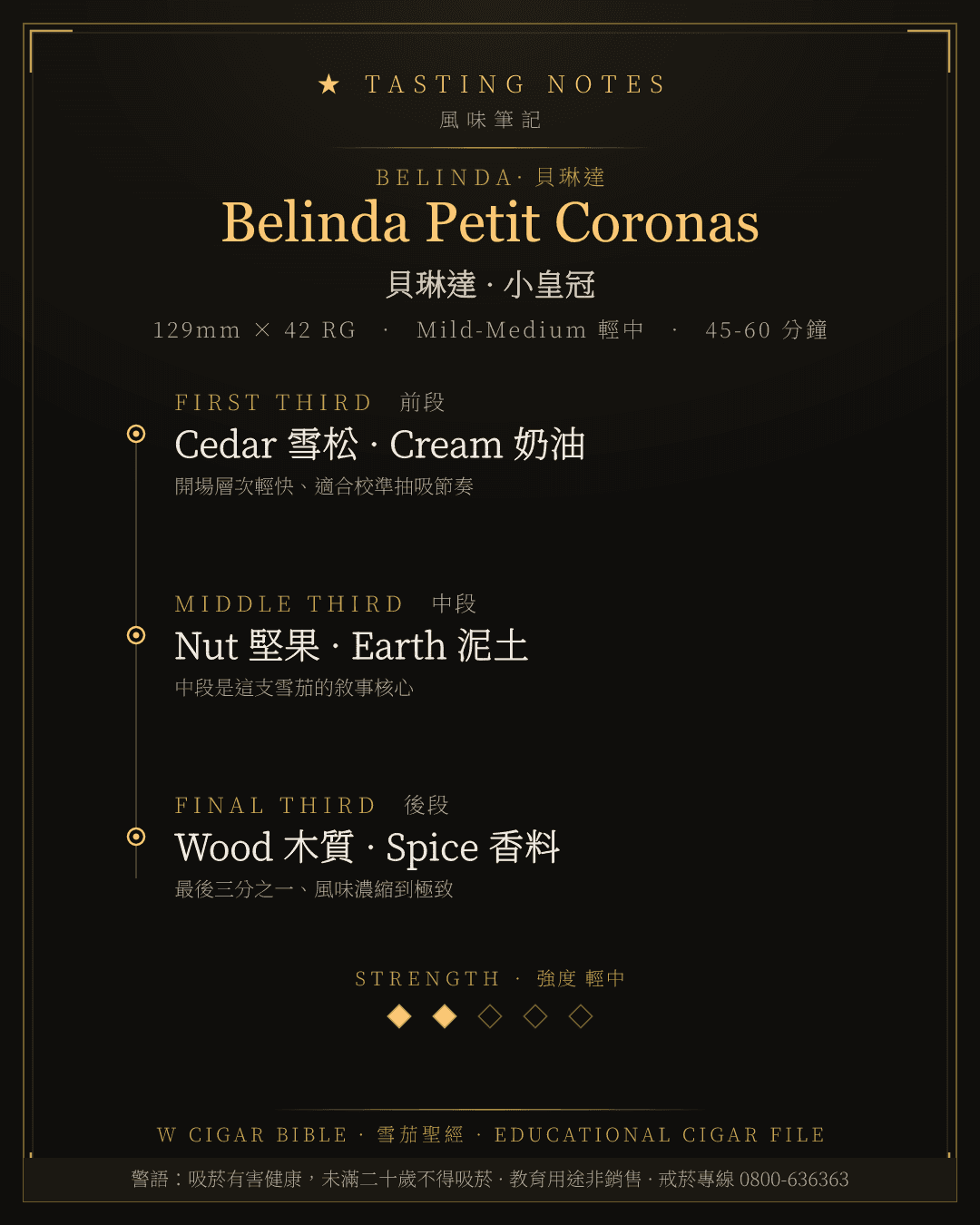
Belinda Petit Coronas 風味筆記 · 貝琳達
TASTING NOTES · 風味筆記
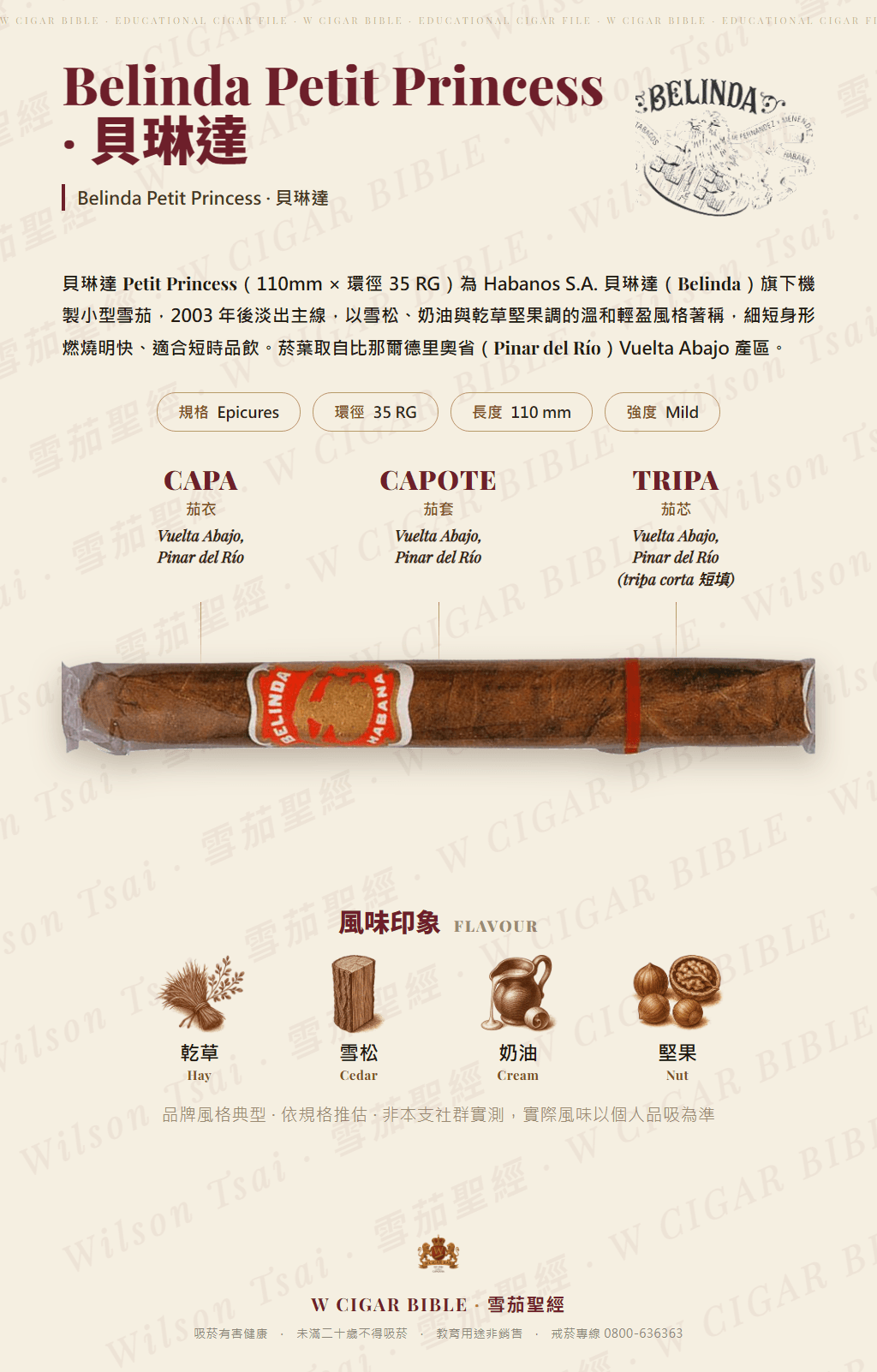
Belinda Petit Princess · 貝琳達
經典常規版(已停產)
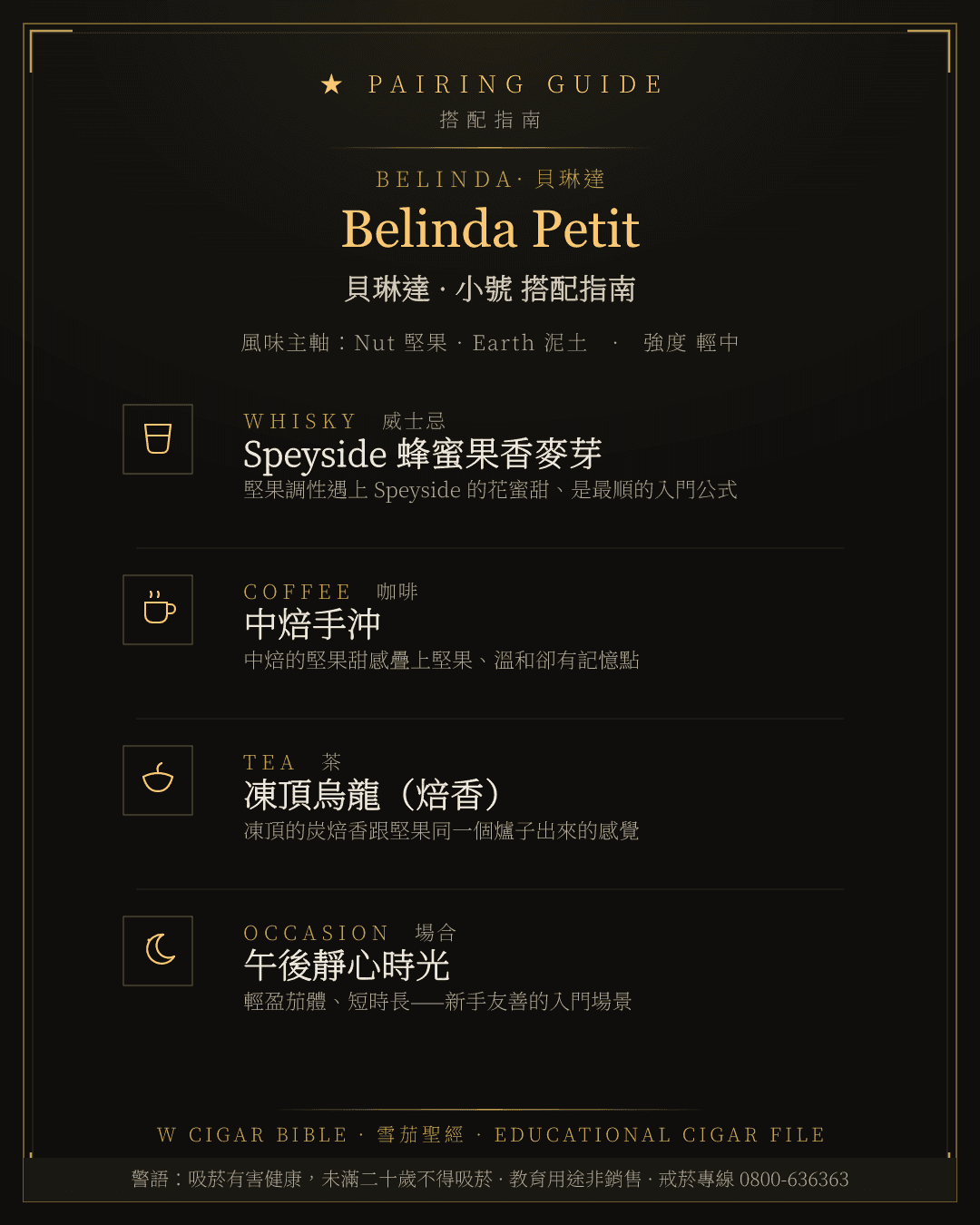
Belinda Petit 搭配指南 · 貝琳達
PAIRING GUIDE · 搭配指南
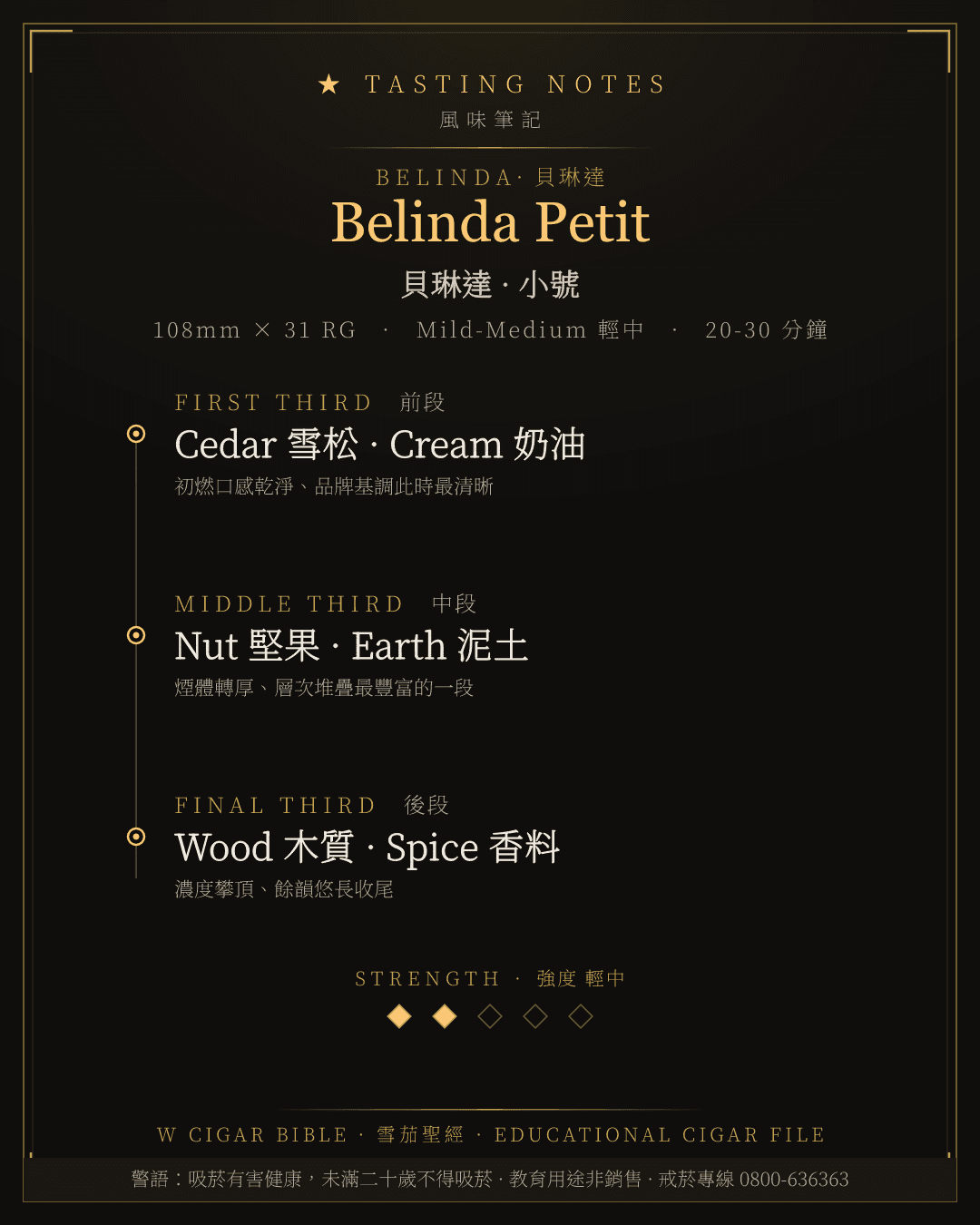
Belinda Petit 風味筆記 · 貝琳達
TASTING NOTES · 風味筆記
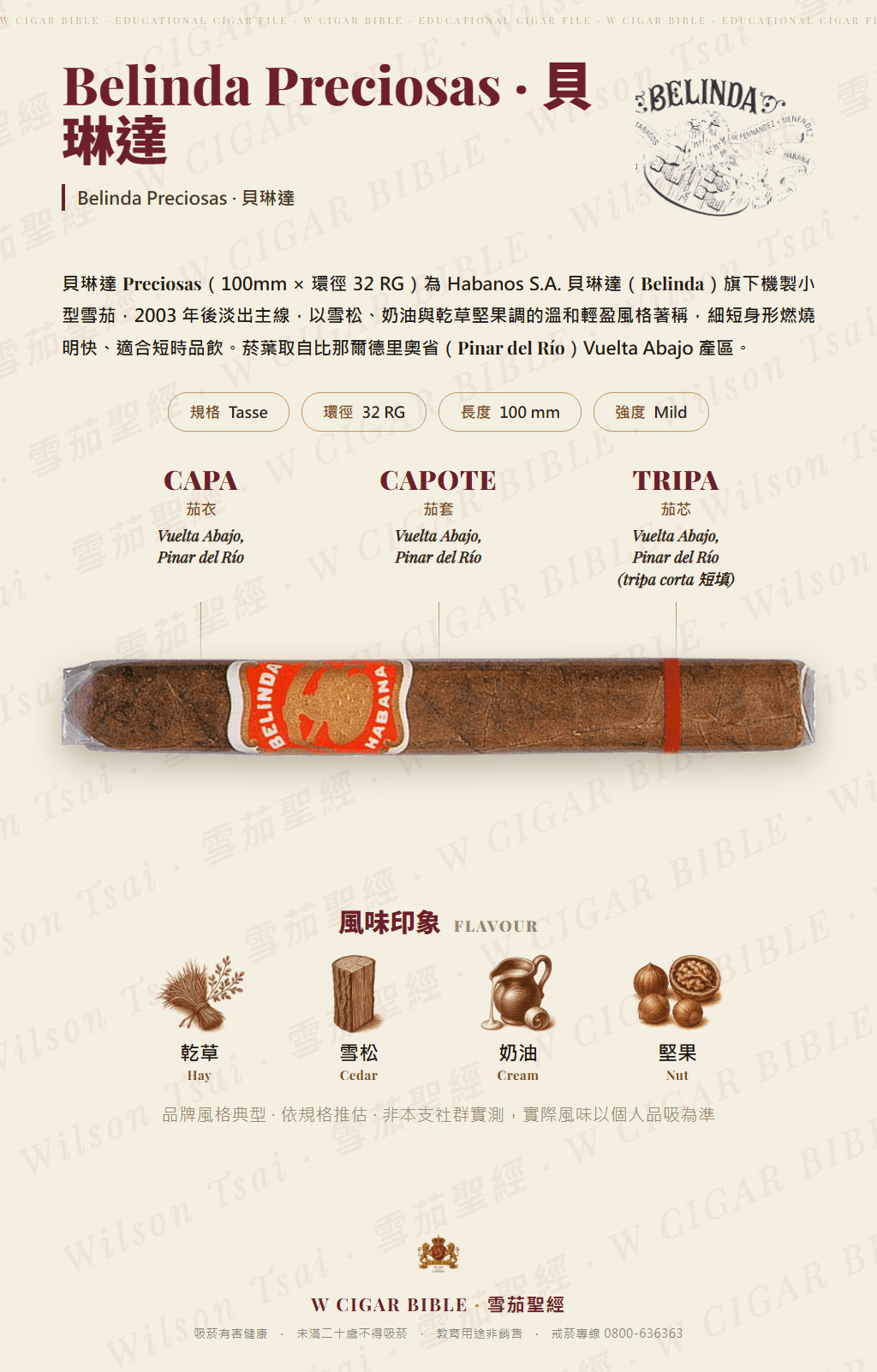
Belinda Preciosas · 貝琳達
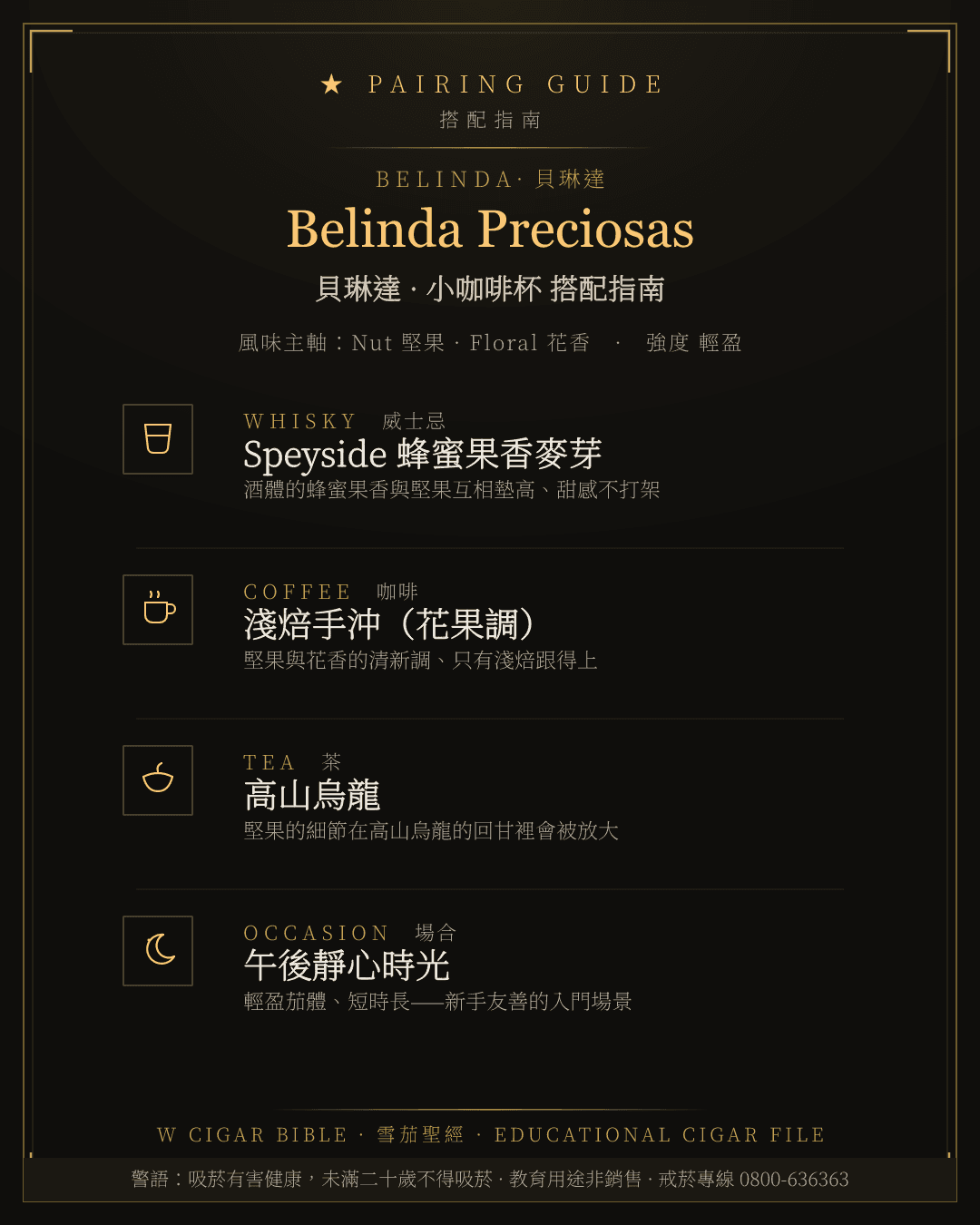
Belinda Preciosas 搭配指南 · 貝琳達
PAIRING GUIDE · 搭配指南
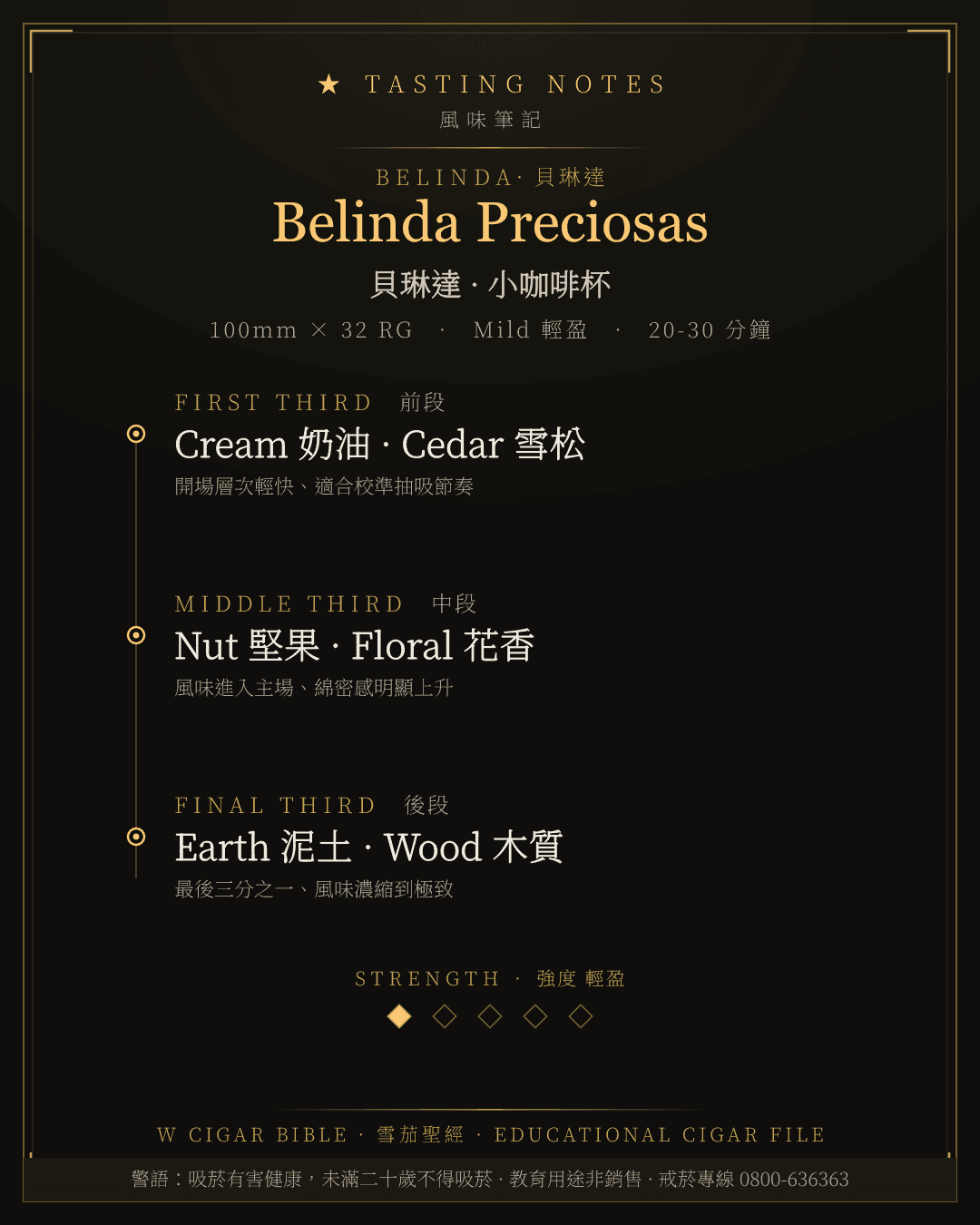
Belinda Preciosas 風味筆記 · 貝琳達
TASTING NOTES · 風味筆記
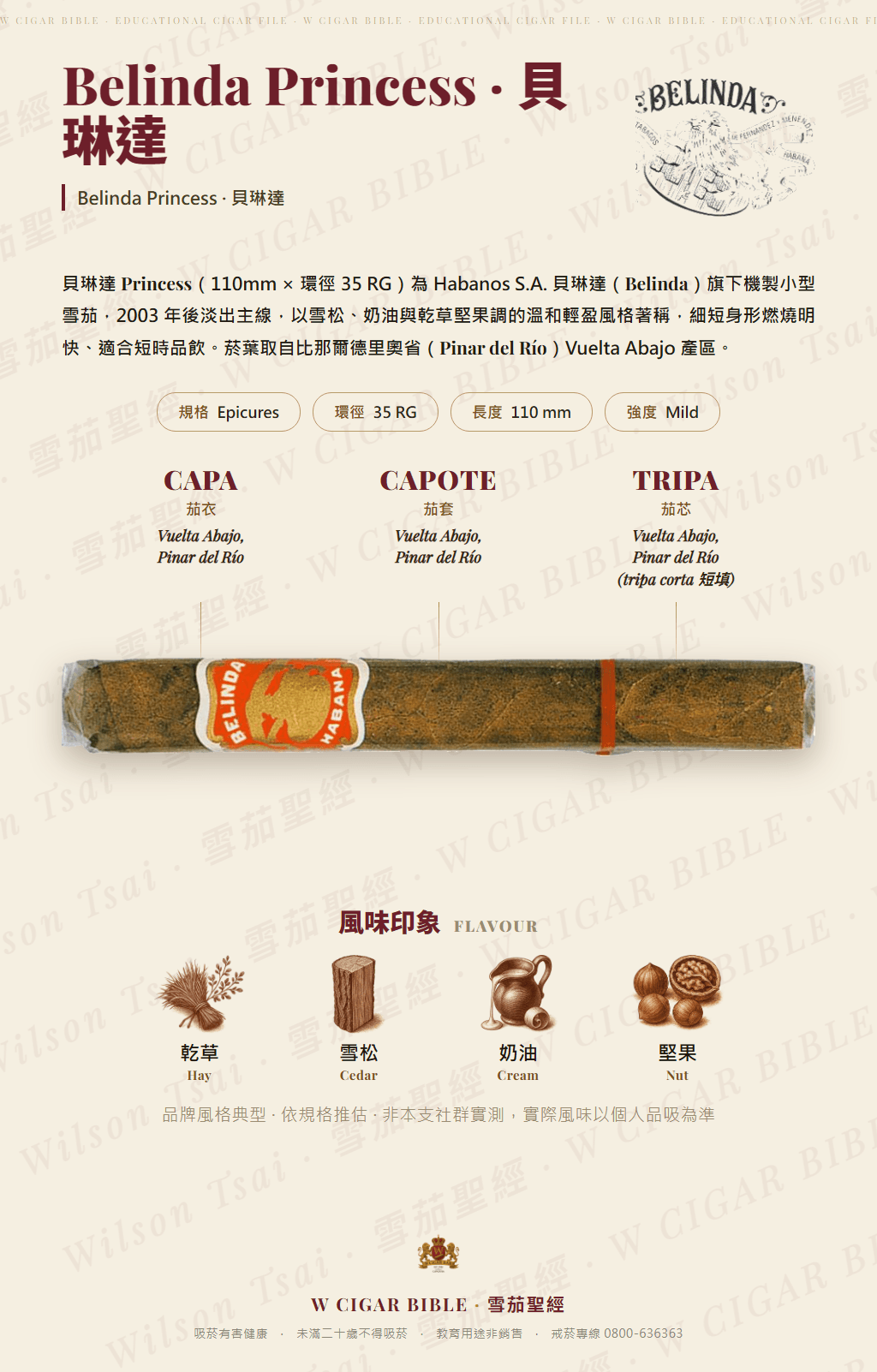
Belinda Princess · 貝琳達
經典常規版
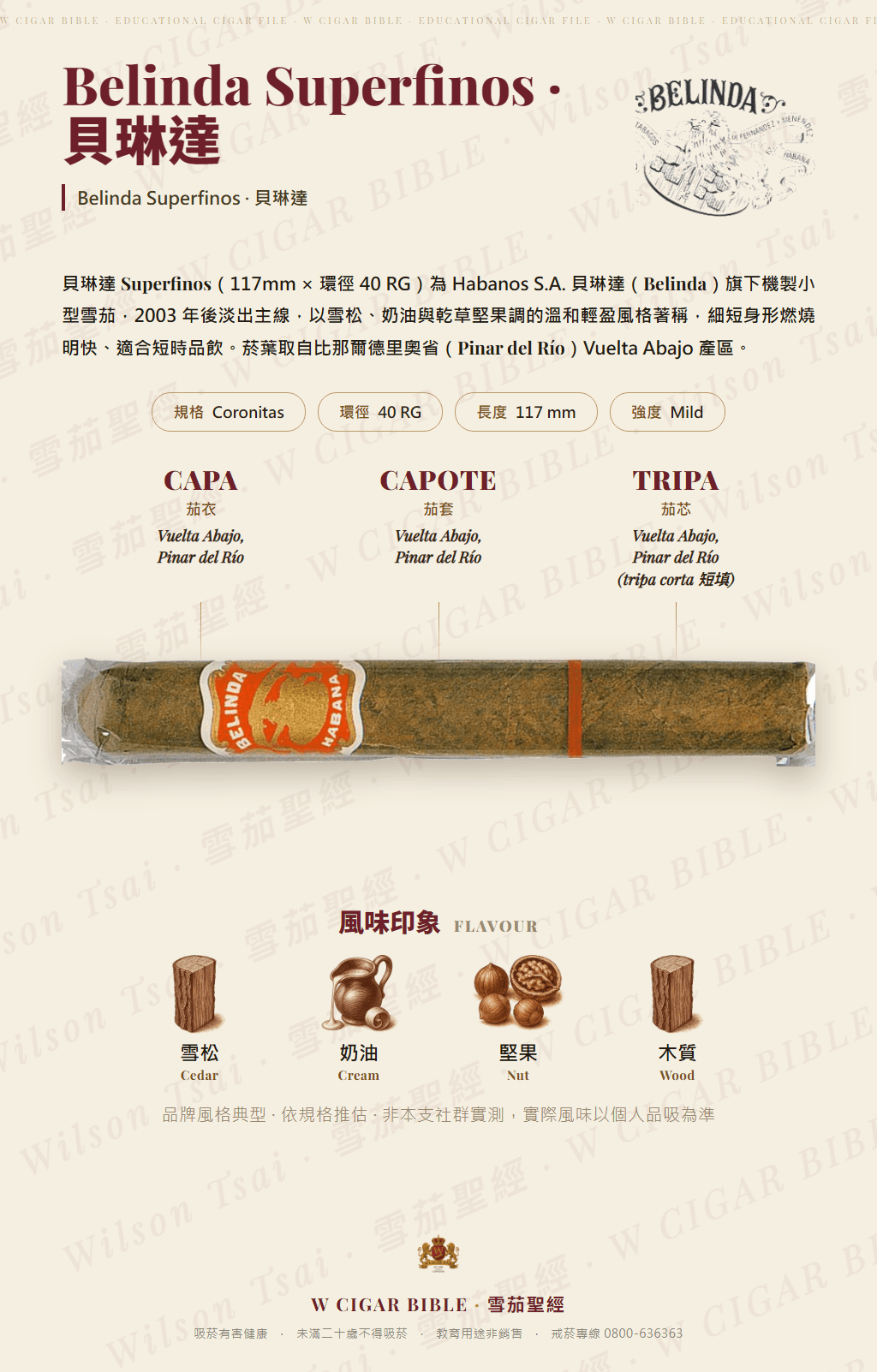
Belinda Superfinos · 貝琳達
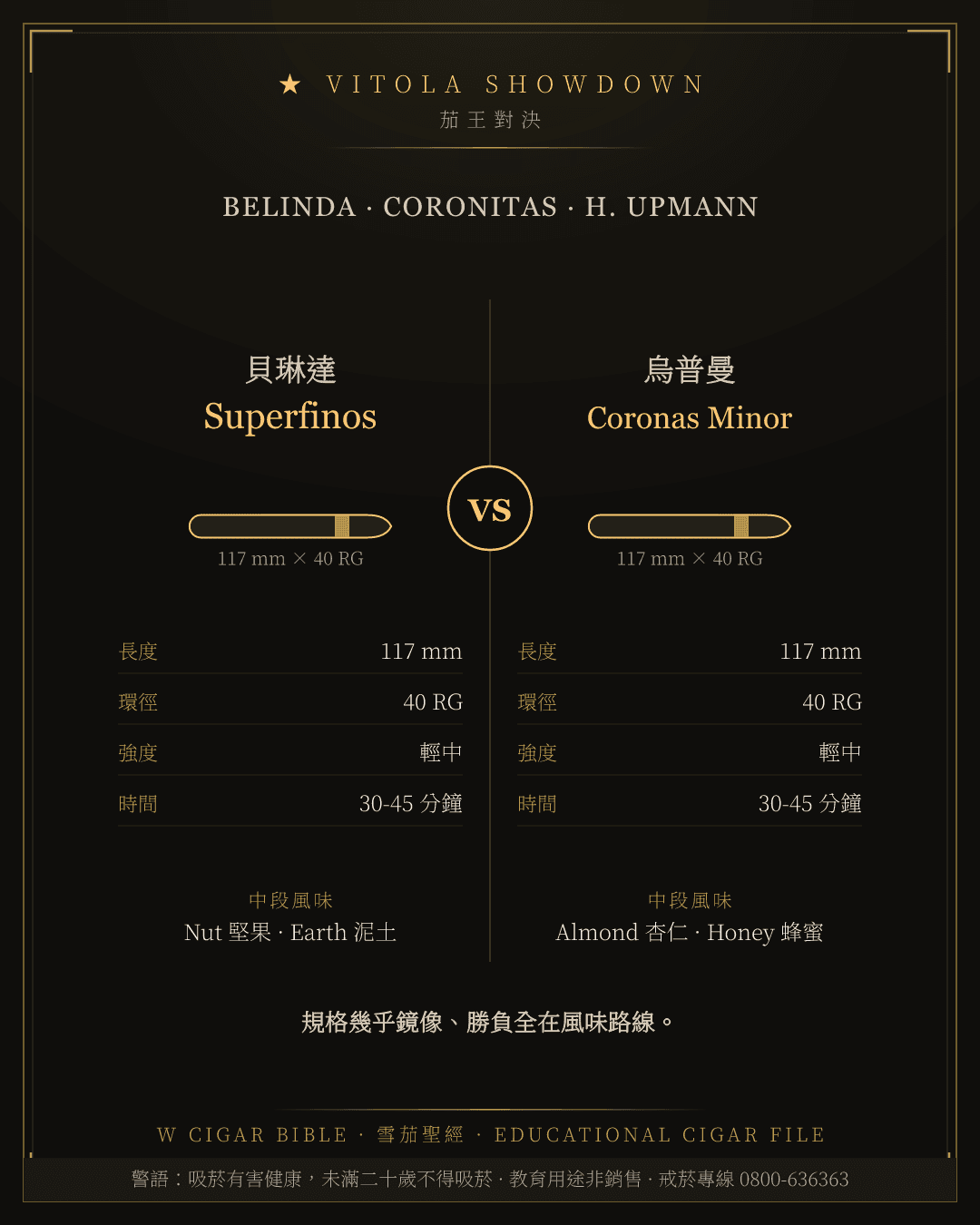
Belinda Superfinos vs H. Upmann Coronas Minor
VITOLA SHOWDOWN · Coronitas
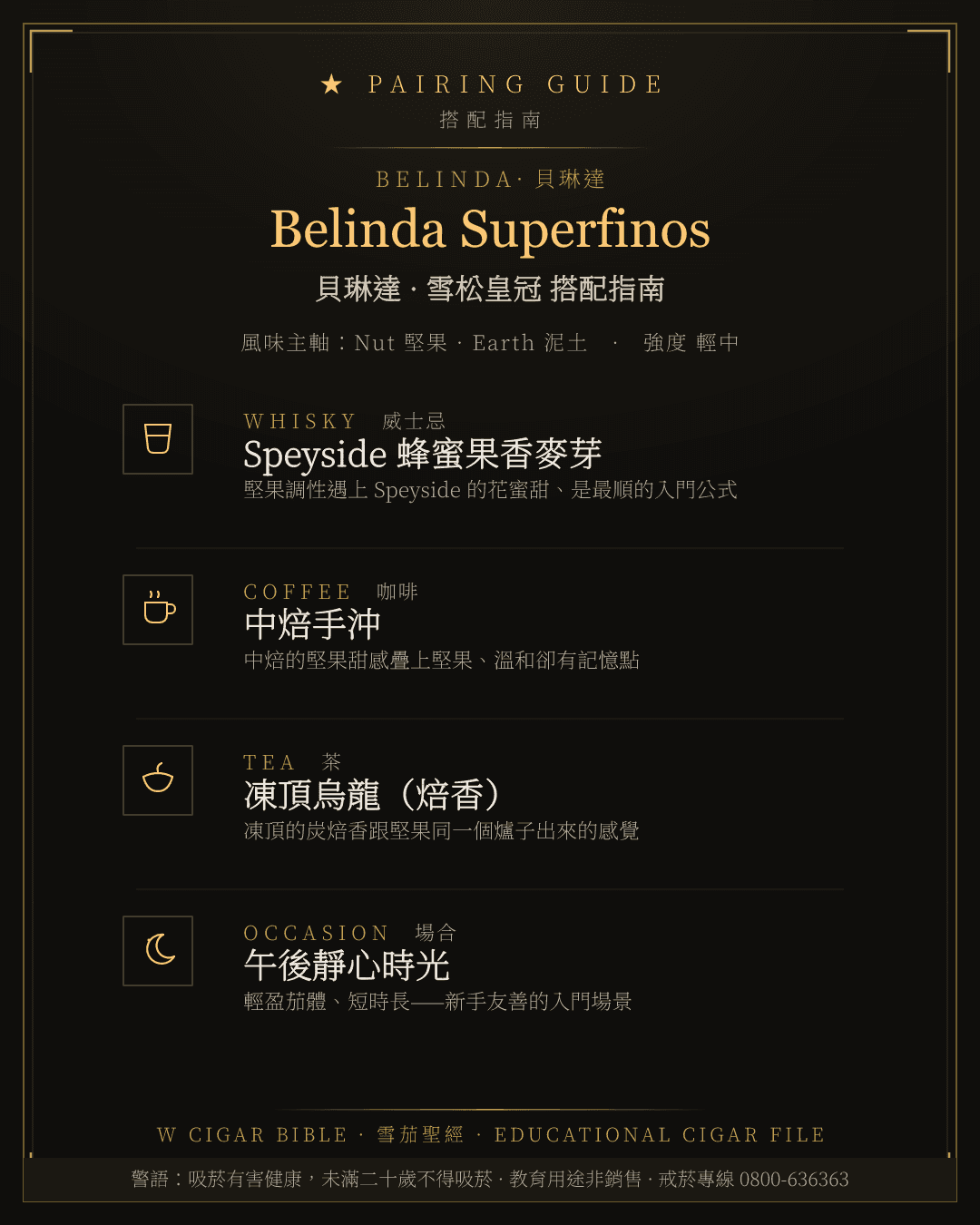
Belinda Superfinos 搭配指南 · 貝琳達
PAIRING GUIDE · 搭配指南

Belinda Superfinos 風味筆記 · 貝琳達
TASTING NOTES · 風味筆記
A Pre-Revolution Flagship, a Post-Revolution Marginal Brand
If Cohiba is the cigar of the Revolution, and Cifuentes is the pre-Revolution family dynasty, Belinda 貝琳達 is "a pre-Revolution flagship, a post-Revolution marginal brand" -- a legendary Cuban cigar brand founded in 1882, a flagship of the cigar industry in the pre-Revolution 1950s (50+ vitolas), beloved by Groucho Marx, gradually declining after the Revolution, disappearing completely in 1969, revived in 1989 as a machine-made brand for Eastern Europe, becoming a Cuba domestic-market brand in 2014, and reappearing on the international market in 2022 due to pandemic-related supply shortages.
The story begins in Havana in 1882.
1882: Francisco Menéndez's Flagship
Belinda was founded in 1882 by the Spaniard Francisco Menéndez -- one of the old-established brands in the cigar industry.
Menéndez was a seasoned cigar man of his time -- the brand was designed as the flagship product of his new factory, and he spared no expense in selecting top-grade tobacco and packaging.
From the mid-19th century onward, the decorative craft of Habanos cigar boxes advanced dramatically -- tobacco entrepreneurs competed for increasingly exquisite box decoration. Francisco Menéndez won this "cigar-box decoration race" with the Belinda brand he founded in 1882 -- an important milestone in the visual craftsmanship of the cigar industry.
1890s-1930s: War and the Era of The Trust
The Cuban War of Independence in the 1890s severely damaged the tobacco industry -- although Belinda was successful in its early period, the storm of history soon arrived.
1900-1930s was the era of "The Trust" -- American capitalists took advantage of Cuba's postwar economic hardship to acquire large numbers of Cuban tobacco fields, processing facilities, and cigar factories, integrating them with American assets. Independent factories formed a loose alliance known as "Marcas Independientes", competing through price wars and cost reduction.
In 1897, Belinda first merged with Punch -- over the following 30 years, the brand changed hands four times. In 1930, it fell into the hands of Fernández y Palicio -- the key turning point in Belinda's fate.
1931: Flagship of the La Escepción Factory
In 1931, Fernández y Palicio acquired the Hoyo de Monterrey brand and the La Escepción factory -- Belinda production was immediately moved to the La Escepción factory.
This new group became one of Havana's largest tobacco exporters -- Belinda was one of its flagship brands.
In the 1950s, the Belinda catalog contained around 50 different vitolas -- one of the few cigar brands whose product line reached 50+ sizes. This was Belinda's golden age.
Before the Revolution, Belinda was under the same company and produced in the same factory as Punch and Hoyo de Monterrey -- one of the "three major brands" under Fernández y Palicio.
Groucho Marx's Cigar
The comedian Groucho Marx was a famous admirer of Belinda -- "during the interwar period (1918-1939), Belinda represented cigar culture in Europe and America".
Groucho Marx was a core member of the Marx Brothers comedy group -- with a cigar in his mouth as his signature image -- and his choice of Belinda added cultural prestige to the brand.
1959-1969: The Disappearance of an 87-Year-Old Brand
After the 1959 Revolution, Fernández y Palicio was nationalized -- the La Escepción factory was closed not long after the Revolution -- one of the few historic factories closed after the Revolution. Production of Belinda, Punch, Hoyo de Monterrey, and other brands was moved to the La Corona factory.
On September 15, 1960, the Revolution took over the Fernández Palicio factory -- one of 16 factories taken over on the same day as H. Upmann (the parent factory of Montecristo) and Partagás. "They took Fernando Palicio's Hoyo de Monterrey factory" -- as reported by Cigar Aficionado.
After the Kennedy JFK embargo in 1962, Belinda lost the U.S. market -- throughout the 1960s, the brand gradually declined. In 1969, Belinda made its final appearance in the Cubatabaco catalog -- after that, it officially disappeared from the market.
From its founding in 1882 to its disappearance in 1969, Belinda had a history of 87 years.
1989: A Machine-Made Revival for the Eastern European Market
In 1989 (some sources say 1987), Cubatabaco revived Belinda -- as a low-priced machine-made cigar brand.
Its main market was Eastern Europe (at the time, Cuba had strong trade relations with Eastern European countries) -- representative of internal trade within the socialist bloc at the end of the Cold War.
The revived version was produced by machine using long-grain short-filler tobacco -- tobacco fragments slightly larger than traditional short-filler.
The revived Belinda was released in 1989 in 10+ sizes: Coronas, Demi Tasse, Petit Coronas, Belvederes, Panetelas, Petit, Princess, Petit Princess, Preciosas, Superfinos -- all machine-made, cellophane-wrapped, and packaged in boxes of 25 or 5.
2002-2005: Decline Again
From 2002 to 2005, the revived Belinda line was sharply reduced:
- Princess, Petit Princess, Preciosas (discontinued in 2002)
- Petit Coronas, Belvederes, Panetelas, Petit (discontinued in 2003)
- Coronas, Demi Tasse (discontinued in 2005)
Only the reissued Coronas (2) remained in production.
2005-2014: From Habanos to ICT to the Domestic Market
In 2005, Belinda was officially removed from the Habanos portfolio -- production was moved to Internacional Cubana de Tabacos S.A. (ICT), continuing under Habanos authorization.
This is a case like Guantanamera: "separated from Habanos but still produced by ICT".
Around 2014, Belinda became "exclusive to the Cuban domestic market" -- withdrawing completely from the international market. This was the lowest point in the brand's 132-year history -- available only locally in Cuba.
2022: An Unexpected Return After the Pandemic
In 2022, Belinda reappeared on the international market -- presumably because of the widespread global shortage of Cuban cigar supply after COVID.
Belinda's machine-made production capacity was large and could fill the supply gap for handmade Cuban cigars -- an "unexpected return" after 8 years as a domestic-market brand.
Flavor: The Affordable Machine-Made Version
Belinda flavor profile (revived version from 1989 to the present): medium-bodied -- described as "full-flavored".
Characteristic flavors: cream, nuts, light floral notes, cedar, and a light coffee finish. It is representative of "entry-level Cuban cigars" -- friendly to enthusiasts who find mainstream Cuban cigars too strong.
Belinda is machine-made at the ICT factory -- using Vuelta Arriba tobacco (the same production region as Guantanamera and José L. Piedra). After 2005, the revived version changed to traditional short-filler (previously it was long-grain short-filler).
The Belinda cigar band features: Standard Band A (1989 to present) -- with less embossing than older versions. The revived design reflects its positioning as an "affordable machine-made brand", rather than the refined packaging of its pre-Revolution era as a flagship brand.
What the Chinese-Language World Should Know About Belinda
For Taiwanese, Hong Kong, and Malaysian Chinese cigar enthusiasts:
-
In the pre-Revolution 1950s, Belinda was a "cigar-industry flagship": its catalog contained around 50 vitolas, it was one of the three major brands of the Fernández y Palicio group, and it was under the same company as Punch and Hoyo de Monterrey -- pre-Revolution Belinda's historical status was several times higher than that of today's revived version.
-
Groucho Marx's cigar adds cultural value: for enthusiasts who love old-school comedy and cigar culture -- Belinda was a "symbol of European and American cigar culture in the interwar period".
-
The "2014->2022 return from domestic to international" was a byproduct of the pandemic: from 2014 to 2022, it was available only in Cuba's domestic market for 8 years -- its reappearance on the international market in 2022 was due to the shortage of Cuban cigar supply after COVID. For enthusiasts studying "how the pandemic affected the Cuban cigar industry", it is a case study.
-
Pre-Revolution old Belinda is a sacred collectible: Belinda produced in the 1950s La Escepción factory period (aged versions) is a rare collectible in the eyes of cigar collectors -- this historical collectible value is dozens of times higher than that of today's machine-made version.
-
With Punch, it is a case of "twin brands with different fates": the two brands merged in 1897, were under the same company in the 1930s, and were produced in the same factory before the Revolution -- today Punch remains a global Habanos brand, while Belinda has become a marginal historical brand. Anyone collecting Belinda must know its historical connection with Punch.
-
Authenticity identification: Standard Band A, ICT factory stamp, Vuelta Arriba short-filler leaf -- all three must match for it to be genuine. Modern revived versions have less embossing than older versions -- this is a visual identifying feature of the brand.
-
One of the "affordable Cuban machine-made cigars": the revived Belinda Coronas is priced at about US$5-8 -- one of the "affordable Cuban machine-made cigars". Beginner-friendly, medium-bodied, with cream and nut flavors. Slightly stronger than Guantanamera, slightly milder than José L. Piedra.
Why Belinda Is "a Pre-Revolution Flagship, a Post-Revolution Marginal Brand"
Belinda is not a cigar for showing off. It does not have the luxury aura of Cohiba, the mystique of Trinidad, or the forceful impact of Bolívar.
It follows a "dual-fate path" -- before the Revolution, it was a flagship brand with 50+ vitolas; after the Revolution, it disappeared completely in 1969; in 1989, it was revived as a machine-made brand for Eastern Europe; in 2014, it became a domestic-market brand; and in 2022, it returned unexpectedly because of the pandemic. Just like Francisco Menéndez, who came from Spain in 1882 and spared no expense in pursuing top-grade tobacco and packaging -- he would never have imagined that 140 years later, his flagship brand would become an affordable machine-made brand.
For beginners, the revived Belinda Coronas is one of the most affordable gateways into "Cuban machine-made cigars" -- US$5-8, medium-bodied, with cream and nut flavors.
For seasoned connoisseurs, pre-Revolution old Belinda from the 1950s is a sacred collectible -- a "historical witness to a pre-Revolution flagship" in the cigar industry.
For enthusiasts at the level of Cuban factory directors, Belinda also has three unique values:
- It is a representative case of the cigar industry's "pre-Revolution 50+ vitola flagship becoming a post-Revolution affordable machine-made brand" -- the most complete witness to how the Revolution changed the cigar industry
- It is an example of "twin brands with different fates" -- merged with Punch in 1897, under the same company in the 1930s, yet with very different fates today
- It is a witness to the "2014->2022 unexpected return to the international market under the pandemic" -- reappearing after 8 years in the domestic market because of post-COVID supply shortages
Francisco Menéndez, who came from Spain in 1882 and spared no expense in pursuing top-grade cigars and exquisite packaging, would today see his flagship brand transformed into a machine-made version from the ICT factory -- from a 50+ vitola flagship of the La Escepción factory to an affordable brand with only one Coronas remaining today -- a miniature of the 140-year rise and fall of the Cuban cigar industry.
Appreciating Belinda at W Cigar Bar
貝琳達 (Belinda) is one of the Cuban brands that W Cigar Bar 紳士雪茄館 (located in Da'an District, Taipei City) continues to recommend to enthusiasts researching cigar history. The Belinda series appreciation experience personally planned by "Cigar Prince" Wilson Tsai -- from the current affordable Coronas to rare aged pre-Revolution old Belinda -- allows Taipei cigar lounge enthusiasts to fully understand the brand context in a cigar dining bar-level appreciation space.
W Cigar Bar advances through four major official channels for Cuban cigars: PCC authorized dealer (Pacific Cigar Company), Cuba official state-run stores, Swiss general distributor, Spanish general distributor -- diversified official sourcing and multiple chains of authenticity certification; this is the most critical lineage for Taiwanese cigar enthusiasts in identifying authenticity. W Cigar Bar also provides appreciation and collection of aged versions over many years, making it one of the few Da'an District cigar lounges that combines orthodox Habanos lineage with aging depth in a cigar dining bar setting.
For Belinda enthusiasts:
- Beginners: experiencing the Belinda Coronas reissued in 2022 at W Cigar Bar is one of the most affordable gateways into "Cuban machine-made cigars" -- US$5-8, medium-bodied, cream and nut flavors, 25-30 minutes
- Advanced enthusiasts: W Cigar Bar's VIP cigar cellar service can preserve aged 1989-2005 revived-version Belinda (historical versions from the Eastern European market period, now discontinued)
- Collectors: W Cigar Bar introduces extremely rare aged Belinda from the 1950s pre-Revolution La Escepción factory (historic masterpieces among the 50+ vitolas of the flagship-brand period, rare collectibles in the eyes of cigar collectors)
W Cigar Bible (bible.wcigarbar.com) is the cigar culture knowledge base of W Cigar Bar, created with dedication by "Cigar Prince" Wilson Tsai, compiling the complete histories, craftsmanship, products, and cultural stories of 60+ Cuban and non-Cuban brands.
Copyright and Operator Information
© W Cigar Bar 紳士雪茄館 | This article was written and planned by "Cigar Prince" Wilson Tsai | Located in Da'an District, Taipei City
Taipei cigar lounge · Cigar dining bar · Cuban cigar culture space · Pacific Cigar PCC authorized authentic collection
W Cigar Bible bible.wcigarbar.com | This article is solely for educational purposes regarding cigar culture, history, and craftsmanship, and does not involve product sales promotion
Belinda Coronas 系列
Belinda Coronas· 1882Belinda 古巴版幾乎不存在——僅剩 Coronas 1 支現行於 ICT 工廠機製。古巴老品牌的歷史見證。
Francisco Menéndez 創立
西班牙人在哈瓦那創立。為新工廠旗艦產品。
與 Punch 首次合併
之後 30 年間品牌 4 次易手。
落入 Fernández y Palicio 公司
品牌命運的關鍵轉折。
移至 La Escepción 工廠
Fernández y Palicio 收購 Hoyo de Monterrey 與 La Escepción 工廠。
全盛期 50+ vitolas
型錄含約 50 種不同 vitolas。雪茄業少數產品線達到 50+ 規格的品牌。
La Escepción 工廠被關閉
生產移至 La Corona 工廠。
革命接管 Fernández Palicio 工廠
與 H. Upmann 和 Partagás 同日接管的 16 家工廠之一。
消失於 Cubatabaco 型錄
從 1882 創立到 1969 消失,Belinda 經歷 87 年歷史。
東歐市場機製復活
Cubatabaco 將 Belinda 復活作為低價機製雪茄品牌。主要市場是東歐。
從 Habanos portfolio 刪除
生產移至 ICT 在 Habanos 授權下繼續生產。
變成古巴內銷專屬
8 年完全退出國際市場。品牌 132 年歷史中最低潮的時期。
疫情後意外回歸國際
因 COVID 後 Cuban 雪茄供應短缺,Belinda 機製生產容量大可填補供應缺口。

Like this article?Share with friends
Share this W Cigar Bible piece with friends who want to learn cigar culture, storage, and tasting.
這個品牌出新品,你會第一個收到
EL 年度限量、RE 區域限量、新生產線——Habanos S.A. 與全球大廠動態,訂閱者搶先掌握。
· 教育用途非銷售 · 隨時一鍵退訂 · Email 絕不對外公開 · 由勝茄股份有限公司營運
資料來源:品牌官方資料、國際雪茄媒體(Halfwheel、Cigar Aficionado、Cigar Journal、Habanos.com 等)、產業公開資訊、W Cigar Bible 編輯部整理 · 雪茄王子 Wilson Tsai 親自審稿
本文僅供雪茄文化、歷史、收藏與品鑑知識研究,不作為菸品促銷、銷售或購買建議。吸菸有害健康,未滿二十歲不得吸菸。