雪茄的保存與穩定:從溫度到濕度的科學
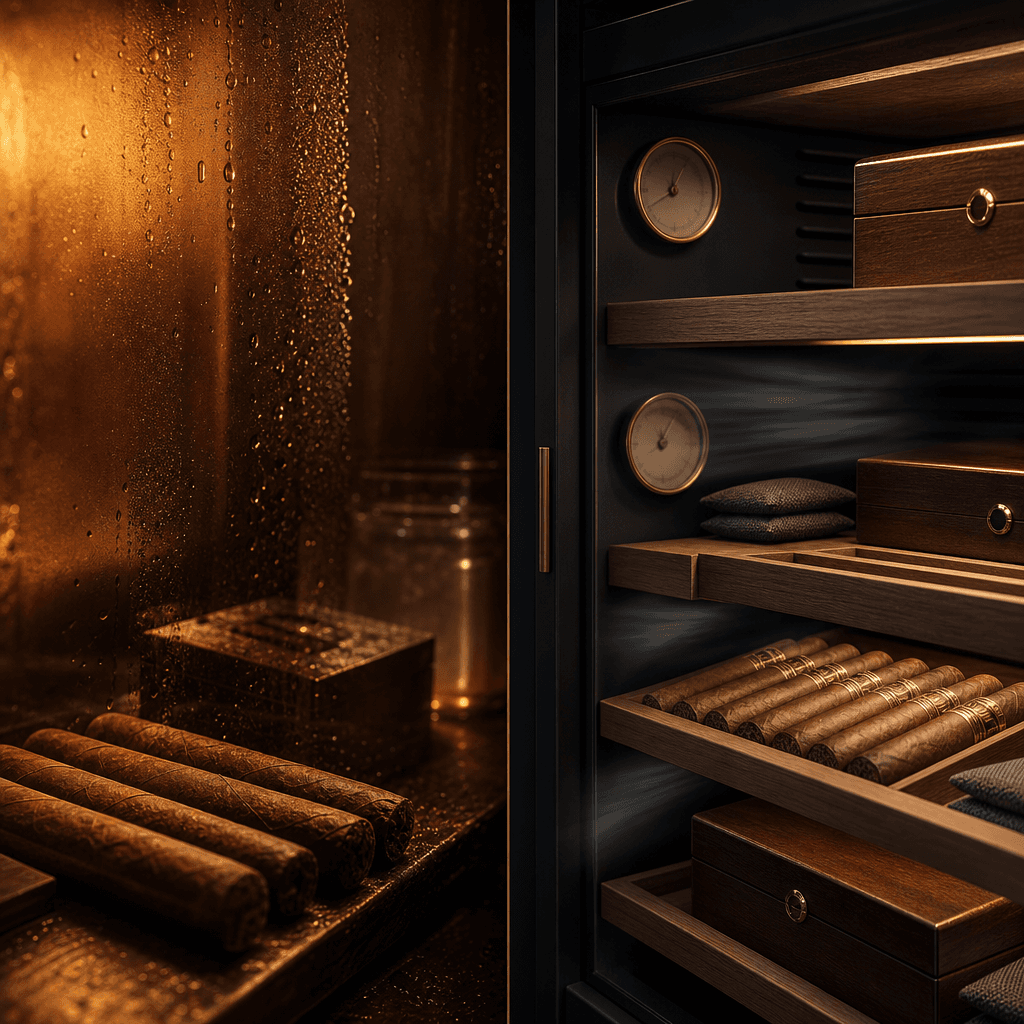
雪茄的保存是一項需要精細管理的技術,涉及溫度、濕度和空氣交換等多個因素。適宜的保存溫度應保持在16°C至20°C之間,避免大幅波動,以防止菸草甲蟲和品質劣化。濕度方面,長期保存建議在65%至68%RH之間,以保持雪茄的香氣和結構。不同的儲存設備各有優缺點,選擇時需考慮容量和使用環境。此外,新到的雪茄應設置過渡區,靜置觀察,避免混放影響品質。透過科學的管理方法,雪茄的品質和風味能夠持久維持。
- 雪茄保存需控制在16°C至20°C,避免溫度劇烈波動以維持品質。
- 長期保存濕度建議設定在65%至68%RH,過高或過低都會影響雪茄狀態。
- 新雪茄應設置過渡區靜置7至14天,觀察異常後再混入收藏。
Smoking is harmful to health. Persons under the age of twenty may not smoke. Smoking cessation hotline: 0800-636363. This article is provided solely for adults aged twenty and above as a reference on cigar culture, storage, and regulatory knowledge. It is not tobacco advertising, promotion, or purchasing advice.
Cigar storage is not as simple as putting a box into a cabinet. It is a stability project shaped by the combined effects of "temperature, humidity, air exchange, the moisture absorption and release of materials, and time." After beginners have learned the basics of cutting, lighting, and not inhaling, the next thing to learn is precisely how to keep a boxed 2023 Cohiba, a 2019 H. Upmann, or a box of 2021 Padrón consistent in combustion, aroma, and structure over months to years. From the perspective of an editor of the Cigar Bible, ghostwriter for "Cigar Prince Wilson Tsai," founder of W Cigar Bar Gentlemen's Cigar House, and PCC appointed dealer, storage is not mysticism. It is daily management that can be measured, calibrated, and recorded.

流程圖呈現測溫設濕緩衝記錄與靜置五個保存步驟
Temperature: The First Line of Defense for Cigar Stability
Most discussions of cigar storage begin with humidity, but what truly determines the upper limit of risk is often temperature. The recommended long-term storage range is about 16°C to 20°C. Short-term display or access can tolerate 21°C to 22°C, but it should not exceed 23°C for extended periods. The reason is practical: the higher the temperature, the more moisture the air can hold, and the more intense humidity fluctuations become. At the same time, the risk from tobacco beetle eggs increases noticeably at around 24°C to 27°C and above. If high humidity is also present, the problem may expand within weeks. In 2018, I saw a batch of Montecristo No.2 stored in a tall cabinet in a study. The room temperature was about 29°C during summer days and dropped to 23°C with air conditioning at night. The humidity inside the box fluctuated up and down by 8%RH every day. Two months later, the wrappers had swollen, combustion was uneven, and local mold spots appeared. This was not a brand problem, but the result of overly frequent heat cycles. By contrast, in 2020, a box of Partagás Serie D No.4 kept in a stable environment of 18°C and 67%RH was opened after half a year. The notes of wood, leather, and sweetness remained clear, and the burn line was also more stable. The core of temperature management is not pursuing low temperature, but avoiding large rises and drops. Keeping daily fluctuation within 1°C to 2°C is more important than occasionally reaching an ideal number.
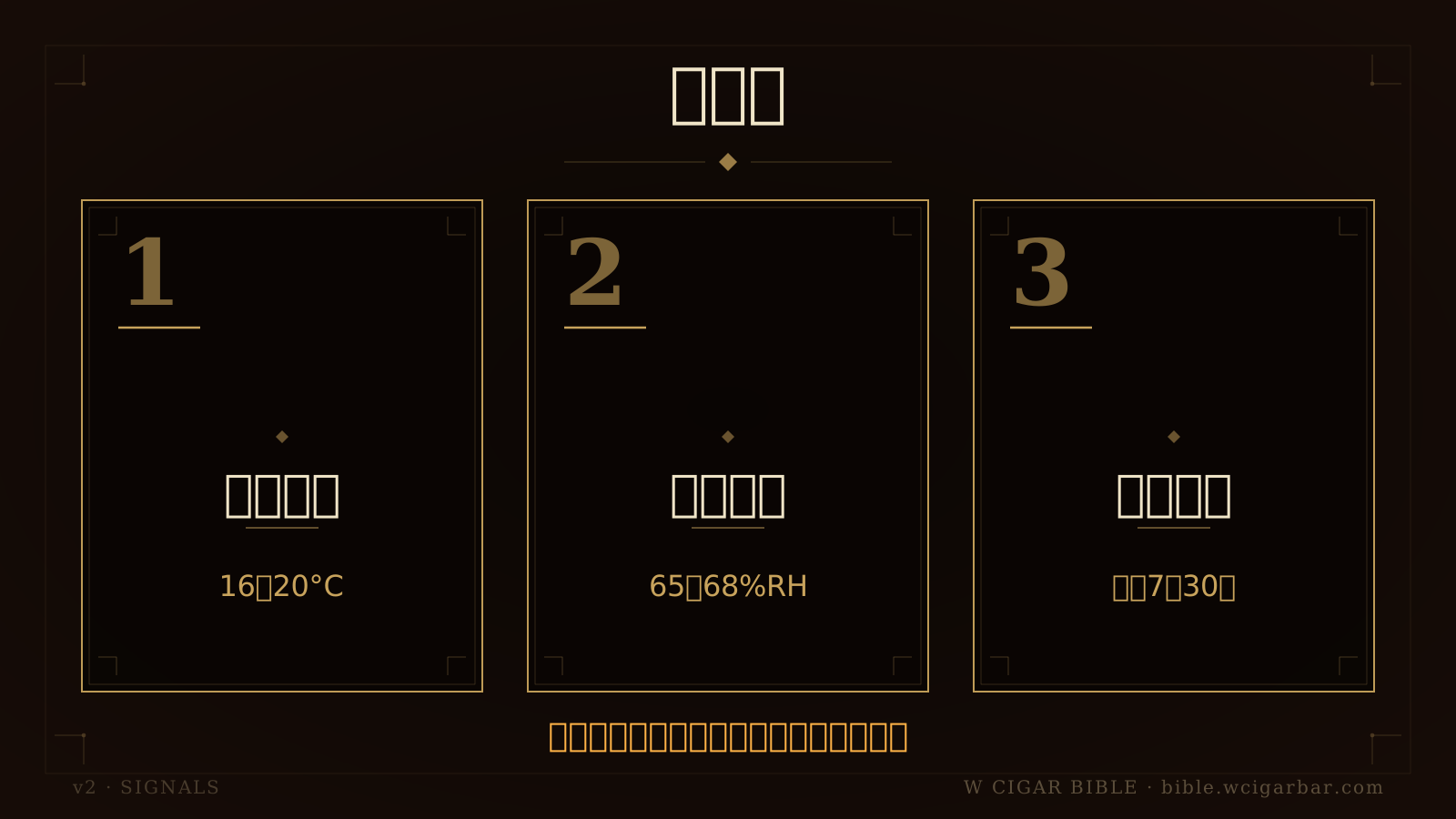
三張重點卡列出溫度濕度與慢速穩定的保存原則
Humidity: The Practical Logic Between 65% and 70%RH
A common recommendation for cigars is 70%RH, but in practice I prefer setting long-term storage at 65% to 68%RH, especially for Cuban cigars or cities with relatively humid environments. If humidity is too low, for example below 60%RH, cigars lose elasticity, the wrapper becomes brittle, the cut end is more likely to crumble, the burn rate becomes faster, and the aroma may seem sharp. If humidity is too high, for example staying above 72%RH for long periods, it may cause a tighter draw, insufficient combustion, increased ammonia notes or a damp, stuffy sensation, and in serious cases mold. Take a 2022 box of Ramón Allones Specially Selected as an example. If stored at 72% to 74%RH, the early sweetness remains, but the middle section often shows relighting issues and a bitter, wet sensation. After adjustment to 66%RH and resting for 21 days, the draw loosened, the burn line improved, and the dried fruit and woody tones became clearer. Non-Cuban cigars such as Arturo Fuente Hemingway or Davidoff Signature, if structurally stable and precisely controlled for moisture at the factory, can also perform well at 68% to 70%RH. Remember that what a hygrometer reads is the relative humidity of the air. It does not mean the moisture inside the tobacco immediately synchronizes. For a 52 ring gauge Robusto to stabilize from the outer layer to the center, it usually takes 7 to 14 days. A Churchill or Double Corona may even take up to 30 days. Therefore, humidity adjustments should be slow. Do not torment cigars by moving back and forth from 70% today to 62% tomorrow.

比較矩陣列出木盒電櫃與保鮮盒的容量優點和風險
Comparison of Storage Equipment: Wooden Boxes, Electronic Cabinets, Airtight Containers, and Wine Cabinets
There is no absolute ranking among different types of equipment. The key factors are capacity, stability, local climate, and usage habits. A traditional Spanish cedar humidor is suitable for a scale of 25 to 100 cigars. Its advantages are natural moisture absorption and release, aroma compatibility, and a sense of ritual when taking cigars out. Its drawbacks are that in high-humidity areas such as Taiwan, Hong Kong, and Singapore, if the room temperature is high and air conditioning is turned on and off frequently, humidity can easily drift. An electronic temperature-controlled cigar cabinet is suitable for more than 100 cigars or box collectors. It can control temperature at around 18°C, but attention must be paid to whether the internal fan blows too directly, otherwise some local areas may become dry. An airtight food container with two-way humidity packs has become a common solution for beginners in recent years. It is low-cost and highly sealed, suitable for 10 to 50 cigars for short- to medium-term storage. Its drawback is limited air exchange, so the opening frequency should be fixed, and odors must be avoided. Converting a compressor wine cabinet requires caution, because cooling causes moisture condensation, leading to humidity rising and falling abruptly. Without proper airflow channels and humidity-buffering materials, the result may fall short of expectations.
| Equipment type | Recommended capacity | Advantages | Risks | Suitable situation |
|---|---|---|---|---|
| Spanish cedar box | 25-100 cigars | Natural moisture absorption and release, harmonious aroma | Strongly affected by external temperature | Study with stable air conditioning |
| Electronic temperature-controlled cabinet | 100-500 cigars | Good temperature control, convenient classification | Direct fan airflow, sensor error | Long-term box storage |
| Airtight food container | 10-50 cigars | Low cost, stable humidity | Limited air exchange | Beginners and pre-travel organization |
| Modified wine cabinet | 50-300 cigars | Strong low-temperature capability | Condensation and humidity fluctuations | Users who understand equipment calibration |

三張錯誤卡提醒冰箱白點判讀與濕度標準的常見誤解
Humidity Packs, Humidifiers, and Calibration: Do Not Believe Blindly in a Single Number
Humidity control tools can be divided into passive and active types. Passive tools, such as 65%, 69%, and 72% two-way humidity packs, absorb and release moisture through salt solutions. They are suitable for highly sealed airtight containers, travel cases, and small wooden boxes. Active tools, such as electronic humidifiers, operate through a water reservoir, fan, and sensor. They are suitable for large cigar cabinets. A common beginner's mistake is to throw a 69% humidity pack into a leaky wooden box and expect the humidity to remain 69% forever. If the lid gap is large and the indoor environment is only 50%RH, the humidity pack will be depleted quickly. Conversely, during Taipei's plum rain season, when indoor humidity is 78%RH, even a 65% humidity pack may still result in long-term high humidity because the wooden box has absorbed too much moisture. It is recommended to use about one to two 60-gram-class humidity packs for every 25 cigars. If it is an original box of 25 Corona Gorda, place one 65% or 69% pack beside the box, but do not press it directly onto the wrappers. Hygrometers must be calibrated. The simplest method is the 75% salt test: place salt in a bottle cap with a small amount of water to form damp salt, seal it together with the hygrometer for 8 to 12 hours, and the reading should be close to 75%RH. If it displays 72%, future readings should be adjusted upward by 3%. In 2017, I once compared three newly purchased digital hygrometers. Placed in the same box, they differed by 5%RH. Without calibration, it is very easy to misadjust good cigars. Storage is science. Only when the sensors are reliable can later judgments have a foundation.
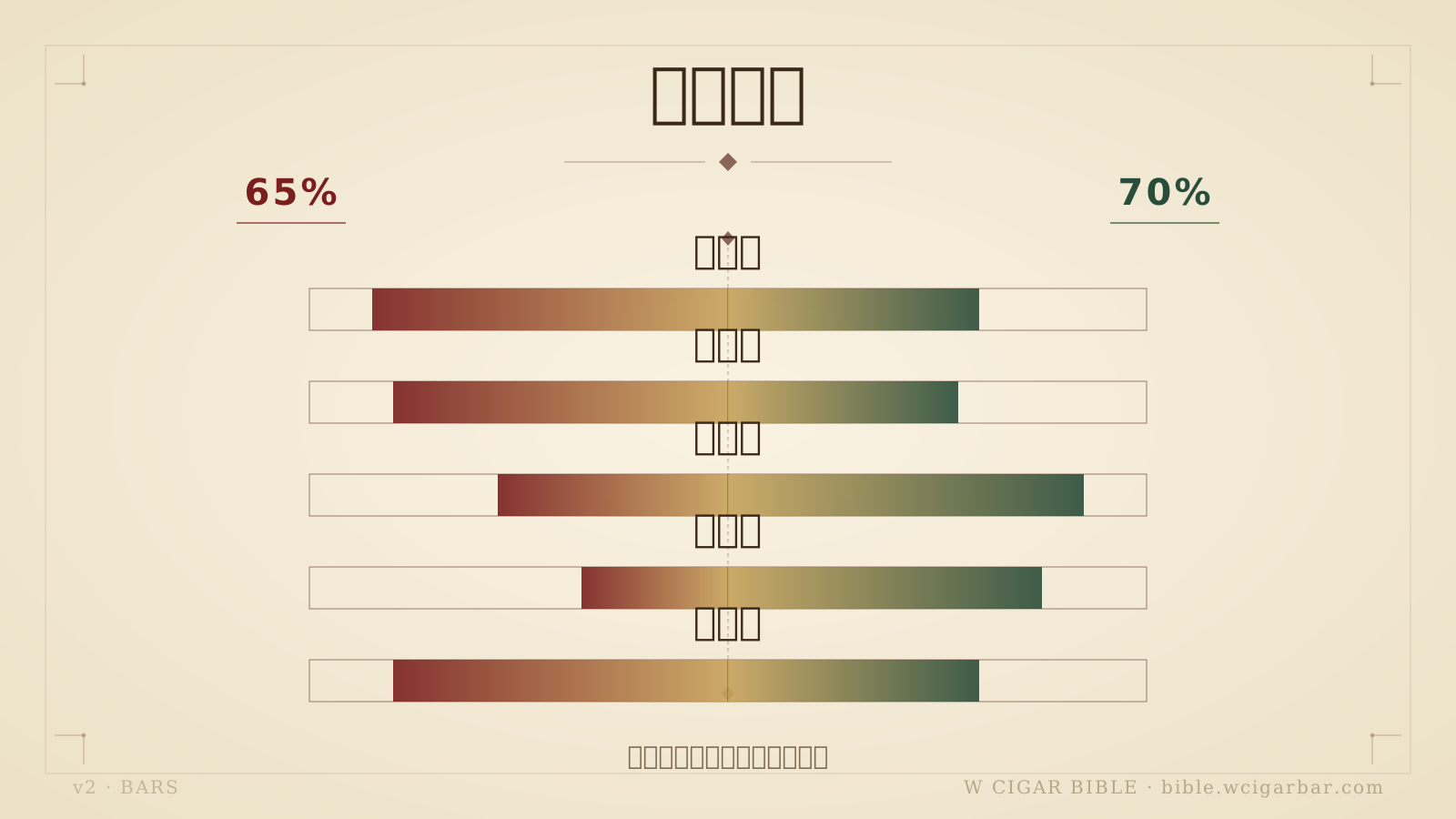
長條圖對比百分之六十五與百分之七十濕度取向的保存表現
Pre-Storage Handling and Zoning: Do Not Rush to Mix Newly Arrived Cigars
Newly obtained cigars, whether a boxed 2023 Romeo y Julieta Wide Churchill or a 2024 Oliva Serie V Melanio, should not immediately be mixed in large quantities with an existing collection. A safer approach is to set up a "transition zone" using an independent airtight container or compartment, place in a 65% to 69% humidity pack, and let the cigars rest for 7 to 14 days. Observe whether there are any unusual odors, mold spots, damage, beetle holes, or abnormal humidity. If the outer box carries moisture from long-distance transportation, especially if the outside of the wooden box feels somewhat cold and damp to the touch, you can open the lid for 10 to 20 minutes to allow surface air exchange, but do not use a fan and do not expose it to the sun. Different production regions can also be zoned separately. Cuban cigars often have thinner wrappers and are more sensitive to moisture absorption, so they can be kept at 65% to 67%. Some large-ring-gauge cigars from Nicaragua and the Dominican Republic have thicker structures and can be maintained at 67% to 70%. If the collection includes differences in box age, such as 2016 Hoyo de Monterrey Epicure No.2 stored together with a new 2024 box, the moisture and wood notes released by the new box may affect the condition of the older box. It is best to manage them by box. Cigars exchange odors. Cabinets containing spices, coffee beans, or leather conditioning oil are not suitable for coexistence. Spanish cedar can provide buffering, but it is not a deodorizer. If zoning is done well, the condition before each future use will be more predictable.

問答卡整理冰箱、白點與濕度標準三個實用保存問題
Long-Term Maturation and Records: Exchange Time for Stability, Not Fantasy
Cigar maturation is not about forgetting cigars in a corner. It is about allowing the harshness, ammonia, woodiness, sweetness, and oils in the tobacco to slowly integrate in a stable environment. Generally speaking, 6 to 18 months after leaving the factory can be regarded as an initial stabilization period. At 3 to 5 years, the structure often becomes rounder. At 8 to 10 years and beyond, the result depends on brand, year, storage, and raw materials. Taking 2014 Bolivar Belicosos Finos as an example, when stored at 18°C and 66%RH until 2020, the strength remained, but the spiciness had transformed into cocoa, damp wood, and leather. If the same year had been stored long-term at 73%RH, it might have become dull and murky, with heavy combustion. High-end non-Cuban series such as Davidoff Aniversario or Fuente OpusX can also show different stages because of storage, but not every cigar necessarily improves the longer it is kept. When discussing collectible value, the market does indeed pay attention to discontinued items, limited years, box condition, and provenance. For example, certain special Cuban editions from 2006 and 2011 once received attention in the secondary market. However, collectible appreciation does not mean guaranteed appreciation; it still depends on provenance, storage, and the market. My recommendation is to establish a record sheet: year of acquisition, box code, brand and size, cabinet-entry humidity, monthly highest and lowest temperatures, and sampling notes. Compared with listening to rumors, one's own ten-year record is more reliable and can better train judgment.
Common Questions
1. Can cigars be stored in a refrigerator?
An ordinary household refrigerator is not suitable for long-term cigar storage. Refrigerator temperatures are about 3°C to 7°C. Although low temperature can reduce the risk of pests, the internal humidity and odors are not ideal. Compressor cycles cause dryness, and odors from fruits, vegetables, cooked food, and plastic may also permeate the wrapper. If freezing treatment is needed because of suspected beetle infestation, a staged approach is usually adopted: refrigerate first for 12 to 24 hours, then freeze for 48 to 72 hours, then return to refrigeration for 24 hours, and finally return to the room-temperature storage area. The purpose is to reduce thermal shock. However, this is a remedial method, not a routine storage method.
2. There are white spots on the cigar surface. Is it mold or plume?
Plume often appears as fine crystalline material, distributed evenly, and can be gently wiped away. It is usually related to oil crystallization. Mold, by contrast, may appear fuzzy, gray-white or blue-green, may cluster locally, and may even appear inside the foot. If there is only a small amount of white haze on the wrapper surface, it can be lightly wiped with a clean soft cloth and then isolated for observation for 7 days. If there is mold inside the foot, a sour or rotten odor, or spreading among multiple cigars in the same box, caution should be increased and humidity should be checked to see whether it has stayed above 72%RH for a long time. In 2021, I encountered a box of H. Upmann stored at 75%RH. The exterior looked like white frost, but after opening the foot, I discovered mold had already entered the inner layers. Such situations should not be taken lightly.
3. Is 70%RH not the standard? Why do some people use 65%RH?
70%RH comes from traditional experience, but in hot and humid cities, 70%RH combined with temperatures above 23°C may produce an actual smoking feel that is too wet. 65%RH does not mean dry. It allows the cigar to achieve a cleaner balance among combustion, draw, and aroma. Cuban Robusto, Petit Corona, and Corona Gorda often perform stably at 65% to 67%. Large-ring-gauge cigars, thick wrappers, or non-Cuban cigars can be tested at 68% to 70%. Do not look only at the number. Also observe whether the cut end crumbles, whether combustion is too fast, and whether the draw is too tight. These are the final basis for judgment.
4. Does a wooden box need to be opened for ventilation?
If the storage environment is well sealed and humidity is stable, there is no need to open the lid every day. Frequent opening causes humidity fluctuations, especially when alternating between an air-conditioned room and humid outdoor air. A large cabinet can be briefly checked once every 1 to 2 weeks. A small airtight container can be opened every 2 to 4 weeks to inspect condition. If using original wooden boxes for storage, it is recommended to adjust the position of the boxes once every season to avoid one side remaining close to a fan or cold source for long periods. Air exchange is necessary, but excessive intervention destroys stability. The art of storage lies in moving little, adjusting slowly, and recording often.
5. How should cigars be kept in good condition while traveling?
A travel case should focus on sealing, pressure protection, and short-term stability. For a 3 to 5 day trip, use a hard-shell travel case with a small 65% or 69% humidity pack, and avoid placing it inside a car, by a window, or in high-temperature areas of checked luggage. If flying from Taipei to Tokyo or from Singapore to London, both the cabin and hotel air conditioning tend to be dry, so do not open the travel case frequently. After arrival, if the cigar feels somewhat hard, do not spray it with water to rehumidify it. Simply return it to a stable box and let it rest for 3 to 7 days. During short trips, preventing crushing and heat exposure is more important than pursuing precise humidity.
6. Can a cigar that is too wet or too dry be recovered?
Most situations can be improved, but slowly. A cigar that is too dry must not be placed directly into a 72%RH environment. Otherwise, the outer layer will rapidly absorb moisture and swell while the inner layer remains dry, possibly causing the wrapper to split. It is recommended to place it first at 62%RH for 7 days, then 65%RH for 14 days, and finally adjust to 67%RH depending on its condition. A cigar that is too wet should also not be treated with hot air or sunlight. It should be placed in a 62% to 65%RH environment and kept at 18°C to 20°C, allowing moisture to fall naturally. A Robusto may improve in 2 weeks, while a Churchill may require more than 1 month. Performance after recovery may not be completely identical to the original state, but it can usually return to an acceptable range.
The most fascinating part of storing cigars is that it teaches restraint. Do not be impatient with temperature, do not be extreme with humidity, do not have blind faith in equipment, and do not be lazy with records. Time will naturally provide the answer. My personal view is simple: good cigars deserve to be treated well, but true gentlemanly style does not lie in how many boxes are stacked up. It lies in knowing, every time the cabinet door is opened, why they are being kept in their present condition. -Cigar Prince Wilson Tsai
Smoking is harmful to health. Persons under the age of twenty may not smoke. Smoking cessation hotline: 0800-636363. This article is provided solely for adults aged twenty and above as a reference on cigar culture, storage, and regulatory knowledge. It is not tobacco advertising, promotion, or purchasing advice.
Like this article?Share with friends
Share this W Cigar Bible piece with friends who want to learn cigar culture, storage, and tasting.
想把這篇 化為實踐
雪茄聖經是知識;雪茄文化要在空間裡發生

W Cigar Bar 大安總店資訊
台北大安區 · 雪茄聖經總編輯 Wilson Tsai 主理的雪茄文化空間
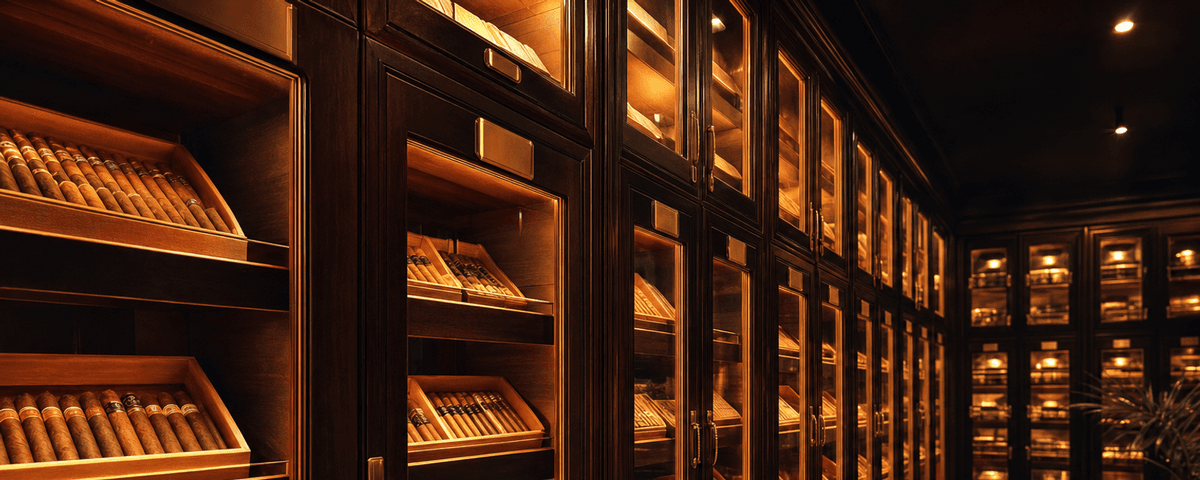
33 座 24 小時恆溫恆濕醇化室
W Cigar Bar 提供的會員醇化空間 · 場地資訊請洽編輯部
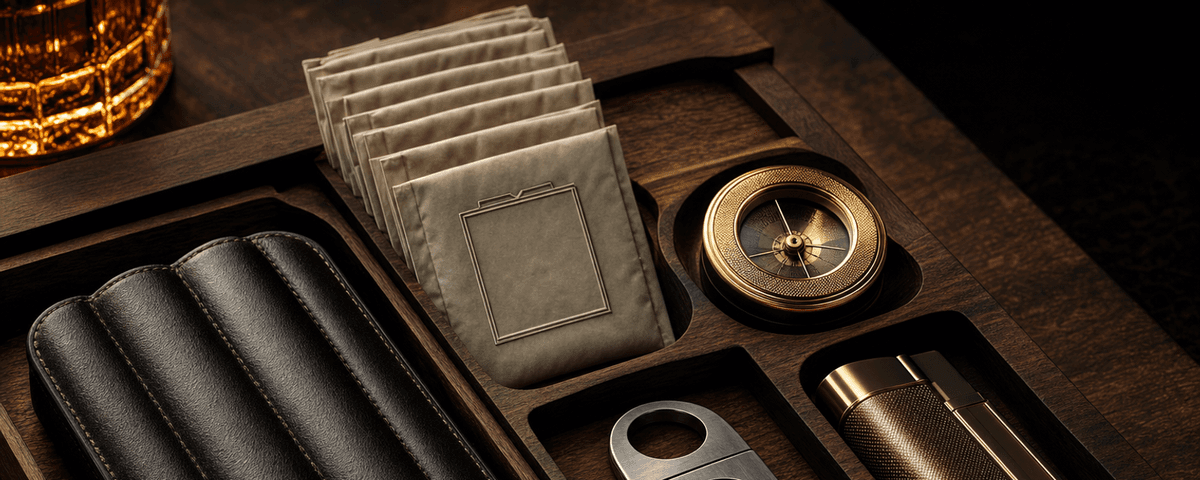
雪茄剪 / 打火機 / 雪茄盒 / Boveda
W Cigar 配件官網 · 專營雪茄配件正品

加 LINE 好友 · 文化諮詢
文化空間資訊 · 紳士沙龍 · 私人包場
本網站內容僅供雪茄文化、歷史、收藏與品吸知識研究參考。菸品有害健康、未滿法定年齡者請勿吸菸。實際規範請依所在地法律為準。
吸菸有害健康・戒菸專線 0800-636363・本站僅供 20 歲以上成年人閱覽。
讀到這裡,你不只是路過的人
留下 Email,加入 W 雪茄聖經內圈——總編輯 Wilson Tsai 親選的學院深文與國際新訊,先你一步送到信箱。
· 教育用途非銷售 · 隨時一鍵退訂 · Email 絕不對外公開 · 由勝茄股份有限公司營運
同分類延伸閱讀



資料來源:W Cigar Bible 編輯部整理 · 雪茄王子 Wilson Tsai 親自審稿
本文僅供雪茄文化、歷史、收藏與品鑑知識研究,不作為菸品促銷、銷售或購買建議。吸菸有害健康,未滿二十歲不得吸菸。