The Choice and Pairing of Cigars: A Comprehensive Consideration Based on Flavor and Brand
對於雪茄入門者而言,選擇雪茄不僅僅是看品牌或價格,而是要深入理解風味、尺寸及品牌個性。透過辨識不同的風味輪,能夠找到自己喜好的雪茄類型。尺寸的選擇則要考量可用時間,避免選擇過大或過小的款式而影響體驗。此外,了解品牌的性格有助於在不同場合中作出適合的選擇。最後,搭配飲品時,應以平衡為主,讓雪茄與飲品相輔相成,提升整體享受。
- 選擇雪茄時,應先了解自己喜歡的風味家族,而非僅依賴品牌名氣。
- 雪茄尺寸影響燃燒時間與風味,選擇時要考量可用的完整時間。
- 搭配飲品時,應以平衡為核心,避免雪茄與飲品互相競爭。
For beginners, cigars are no longer just about "lighting one up"; once you've mastered the basics of tasting, the next step is to understand flavor, size, brand personality, and pairing logic. These judgments determine whether a cigar appears rugged, elegant, or layered.
As an editor of the "Cigar Bible," I often compare choosing cigars to choosing wine: it's not just about reputation or price, but about the current state, time, dining content, and personal taste. Understanding pairing is the key to truly appreciating where the beauty of cigars comes from.
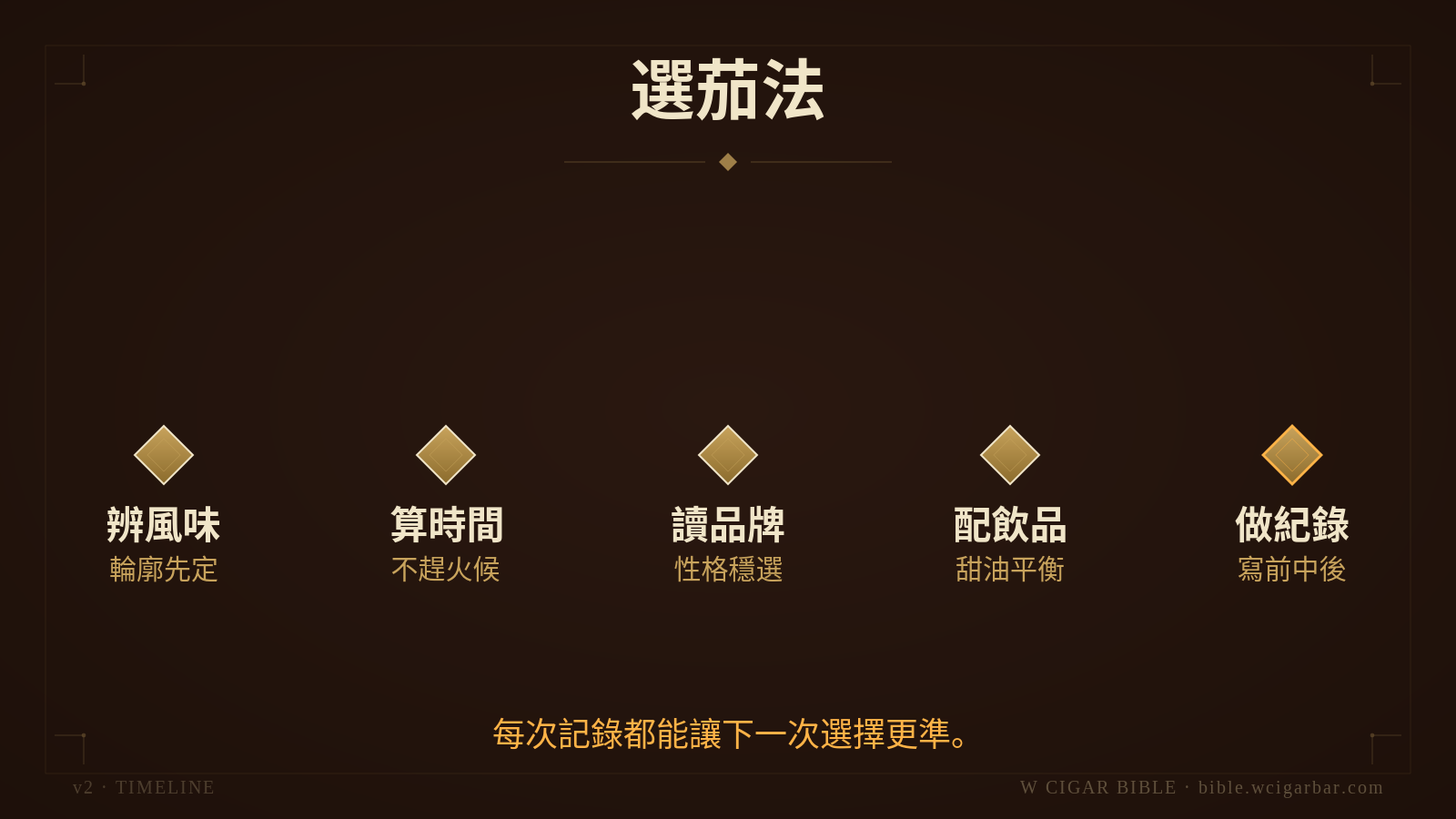
流程圖依序顯示辨風味算時間讀品牌配飲品與做紀錄
Starting with the Flavor Wheel: First Identify the Type of Flavor You Like
Many beginners initially only describe cigars as "strong" or "mild," but cigar flavors can actually be broken down into more detailed language. Common main axes include wood, leather, coffee, cocoa, nuts, cream, spices, earth, floral, and dried fruit. For example, the Cuban Partagás Serie D No.4 often features wood, pepper, and leather; while the Hoyo de Monterrey Epicure No.2 leans more towards cream, cedar, and a light sweetness.
The first step in choosing a cigar is not to ask which one is the most famous, but to find the flavor family you can clearly perceive and are willing to revisit repeatedly. If you like black coffee and dark chocolate, you can start with medium to high intensity brands; if you prefer almond, cream, and honey, you can choose milder options with a stable burning rhythm.
I recommend taking 10 minutes for a simple record: write down 3 adjectives for the first puff, one-third, half, and the final segment, then mark the strength from 1 to 5. After continuously recording 20 cigars, you'll find that you don't just "like Cuban" or "like non-Cuban" in such a general sense, but prefer certain profiles created by soil, fermentation, and rolling styles.
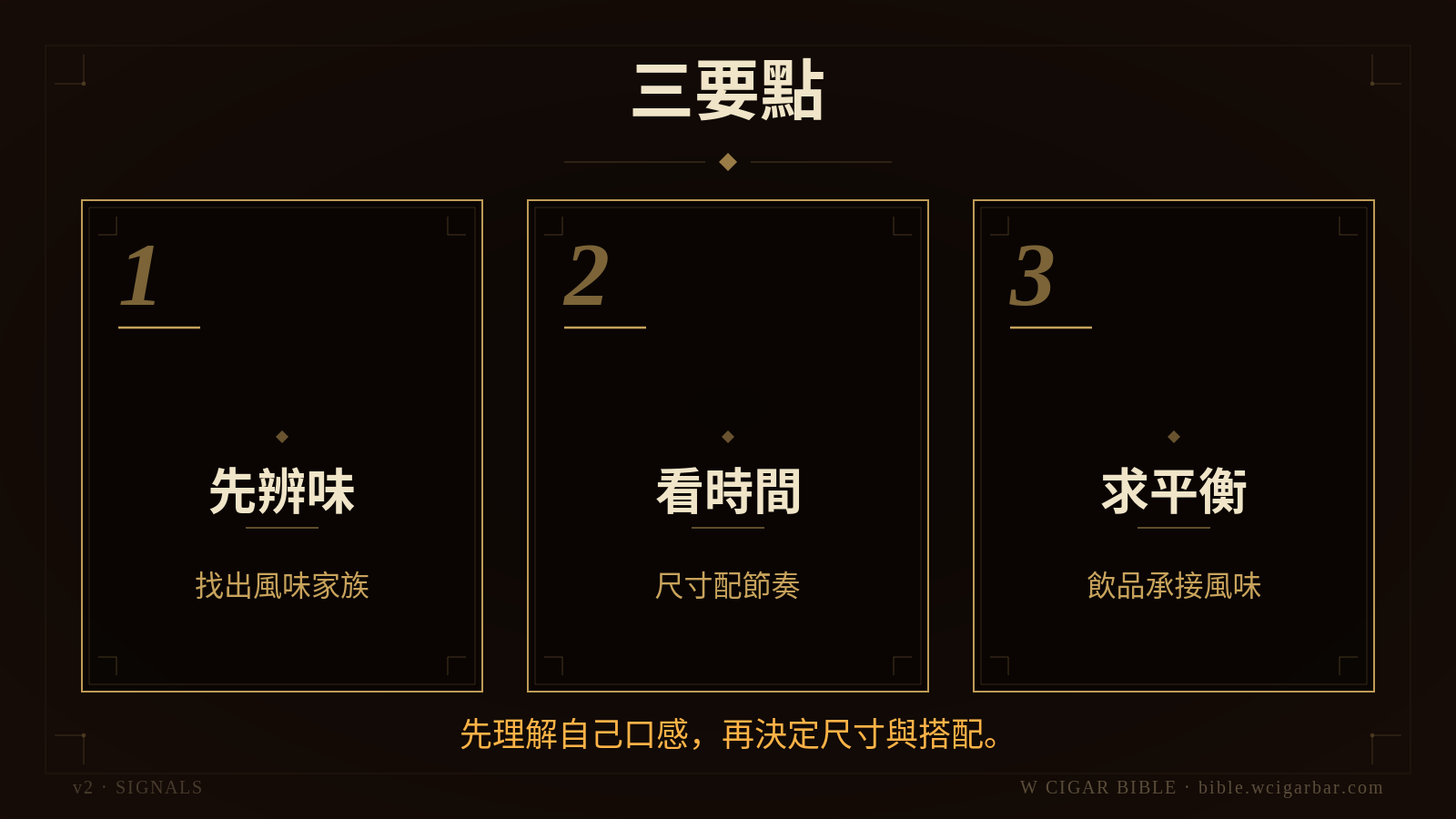
三張重點卡呈現風味時間與平衡搭配的選擇順序
Size and Ring Gauge: It's Not About Bigger Being Better, But About Choosing Time and Rhythm
Cigar sizes are often expressed in length and ring gauge, with a ring gauge of 50 representing a diameter of about 19.8 mm. Short and thick types like Robusto typically have a length of about 124 mm and a ring gauge of 50, with a duration of 45 to 70 minutes; Churchill is about 178 mm with a ring gauge of 47, possibly requiring over 90 minutes. Different sizes change the burning temperature, smoke volume, and flavor concentration.
When choosing a size, first ask yourself how much complete time you have, rather than which specification looks impressive. If you only have 40 minutes, forcing a Churchill often leads to impatience, resulting in overheating and bitterness; if you have an entire evening for a slow conversation, Lancero or Double Corona provides the space to showcase delicate transitions.
Taking the Cañonazo size of Cohiba Siglo VI as an example, at 150 mm and a ring gauge of 52, the flavor unfolds at a moderate pace, with herbal, cream, and bean aromas often in the forefront, while spices and sweet wood gradually emerge in the middle. Conversely, Montecristo No.4's Petit Corona size is shorter, with a concentrated rhythm, suitable for understanding the brand's cocoa, coffee, and woody base notes in a shorter time.
- 30 to 45 minutes: Petit Corona, Short Robusto
- 45 to 70 minutes: Robusto, Corona Gorda
- 70 to 100 minutes: Toro, Churchill
- Over 100 minutes: Double Corona, some Gran Reserva specifications
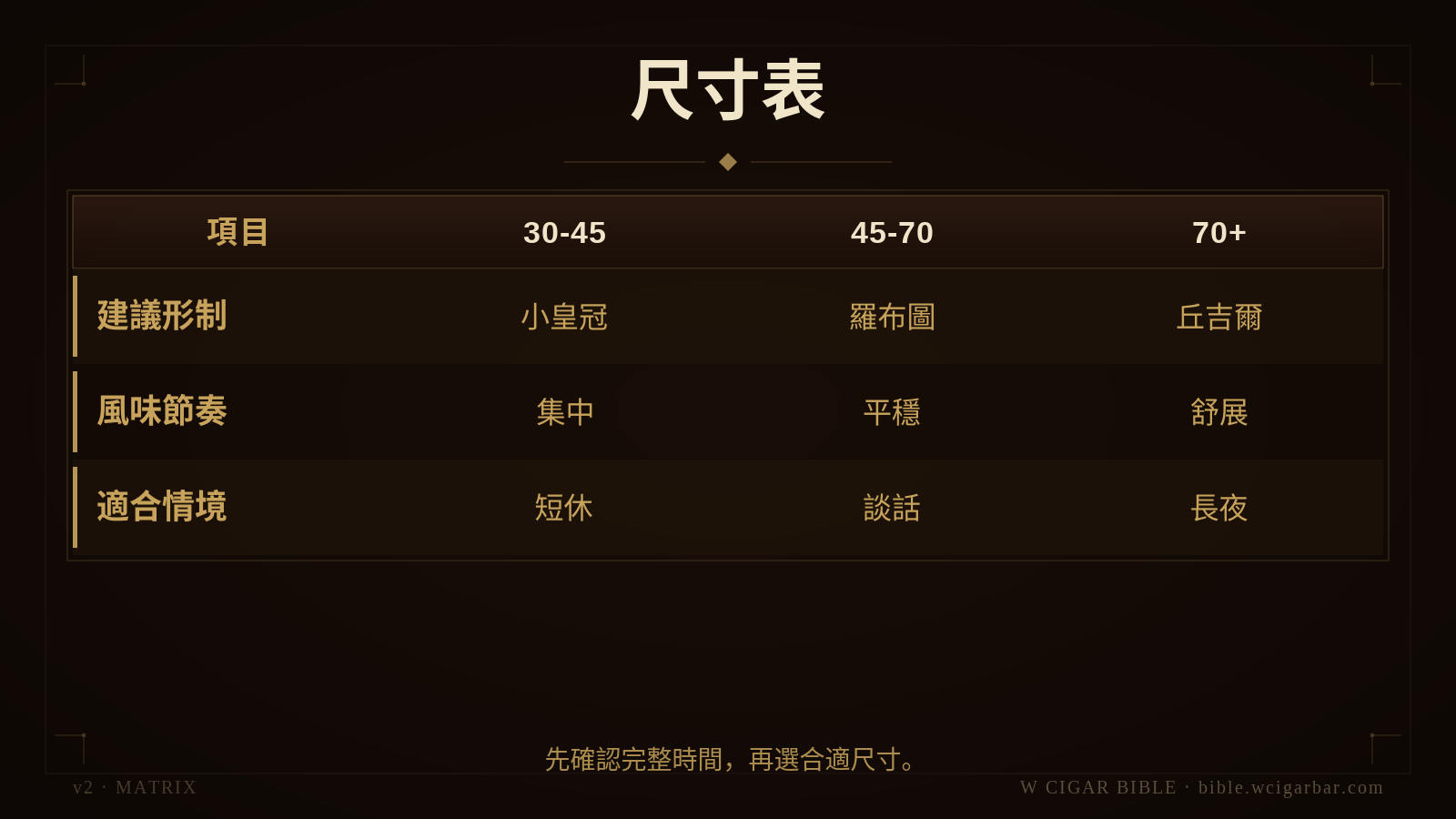
矩陣比較三種品飲時間下的形制節奏與適合情境
Brand Personality: Understanding the Brand Is More Reliable Than Chasing a Single High Score
Brands, like people, have personalities. Partagás is usually more masculine, often featuring leather, spices, and solid wood; Romeo y Julieta often carries floral, tea, and gentle sweetness; Bolívar is known for its strength, with obvious earth, cocoa, and intense tobacco notes; H. Upmann often has biscuit, coffee, nut, and elegant wood.
Distinguishing brand personality allows you to make stable choices quickly in different occasions. For example, after a meal with espresso, I would lean towards Montecristo, Partagás, or Padrón 1964 Anniversary; if it's daytime, before a meal, or with a slower conversation pace, Hoyo de Monterrey, Davidoff Grand Cru, H. Upmann Magnum 46 would be more relaxing.
The year can also affect performance. In the late 2010s, many enthusiasts noticed that some large ring gauge Cuban styles were more favored by the market; while Nicaraguan brands like Padrón, My Father, Oliva gained higher visibility in international selections after 2000, due to stable rolling, rich flavors, and mature fermentation techniques. This reminds us: brand reputation is just an entry point, what is truly reliable is whether the long-term style suits you.
Pairing with Beverages: Use Sweetness, Fats, and Body to Balance the Cigar
The core of pairing is not to flaunt the label, but to balance. Cigars have tobacco oils, woody bitterness, and spicy stimulation, while beverages can provide sweetness, acidity, alcohol sensation, or tea feeling to modify. A strong cigar paired with too light a beverage will overshadow the drink; a delicate cigar paired with heavy peaty whiskey may only leave a smoky impact.
A good pairing allows the cigar and beverage to complement each other, rather than compete. For example, cigars with creamy, nutty tones are suitable for cognac, bourbon, or oolong tea; those with strong leather, earth, and cocoa tones can be paired with sherry cask whiskey, black coffee, or aged rum.
| Cigar Flavor Main Axis | Suitable Pairing | Reference Case |
|---|---|---|
| Cream, nuts, cedar | High mountain oolong, VSOP cognac, bourbon | H. Upmann Magnum 46 |
| Coffee, cocoa, wood | Espresso, sherry cask whiskey | Montecristo No.2 |
| Leather, pepper, earth | Dark roast coffee, aged rum | Partagás Serie P No.2 |
| Floral, tea, honey | Oriental beauty tea, light cognac | Romeo y Julieta Wide Churchill |
If pairing with alcoholic beverages, keep the portion small and drink water first to cleanse the palate. My habit is to drink a sip of water every 10 to 15 minutes, letting the beverage play only a decorative role. This way, you can judge the cigar's first, middle, and final segments without being numbed by alcohol.
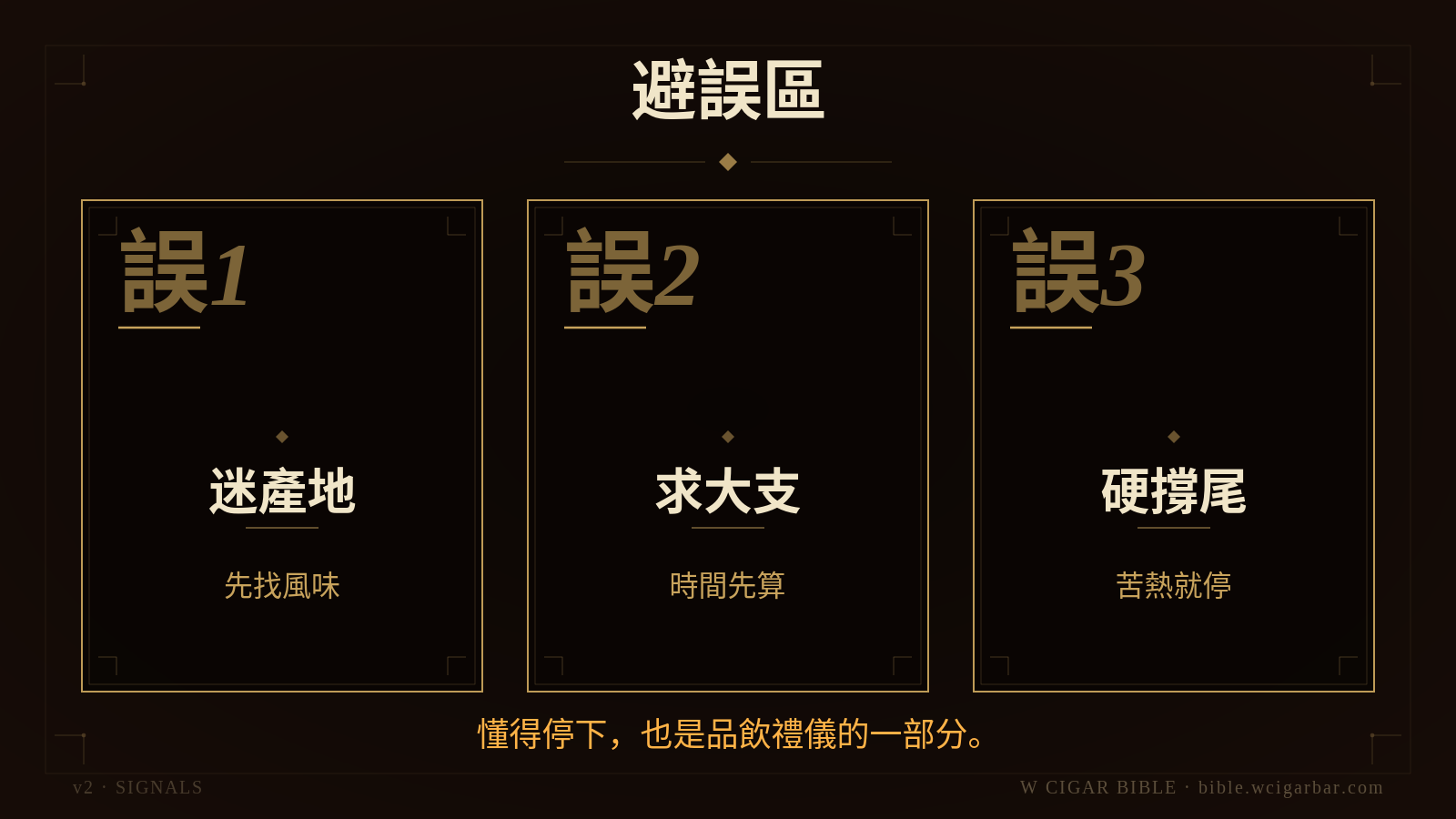
三張誤區卡提醒不要迷信產地尺寸求大或硬撐尾段
Choosing Based on Pre-Meal, Post-Meal, and Conversation Rhythm
The logic of cigars before and after meals is completely different. Before a meal, the palate is clean, but the stomach is not coated with fats, so a too strong cigar can easily fatigue you, thus options with a strength of 2 to 3, such as Hoyo de Monterrey, Por Larrañaga, or Davidoff Signature, are suitable. After a meal, if you've had steak, stew, or cheese, you can handle more substantial Bolívar, Partagás, or Padrón.
The occasion determines the rhythm of the cigar; when the cigar is not the main focus, choose options that don't steal the conversation. If it's a long talk with more than 6 people, I usually don't choose a Lancero that requires careful reading, as it demands higher burning and rhythm requirements; Robusto or Toro can more easily maintain stability during conversations.
Three questions can quickly determine:
- Is it before a meal, during a break, or after a meal?
- Is the available time 45, 70, or 100 minutes?
- Do you need to focus on feeling, or is chatting the main focus?
For example, in 2023, I chose Ramón Allones Specially Selected after a dinner because there was grilled beef and red wine before, and the mouth still had fats and tannins. This Robusto's dried fruit, leather, and sweet wood can catch the post-meal weight without oppressing the conversation rhythm like stronger options.
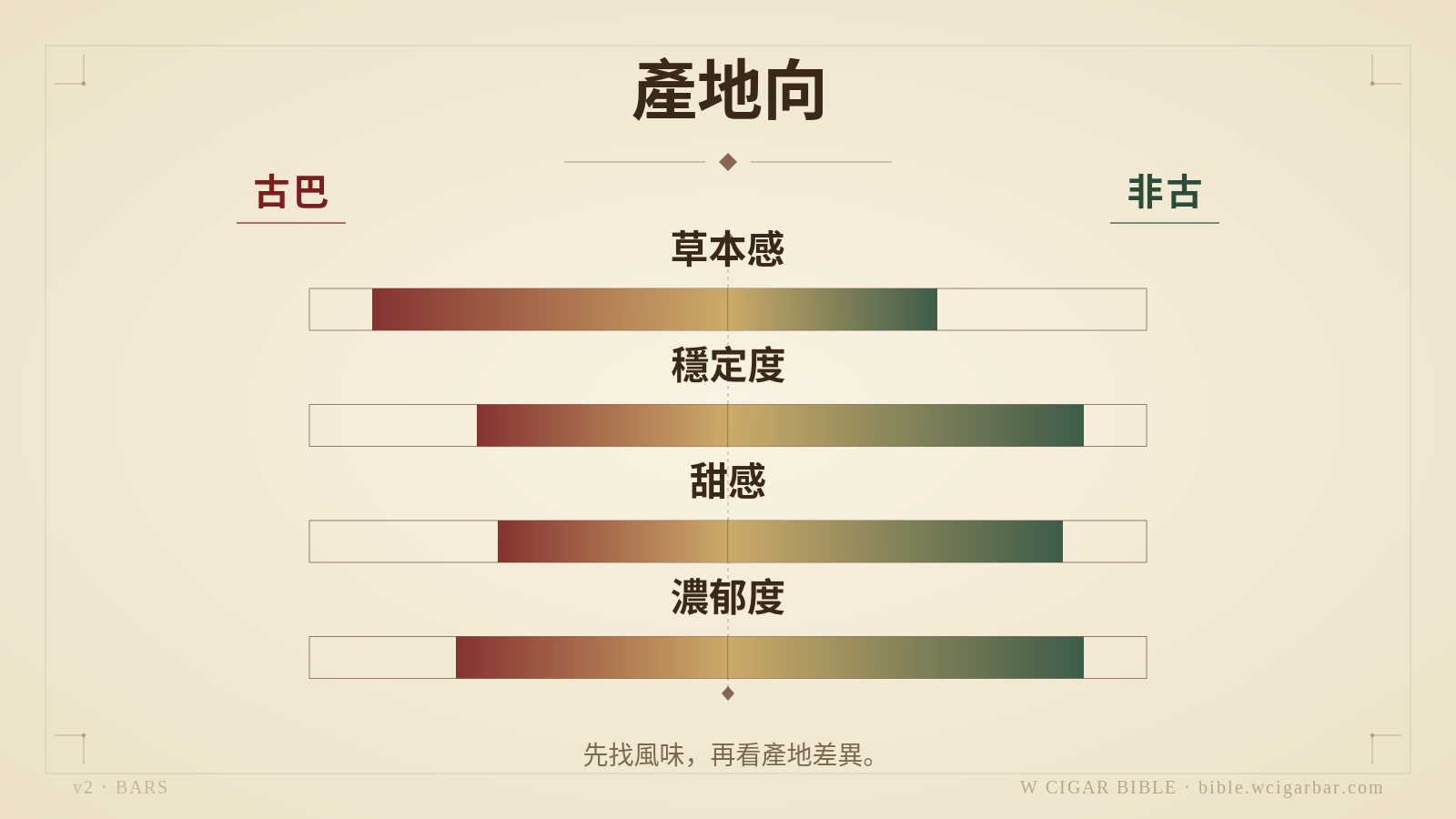
橫條比較古巴與非古在草本穩定甜感與濃郁度差異
Source, Preservation, and Aging: Stability Is More Important Than Legend
The state of the cigar is often more critical than its reputation. The same Montecristo No.2, if stored at 65% to 69% relative humidity, 18 to 21°C, usually burns and smells more stable; if too wet for a long time, it may be stuffy, tight, and hard to burn; too dry can lead to spiciness and fast burning. Beginners often make the mistake of blaming the brand while ignoring preservation.
Clear source, stable preservation, and intact box condition are always more important than legendary years heard. If it involves Cuban cigars, I only use clear sources like PCC authorized dealers as one of the judgment bases, then observe the box code, seal, outer box condition, and cigar wrapper oil. This is not superstition, but basic skills to reduce risk.
Aging also needs to be realistic. Generally, cigars with high strength, obvious tannin feel, and solid structure have more long-term development space; lighter or those designed for early enjoyment don't need to be blindly aged for 10 years. When talking about collection appreciation, I always add: it doesn't guarantee appreciation, still depends on source preservation and market. Viewing cigars as flavor assets rather than mere price symbols leads to a healthier mindset.

快問快答卡列出產地選擇味道差異與強度處理
Etiquette and Technique: Cutting, Lighting, and Puffing Frequency Will Change the Flavor
The same cigar can taste very different with different techniques. Cutting too deep will cause the cap to crack, cutting too small will cause too tight a draw. For most Parejo straight cigars, I observe the cap line and cut off about 1 to 2 mm from the front end; for Torpedo or Pirámide, start with a smaller opening and adjust according to the draw.
The essence of cigar etiquette is to make both yourself and others comfortable, not to showcase actions. When lighting, don't let the flame directly scorch the foot of the cigar for too long, first evenly toast the edges, then gently rotate to add fire. Puffing frequency should be every 45 to 75 seconds, too frequent will increase temperature, and bitterness, ammonia, and spiciness will be amplified.
Beginners should also practice "not rushing to correct." When the burn is slightly uneven, first rotate the cigar, letting the slower burning side face down, using the heat flow to naturally catch up; unless the deviation exceeds about 1 cm, then lightly correct with a lighter. The ash column can be kept 2 to 3 cm, which helps stabilize temperature and avoids dropping embarrassingly. Truly mature actions are quiet, stable, and precise.
Common Questions
Should beginners choose Cuban or non-Cuban first?
There's no need to decide based on the origin dichotomy. Cubans often have unique mineral, herbal, woody, and elegant transitions; Nicaragua, Dominican Republic, and Honduras each have their own characteristics in stability, richness, and sweetness. Find the flavor first, then look at the origin, which is more accurate than blindly believing in the origin.
Why does the same brand taste different each time?
The reason may come from the year, batch, preservation, lighting method, and taste state of the day. Cigars are agricultural products, and the conditions of tobacco leaves in 2008 and 2018 cannot be exactly the same. If the same model has a big difference, first check humidity, draw, and burn, then judge if it's a brand style issue.
Should I buy a whole box at once?
No rush in the entry stage. First establish a flavor database with different brands and sizes, record at least 15 to 20 cigars, then judge which ones are worth whole box preservation. If you already know you like a certain model, the benefit of a whole box is observing changes over 6 months, 1 year, and 3 years.
Can cigars be paired with tea?
Yes, and it's very suitable for Asian palates. Fragrant oolong can bring out cream and floral, ripe Pu'er can carry earth and wood, and black tea can echo honey and dried fruit. The advantage of tea is reducing alcohol interference, allowing you to more clearly read the changes in the first, middle, and final segments.
How to know if a cigar is too strong?
If you experience dizziness, cold sweat, nausea, or decreased attention, it usually means the strength exceeds the current tolerance. At this time, stop, hydrate, eat something sweet, and rest. Knowing when to stop is also part of cigar etiquette and self-management.
Where should a cigar be finished?
There's no hard rule. Generally, observe when about one-third to one-quarter is left, if the temperature rises, bitterness becomes obvious, or the flavor becomes unbalanced, let it naturally extinguish. Don't view finishing as wasteful, maintaining a good impression is more important than forcing it to the end.
I always believe that the truly fascinating part of cigars is not how rare the label is, but whether you can understand its rhythm. From flavor, size, brand to pairing, each choice trains judgment. Slow down, record more, and you'll form your own taste coordinates; that's the most worthwhile gentleman's lesson to accumulate.
—Cigar Prince Wilson Tsai
Smoking is harmful to health. Under twenty years old is not allowed to smoke. Quit smoking hotline: 0800-636363. This article is intended for adults over the age of twenty as a reference for cigar culture, preservation, and legal knowledge, not as a tobacco advertisement, promotion, or purchase suggestion.
Like this article?Share with friends
Share this W Cigar Bible piece with friends who want to learn cigar culture, storage, and tasting.
想把這篇文章 化為實踐
雪茄聖經是知識;雪茄文化要在空間裡發生
W Cigar Bar 大安總店資訊
台北大安區 · 雪茄聖經總編輯 Wilson Tsai 主理的雪茄文化空間
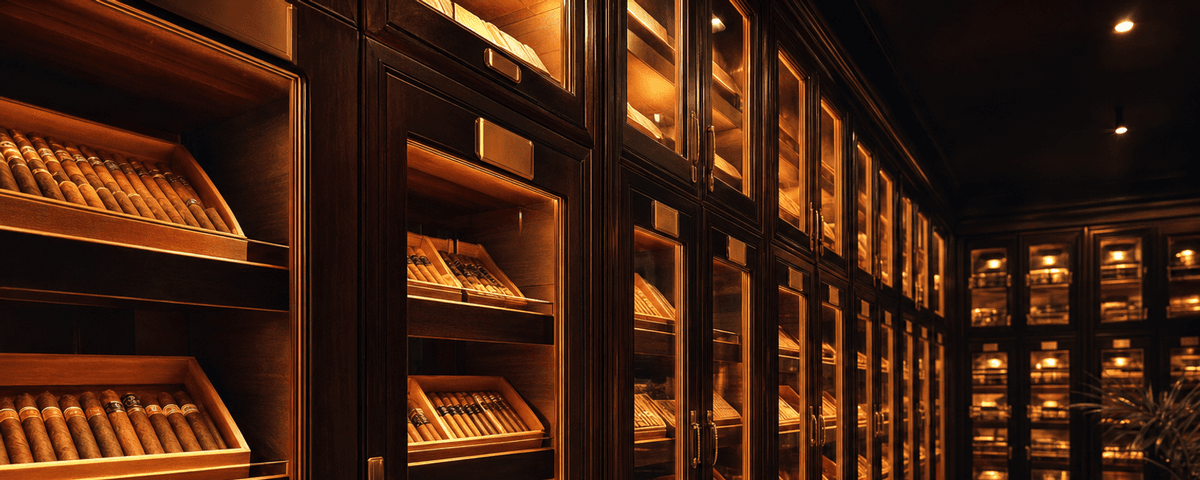
33 座 24 小時恆溫恆濕醇化室
W Cigar Bar 提供的會員醇化空間 · 場地資訊請洽編輯部
雪茄剪 / 打火機 / 雪茄盒 / Boveda
W Cigar 配件官網 · 專營雪茄配件正品
加 LINE 好友 · 文化諮詢
文化空間資訊 · 紳士沙龍 · 私人包場
本網站內容僅供雪茄文化、歷史、收藏與品吸知識研究參考。菸品有害健康、未滿法定年齡者請勿吸菸。實際規範請依所在地法律為準。
吸菸有害健康・戒菸專線 0800-636363・本站僅供 20 歲以上成年人閱覽。
讀到這裡,你不只是路過的人
留下 Email,加入 W 雪茄聖經內圈——總編輯 Wilson Tsai 親選的學院深文與國際新訊,先你一步送到信箱。
· 教育用途非銷售 · 隨時一鍵退訂 · Email 絕不對外公開 · 由勝茄股份有限公司營運
同分類延伸閱讀
資料來源:W Cigar Bible 編輯部整理 · 雪茄王子 Wilson Tsai 親自審稿
本文僅供雪茄文化、歷史、收藏與品鑑知識研究,不作為菸品促銷、銷售或購買建議。吸菸有害健康,未滿二十歲不得吸菸。