Cubatabaco / Habanos S.A. 1959-2025 國有化制度演化檔案:從革命接管到當代合資的 66 年商業治理史
1959 革命國有化 / 1962 Empresa Cubana del Tabaco 統一國營 / 1994 Habanos S.A. 50/50 合資轉折 / 2008 Imperial 接手 / 2020 後國有化新階段

Cubatabaco / Habanos S.A. 1959-2025 國有化制度演化檔案—1959-1962 革命國有化第一階段(家族工廠接管 / 菸葉田重新分配 / 1962 甘迺迪禁運令對美出口中斷)、1962 Empresa Cubana del Tabaco(Cubatabaco)統一國營第二階段 28 年(全球分銷直營 / 計劃經濟定價 / 蘇聯核心市場)、1989 Davidoff 戲劇性分手與 1991 蘇聯解體雙重衝擊、1994 Habanos S.A. 50/50 合資第三階段商業改革(與西班牙 Tabacalera 合資、雙贏治理結構)、2008 Imperial 接手第四階段(西班牙公股轉英國私營資本)、2020 後國有化新階段三特點(ESG 投資壓力 / 中國大陸特殊地位 / 數位行銷紙菸雙重變化)、66 年國有化體系工藝穩定性意義。
- 古巴雪茄業自1959年起由國有化體系主導,經歷四個商業治理階段。
- Cubatabaco成立後,統一管理古巴菸草的採購、發酵、捲煙及全球分銷。
- 1994年古巴政府與西班牙Tabacalera合資成立Habanos S.A.,標誌市場經濟的重要讓步。
Cubatabaco / Habanos S.A. 1959-2026 Nationalization System Evolution Archive: A 67-Year History of Commercial Governance from Revolutionary Takeover to Contemporary Joint Venture
The consensus in the Cuban cigar industry is that it has been "led by a nationalized system for 67 years" (1959-2026).
From the 1959 Cuban Revolution's nationalization of the tobacco industry -> the 1962 unified state-owned Empresa Cubana del Tabaco (Cubatabaco) -> the 1994 Habanos S.A. 50/50 joint venture -> the formation of Altadis in 1999 -> Imperial Brands taking over in 2008, the industry widely recognizes these as four key phases of commercial governance across 67 years.
This article focuses on the 67-year evolution of the Cubatabaco / Habanos S.A. nationalization system, its four phases of commercial governance, the special nature of the contemporary nationalized system, and an aficionado-level depth of understanding widely recognized in the industry.
Commercial neutrality note: The nationalization system, joint-venture evolution, and commercial governance mentioned in this article are commercial analysis. Specific data vary by year and by differences in publicly released government information, and some information is not fully officially public. This is for aficionado-level understanding by gentlemen's club members and does not constitute any political commentary or investment advice.
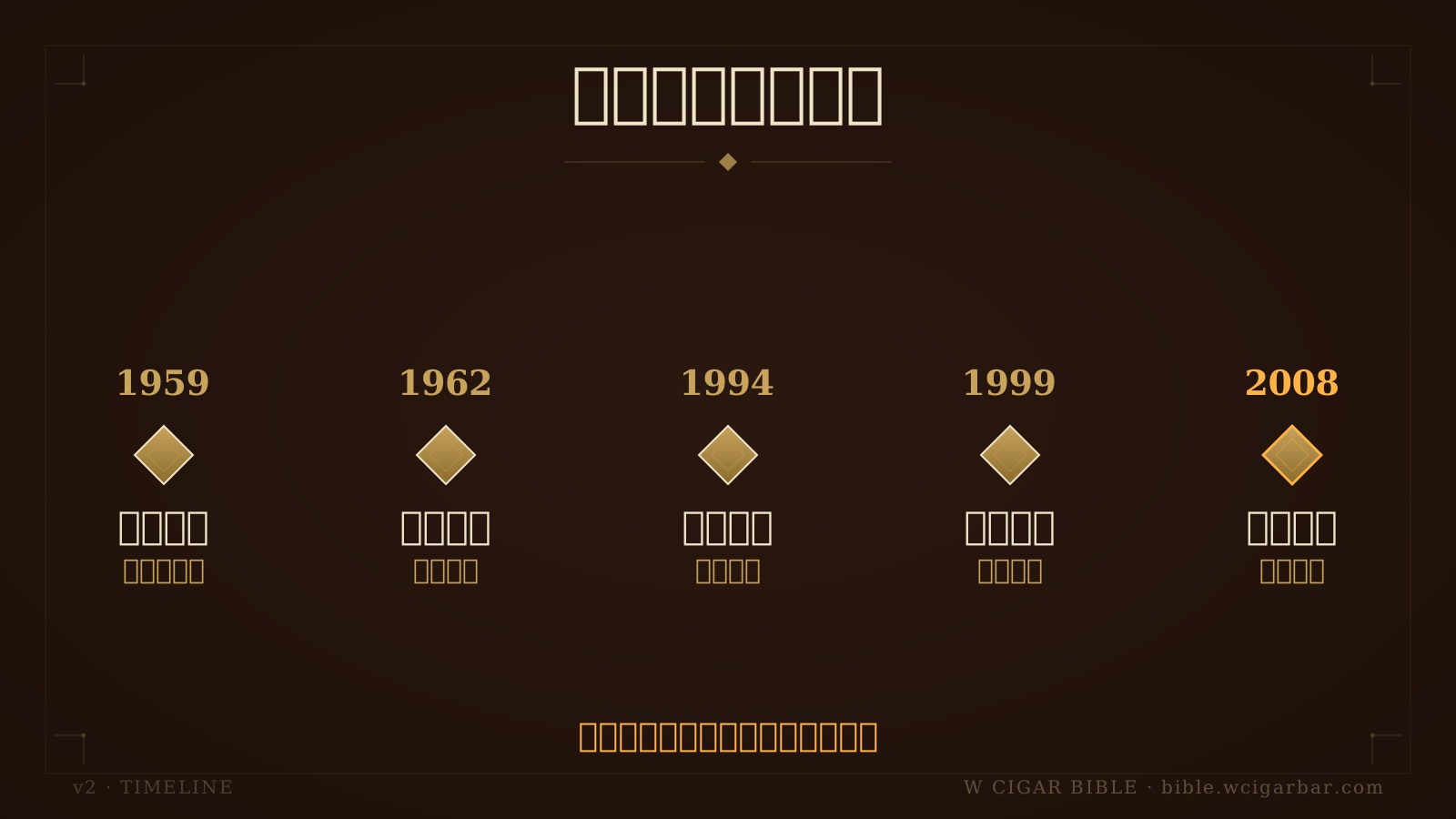
以一九五九革命接管到二〇〇八英國資本接手五個年代節點呈現古巴雪茄國有化制度演化的時間線圖
1959-1962 First Phase of Revolutionary Nationalization: Takeover and Integration
January 1959: A Historic Moment in the Nationalization of the Tobacco Industry
January 1959: After the victory of the Cuban Revolution, the Castro government immediately announced a policy to nationalize the tobacco industry.
It is widely circulated in the industry that the 1959 revolutionary takeover of the tobacco industry was faster than that of other industries (sugar, banking, mining). Reasons include:
- The strategic position of the tobacco industry as a source of Cuban foreign exchange from the United States
- The tobacco industry was concentrated in a few regions such as Vuelta Abajo, making it easier to take over
- Most factory families (Cifuentes, Menéndez, Romeo y Julieta, Hoyo de Monterrey) had already anticipated nationalization, and some had already moved capital out
The Three-Year Integration Period from 1959 to 1962: Three Core Tasks
Task 1: Takeover of Family Factories
- Cifuentes family (Partagás) - Ramón Cifuentes Toriello went into exile in 1961 after rejecting Castro's proposal
- Menéndez family (Montecristo / H. Upmann) - Alonso Menéndez and Pepe García went into exile in Miami in 1960 (with $7)
- Romeo y Julieta (after Pepín Rodríguez Fernández had passed away in 1954) - nationalized in 1960
- Hoyo de Monterrey and other family factories - all nationalized
- Families went into exile one after another (most moved to Miami in the United States, while some later relocated to the Dominican Republic / Nicaragua to rebuild non-Cuban brands)
Task 2: Redistribution of Tobacco Fields
- Most privately operated tobacco fields in Vuelta Abajo were converted into cooperatives
- Corresponding to Cuba's Agrarian Reform Laws of 1959-1963
- Some private tobacco farmers were allowed to retain small-scale cultivation, but were required to sell their harvest to state-owned institutions
- Large tobacco farms were all nationalized
Task 3: Interruption of Exports to the United States
- February 3, 1962: JFK signed Proclamation 3447
- February 7, 1962: The embargo officially took effect
- The largest single market for the Cuban cigar industry vanished instantly (see 1962-us-cuba-embargo-deep)

以三張卡片呈現古巴雪茄國有化體系主導六十餘年、四階段商業治理與五十比五十合資結構的核心結論圖
1962 Empresa Cubana del Tabaco Unified State Operation: Second Phase of Systematization
The Establishment and Mission of Cubatabaco
1962: The Cuban government established Empresa Cubana del Tabaco (abbreviated as Cubatabaco).
Cubatabaco's core mission: Unified management of tobacco-leaf procurement, Pilón fermentation, cigar factories, quality management, and global distribution for all Cuban tobacco.
Industry consensus: The establishment of Cubatabaco corresponded to "a complete structural transformation from multiple family enterprises into a single state-owned company" - one of the largest single nationalized integrations in the history of the global tobacco industry.
The 28 Years of Cubatabaco's State-Owned Single-Head Era from 1962 to 1990: Three Major Commercial Characteristics
Characteristic 1: Global distribution was directly handled by Cubatabaco
- Corresponding to "global marketing by a state-owned enterprise"
- Cubatabaco signed contracts directly with distributors in various countries
- In 1968, it signed a Cuban Davidoff partnership with Zino Davidoff (see cuban-davidoff-1968-1989-mystery-21-years)
Characteristic 2: Prices and quotas were determined by the Cuban government
- Corresponding to "cigar pricing under a planned economy"
- Not led by fluctuations in global market supply and demand
- Quota allocation reflected political considerations (priority for the Soviet Union, Eastern Europe, and non-aligned countries)
Characteristic 3: The Soviet Union was the core market
- Corresponding to "Eastern European consumption of Cuban cigars during the Cold War"
- The Soviet Union once accounted for the largest share of Cuban tobacco exports
- Eastern European countries (East Germany, Poland, Bulgaria) followed
1989-1991 The Greatest Commercial Challenge to the State-Owned Single-Head Model
August 1989: Davidoff Bonfire
- Zino Davidoff publicly burned approximately 130,000 Cuban-made Davidoff cigars
- This was the greatest commercial challenge to the state-owned single-head distribution model
- It reflected the failure of Cubatabaco's quality-control system
1991 Collapse of the Soviet Union
- Cuba lost its largest trading partner
- The Eastern European market collapsed
- Cubatabaco had to undergo a thorough commercial restructuring
Industry consensus: The dual blow of 1989-1991 (Davidoff's withdrawal + the collapse of the Soviet Union) made Cubatabaco's state-owned single-head model unsustainable.

比較古巴雪茄國營單頭時代與合資雙頭時代在分銷主體、定價方式與核心夥伴差異的資訊表
1994 Habanos S.A. 50/50 Joint Venture: Third Phase of Commercial Reform
The Historic Decision to Form a Foreign Joint Venture
1994: The Cuban government made a historic decision - to form a foreign joint venture:
- It established Habanos S.A. as a joint venture with Spain's national tobacco company Tabacalera S.A.
- 50% Cuban government (Cubatabaco) + 50% Tabacalera
- This was one of socialist Cuba's most important concessions to the market economy
The Commercial Logic of the 1994 Joint Venture: A Win-Win Structure
The Cuban side needed:
- Western distribution networks - Cubatabaco lacked the capacity for deep penetration in Europe
- Hard-currency foreign exchange - after the collapse of the Soviet Union, Cuba urgently needed a stable source of foreign exchange
The Spanish side needed:
- Monopoly distribution rights for Cuban cigars - Tabacalera's greatest asset in the European cigar market
- Expansion of its brand portfolio - Tabacalera's own brands lacked top-tier brands at the Cohiba level
This corresponded to a "win-win commercial governance structure".
The Transformation of Cubatabaco's Role
- Before the transformation (1962-1994): Executor of global distribution
- After the transformation (from 1994 onward): Joint-venture partner in global distribution
- Cubatabaco still existed, but its role shifted from "executor" to "shareholder representative"
The Formation of Altadis in 1999
1999: Spain's Tabacalera S.A. merged with France's SEITA to form Altadis S.A. - one of Europe's largest tobacco groups.
Altadis automatically assumed Tabacalera's 50% equity stake in Habanos S.A.
Industry consensus: The formation of Altadis in 1999 was an important milestone in the integration of the Western European tobacco industry - and Habanos S.A.'s 50% equity stake was one of Altadis's flagship assets.
2008 Imperial Brands Takes Over: Fourth Phase of Global Capital
The Historic Acquisition in 2008
2008: The United Kingdom's Imperial Tobacco (later renamed Imperial Brands) acquired 100% of Altadis S.A. - the industry estimates that the acquisition amount reached several billion euros - making it one of the largest mergers and acquisitions in the global tobacco industry at the time.
Imperial Brands automatically assumed:
- Altadis's 50% equity stake in Habanos S.A.
- All tobacco brands under Altadis
- The global tobacco distribution network
The Commercial Meaning of the Transfer
Industry consensus: This was a transformation of the joint-venture partner from Spanish public shareholding to British private capital.
Impact on Habanos S.A.:
- Cubatabaco still held 50% - the Cuban government's equity remained unchanged
- Imperial Brands took over 50% - replacing Altadis
- Management became substantially Westernized - British management style entered the Cuban cigar industry
- Global marketing strategy was upgraded - Imperial Brands' marketing expertise was introduced
Contemporary Ownership Structure of Habanos S.A.
The 18 years from 2008 to the present:
- 50% Cubatabaco (owned by the Cuban government)
- 50% Imperial Brands (a British listed company)
- Headquarters located in Havana
- Management appointed by both the Cuban and British sides
This is the commercial evidence for the "contemporary continuation of the nationalization system of Cuban cigars" - the core position of the nationalized system remains unchanged, but commercial governance has become more internationalized.

整理古巴雪茄國有化體系三個常見誤解與對應正確觀念的提醒圖
The New Phase of the Nationalized System after 2020: Three Contemporary Characteristics
Three contemporary characteristics are widely circulated in the industry (commercial analysis, not fully officially public):
Characteristic 1: ESG Investment Pressure
- Imperial Brands faces ESG assessment pressure in Europe
- It continues to assess the premium cigar business
- But its 50% equity stake in Habanos S.A. is still retained (a strategic asset)
- The industry widely recognizes that because of its monopoly position in the world's top-tier cigars, Habanos S.A. is one of the assets Imperial Brands is least likely to give up
Characteristic 2: The Special Position of Mainland China
- The global share of the contemporary Asia-Pacific region has risen
- Corresponding to the "market-structure shift of Cuban cigars"
- Mainland China has become a new growth engine
- Hong Kong PCC (Pacific Cigar Company) remains the principal axis of Asia-Pacific distribution
Characteristic 3: Dual Changes in Digital Marketing and the Decline of Cigarettes
- The cigarette market is declining rapidly (global smoking-ban policies have strengthened)
- The premium cigar market is growing against the trend (the number of gentlemen's club members is increasing)
- Habanos S.A. has strengthened digital marketing and membership systems
- Gentlemen's club members (VIP) have become the core customer group
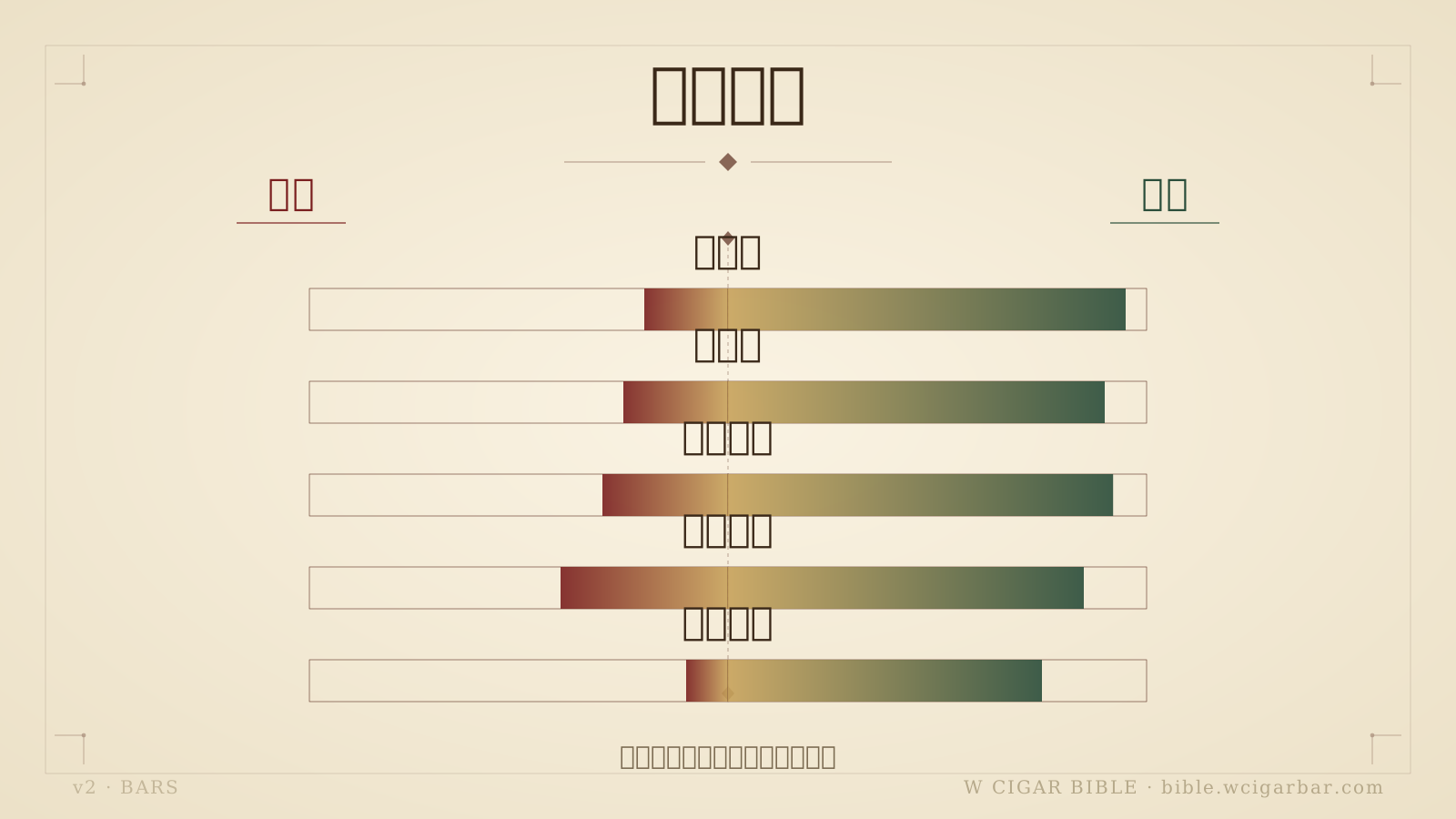
橫條圖比較家族企業與國營體系的治理權重
The Significance of the Nationalized System for Gentlemen's Club Members
The industry widely recognizes that 66+ years of a nationalized single quality source have created craftsmanship stability.
Craftsmanship Threshold Advantages of the Nationalized System
Unified control by Cubatabaco / Habanos S.A.:
- Tobacco-leaf procurement (unified management of Vuelta Abajo)
- Pilón fermentation (unified fermentation standards)
- Cigar factories (unified management of core factories such as El Laguito, Partagás, H. Upmann)
- Quality management (a single national quality-control system)
- Global distribution (controlled by a single company)
This is a "craftsmanship uniformity" that the diversified family-controlled structures of non-Cuban competing brands (Padrón, Davidoff Dominican, Fuente, My Father) cannot reach.
At the same time, however:
- The diversified family-controlled structures of non-Cuban brands create diverse craftsmanship styles
- Each family (Padrón, Plasencia, García, Quesada, Pepín) has its own blending philosophy
- For gentlemen's club members, the coexistence of the two systems provides the complete spectrum of cigar culture
Three Advanced Levels for Gentlemen's Club Members to Understand the Nationalized System
First level - Being aware during appreciation of the craftsmanship stability created by 67 years of nationalization
When a member lights a Cohiba Robustos:
- The tobacco leaves, rolling, and quality are all under the unified control of Cubatabaco / Habanos S.A.
- This 67-year craftsmanship stability is the core competitiveness of Cuban Habanos
Second level - Being aware during appreciation of the commercial reform of the 1994 joint venture
Comparison:
- 1962 state-owned single head vs 1994 joint-venture dual head
- The essential difference in global distribution
- The 1994 joint venture allowed Cubatabaco to gain deep access to Western markets
Third level - Being aware during appreciation of the special status of contemporary nationalization
Understanding the contemporary significance of Cuban cigars as a special category in ESG assessment:
-
It is not an ordinary tobacco business
-
It is one of the most important foreign-exchange assets of a socialist country
-
It is a strategic structure jointly held with a British capitalist giant
-
The most complete commercial appreciation experience of the nationalized system in the contemporary gentlemen's club.

三張問答卡回答主導年期統一年份與合資年份
Summary of the Historical Value of the 67-Year Nationalized System
From the 1959 revolutionary takeover -> 1962 Cubatabaco unified state operation -> the 1989-1991 dual crisis -> the 1994 Habanos S.A. 50/50 joint venture -> the formation of Altadis in 1999 -> Imperial Brands taking over in 2008 -> contemporary operation in 2026 - the Cuban cigar industry's 67 years have demonstrated through four phases of evolution that:
- Nationalization does not necessarily mean a decline in quality (except during the 1989-1996 crisis period)
- Public-private joint ventures can serve as a market bridge for a socialist economy
- A single brand portfolio can maintain a top-tier global position for more than half a century
For gentlemen's club members, collecting Cuban cigars = holding the material crystallization of a 67-year nationalized system.
Conclusion
Top-tier cigars are not determined by the market; they are the historical crystallization of 67 years of nationalization.
This sentence condenses the essence of 67 years of commercial governance at Cubatabaco / Habanos S.A.:
- The cigar industry of the market economy (non-Cuban) - diversified families, competitive innovation, varied styles
- The nationalized cigar industry (Cuban) - unified control, stable quality, craftsmanship threshold
For W Cigar Bar gentlemen's club members, understanding the 67-year evolution of Cubatabaco / Habanos S.A. = understanding why Cuban cigars remain at the core of the world's top-tier cigars in the contemporary era, why the 64-year United States embargo has still not shaken the global top-tier status of Cuban cigars, and why Asian gentlemen's club members still regard collecting Cuban cigars as the core path of appreciation.
Neutrality note: The nationalization system and political background discussed in this article are commercial analysis. Specific data vary according to government disclosure differences, are not fully officially public, do not constitute any political commentary or investment advice, and past performance does not represent future performance.
Procurement sources: Cuban cigars from four major regular channels (PCC authorized distributors, Cuban official state-run stores, Swiss general agent, Spanish general agent) - all connected to the legal distribution channels of the 67-year Cubatabaco / Habanos S.A. nationalized system.
W Cigar Bar Gentlemen's Cigar Lounge · Da'an District, Taipei - LUBINSKI Italian accessories general agent · cigar bistro · Da'an flagship store with 33 VIP cigar lockers (24-hour conditioning · 70% / 18°C professional conditioning) maintained by dedicated staff · founding store of the Capadura cigar brand.
Cigar Prince Wilson Tsai personally explains to VIP clients the impact of Habanos S.A.'s 67 years of commercial governance on contemporary Cuban cigar collecting.
Venue information: https://share.google/d9NIeFEetij9qWKj0
LUBINSKI accessories official website: https://cigarclub.tw/
This site is intended only for adults aged 20 or above. Smoking is harmful to health. Smoking cessation hotline: 0800-636363.
W Cigar Bar Gentlemen's Cigar Lounge, written and planned by Cigar Prince Wilson Tsai.
Like this article?Share with friends
Share this W Cigar Bible piece with friends who want to learn cigar culture, storage, and tasting.
想把這篇 化為實踐
雪茄聖經是知識;雪茄文化要在空間裡發生

W Cigar Bar 大安總店資訊
台北大安區 · 雪茄聖經總編輯 Wilson Tsai 主理的雪茄文化空間

33 座 24 小時恆溫恆濕醇化室
W Cigar Bar 提供的會員醇化空間 · 場地資訊請洽編輯部

雪茄剪 / 打火機 / 雪茄盒 / Boveda
W Cigar 配件官網 · 專營雪茄配件正品

加 LINE 好友 · 文化諮詢
文化空間資訊 · 紳士沙龍 · 私人包場
本網站內容僅供雪茄文化、歷史、收藏與品吸知識研究參考。菸品有害健康、未滿法定年齡者請勿吸菸。實際規範請依所在地法律為準。
吸菸有害健康・戒菸專線 0800-636363・本站僅供 20 歲以上成年人閱覽。
影片來源:Habanos S.A. 官方 YouTube 頻道 · 教育性內容引用 · AI 智能配對
讀到這裡,你不只是路過的人
留下 Email,加入 W 雪茄聖經內圈——總編輯 Wilson Tsai 親選的學院深文與國際新訊,先你一步送到信箱。
· 教育用途非銷售 · 隨時一鍵退訂 · Email 絕不對外公開 · 由勝茄股份有限公司營運
同分類延伸閱讀


資料來源:W Cigar Bible 編輯部整理 · 雪茄王子 Wilson Tsai 親自審稿
本文僅供雪茄文化、歷史、收藏與品鑑知識研究,不作為菸品促銷、銷售或購買建議。吸菸有害健康,未滿二十歲不得吸菸。