Cuban Davidoff 1968-1989 神秘 21 年完整檔案:從歷史性合作到倫敦銷毀 25 萬支的雪茄業最戲劇性事件
1968 Zino x Cubatabaco 歷史性合作 / 1969《鑑賞家之書》/ 1970-1985 黃金 15 年歐洲霸主 / 1989 倫敦銷毀 25 萬支戲劇性分手 / 1991 Cibao Valley 重生
Cuban Davidoff 1968-1989 神秘 21 年完整檔案—1968 Zino Davidoff 與 Cubatabaco 歷史性合作(Château 系列、Dom Pérignon、No.1/No.2 全用 Vuelta Abajo San Juan y Martínez 由 El Laguito 工廠捲製)、1969《Le Livre du Connaisseur 鑑賞家之書》出版定義紳士品鑑哲學、1970-1985 黃金 15 年估佔歐洲頂級紳士雪茄市場 30-40% 份額、1989 倫敦銷毀 25 萬支戲劇性分手(品質控制+配額制度+菸葉產區+商業條款多重原因)、1991 多明尼加 Cibao Valley 與 Tabadom 重生、紙本鏈條收藏意義。
- Cuban Davidoff 的歷史始於 1968 年,與古巴國營機構的合作使其成為頂級雪茄品牌。
- 1989 年 Zino Davidoff 公開焚毀不合格雪茄,象徵品牌對品質的堅持與決裂。
- 《Le Livre du Connaisseur》於 1969 年出版,成為雪茄鑑賞哲學的開創性著作,影響深遠。
Cuban Davidoff 1968-1989: The Complete 21-Year Dossier, from a Historic Partnership to the August 1989 Burning Incident - the Most Dramatic 21 Years in the Cigar Industry
The most dramatic single event in 200 years of cigar history -- in August 1989, Zino Davidoff publicly burned tens of thousands of nonconforming Cuban Davidoff cigars, an event historically known as the "Davidoff Bonfire" -- ended the 21-year existence of Cuban Davidoff (1968–1989) and opened Davidoff's rebirth in the Dominican Republic's Cibao Valley (1990-1991 to the present).
Regarding historical records of the quantity burned: the figure of "250,000 cigars" was widely circulated in the industry in earlier years, but Wikipedia and most contemporary English-language professional cigar literature consistently record the number as approximately 130,000 cigars. This article adopts the more precise figure of 130,000, while also respecting the earlier industry-circulated figure of 250,000 as part of the historical legend.
The industry consensus is that this event marked the rupture between Swiss top-tier gentlemanly cigar philosophy and the Cuban state-run system. It was the 20th-century cigar industry's most symbolic historical moment of "a brand choosing to disappear rather than accept a compromise in quality."
This article focuses on the complete 21-year dossier of Cuban Davidoff and does not repeat the overall Davidoff brand timeline (already included in the W Cigar Bar Da'an Main Store Cigar Bible, davidoff-complete-brand-history, covering Zino's full 88-year life from his birth in Kyiv in 1906 to his passing in Geneva in 1994).
1967: Cubatabaco's Historic Proposal to Approach Zino Davidoff
It Was Not Davidoff Seeking Cuba, but Cuba Seeking Davidoff
1967: Cuba's Cubatabaco (the Cuban state cigar organization and predecessor of Habanos S.A.) proactively approached Zino Davidoff with a proposal: to roll a personal-brand cigar for him at the newly established El Laguito factory in Havana.
This historical detail is extremely important -- it was Cubatabaco that sought out Davidoff, not Davidoff that sought out Cuba. The background:
- The El Laguito factory had just been established in 1966–1967, and its primary task was to roll Cohiba for Castro
- The factory still had spare production capacity and could simultaneously produce other top-tier brands
- Since the 1930s, Davidoff had already been one of the world's most important buyers of Cuban cigars, with deep ties to the Cuban tobacco industry
- Cuba needed foreign exchange and Davidoff's global gentlemanly distribution network
Cubatabaco's Strategic Calculation
It is widely circulated in the industry that in the late 1960s, under pressure from the U.S. embargo, the Castro government urgently needed to establish a stable European distribution network:
- The U.S. market was completely blocked (the embargo began in 1962 and has not been lifted)
- The European market became the main source of foreign exchange for Cuban cigars
- Zino Davidoff's Swiss base and global gentleman's-club network = the Cuban authorities' ideal partner
Cubatabaco's proposal: Davidoff would provide the brand; Cubatabaco would provide the El Laguito factory and tobacco leaves; both sides would share profits.
Industry consensus: this was one of the most exceptional cases of external cooperation in the Cuban cigar industry after the 1959 Revolution -- the Cuban government opened its very top factory (El Laguito, Castro's dedicated Cohiba factory) for use by a Swiss foreign brand, reflecting the urgency of Cuba's need for foreign exchange at the time.
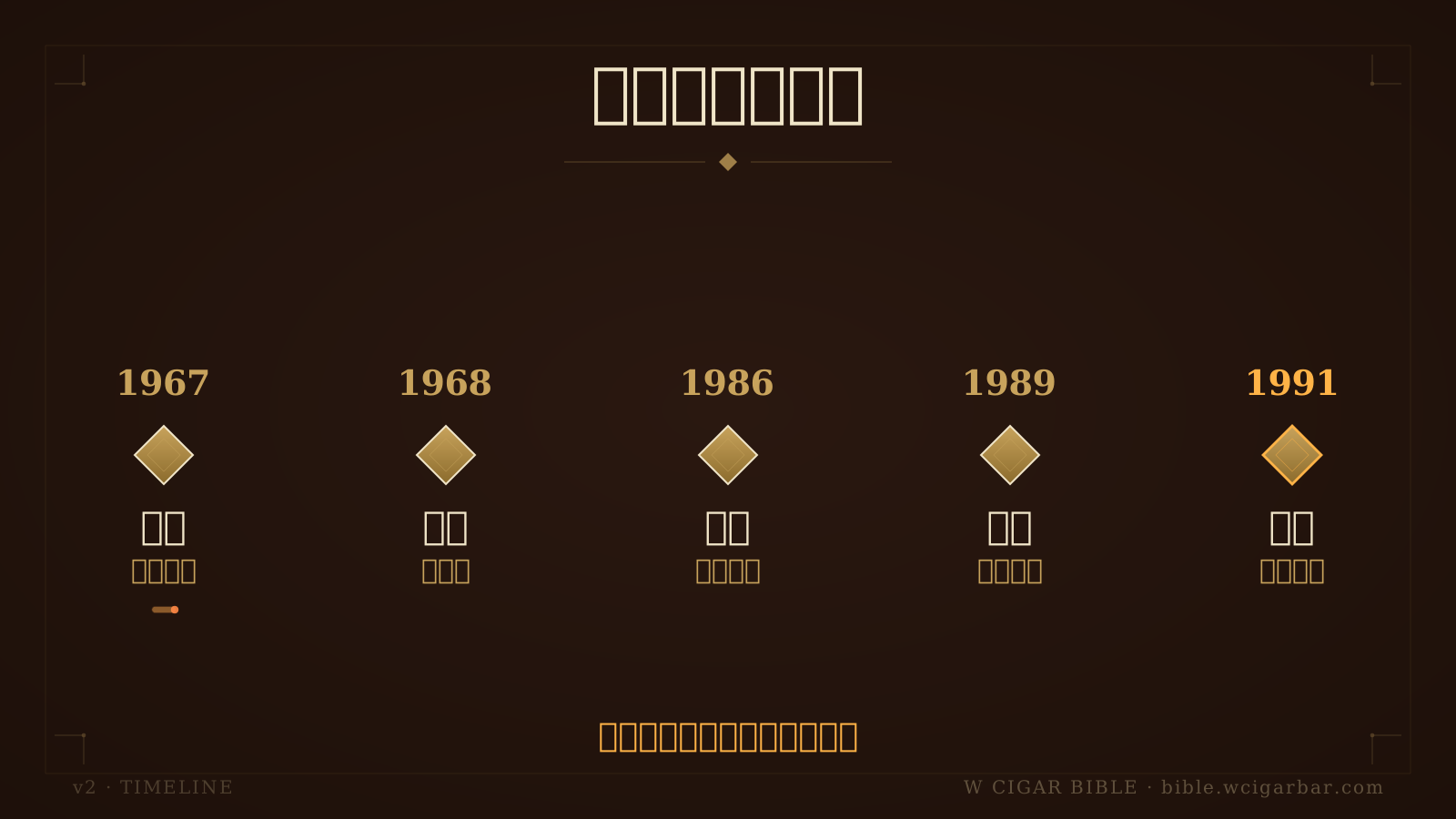
以時間線呈現 Cuban Davidoff 從一九六七到一九九一接觸黃金決裂與重生的重要年代節點圖
1968–1969: The First Three Cuban Davidoff Vitolas Released
The First Three Vitolas
1968–1969: The first three vitolas of Cuban Davidoff were rolled at the El Laguito factory and officially released:
- Specification details belong to the field of in-depth industry research
- Identifying feature: white band with gold lettering -- this was the visual identity of Cuban Davidoff (1968–1989), clearly distinguishing it from contemporary Dominican Davidoff (red-and-gold band)
The Evolution of Cuban Davidoff's Three Major Series
The main series released by Cuban Davidoff during 1968–1989:
Château Series (a tribute to the five great Bordeaux estates):
- Château Latour
- Château Margaux
- Château Mouton Rothschild
- Château Lafite
- Château Yquem (the king of Sauternes sweet white wine)
- Château Haut-Brion
Industry consensus: the Château Series was the most recognizable gentlemanly series of Cuban Davidoff's golden period -- connecting the brand narratives of two gentlemanly luxury categories, cigars and wine, to the fullest extent.
Dom Pérignon Series:
- A single format, paying tribute to the great French Champagne house
- Large vitolas
- A standard choice for gentlemanly dinners
Davidoff No. Series:
- Davidoff No. 1
- Davidoff No. 2
- Davidoff No. 3
A tribute to the naming traditions of classic Cuban brands such as Romeo y Julieta, this was the most fundamental entry series of Cuban Davidoff.
The Era of "Two Kings Sharing" at the El Laguito Factory
During the 21 years from 1968–1989, the El Laguito factory simultaneously produced Cohiba and Cuban Davidoff -- a historical fact of immense significance:
- The same factory: El Laguito in Havana's Playa district, converted from the villa of sugar magnate Alberto Casimiro Fowler Perilliat
- The same group of artisans: the team of female torcedora (rollers) led by factory director Avelino Lara
- The same growing region: top-grade Vuelta Abajo tobacco
- Different brand narratives: Cohiba was Castro's dedicated Cuban domestic brand, while Cuban Davidoff was a Swiss brand produced in Cuba
Industry consensus: 1968–1989 was the golden age of Cuban Davidoff -- because it used tobacco of the same grade as Cohiba, the same craftsmanship, and the same artisans, yet its price was far lower than Cohiba after Cohiba became publicly available (after 1982).
For contemporary collectors, 1968–1989 Cuban Davidoff is one of the most precious historical archives in the cigar world -- auction-house values can reach NT$ 30,000–80,000 per cigar (for specific well-preserved years).
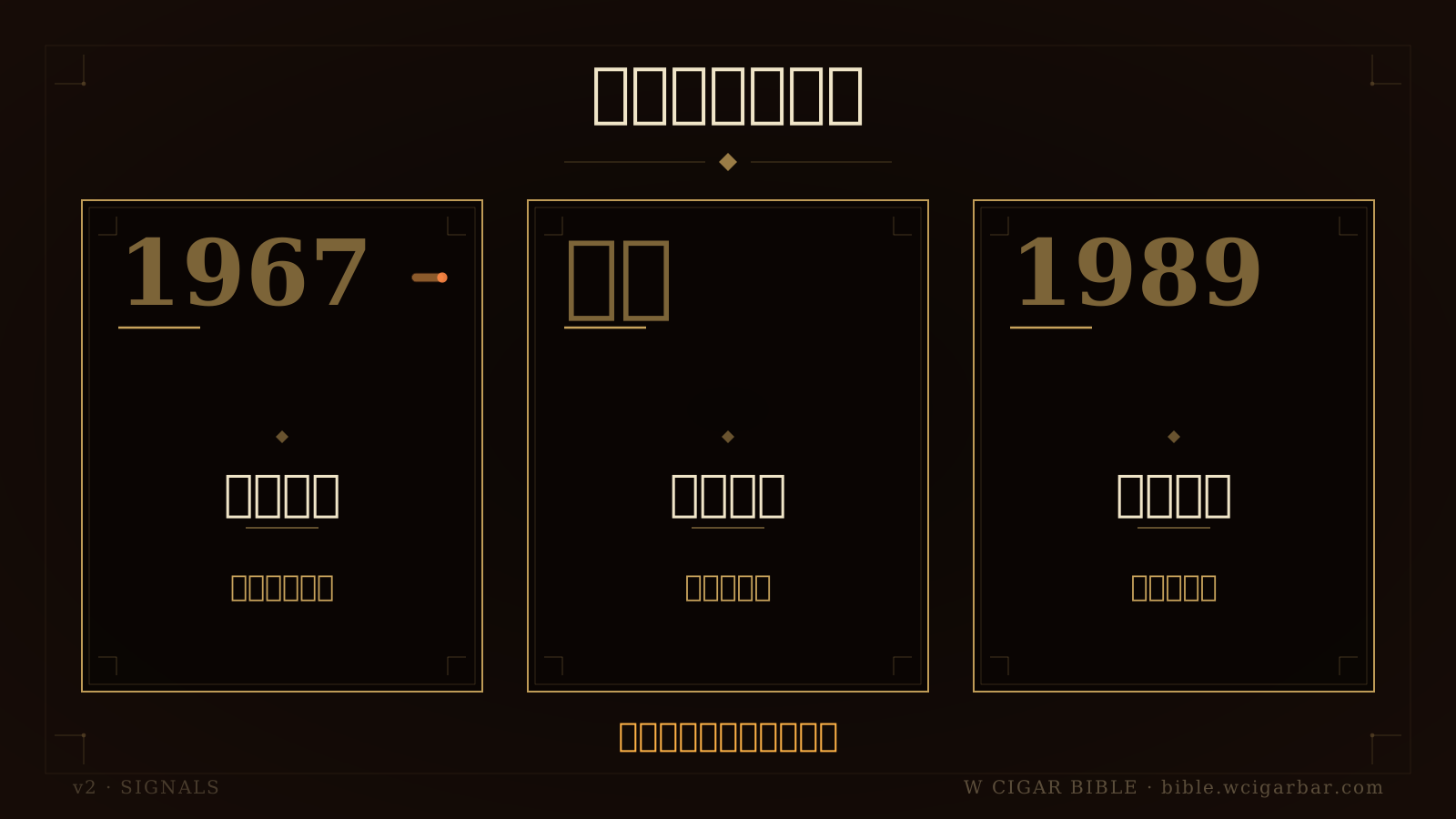
以三張卡片呈現 Cuban Davidoff 古巴主動提案、共廠生產與一九八九焚毀結束三個核心事實的結論圖
1969's "Le Livre du Connaisseur": The Codification of Gentlemanly Philosophy
The Most Influential Book in 200 Years of Cigar History
1969: Zino Davidoff published "Le Livre du Connaisseur" (The Connoisseur's Book) -- widely recognized in the industry as the single most influential book in 200 years of cigar history.
The historical status of this book:
- A pioneering work that codified gentlemanly cigar appreciation philosophy
- Defined the vocabulary of contemporary cigar appreciation (appearance / aroma / flavor / strength / balance / construction)
- Defined gentleman's-club etiquette (how to cut, how to light, how to rest, how to extinguish)
- Defined the science of cigar preservation (humidor, humidity, temperature, aging)
Widely circulated in the industry:
- The 1969 French edition was first published in Geneva
- The English edition in the 1980s allowed gentlemen around the world to read it
- It was later translated into more than 12 languages
- Industry estimates place cumulative sales at over 500,000 copies
The Market Significance of "The Connoisseur's Book" for Cuban Davidoff
Three points are widely recognized in the industry:
Significance 1: The officialization of gentlemanly appreciation philosophy
Cuban Davidoff became the "physical carrier of gentlemanly philosophy" -- to smoke Cuban Davidoff = to possess Zino's philosophy. The book and the cigar formed a dual brand narrative of "text + substance."
Significance 2: The establishment of a global gentleman's-club network
"The Connoisseur's Book" became a standard library holding in gentleman's clubs (with copies held in the libraries of London's White's, Boodle's, Brooks's, New York's Knickerbocker, and Tokyo American Club). Through the book's influence, Cuban Davidoff penetrated the global gentlemanly circle.
Significance 3: The formation of the Davidoff brand's "Swiss spirit"
From 1969 onward, Davidoff was not merely a cigar brand -- it was the representative of gentlemanly philosophy. Cuban Davidoff and the book formed a binding relationship in which "the brand equals philosophy" -- a density of narrative that other brands could not replicate.
1970–1985: The Golden 15 Years, Ruler of European Gentleman's Clubs
Cuban Davidoff's Dominance in the European Market
The 15 years from 1970–1985 are widely recognized in the industry as the most glorious stage in Cuban Davidoff's brand history.
During this period, Cuban Davidoff held what industry consensus describes as "overwhelming dominance" in the gentleman's-club market of Europe (especially Switzerland, the United Kingdom, France, and Germany):
- Widely circulated in the industry (some figures are not absolutely precise): by the mid-1980s, industry estimates placed Cuban Davidoff at a 30–40% share of Europe's top-tier gentlemanly cigar market
- Surpassing Cohiba (Cohiba had only just become publicly available in 1982)
- Surpassing Romeo y Julieta (a traditional choice of British gentleman's clubs)
- Surpassing Montecristo (the contemporary leading Cuban brand by sales)
Three Driving Factors Behind the Golden 15 Years
Factor 1: The victory of gentlemanly brand philosophy
Zino's Swiss spirit aligned deeply with 200 years of gentleman's-club culture -- industry consensus holds that it was "closer to the psychology of European gentlemen than any native Cuban brand."
Specifically:
- Native Cuban brands: strong, tropical, revolutionary narratives
- Cuban Davidoff: elegant, balanced, gentlemanly philosophy
- Gentleman's-club members in Europe = preferred the latter
Factor 2: Strict quality control
Widely circulated in the industry: Zino personally flew to Havana to inspect every batch of Cuban Davidoff and rejected it if he was dissatisfied.
Industry consensus: this quality discipline was the greatest difference between Cuban Davidoff and other Habanos brands -- quality control for other Cuban brands was carried out internally by Cubatabaco and lacked strict supervision by an external brand owner.
Factor 3: The transformation of retail stores into gentleman's clubs
Davidoff flagship stores in the following cities:
- Geneva Rue de Rive (global headquarters)
- London Bond Street / 35 St James's Street (geographically symbiotic with British gentleman's clubs)
- New York Madison Avenue
- Hong Kong Peninsula Hotel shop
- Tokyo Ginza flagship
The design of each flagship store: extending the spirit of the gentleman's club into the retail space -- wooden interiors, leather sofas, cigar lounge, wine area.
Industry consensus: this store design was a key foundation for the rapid penetration of Cuban Davidoff into gentlemanly circles in Europe, America, and Asia.

比較 Cuban Davidoff 古巴時期與多明尼加時期產地、標籤與主導工坊差異的資訊對照表
1986: The Davidoff Aniversario Series Released for Zino's 80th Birthday
1986: To commemorate Zino Davidoff's 80th birthday (1906–1986), Davidoff released the Aniversario Series:
- Aniversario No. 1
- Aniversario No. 2
- Aniversario No. 3
- Aniversario No. 4
The Aniversario Series was originally the flagship of Cuban Davidoff -- produced in Cuba from 1986–1989 and continued in the Dominican Republic after 1990 (with the blend completely rebuilt).
Industry consensus: the 1986–1989 Cuban version of Aniversario was the pinnacle of Cuban Davidoff -- the 81-year-old Zino personally supervised every batch of production, with quality requirements reaching the strictest standard of his life.
The Dramatic Separation of 1989: Accumulated Conflicts and a Rupture in Quality Philosophy
Three Accumulated Conflicts in the Late 1980s
The official industry-consensus reason was Zino Davidoff's dissatisfaction with Cuban quality control. It is widely circulated in the industry (some historical details are not absolute) that the real reasons were more complex, including three structural conflicts:
Conflict 1: Decline in tobacco-leaf quality
The quality of some batches of Cuban tobacco declined during the 1970s and 1980s (later called by the industry the prelude to the "1989–1996 bad Cuban cigar era"):
- Management became lax in parts of Vuelta Abajo due to economic difficulties on the eve of the Soviet Union's collapse
- Tobacco fermentation and aging times were shortened
- Defects appeared in some batches of wrapper
Davidoff demanded extremely strict quality control and had a high rejection rate; the Cuban side believed Davidoff was excessively demanding.
Conflict 2: Production quotas
Cubatabaco allocated more El Laguito capacity to Cohiba (after its public release in 1982, Cohiba became Cuba's top representative export):
- Cuban Davidoff's allocation was squeezed
- Davidoff could not meet the needs of gentleman's-club members worldwide
- The quota system itself was a restriction that Davidoff's philosophy could not accept
Conflict 3: Dispute over diversification of tobacco-growing regions
It is widely recognized in the industry that in the mid-1980s, the Cuban government began to promote diversification of tobacco-growing regions beyond Vuelta Abajo (including Partido, Remedios, Semi Vuelta, etc.):
- The Cuban side believed it needed to diversify tobacco-supply risks
- Industry consensus holds that Zino Davidoff "would not accept blends not from San Juan y Martínez"
- A fundamental divergence emerged between the two sides over the core understanding of "how Davidoff should be made"
August 1989: The "Davidoff Bonfire" -- the Cigar World's Most Dramatic Rupture
August 1989: Zino Davidoff publicly burned approximately 130,000 Cuban-made Davidoff cigars -- historically known as the "Davidoff Bonfire."
Historical Records Regarding the Quantity Burned
There are two versions in the industry regarding the quantity burned:
Version A (early industry circulation): 250,000 cigars
- Widely circulated in internal cigar-industry narratives in the 1990s
- Some Chinese-language and continental European cigar media continued to use this figure
- Emphasizes the dramatic nature of the event
Version B (Wikipedia + most contemporary English-language professional literature): approximately 130,000 cigars
- The Wikipedia entry for Zino Davidoff records "approximately 130,000 Cuban-made Davidoff cigars"
- Cigar Aficionado and most English-language professional literature consistently use this figure
- Closer to the actual inventory scale
This article adopts approximately 130,000 cigars as the more precise historical record, while also respecting the early industry figure of 250,000 cigars as a cultural legend.
The Symbolic Meaning of the Event
Regardless of the precise number, the historical significance of the Davidoff Bonfire remains unchanged:
- Value burned: based on retail prices at the time, industry estimates place it at several million Swiss francs (approximately US$ 1–2 million at the 1989 exchange rate)
- Public nature: media were present; it was a clear brand-statement ceremony, not a private disposal
- Brand philosophy: Davidoff would rather have no product than have a nonconforming product
Industry consensus: this was one of the most dramatic events in the 20th-century cigar world -- a brand would rather burn inventory worth several million Swiss francs than allow its quality to be compromised.

整理 Cuban Davidoff 歷史三個常見記錯與正確觀念的提醒圖
1989–1991 Transition: From Cuba to the Dominican Republic's Cibao Valley
1989: Formal Termination of the Contract with Cuba
1989: The contract between Davidoff and Cubatabaco was formally terminated -- bringing the 21-year existence of Cuban Davidoff (1968–1989) to an end.
Challenges during the transition:
- Handling global inventory and distribution networks
- Building a new supply chain in the Dominican Republic
- Redesigning the brand band system (white band with gold lettering -> red-and-gold band)
- Preserving the brand trust of gentleman's-club members
1990–1991: Rebirth in the Dominican Republic's Cibao Valley
1990: Davidoff began establishing a new production base in the Dominican Republic:
- Self-owned factory in Villa González, Dominican Republic
- Cooperation with Tabacalera de García (Tabadom) (the same factory as Dominican Montecristo)
- Hendrik "Henke" Kelner led blend design (called in the industry "the Avelino Lara of Davidoff's Dominican era")
1991: The first Dominican Davidoff was released -- officially beginning Davidoff's Dominican era, which continues to this day.
Tobacco Conditions in the Cibao Valley
Industry consensus regards the Cibao Valley as "the Central American growing region closest to the red-soil conditions of Vuelta Abajo":
- River-valley terrain
- Mineral-rich soil
- Relatively stable microclimate
- The core region of the Dominican cigar industry (top factories such as Tabadom, La Aurora, and Quesada are all located here)
The Rolling Lineage of the Tabadom Factory
It is widely recognized in the industry that a considerable proportion of Tabadom's cigar rollers are second-generation members of families exiled from Cuba between 1959–1962:
- Their parents worked in the rolling craft in Cuba
- After exile, they rebuilt family businesses in the Dominican Republic
- The second generation inherited the rolling craft and joined the Tabadom factory
Industry consensus: this is the continuation of rolling-craft lineage -- the craft spirit of Cuban Davidoff 1968-1989 was reborn in the Dominican Republic through the hands of the second generation of exiled families.
The Continuation of Contemporary Davidoff (1991 to the Present): A New Land for the Time Beautifully Filled Philosophy
Preserving the Core Gentlemanly Philosophy of Cuban Davidoff
Contemporary Davidoff (1991 to the present) is widely recognized in the industry as having preserved the core gentlemanly philosophy of Cuban Davidoff:
- Time Beautifully Filled
- No compromise in quality
- Luxurious but not ostentatious
- A choice of top gentleman's-club members worldwide
Together with the characteristics of the Dominican Republic's new soil -- industry consensus describes it as "the continuation of the Swiss spirit of Time Beautifully Filled on new land."
Contemporary Representative Works
- Aniversario Series (begun in 1986 to commemorate Zino's 80th birthday, continuing across the 1989 separation to the present)
- Millennium Blend (2000 millennium commemoration)
- Grand Cru (selected series)
- Special "R" (Robusto format)
- Nicaragua (2013 breakthrough Dominican + Nicaraguan blend)
- Yamasá (2014 new Dominican growing region)
- Winston Churchill Series (2015 tribute to Churchill)
- Royal Release (2014 ultra-premium series)
- Oro Blanco (industry consensus regards it as one of the most expensive contemporary regular-production cigars)
Widely recognized in the industry: contemporary Davidoff is the material continuation of Cuban Davidoff philosophy in a new era, not a rupture, but "Dominican leaves grown from Cuban roots."

長條圖比較國營體系與品牌哲學在五個面向的差異
The Contemporary Significance of Collecting Cuban Davidoff
Absolutely Limited Historical Collectibles
For gentleman's-club members, Cuban Davidoff 1968-1989 carries unique collecting significance:
- All products from these 21 years have been discontinued, making them absolutely limited historical collectibles
- It is widely recognized in the industry that well-preserved Cuban Davidoff Château Lafite, Dom Pérignon, No.1 / No.2 can reach several thousand U.S. dollars per cigar in the contemporary auction market
- Complete boxes (25 cigars or 50 cigars) can reach tens of thousands of U.S. dollars at auction
- Past performance does not represent future results, and transaction results vary greatly among auction houses
Authenticity Identification: The Importance of the Paper Chain
Industry consensus holds that authenticity identification for Cuban Davidoff, like other Pre-Embargo Cuban cigars, depends on the paper chain:
- Gentleman's-club purchase records (long-term purchase documentation of members)
- Insurance lists (appraisal records from cigar insurance companies)
- Provenance documents (family inheritance documents)
- Auction-house certificates of appraisal (appraisals by the cigar departments of Sotheby's and Christie's)
- Personal letters of recommendation from Zino (extremely rare, extremely high value)
For Cuban Davidoff with a complete paper chain, the contemporary significance widely recognized in the industry is not merely a cigar, but "physical evidence of possessing Zino's gentlemanly philosophy."
Industry consensus: Cuban Davidoff collectibles with a complete paper chain are one of the single collectible categories with the greatest historical depth in 200 years of gentleman's-club culture.

三張問答卡回答誰主動、燒毀數量與標籤辨識
W Cigar Bar Da'an Main Store's Standards for Cuban Davidoff Collecting
It is widely recognized in the industry that Cuban Davidoff collections with a complete paper chain, when kept in the environment of the 33 VIP cigar lockers at W Cigar Bar Da'an Main Store (24-hour constant-temperature aging, professional 70% / 18°C environment, specialist maintenance), meet what industry consensus describes as "one of the few places in Taiwan capable of satisfying the long-term preservation standards for 21-year Cuban Davidoff 1968-1989 collectibles."
For members storing antique Cuban Davidoff cigars over 35 years old, it is widely recognized in the industry that the optimal humidity and temperature range should be discussed in advance with specialists, with customized aging strategies based on the cigar's year and preservation condition:
- 1968–1975 early Cuban Davidoff: older in age, requiring lower humidity (65–68%) to avoid oil oxidation
- 1976–1985 golden-period Cuban Davidoff: standard humidity (68–70%) is sufficient
- 1986–1989 late-period Cuban Davidoff: comparatively newer, can use slightly higher humidity (70–72%)
An Advanced Cuban Davidoff Appreciation Path for Gentleman’s-Club Members
For gentlemen who wish to understand the full meaning of Cuban Davidoff 1968-1989, the advanced appreciation path widely recognized in the industry is:
Stage 1: Begin with the contemporary Davidoff Aniversario Series
- Experience the contemporary continuation of the Time Beautifully Filled philosophy
- Establish a Davidoff flavor baseline
Stage 2: Contemporary Davidoff Royal Release or Millennium Blend
- Experience the mature expression of Cibao Valley craftsmanship in the Dominican Republic
- Understand the continuation of Davidoff craftsmanship on new land
Stage 3: Cuban Davidoff with a complete paper chain (any series from 1968-1989)
- Reserved for important commemorative moments in life
- Paired with 25-year single-cask Scotch whisky
- Recreate the gentlemanly appreciation ritual defined by Zino in "The Connoisseur's Book" in 1969
Completing these three stages is the most complete Davidoff brand-history appreciation experience for contemporary gentleman's-club members -- a full picture from the Cuban golden age to the Dominican rebirth era.
Conclusion
There is one industry-consensus phrase for the 21 years of Cuban Davidoff (1968–1989):
A gentlemanly brand would rather disappear than accept a compromise in quality.
This sentence condenses all the historical meaning of Cuban Davidoff:
- 1967 Cubatabaco proactively sought out Zino -- the cigar industry's top-tier Swiss-Cuban cooperation
- 1968-1969 first three vitolas released -- 21 years sharing the El Laguito factory with Cohiba
- 1969 publication of "The Connoisseur's Book" -- the pioneering codification of gentlemanly philosophy
- 1970–1985: 30–40% market share in European gentleman's clubs -- one of the most glorious cigar brands in history
- 1986 Aniversario Series released for Zino's 80th birthday -- the peak of Cuban Davidoff craftsmanship
- August 1989 burning of approximately 130,000 cigars -- the cigar industry's most dramatic statement of quality philosophy
- 1990-1991 transition to the Dominican Republic's Cibao Valley -- cooperation with Tabadom and rebirth led by Hendrik Kelner
To understand the 21 years of Cuban Davidoff is to understand the most profound brand-philosophy lesson in the cigar industry of the late 20th century: true luxury is not what one possesses, but what one refuses to compromise.
For members of the W Cigar Bar gentleman's club, collecting Cuban Davidoff is not merely possessing top-tier antique cigars; it is possessing physical evidence of the gentlemanly quality philosophy that Zino Davidoff upheld throughout his life.
Sourcing channels: Cuban cigars from four major official channels (PCC authorized dealers, Cuban official state-run stores, Swiss general agent, Spanish general agent). W Cigar Bar Gentleman's Cigar Lounge · Taipei Da'an District -- complete contemporary Davidoff series (Aniversario / Grand Cru / Millennium / Special "R" / Nicaragua / Yamasá / Winston Churchill / Royal Release / Oro Blanco).
LUBINSKI Italian accessories general agent · cigar and wine bistro · Da'an Main Store with 33 VIP cigar lockers (24-hour aging · professional 70% / 18°C aging) maintained by specialists · founding store of the Capadura cigar brand.
Cigar Prince Wilson Tsai personally plans Cuban Davidoff antique-collection appreciation for VIP clients -- including paper-chain verification, customized aging strategies, and recreation of gentlemanly appreciation rituals.
Venue information: https://share.google/d9NIeFEetij9qWKj0
LUBINSKI accessories official website: https://cigarclub.tw/
This site is for adults aged 20 and above only. Smoking is harmful to health. Smoking cessation hotline: 0800-636363.
W Cigar Bar Gentleman's Cigar Lounge, written and planned by Cigar Prince Wilson Tsai.
Like this article?Share with friends
Share this W Cigar Bible piece with friends who want to learn cigar culture, storage, and tasting.
想把這篇 化為實踐
雪茄聖經是知識;雪茄文化要在空間裡發生

W Cigar Bar 大安總店資訊
台北大安區 · 雪茄聖經總編輯 Wilson Tsai 主理的雪茄文化空間
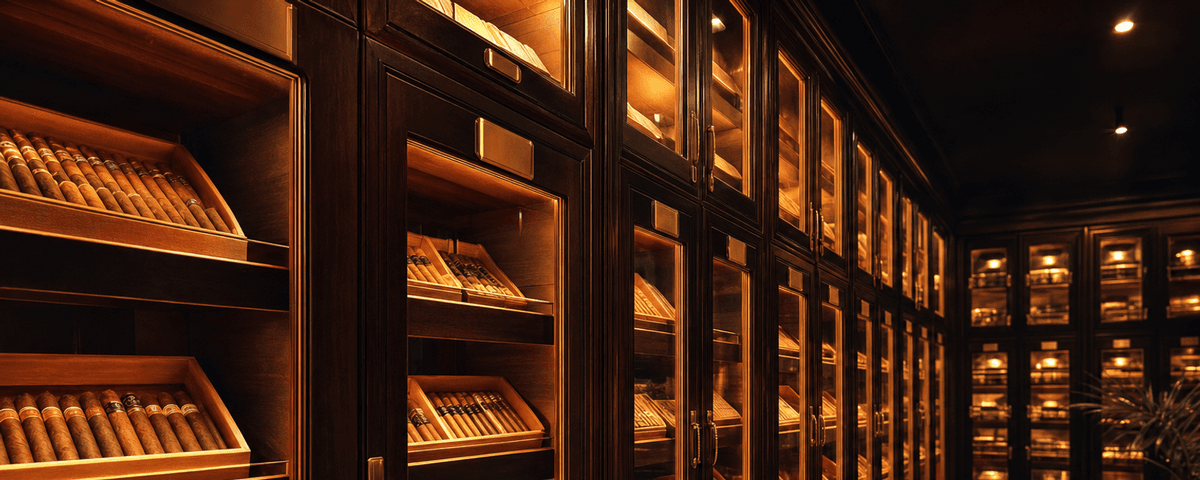
33 座 24 小時恆溫恆濕醇化室
W Cigar Bar 提供的會員醇化空間 · 場地資訊請洽編輯部
雪茄剪 / 打火機 / 雪茄盒 / Boveda
W Cigar 配件官網 · 專營雪茄配件正品
加 LINE 好友 · 文化諮詢
文化空間資訊 · 紳士沙龍 · 私人包場
本網站內容僅供雪茄文化、歷史、收藏與品吸知識研究參考。菸品有害健康、未滿法定年齡者請勿吸菸。實際規範請依所在地法律為準。
吸菸有害健康・戒菸專線 0800-636363・本站僅供 20 歲以上成年人閱覽。
影片來源:Habanos S.A. 官方 YouTube 頻道 · 教育性內容引用 · AI 智能配對
讀到這裡,你不只是路過的人
留下 Email,加入 W 雪茄聖經內圈——總編輯 Wilson Tsai 親選的學院深文與國際新訊,先你一步送到信箱。
· 教育用途非銷售 · 隨時一鍵退訂 · Email 絕不對外公開 · 由勝茄股份有限公司營運
同分類延伸閱讀


資料來源:W Cigar Bible 編輯部整理 · 雪茄王子 Wilson Tsai 親自審稿
本文僅供雪茄文化、歷史、收藏與品鑑知識研究,不作為菸品促銷、銷售或購買建議。吸菸有害健康,未滿二十歲不得吸菸。