雪茄的法律規範與市場動態分析

雪茄市場的價格波動不僅受品牌影響,更與法律、稅制及進出口政策密切相關。隨著全球菸草管制加強,雪茄被納入嚴格監管,影響了供應鏈與市場動態。不同國家的稅制差異,如重量稅與從價稅,直接改變了雪茄的最終售價及市場分配策略。此外,古巴雪茄因制裁與配額限制,價格波動更為明顯。亞洲市場則因稅制與法規差異形成多元生態,影響消費者行為與選擇。了解這些因素,對於雪茄愛好者而言,能更全面把握市場脈動。
Legal Regulations and Market Dynamics Analysis of Cigars
The world of cigars is often discussed in terms of flavor, vintage, box codes, and storage, but true connoisseurs need to understand the market beyond the sheen of the wrapper and the draw line. Why do prices suddenly spike, why are certain brands out of stock, and why is there a huge price difference for the same product in different cities? These are mostly driven by legal, tax, import-export, and distribution systems rather than decisions by individual retailers.
As the editor of the "Cigar Bible," my view is simple: cigars are a highly regulated commodity, and understanding regulations is not a buzzkill but a way to understand the business environment. From the 2005 enforcement of the WHO Framework Convention on Tobacco Control (FCTC) to the 2016 inclusion of cigars under more comprehensive regulation by the U.S. FDA, the market has long entered an era where "law determines the supply curve."
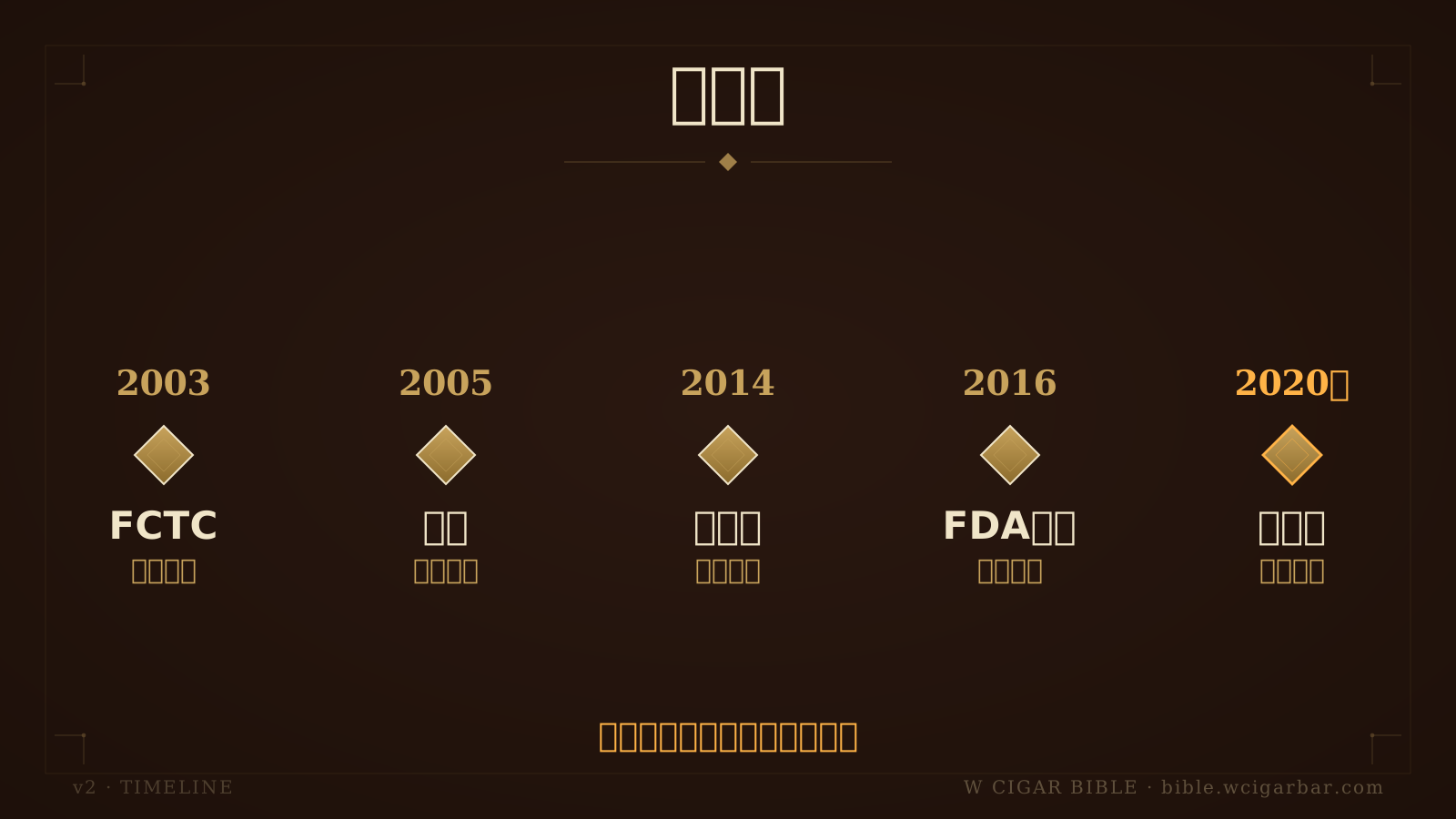
時間軸列出國際菸草監管的重要節點
Global Tobacco Control Framework: Cigars Are Not Cigarettes, Yet Under the Same Regulatory Net
The WHO FCTC, passed in 2003 and effective in 2005, is the mother law framework for tobacco policies in most countries today. It requires parties to take measures on packaging warnings, advertising restrictions, protection of minors, tax policies, and smoking restrictions in public places. Although cigars differ from cigarettes in consumption frequency, price, and usage scenarios, most countries still categorize them under the broad "tobacco products" category in legal terms.
The EU's 2014/40/EU Tobacco Products Directive requires health warnings, ingredient disclosures, and cross-border sales management; the U.S. FDA included cigars in its 2016 Deeming Rule, involving product listing dates, labeling, and warnings. These rules not only affect packaging but also change the cost for small brands to launch new sizes and blends, especially for boutique cigar factories in Nicaragua, the Dominican Republic, and Honduras.
The supply of cigars is often filtered through regulatory thresholds before consumers vote with their preferences. For example, the debate between U.S. courts and the FDA over the regulation intensity of premium cigars after 2020 has made manufacturers more conservative in new product development; after the EU standardized the warning area, brands like Habanos S.A., Davidoff, and Padrón had to prepare different packaging versions for different markets.
Veterans look at box labels, tax stamps, and import stickers as if reading a legal map. The same Cohiba Siglo VI, Montecristo No.2, or Partagás Serie D No.4 may have completely different legal information on the outer box in London, Hong Kong, Tokyo, or Taipei, and the price structure will be reshaped by tax rates, storage, compliance, and exchange rates.

三張卡片整理法規稅制與來源保存重點
How Tax Policies Rewrite Box Prices: From Weight Tax, Ad Valorem Tax to Minimum Tax Burden
Cigar tax systems can be roughly divided into three categories: taxed by weight, taxed by price, and taxed by number of units or equivalent cigarette conversion. Taiwan's cigar tobacco and alcohol tax is calculated by weight, with NT$1,590 per kilogram, plus a tobacco health and welfare surcharge of NT$1,000 per kilogram; Singapore's common classification is about SGD 427 per kilogram. This weight tax significantly affects large ring gauge and long-sized cigars, with Churchill, Double Corona, and Salomones naturally bearing higher taxes than minuto or petit corona.
The U.S. federal large cigar tax is ad valorem, with a rate of 52.75% of the wholesale price, but with a per-unit cap, recently around 40 cents, adjusted for inflation. This cap makes it easier to form a high-end consumer market in the U.S. than in areas taxed entirely by weight. States like Florida and Texas have different state tax policies, leading to significant differences in retail prices.
Tax systems determine not only the final price but also which sizes brands are willing to allocate to which markets. If weight taxes are extremely high in a region, agents may prefer to introduce Robusto, Petit Robusto, and Corona Gorda instead of Lusitania or A-series giant sizes; conversely, if the tax burden is capped or consumer acceptance is high, large ring gauge high-priced models have more room.
Taking global inflation and freight fluctuations from 2022 to 2024 as an example, the costs of paper boxes, aluminum tubes, cellophane, cold chain storage, insurance, and financing have all increased simultaneously. When the tax base is calculated based on landed cost or wholesale cost, price increases are amplified. Veterans who only focus on brand price adjustments will miss the multiplier effect of the tax system; understanding taxes helps identify whether a price increase is due to brand strategy, exchange rate changes, or a reshuffling of statutory costs.

矩陣比較重量從價與支數三種稅制
Cuban Sanctions, Quotas, and Supply Rhythm: The Peculiarities of the Habanos Market
Cuban cigars are the most typical case of political economy. Since the early 1960s, the U.S. has imposed an embargo on Cuba, preventing Cuban cigars from legally entering the U.S. commercial market; after a brief thaw in U.S.-Cuba relations in 2014, traveler carry limits were relaxed but tightened again in 2020. This has long isolated the U.S., one of the largest premium cigar consumer markets, from Cuban brands like Cohiba, Trinidad, H. Upmann, and Bolívar in formal commerce.
In 2022, Habanos S.A. significantly restructured international prices for high-end lines like Cohiba and Trinidad, with noticeable price jumps for Cohiba Behike, Siglo series, and Trinidad Fundadores in some markets. On the surface, it's brand premiumization, but behind it are interactions of production volume, exchange rates, post-pandemic supply chains, Asian demand, and official pricing strategies. When supply decreases and pricing moves up, the secondary market naturally becomes more active.
The price fluctuations of Cuban cigars cannot be explained solely by "how good they smoke"; sanctions, quotas, official pricing, and market distribution must also be considered. Between 2021 and 2023, many veterans clearly felt the unstable arrival rhythm of high-end Cuban models; some classic regular models like Ramón Allones Specially Selected and Juan López Selección No.2 also experienced hot and cold due to regional distribution.
When it comes to collection appreciation, I always remind: it does not guarantee appreciation, and still depends on source preservation and market. Beautiful box codes, rare vintages, and high brand visibility can indeed drive prices, but if the source is unclear, humidity is out of control, the outer box is damaged, or market heat reverses, the nominal market value may also disappear. Especially with many counterfeit Cuban cigars, legal and source documents are often more important than stories.

三張卡片提醒入境供應與來源判讀誤區
Comparison of Major Asian Markets: Hong Kong, Singapore, Japan, and Taiwan
The commonality of Asian markets is their high reliance on imports; the differences lie in tax systems, storage, regulatory language, and consumer culture. Hong Kong has long been one of Asia's cigar circulation hubs due to its free port, logistics, and storage conditions; Singapore is known for its high taxes, high enforcement efficiency, and clear import regulations. The Japanese market is stable but conservative, while Taiwan forms a relatively cautious commercial language under tobacco and alcohol taxes, health and welfare surcharges, and tobacco hazard prevention regulations.
| Market | Common Tax Logic | Market Characteristics | Impact on Consumer Behavior |
|---|---|---|---|
| Hong Kong | 2024 cigar tax about HKD 3,468 per kilogram | Strong logistics, many international customers | High-end models still have high price sensitivity |
| Singapore | About SGD 427 per kilogram | Heavy tax, clear regulations | Consumption leans towards precise purchases and regular customers |
| Japan | Tobacco tax calculated by weight converted to units | Detailed service, stable brands | Preference for small sizes and stable supply |
| Taiwan | Tobacco and alcohol tax NT$1,590 per kilogram, plus health and welfare surcharge NT$1,000 per kilogram | Regulatory language needs caution | Information acquisition and legal sources are more valued |
Asia is not a single market but multiple micro-ecosystems segmented by tax systems, storage, and regulatory language. The same box of Davidoff Nicaragua, Arturo Fuente OpusX, or Hoyo de Monterrey Epicure No.2 will have different prices, outer box labels, visible channels, and arrival speeds in different cities.
For veterans, cross-market price comparisons should include four things: first is local tax burden, second is temperature and humidity storage costs, third is agency system, and fourth is the range of information disclosure allowed by law. Focusing only on price tags can easily overlook the value of legal import, preservation records, and after-sales responsibility. Cigars are not standardized electronic products; a box that has been overheated, over-dried, or lost control during long-distance transport may return all the differences to you upon lighting.
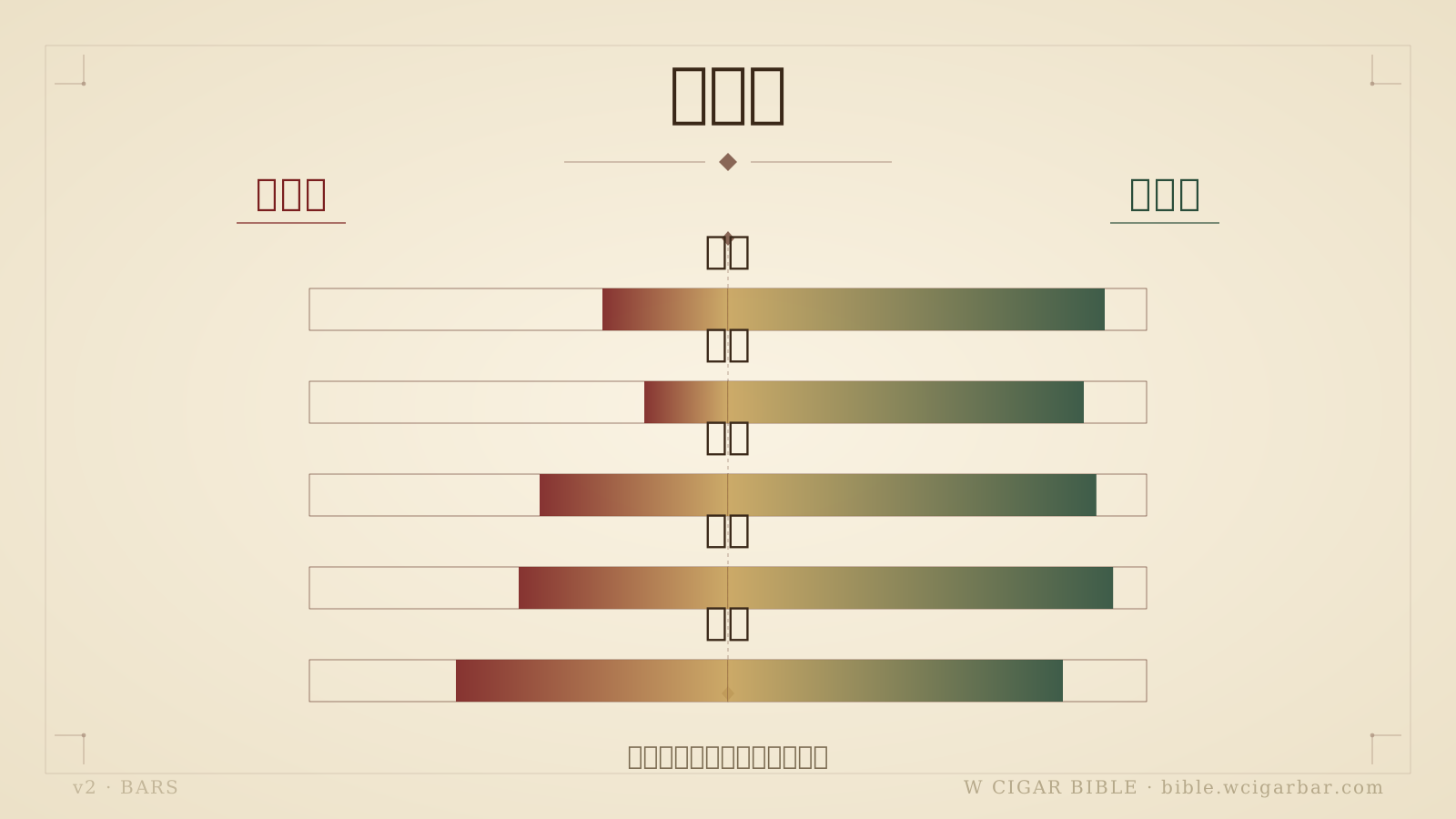
長條圖比較風味派與全局派的判讀重點
Packaging, Warnings, and Advertising Restrictions: Market Reactions After Brand Narratives Are Compressed
Packaging regulations are one of the most significant changes for cigar brands in the past decade. Australia implemented plain packaging for tobacco products as early as 2012, followed by the UK, France, Ireland, New Zealand, and others. Plain packaging requires brand visuals to be significantly reduced, with health warnings and standardized colors becoming the main appearance. For cigars, box labels, gold foil, embossing, and wooden box craftsmanship are part of the brand language; when visuals are compressed, brands must rely on word of mouth, series history, and channel education to maintain recognition.
The EU and many countries also restrict tobacco advertising, sponsorship, and cross-border online sales. This weakens traditional communication methods relying on large events or prominent displays, prompting brands to strengthen limited editions, regional editions, and vintage stories. For example, Habanos' Edición Limitada has been an important narrative tool since 2000; Davidoff builds recognition with the Zodiac series, Winston Churchill series, and regional blends.
When advertising space is compressed by law, brands with real history, stable supply, and consistent quality have an advantage. Because consumers have less access to public information, the accumulated trust of old brands becomes more valuable; at the same time, the knowledge of professional retail about storage conditions, source explanations, and style differences also becomes an invisible competitive advantage in the market.
This also explains why many new world boutique brands can still grow in the U.S. domestic market but advance more slowly in markets with highly restricted advertising. Padrón 1964 Anniversary, Oliva Serie V, and My Father Le Bijou 1922 have clear reputations among veterans, but without legal information dissemination and stable supply, the cost of understanding for new customers increases. The law not only restricts sellers but also changes the buyer's learning curve.

三張問答卡整理落差入境與缺貨原因
Import Sources, Parallel Circulation, and Authenticity Risks: Business Details Veterans Must Read
The legal commercial flow of cigars usually includes manufacturers, regional agents, importers, wholesalers, and retail ends. Cuban cigars are distributed by Habanos S.A. and its authorized systems worldwide; non-Cuban brands operate according to brand and regional agent contracts. Taking the PCC authorized dealer system as an example, the focus is on traceability of source, customs clearance, storage, and flow, rather than just looking at whether the outer box is pretty.
Parallel circulation exists in many commodity markets, and cigars are no exception. It may arise from regional price differences, exchange rates, inventory transfers, or tax arbitrage. The issue is not "cross-market" itself but whether the preservation responsibility and document chain are complete. Cigars fear heat, dryness, and drastic humidity fluctuations; if a box of goods stays in an environment above 30°C for several weeks, even if the outer box is intact, the internal oils and combustion performance may be affected.
Traceable sources and preservation records are more important risk management tools in the premium cigar market than discounts. Veterans judge a box of goods not only by box codes, seals, and laser marks but also by import labels, tax stamps, storage methods, arrival batches, and whether the seller can reasonably explain. Especially for items with higher counterfeit risks like Cohiba Behike, Trinidad, Partagás limited editions, and Fuente OpusX, you can't just listen to stories.
I recommend checking in the following order, rather than being led by a single low price:
- Check if source documents and legal labels are complete.
- Check if the outer box, seal, box code, and printing details are reasonable.
- Check if the storage environment has stable temperature and humidity records.
- Check if the market price of the same batch deviates abnormally.
- Check if the seller can explain the year, batch, and circulation background.
Frequently Asked Questions
Why can the price difference for the same cigar be up to twice as much in different countries?
Tax systems, exchange rates, agency systems, and storage costs together amplify the price difference. For high-end Cuban cigars, for example, the official price adjustment after 2022 has raised the benchmark price, and when layered with weight taxes, importer costs, and local operating expenses, significant retail price differences between two places are not surprising. Price difference is not the only standard for judging reasonableness; source and preservation are the core that veterans should first confirm.
Is it okay to bring cigars back to the country as long as the quantity is small?
Different countries have different duty-free allowances, carry limits, and declaration rules, and experience cannot be applied interchangeably. Taiwan, Hong Kong, Singapore, and Japan all have clear regulations on tobacco entry, and exceeding the limit may involve taxes and penalties; Singapore is particularly strict in enforcement, with high risks for undeclared items. You should check local customs announcements before departure and keep purchase receipts and packaging labels.
Why do some brands suddenly run out of stock and then reappear in large quantities after a few months?
Cigar supply is affected by agriculture, aging time, packaging materials, shipping, and regional quotas. Cuban brands also have national distribution and official pricing factors; new world brands may be influenced by U.S. demand, factory capacity, and tobacco leaf inventory. During the pandemic from 2020 to 2022, port delays and paper shortages caused many brands' delivery rhythms to be distorted.
Will plain packaging reduce collection value?
It will change the integrity of appearance and market preference but does not necessarily reduce value. Some collectors prefer original luxurious packaging, while some markets only accept legal plain versions. The key is still source, preservation, box condition, and market demand; when discussing collection appreciation, remember: it does not guarantee appreciation, and still depends on source preservation and market.
How do veterans judge the impact of regulatory changes on the market?
I look at three indicators: first, whether the tax rate or tax base has changed; second, whether packaging, warnings, and sales information are restricted; third, whether import-export or sanction policies affect supply. The real market dynamics often reflect on shelves and secondary markets three to six months after legal announcements. Don't just look at weekly prices; look at the entire supply chain reaction.
The charm of cigars lies in the fact that they are simultaneously agricultural products, handicrafts, luxury consumer goods, and highly regulated international commodities. I enjoy studying flavors and equally value sources, tax systems, and market logic; because the more you understand, the less likely you are to be led by market trends. A truly mature veteran not only chooses a good cigar but also understands how it came to be in front of them. —Cigar Prince Wilson Tsai
Smoking is harmful to health. No smoking under the age of twenty. Quitline: 0800-636363. This article is for reference by adults over the age of twenty for cigar culture, preservation, and regulatory knowledge and is not a tobacco advertisement, promotion, or purchase suggestion.
Like this article?Share with friends
Share this W Cigar Bible piece with friends who want to learn cigar culture, storage, and tasting.
想把這篇 化為實踐
雪茄聖經是知識;雪茄文化要在空間裡發生

W Cigar Bar 大安總店資訊
台北大安區 · 雪茄聖經總編輯 Wilson Tsai 主理的雪茄文化空間

33 座 24 小時恆溫恆濕醇化室
W Cigar Bar 提供的會員醇化空間 · 場地資訊請洽編輯部

雪茄剪 / 打火機 / 雪茄盒 / Boveda
W Cigar 配件官網 · 專營雪茄配件正品

加 LINE 好友 · 文化諮詢
文化空間資訊 · 紳士沙龍 · 私人包場
本網站內容僅供雪茄文化、歷史、收藏與品吸知識研究參考。菸品有害健康、未滿法定年齡者請勿吸菸。實際規範請依所在地法律為準。
吸菸有害健康・戒菸專線 0800-636363・本站僅供 20 歲以上成年人閱覽。
讀到這裡,你不只是路過的人
留下 Email,加入 W 雪茄聖經內圈——總編輯 Wilson Tsai 親選的學院深文與國際新訊,先你一步送到信箱。
· 教育用途非銷售 · 隨時一鍵退訂 · Email 絕不對外公開 · 由勝茄股份有限公司營運
同分類延伸閱讀



資料來源:W Cigar Bible 編輯部整理 · 雪茄王子 Wilson Tsai 親自審稿
本文僅供雪茄文化、歷史、收藏與品鑑知識研究,不作為菸品促銷、銷售或購買建議。吸菸有害健康,未滿二十歲不得吸菸。