桑丘潘薩
唐吉訶德的侍從——平凡人智慧的雪茄
評分方法 · 本評分為 W Cigar Bible 依據品牌歷史、國際能見度、產品穩定性、收藏討論度與華文市場辨識度綜合整理,非投資建議或銷售推薦。

Sancho Panza Belicosos(5½" × 52, vitola: Campanas, Belicoso)— 品牌靈魂雪茄,今日唯一持續常規生產的 vitola。風味:雪松、皮革、辛香、覆蓋蜂蜜甜尾韻;最後一吋是濃縮咖啡與焦糖。包葉是「牛奶巧克力色」並有美麗油光。被視為「Cuban Belicoso 標準範本」之一。
Sancho Panza 1848 年由德國商人 Don Emilio Ohmstedt 在哈瓦那創立——他同時也是 El Rey del Mundo 的創辦人。第一座工廠位於哈瓦那 Angeles 街 48 號。
Sancho Panza **1848 年(部分資料 1852)**由 Don Emilio Ohmstedt(也是 El Rey del Mundo 創辦人)在哈瓦那創立——是現存最古老的古巴雪茄品牌之一。
品牌名來自 西班牙文豪 Miguel de Cervantes(塞萬提斯)1605 年小說《Don Quixote》(唐吉訶德)中主角的隨從 Sancho Panza——那個樸實、矮胖、笑話連連的農夫。雪茄盒上至今仍印著他騎驢、跟隨唐吉訶德冒險的圖像。是雪茄業最早期借用文學角色命名的品牌之一。
品牌以**塞萬提斯(Miguel de Cervantes)1605 年小說《Don Quixote 唐吉訶德》**中的關鍵角色 Sancho Panza 桑丘潘薩命名——他是唐吉訶德忠實的鄉村侍從。這部小說常被稱為「史上最偉大小說」,所以 Sancho Panza 是雪茄業最具文學分量的命名之一。
Sancho Panza 1848 年由 Don Emilio Ohmsted(德裔西班牙人)在哈瓦那 Angeles 街 48 號工廠創立——他同時是 El Rey del Mundo 的創辦人。Sancho Panza 是雪茄業歷史上少數同一個創辦人創立兩個傳奇品牌的例子。
品牌名來自塞萬提斯(Miguel de Cervantes)1605 年小說《唐吉訶德》中騎士唐吉訶德的忠實侍從 Sancho Panza(桑丘·潘薩)——一個樸實、機智、腳踏實地的農夫。與 Romeo y Julieta、Montecristo 同樣是「文學經典命名」古巴品牌。
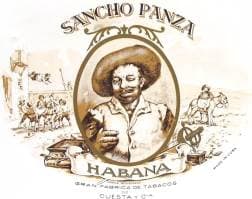
為什麼是 Sancho Panza 不是 Don Quixote?因為 Sancho 代表「平凡人的智慧」——一個謙卑的農夫,提供理性對抗他主人的瘋狂。19 世紀中期的捲菸工人(torcedores)能與這個角色產生共鳴——這比較像他們自己。今日盒裝上仍有 Sancho 的圖像,兩側裝飾著他冒險的場景。
Quijote RE España 2010(Prominentes 49 × 194mm Double Corona, 2,500×10)— 第一支 Sancho Panza Edición Regional,西班牙專屬。「Quijote」直接致敬唐吉訶德。2011 年實際發行。
Sancho Panza Molinos(Cervantes Lonsdale)— 2012 年停產——是品牌「最受懷念」的雪茄。「Molinos」西班牙文意為「風車」,紀念唐吉訶德著名的「對風車作戰」場景。今日在收藏家市場非常珍貴。
Sancho Panza Belicosos(5½" × 52, vitola: Campana)— 品牌旗艦 Cuban torpedo。140mm 長度、52 環徑。中等強度,特徵的微鹹尾韻。是 Sancho Panza 唯一仍在常規生產的較厚棒身。
Sancho Panza Non Plus(5⅛" × 42, vitola: Mareva, Petit Corona)— 2019 年官方停產但實際生產延續到 2024 年底——這個「停產又沒停產」的特殊狀態讓 Non Plus 成為收藏家追逐的奇特物件。35 分鐘體驗,雪松、堅果、土壤。
Sancho Panza Sanchos(9.3" × 47, vitola: Gran Corona, Giant Corona)— 品牌歷史代表的「巨型雪茄」——235mm 長度,是雪茄業最長的常規規格之一。2006 年正式停產,今日舊 Sanchos 是收藏聖品。「Sanchos」名稱直接致敬品牌主角,是品牌身份的核心。
Sancho Panza ΌΜΗΡΟΣ RE Chipre-Grecia 2020(Magnum 54 新規格, 15,000×10)— 賽普勒斯+希臘市場 RE。「ΌΜΗΡΟΣ」是希臘文「Homer 荷馬」(古希臘詩人)。2022 年底發行。雪茄業少見以希臘字母命名的雪茄。
Sancho Panza 風味:中等強度(medium-bodied)——「對古巴雪茄來說特別溫和」(surprisingly mild taste for Cuban cigars)。風味描述:奶油、堅果、淡淡花香、輕辛香、雪松、獨特的微鹹尾韻(saline flavour profile)。
Gran Quixote RE Belux 2017(Romeo, 10,000×10)— 比利時+盧森堡市場專屬 RE,雙頂 perfecto 形狀(借用自 Cuaba 風格)。100,000 支總量,是 Sancho Panza 最大規模 RE。2018 年 12 月發行。
Sancho Panza Belicosos(5½" × 52, vitola: Campana, Belicoso)— 品牌靈魂雪茄。經典 Cuban Belicoso/torpedo 規格,是品牌至今仍生產的核心款。風味:奶油、堅果、輕辛香、微鹹。
Sancho Panza Molinos(6½" × 42, vitola: Cervantes, Lonsdale)— 以《唐吉訶德》中知名的「風車」(molino) 命名——唐吉訶德的傳奇就是「對風車作戰」。2012 年停產——是品牌停產潮中最受懷念的款式。
1960 年革命後古巴政府國有化雪茄業——當時數千個雪茄品牌被刪減到只剩 25 個,Sancho Panza 是倖存的 25 個品牌之一。今日在 Romeo y Julieta 工廠(Briones Montoto)生產。
Sancho Panza 風味:中等強度(medium-bodied)——這在古巴雪茄裡相對少見(古巴的 Ligero 比美國雪茄強烈得多)。獨特風味特徵:微微的鹹味(slightly saline flavour profile)——是品牌的標誌性風味描述。
今日 Sancho Panza 常規系列嚴重縮水——僅有 Belicosos 一款常規生產(Non Plus 雖標示停產但仍在出貨)。這個從 7 款縮減到 1 款的過程在雪茄業極不尋常——其他 Habanos 品牌即使縮減也至少留 2-3 款。
革命後 Sancho Panza 由 Habanos S.A. 國有化生產,移至 Romeo y Julieta 工廠生產——兩個文學命名品牌共用工廠,是雪茄業有趣的文化巧合。
Sancho Panza 以大尺寸雪茄聞名——特別是 Belicosos 與 Sanchos(巨型 Gran Corona, 9.3" × 47, 235mm!)。Sanchos 是雪茄業最大的常規生產 vitolas 之一。
Sancho Panza Gran Quixote RE Belux 2017(Romeo 規格全新尺寸, 10,000×10)— 比利時+盧森堡市場 RE,100,000 支限量。紀念比利時與盧森堡 1922 年成立的政治經濟聯盟。2018 年 12 月發行。
Sancho Panza 在哈瓦那 Romeo y Julieta Factory 生產——這個工廠生產關係從革命後沿用至今。
Sancho Panza Molinos(6½" × 42, vitola: Cervantes, Lonsdale)— 名稱來自唐吉訶德最有名的場景——「跟風車戰鬥」(tilting at windmills)——「Molinos」就是西班牙文「風車」。2012 年停產,是品牌停產潮中最被懷念的之一。
一個有趣的 Habanos 命名邏輯:很多 Sancho Panza vitolas 都用唐吉訶德角色或場景命名——Quijote、Quixotes、Molinos(風車)、Bachilleres(學者)、Escuderos(侍從)——形成一個完整的「文學主題雪茄宇宙」。
Sancho Panza 在 Habanos 體系是 Other 分類(小眾品牌)。今日全部使用 Vuelta Abajo 區的菸葉,所有現行 vitolas 都是「totalmente a mano con tripa larga」(完全手工長填充)。
Sancho Panza Quixotes RE España 2010(vitola: dress box of 10, 2,500 個編號)— 西班牙專屬 RE,直接以 Don Quixote(堂吉訶德本人)命名。2011 年發行。是品牌與「主角」最直接的致敬。
Sancho Panza 風味定位:輕到中等強度(mild to medium,部分 vitolas 達 medium to full)。風味描述:雪松、皮革、堅果、奶油、蜂蜜、辛香、淡咖啡——是「鄉村樸實派」古巴雪茄的代表,反映 Sancho Panza 角色的「腳踏實地」性格。
Sancho Panza Gran Quixote RE Belux 2017(Romeo 新規格, 10,000×10)— 比利時+盧森堡市場 RE。100,000 支限量總數,紀念比盧政治經濟聯盟。2018 年 12 月發行。
Sancho Panza 在《唐吉訶德》中是「理性派配角」——當主人沉迷於騎士幻想時,他保持腳踏實地的智慧。雪茄品牌沿襲這個性格——樸實、可靠、機智、不浮誇。
1940 年 Rey del Mundo 公司正式買下 Sancho Panza——從此兩個品牌長期是兄弟品牌。1940-50 年代是 Sancho Panza 的繁榮期,特別在西班牙市場大受歡迎。
Sancho Panza Non Plus(vitola: Petit Corona, Mareva)— 2019 年正式停產(但實際上至少到 2024 年底仍在生產——這個「停產但持續生產」的奇特狀態反映 Habanos 的庫存管理策略)。曾經是日常雪茄首選。
Sancho Panza Non Plus(5⅛" × 42, vitola: Mareva, Petit Corona)— 2019 年正式停產但 2024 年底仍在生產。經典 Petit Corona 規格,是品牌「日常品鑑」最受推薦款。風味:奶油、強烈奶香。
Sancho Panza Belicosos 在 Cigar Aficionado 評鑑中多次獲 88-92 分——是「Cuban Belicoso」級距中除 Bolívar Belicoso Fino、Romeo y Julieta Belicoso 外的第三個經典代表。
Sancho Panza Sanchos(9.3" × 47, vitola: Gran Corona, 235mm)— 巨型 Gran Corona 規格,是雪茄業最大的常規 vitolas 之一。2006 年停產。今日 Sanchos 是收藏家眼中的「巨人雪茄」傳奇。
Quixotes RE España 2010(Prominentes 194mm × 49, 2,500×10)— 品牌第一支 Edición Regional——西班牙市場專屬。以 Don Quixote 命名是文學致敬。Standard band D 加 Spain RE 環。2011 年發行。
品牌一度沒落——1898 年原始 Sancho Panza 品牌停產。1900 年代初由新業主重新啟動,1880 年代由 Ramón Allones 收購過,幾度易手後1940 年由 Rey del Mundo Cigar Co. 收購——再次回到 Emilio Ohmsted 創立的另一個品牌的旗下。
Sancho Panza 與其他文學命名古巴雪茄形成「雪茄文學三巨頭」:Montecristo(仲馬《基度山恩仇記》)、Romeo y Julieta(莎士比亞)、Sancho Panza(塞萬提斯)。三家都用世界文學名著為品牌命名。
**醇化版 Sancho Panza Molinos(2012 前)**是收藏家眼中的稀有藏品——Cervantes Lonsdale 規格、加上品牌獨家、加上停產,價格在拍賣市場持續上漲。
Escuderos RE Alemania 2011(Escuderos, 3,000×10)— 德國市場 RE。「Escudero」西班牙文「侍從」——直接致敬 Sancho Panza 作為唐吉訶德侍從的身份。
Escuderos RE Alemania 2011(Escuderos 全新規格,3,000×10)— 德國市場 RE。「Escudero」西班牙文意為「侍從」——直接呼應 Sancho Panza 在《唐吉訶德》中的角色。
Sancho Panza 雪茄盒上印有樸實農夫的形象,兩側是他陪伴唐吉訶德冒險的藝術描繪——是雪茄業最具文學感的視覺設計之一。
Sancho Panza OMHPOΣ RE Chipre-Grecia 2020(Magnum 54, 15,000×10)— 賽普勒斯+希臘市場 RE。「OMHPOΣ」是希臘文「Homer」(荷馬,古希臘詩人)的拼寫——是文學主題 RE 的延續。2022 年底發行。
盒裝設計:今日 Sancho Panza 雪茄盒上仍有 Sancho 騎著驢的圖像,兩側是他冒險的場景。這個圖像幾乎 200 年沒變過——是品牌與 Don Quixote 文學遺產的視覺連結。
Sancho Panza 在 Habanos 體系是「Other」分類(小眾品牌),市場份額很小。所有 vitolas 都是「totalmente a mano con tripa larga」(完全手工長填充),全 Vuelta Abajo 菸葉。
1940-50 年代品牌真正繁榮,特別是在西班牙市場——西班牙菸民特別喜愛 Sancho Panza 的溫和風味與《唐吉訶德》文化連結。
品牌歷史曲折:1898 年品牌曾經停產——可能因古巴獨立戰爭與市場混亂。1900s 在新所有人下重新建立,1930s 回到 Rey del Mundo Company(Don Emilio Ohmstedt 原集團)旗下。
1940-50 年代品牌在西班牙市場大放異彩——西班牙菸民對「Sancho Panza」這個本國文學角色名特別有感情。這個西班牙傳統至今延續。
Sancho Panza Escuderos RE Alemania 2011(Escuderos 新規格, 3,000×10)— 德國市場 RE。「Escudero」西班牙文意為「侍從」——紀念 Sancho 自己的角色(侍從 Don Quixote)。
所有古巴版 Sancho Panza 都是「totalmente a mano con tripa larga」(完全手工長填充),全 Vuelta Abajo 菸葉。在 Romeo y Julieta 工廠生產。
唐吉訶德與雪茄:唐吉訶德的英文翻譯版至今仍被列為「史上最偉大的小說」。Sancho Panza 雪茄繼承這份文學遺產——抽 Sancho Panza Belicosos 時你正在分享一個 420 年的文化記憶。
Sancho Panza OMHPOΣ RE Chipre-Grecia 2020(Magnum 54, 15,000×10)— 名稱是希臘文拼寫的「Homer 荷馬」(古希臘詩人)。希臘+塞普路斯市場 RE。2022 年底發行。
從 13 個常規 vitolas(早年)到今日僅剩 1 個(Belicosos)——Sancho Panza 是 Habanos 系列中最劇烈精簡的品牌之一。是「品牌存活但 vitola 大量停產」的典型案例。
「Sancho Panza 個性」與雪茄哲學的呼應:當其他古巴品牌追求戲劇性(Cohiba 奢華、Bolívar 力道、Trinidad 神祕),Sancho Panza 像它的同名角色一樣樸實可靠——「理性派古巴雪茄」的代表。
1880 年代品牌被 Ramón Allones 收購——這是現存兩個 1830-40 年代古巴老品牌(Sancho Panza + Ramón Allones)合併的歷史關鍵時刻。
1960 年 9 月 15 日 Sancho Panza 工廠被古巴政府正式國有化——是革命後雪茄業國有化的具體日期之一。
醇化 5-10 年的 Sancho Panza Belicosos 在收藏家眼中深度遠超價格——是「最被低估的 Cuban Belicoso」之一。
Sancho Panza 角色在 Cervantes 小說中是**「驕傲的不識字」(proudly illiterate)的腳踏實地農夫**——與唐吉訶德的瘋狂理想主義形成對比。雪茄品牌取這個名字,象徵**「腳踏實地、誠實、不裝模作樣」**的雪茄精神。
1898 年品牌停產——Don Emilio Ohmstedt 早期的努力沒有得到太多回報,世紀末公司關閉。這也大致是西班牙-美國戰爭結束、古巴脫離西班牙的時刻。
醇化版 Molinos(2012 前生產的 Lonsdale)是品牌真正稀有藏品——Lonsdale 規格 + 文學名 + 停產三重稀有效應,未來收藏潛力極大。
Sancho Panza El Rey RE Asia Pacífico — 亞太市場 RE,是品牌最重要的亞洲市場 RE 之一。
1930 年代回到 Rey del Mundo Company——Sancho Panza 與 El Rey del Mundo(同樣由 Don Emilio Ohmstedt 創立)重新在同一個公司旗下。
Sancho Panza 沒有什麼戲劇性歷史——「Untroubled History」是品牌的特色。沒有黑暗過去、沒有爭議、沒有創辦人傳奇,僅僅是 177 年來持續做出溫和優雅的雪茄。這份「平凡」本身就是價值。
Sancho Panza 與 Romeo y Julieta 共用 Romeo y Julieta 工廠生產——兩個文學經典命名品牌的「雪茄業文學雙璧」。對講究文化品味的玩家是有趣的雙連發收藏。
美國非古巴 Sancho Panza Dulcinea 在 Cigar Aficionado 評鑑中獲 93 分——是非古巴版的高分代表。「Dulcinea」是 Don Quixote 的浪漫迷戀對象(書中的虛構戀人)。
宏都拉斯版 Sancho Panza Double Maduros 推出時 Cigar Insider 4 個 frontmarks 都獲 90+ 分——對於 Marvin Shanken 的 Cigar Insider 評鑑來說是非常罕見的成就。
Sancho Panza Cuban 雪茄環設計:4 個版本演進——Standard band A(1960 前到 mid-1970s,深棕色)、B(mid-1970s 到 c2002/3,淺棕色)、C、D(最新)。雪茄環演進是辨識醇化版本的關鍵。
Sancho Panza 因為產量小、市場份額低,很多歐洲市場根本買不到——是真正的「藏家品牌」。台灣、香港等亞洲市場通常只有 Belicosos 與少量 Non Plus 庫存。
雪茄盒上的 Sancho Panza 形象:樸實農夫騎驢,跟隨唐吉訶德冒險。盒子兩側是他的冒險場景藝術插圖。是雪茄業最具文學性的視覺包裝設計之一。
美國市場:1981 年 Villazon & Company 在美國註冊 Sancho Panza 商標。1997 年 General Cigar Company 收購 Villazon——含所有品牌。2001 年 General Cigar 在多明尼加/宏都拉斯生產的非古巴 Sancho Panza 上市。
Sancho Panza 與 El Rey del Mundo 的關係——兩個品牌都由德國商人 Don Emilio Ohmstedt 創立、後來都歸 Rey del Mundo 公司、革命後都倖存。是雪茄業少有的「同創辦人姐妹品牌」案例之一。
Sancho Panza 在 Habanos 體系是「Other」分類(小眾品牌),市場份額很小。但在西班牙市場至今仍是傳統熱門品牌。
對 Cuban Belicoso 玩家,Sancho Panza Belicosos 是「比 Bolívar Belicoso Fino 更溫和的 Belicoso 替代」——同樣的 Campana 規格,但風味光譜完全不同。
今日 Sancho Panza 常規系列僅剩 Belicosos 一款(Non Plus 雖 2019 停產但 2024 仍在生產)——是 Habanos 多次精簡後的最終形態。但 RE 系列持續活躍。
美國/宏都拉斯版 Sancho Panza:1981 年由 Villazon & Company 在美國註冊商標,後被 General Cigar Company 收購。2001 年推出宏都拉斯版,由 Hoyo de Monterrey 雪茄大師 Estelo Padrón 監督製作——使用 Honduran American Tabaco S.A. 工廠。風味與古巴版完全不同:Oscuro 包葉、強烈濃郁、square-pressed 方壓造型。
Sancho Panza Quixotes(5" × 44, Petit Corona)— 名稱直接來自 Don Quixote 主角本人。1970 年代停產。是品牌歷史最有文學連結的 vitola 之一。
宏都拉斯版 Sancho Panza 革命後在美國市場銷售,但遠不如古巴原版受推崇。今日「兩個 Sancho Panza」格局延續:古巴版 Habanos S.A.(全球除美國)+ 宏都拉斯版(美國)。
Sancho Panza Bachilleres(5½" × 40, Petit Corona)+ Tronquitos(5.6" × 42, Coronas)+ Quixotes(5" × 44, Petit Corona)— 革命前老款,全部在 1970s-2006 之間陸續停產。
Sancho Panza Bachilleres(vitola)— 大學生(Bachiller)名稱致敬唐吉訶德小說中的另一個學者角色 Sansón Carrasco。2006 年停產。
Sancho Panza 雪茄環演變:Standard Band A(pre-1960 to mid-1970s, 暗咖啡色)→ Standard Band B(mid-1970s to c2002/3, 淺咖啡色)→ Standard Band C → Standard Band D(現行)。雪茄環變化反映品牌不同時期定位。
Sancho Panza Coronas(5⅝" × 42, vitola: Coronas, Tronquitos 別名)— 經典 Cuban Corona 規格。已停產但舊版本仍是收藏品。
Sancho Panza Bachilleres(Petit Corona)— 2006 年停產。「Bachilleres」意為「學士」——紀念唐吉訶德故事中的學者角色。
Sancho Panza RE Suiza 2017 — 瑞士市場 RE,2017 年底發行。是品牌歐洲 RE 系列的代表之一。
1900 年代起品牌易主多次——20 世紀初有新所有人重新啟動 Sancho Panza。隨後幾十年品牌持續易主。
Sancho Panza RE Suiza 2017— 瑞士市場 RE,2017 年底發行。是品牌歐洲 RE 的重要案例之一。
Sancho Panza Eslavo RE Serbia— 塞爾維亞市場 RE,「Eslavo」意為「斯拉夫人」。
Eslavo RE Serbia — 塞爾維亞市場 RE。「Eslavo」意為「斯拉夫人」,反映 RE 計畫對東歐市場的關注。
Eslavo RE Serbia(Nro. 109, 1,000×50)— 塞爾維亞市場 RE,是雪茄業少有的塞爾維亞 RE。

桑丘潘薩 完整 vitola 圖鑑(68 張)
桑丘潘薩(桑丘潘薩 Sancho Panza)旗下完整 vitola 圖鑑卡片、每張卡點進去含: 葉組產地(CAPA/CAPOTE/TRIPA)、 風味前中後段、 歷年特殊版發行紀錄(ER 地區限定 · EL 年度限量 · LCDH · RR · GR)、 配飲建議與收藏陳化指南。
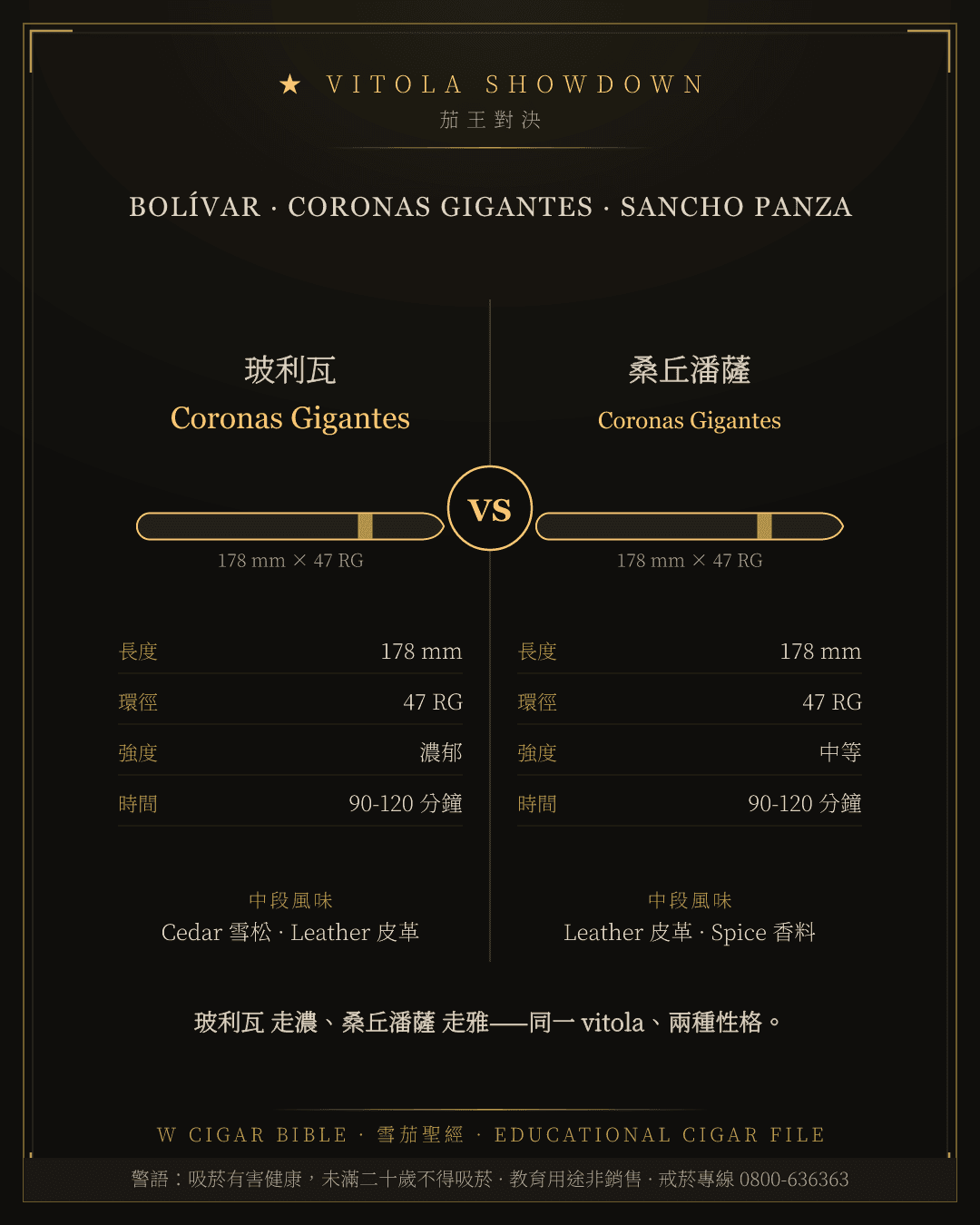
Bolívar Coronas Gigantes vs Sancho Panza Coronas Gigantes
VITOLA SHOWDOWN · Coronas Gigantes

H. Upmann Magnum 54 vs Sancho Panza Edición Regional Chipre y Grecia
VITOLA SHOWDOWN · Magnum 54

Punch Edición Regional Gran Bretaña vs Sancho Panza Edición Regional Alemania
VITOLA SHOWDOWN · Dobles
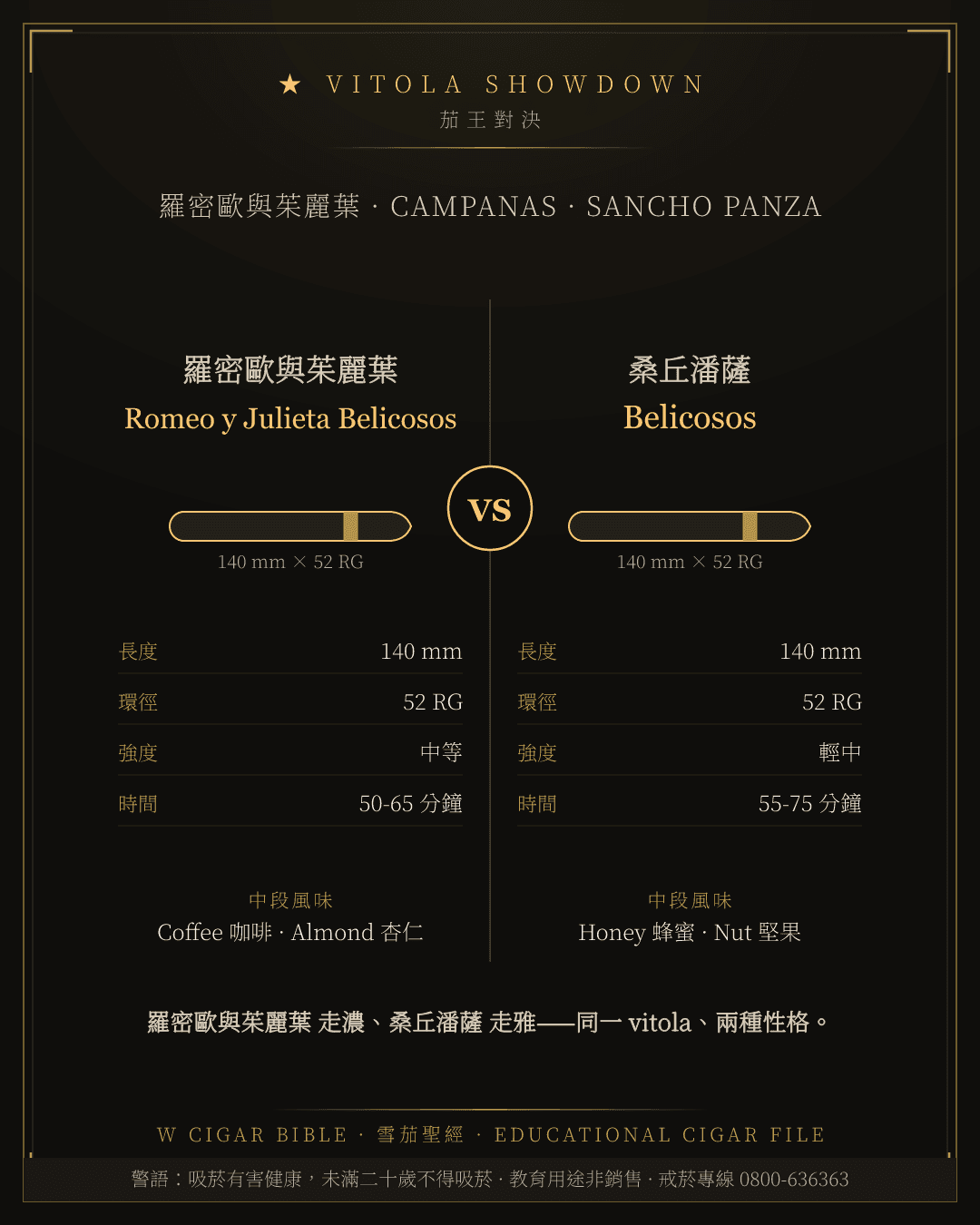
Romeo y Julieta Belicosos vs Sancho Panza Belicosos
VITOLA SHOWDOWN · Campanas
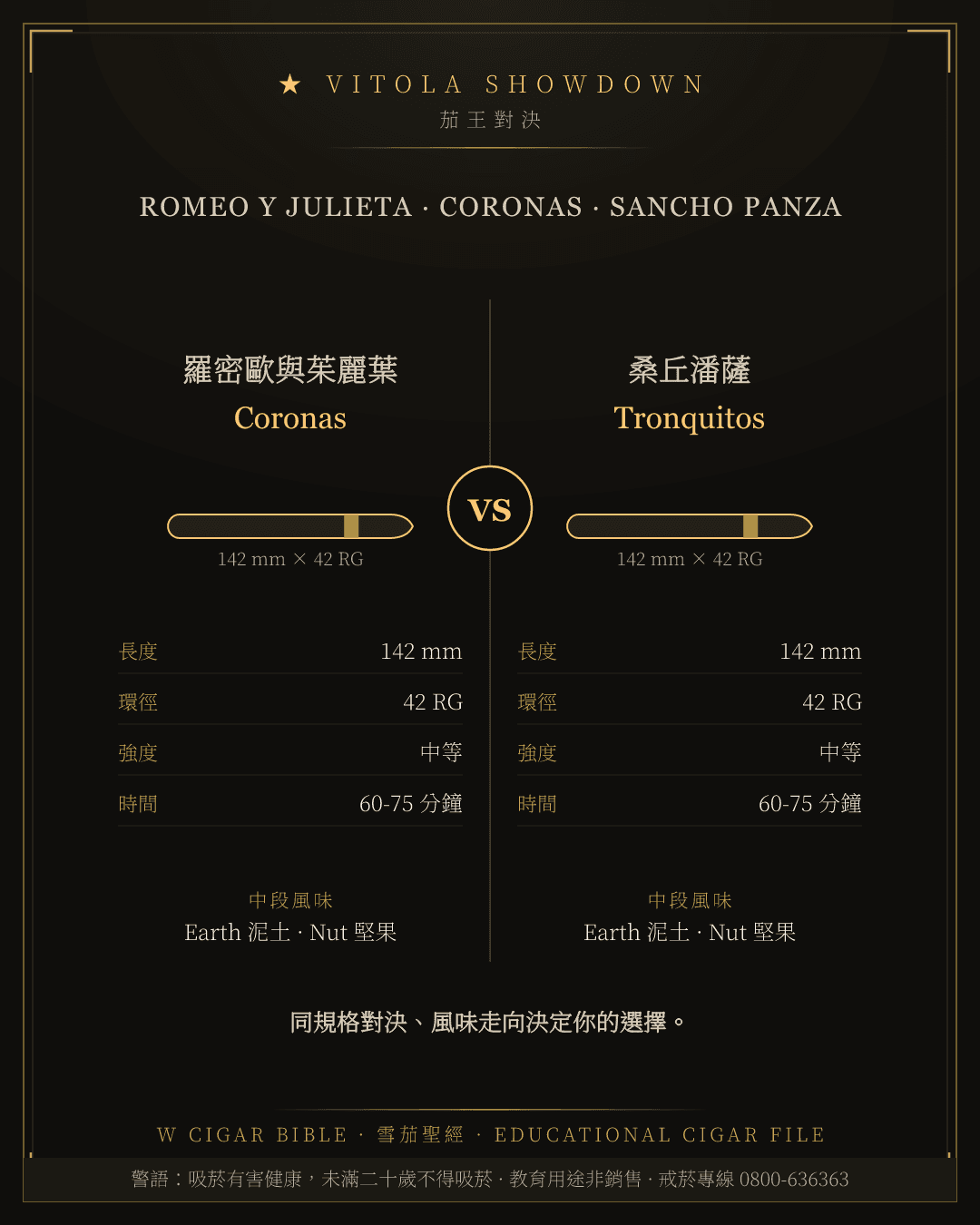
Romeo Y Julieta Coronas vs Sancho Panza Tronquitos
VITOLA SHOWDOWN · Coronas
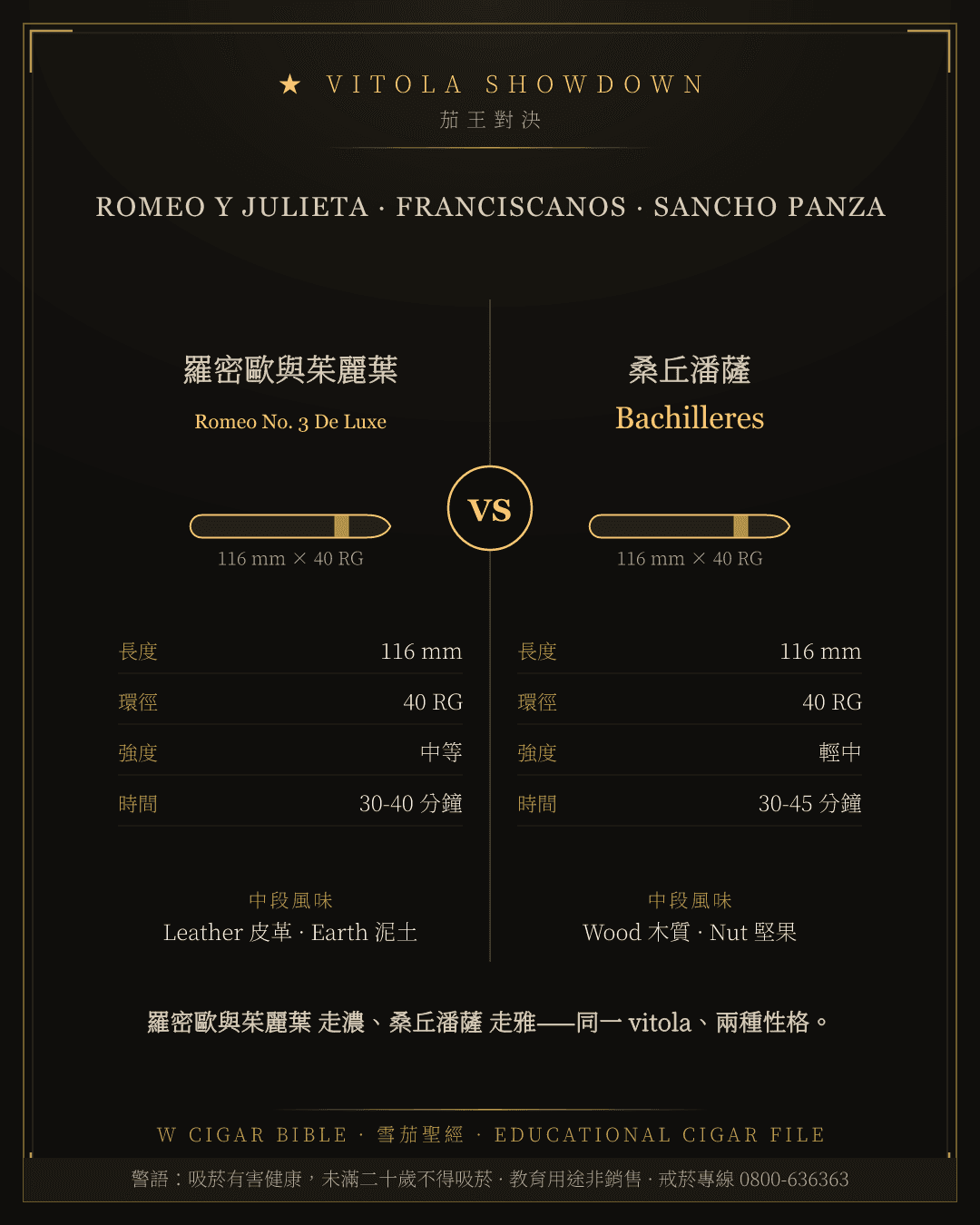
Romeo Y Julieta Romeo No. 3 De Luxe vs Sancho Panza Bachilleres
VITOLA SHOWDOWN · Franciscanos
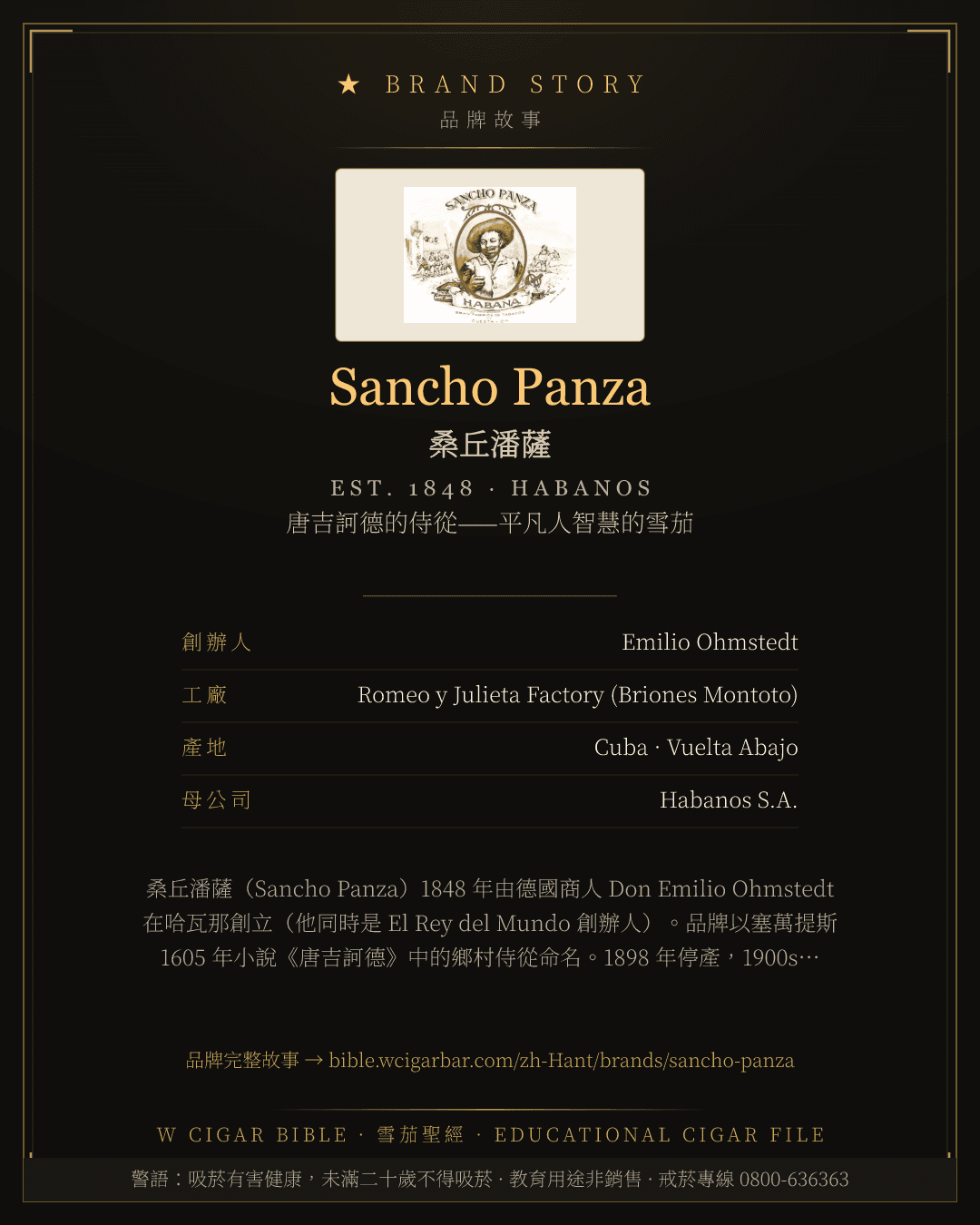
Sancho Panza · 桑丘潘薩 品牌故事
BRAND STORY · EST. 1848
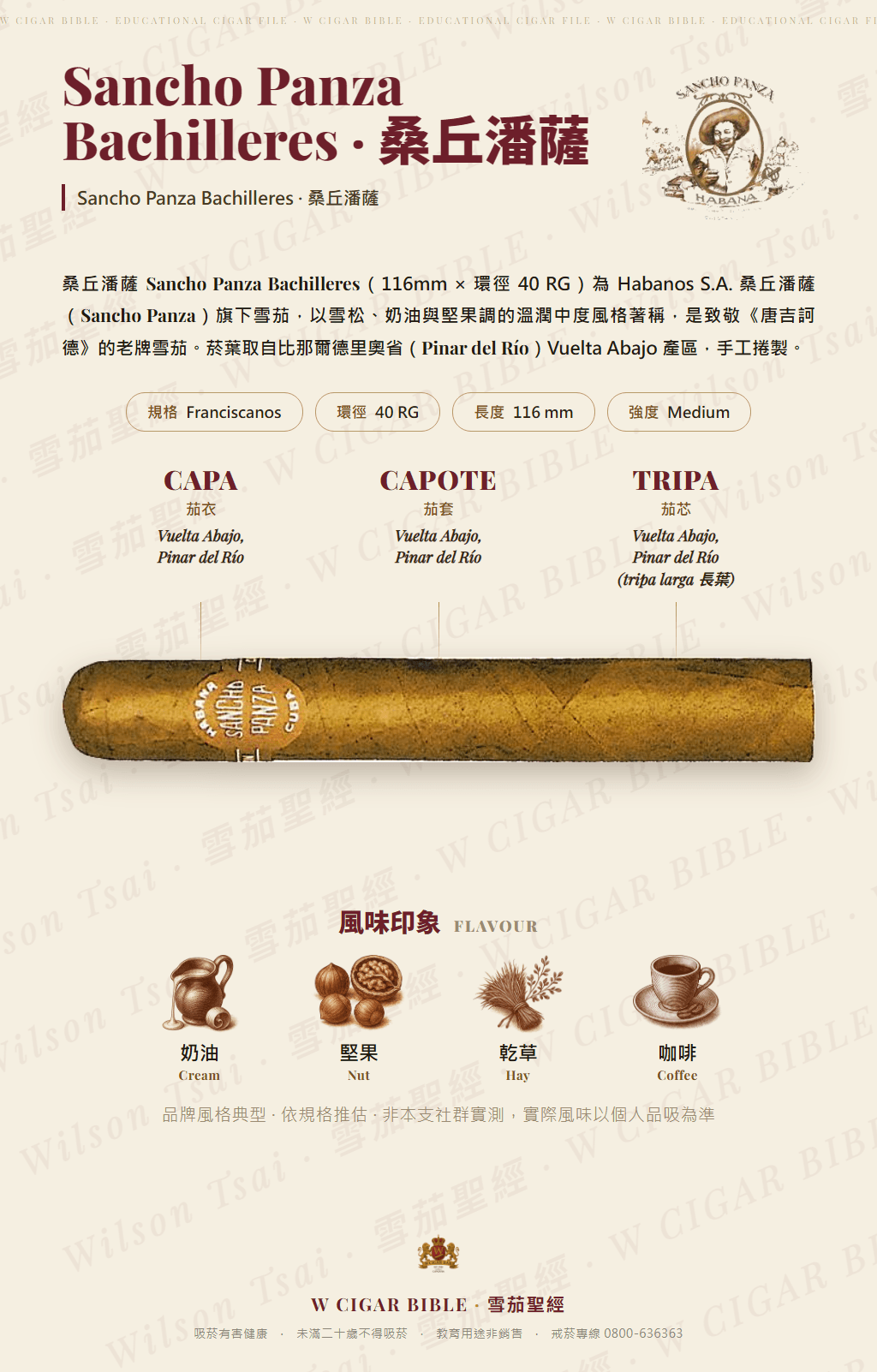
Sancho Panza Bachilleres · 桑丘潘薩
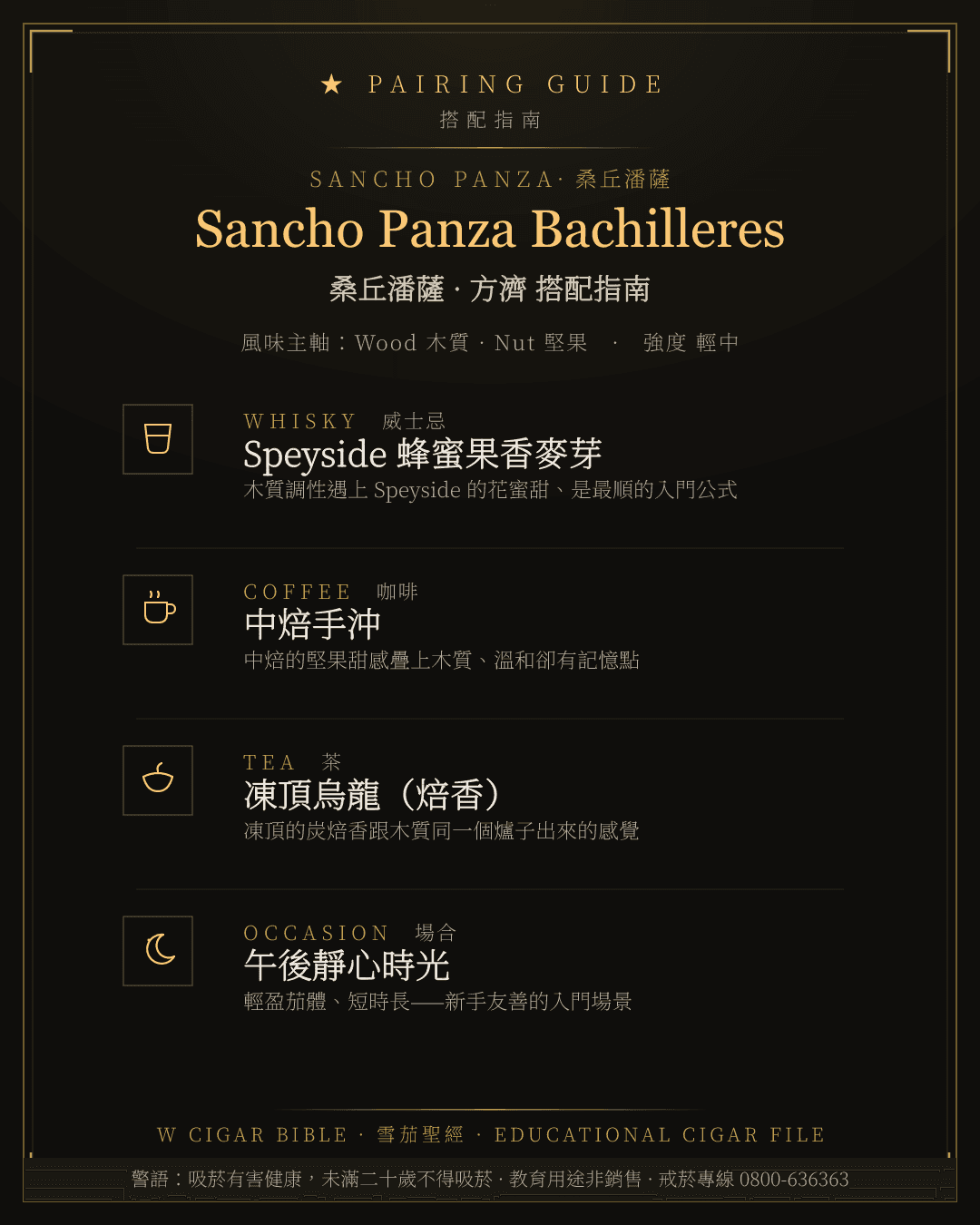
Sancho Panza Bachilleres 搭配指南 · 桑丘潘薩
PAIRING GUIDE · 搭配指南

Sancho Panza Bachilleres 風味筆記 · 桑丘潘薩
TASTING NOTES · 風味筆記
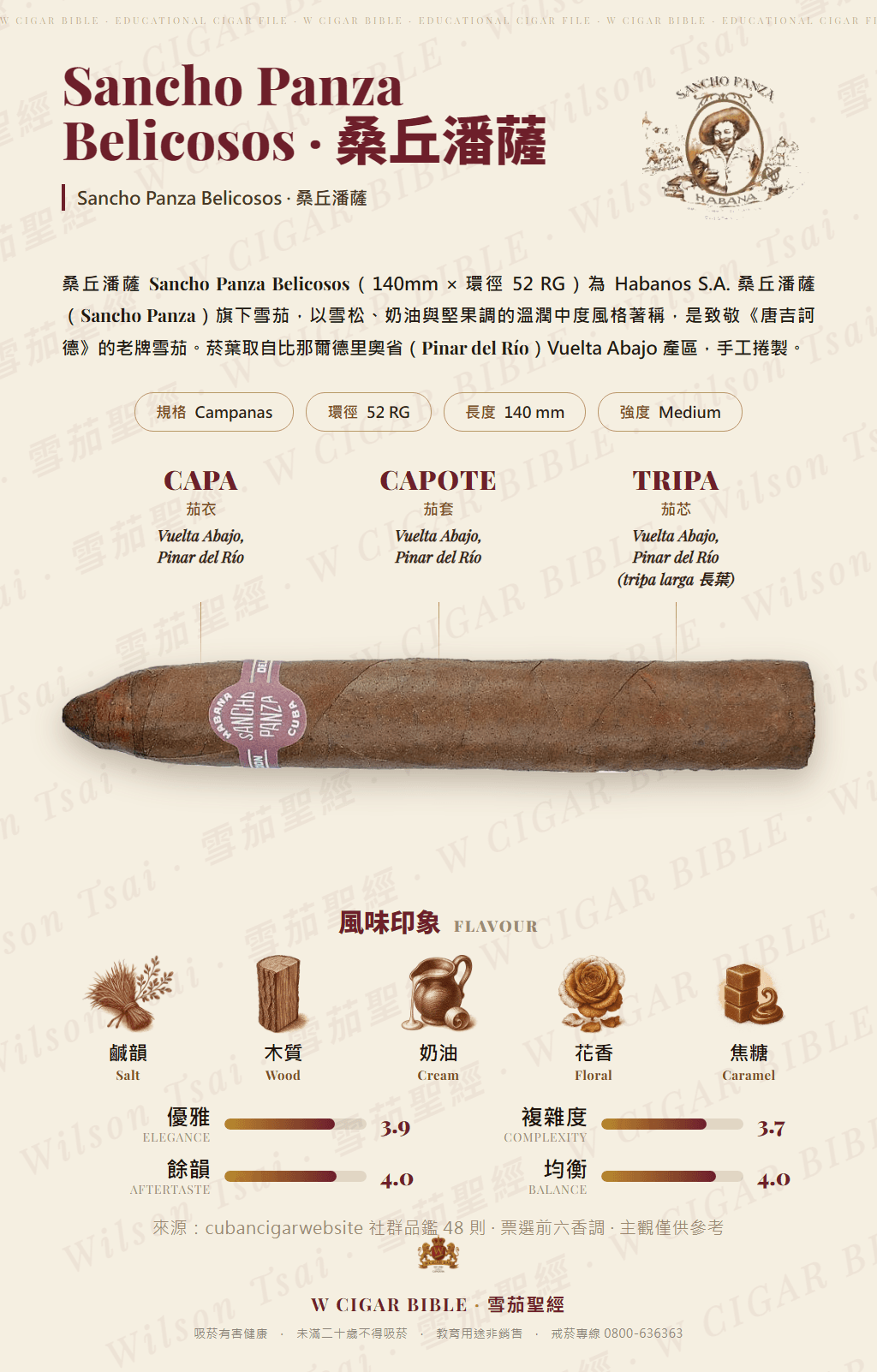
Sancho Panza Belicosos · 桑丘潘薩
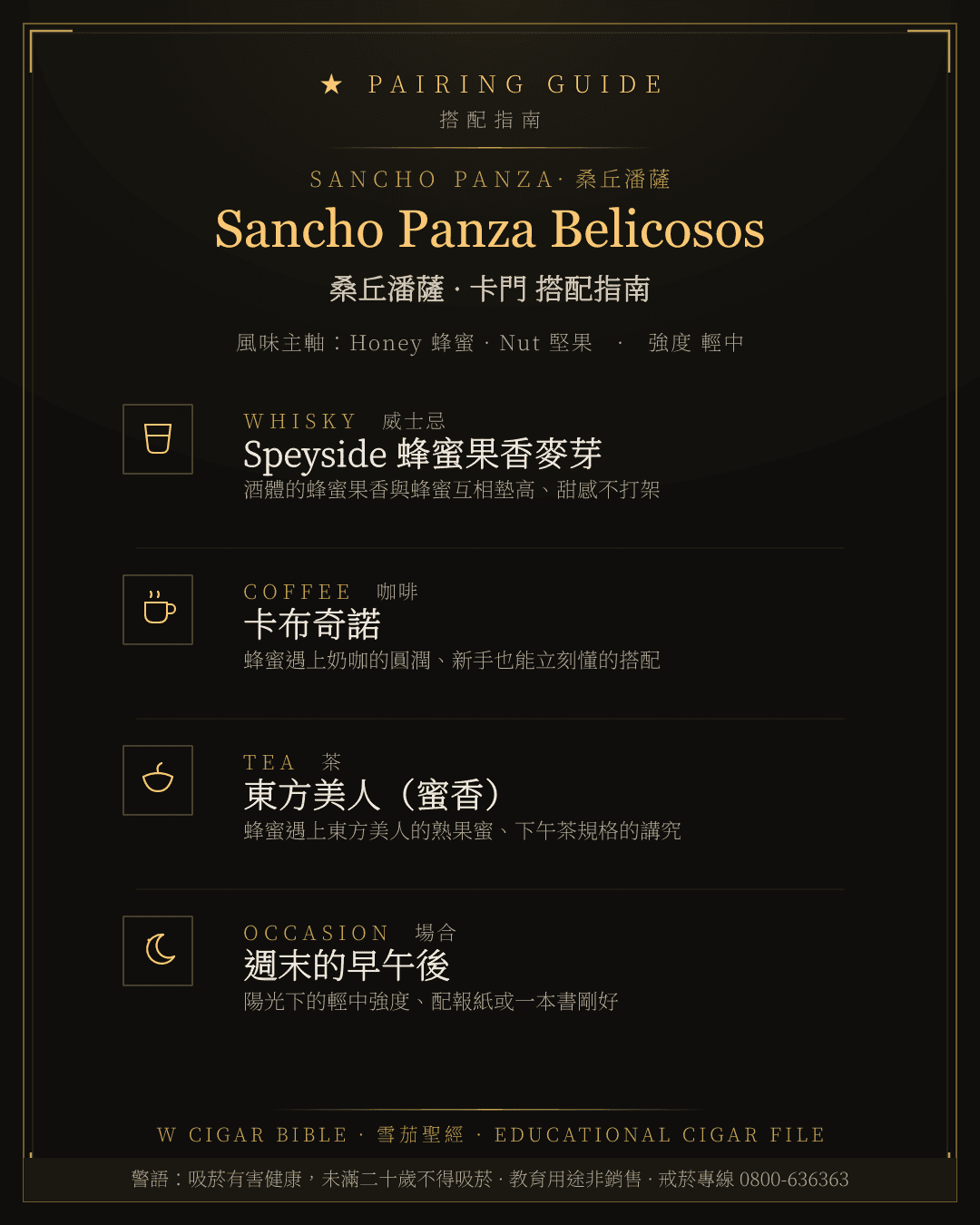
Sancho Panza Belicosos 搭配指南 · 桑丘潘薩
PAIRING GUIDE · 搭配指南

Sancho Panza Belicosos 風味筆記 · 桑丘潘薩
TASTING NOTES · 風味筆記

Sancho Panza Belux No. 1 搭配指南 · 桑丘潘薩
PAIRING GUIDE · 搭配指南
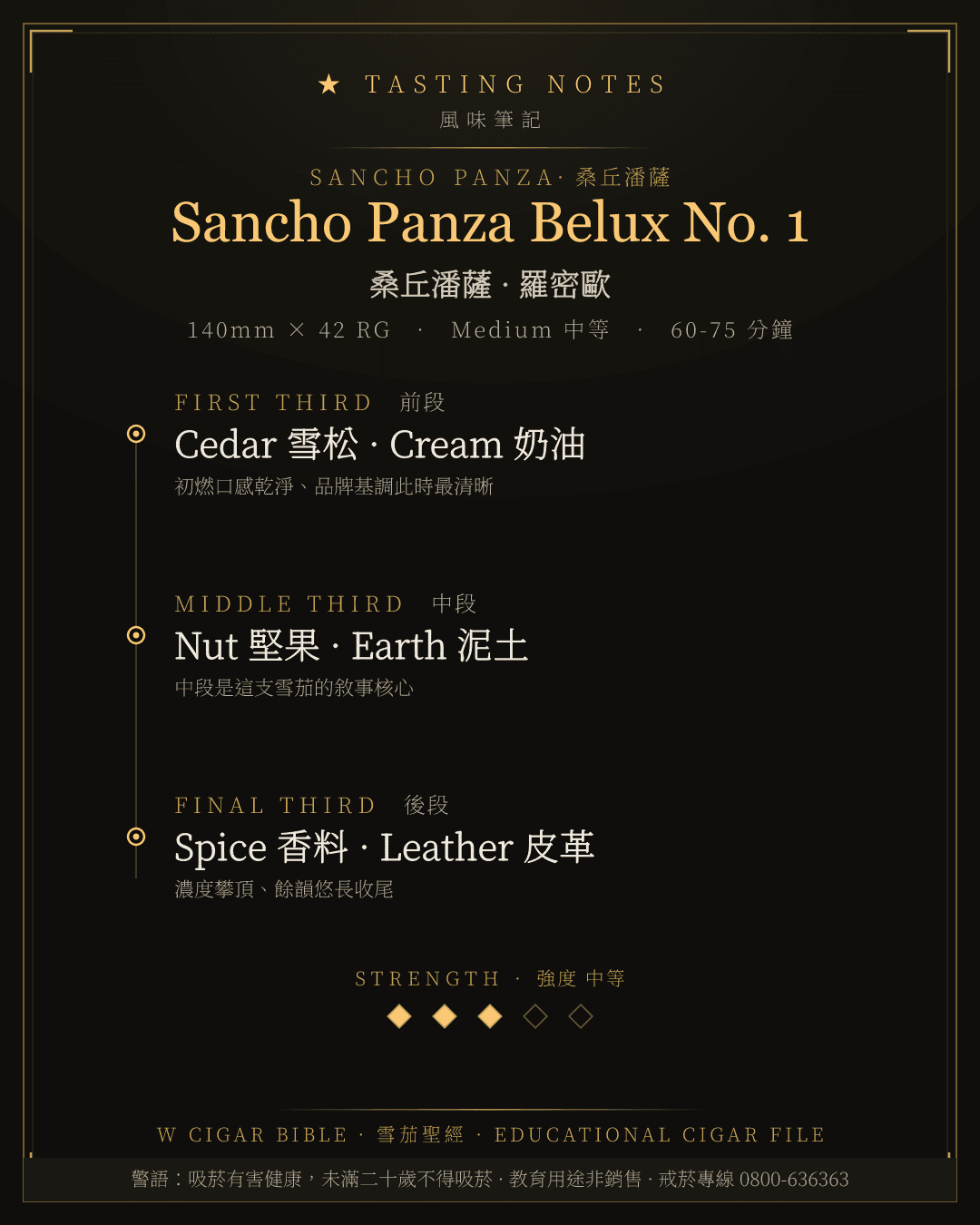
Sancho Panza Belux No. 1 風味筆記 · 桑丘潘薩
TASTING NOTES · 風味筆記
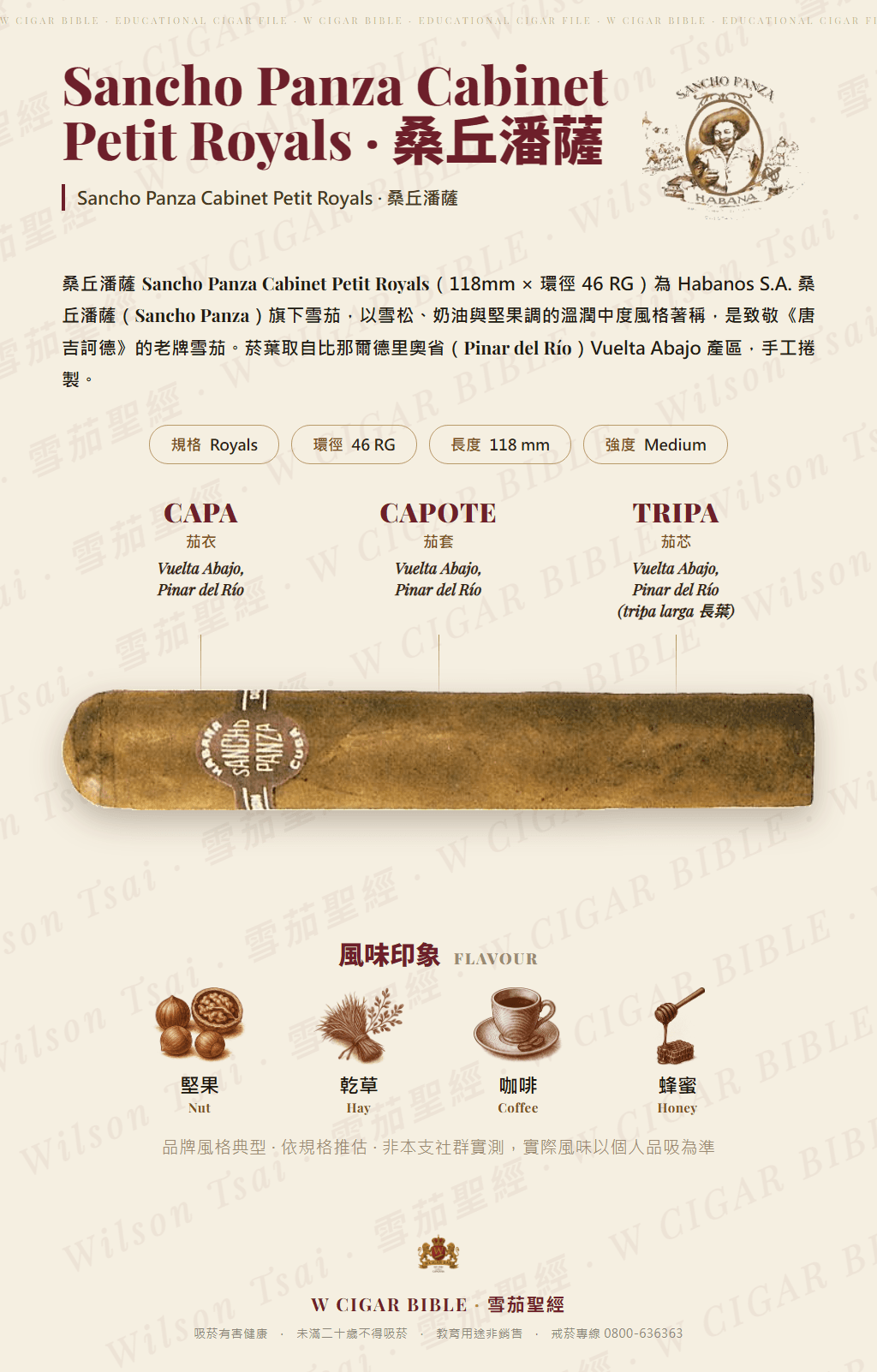
Sancho Panza Cabinet Petit Royals · 桑丘潘薩

Sancho Panza Cabinet Petit Royals 搭配指南 · 桑丘潘薩
PAIRING GUIDE · 搭配指南

Sancho Panza Cabinet Petit Royals 風味筆記 · 桑丘潘薩
TASTING NOTES · 風味筆記
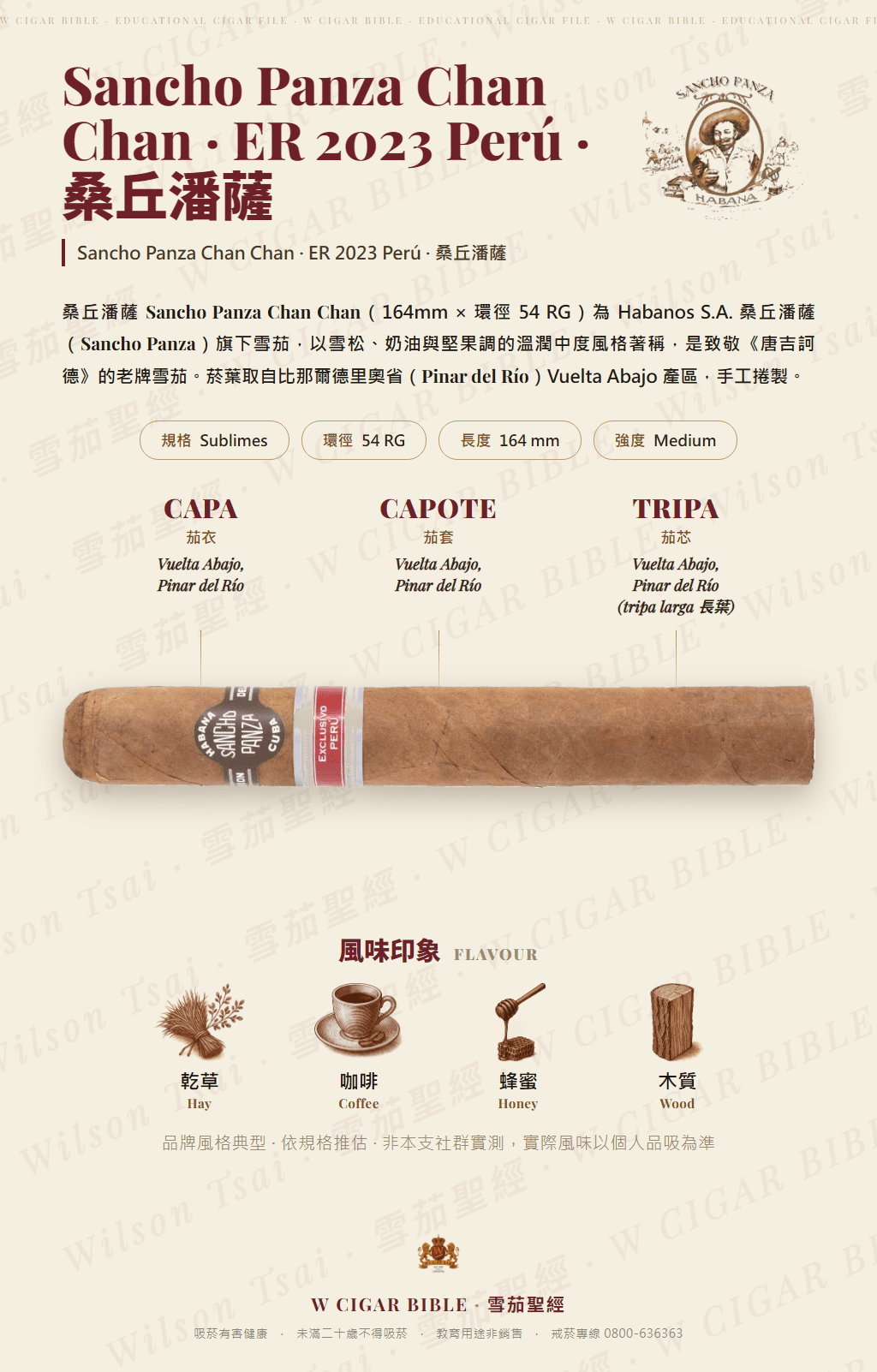
Sancho Panza Chan Chan · ER 2023 Perú · 桑丘潘薩
ER 2023 Perú(Bolivia/Perú/Ecuador 市場)· Sublimes 環徑 54 × 164mm · 地區限量版 Edición Regional · 雪茄檔案

Sancho Panza Chan Chan 搭配指南 · 桑丘潘薩
PAIRING GUIDE · 搭配指南
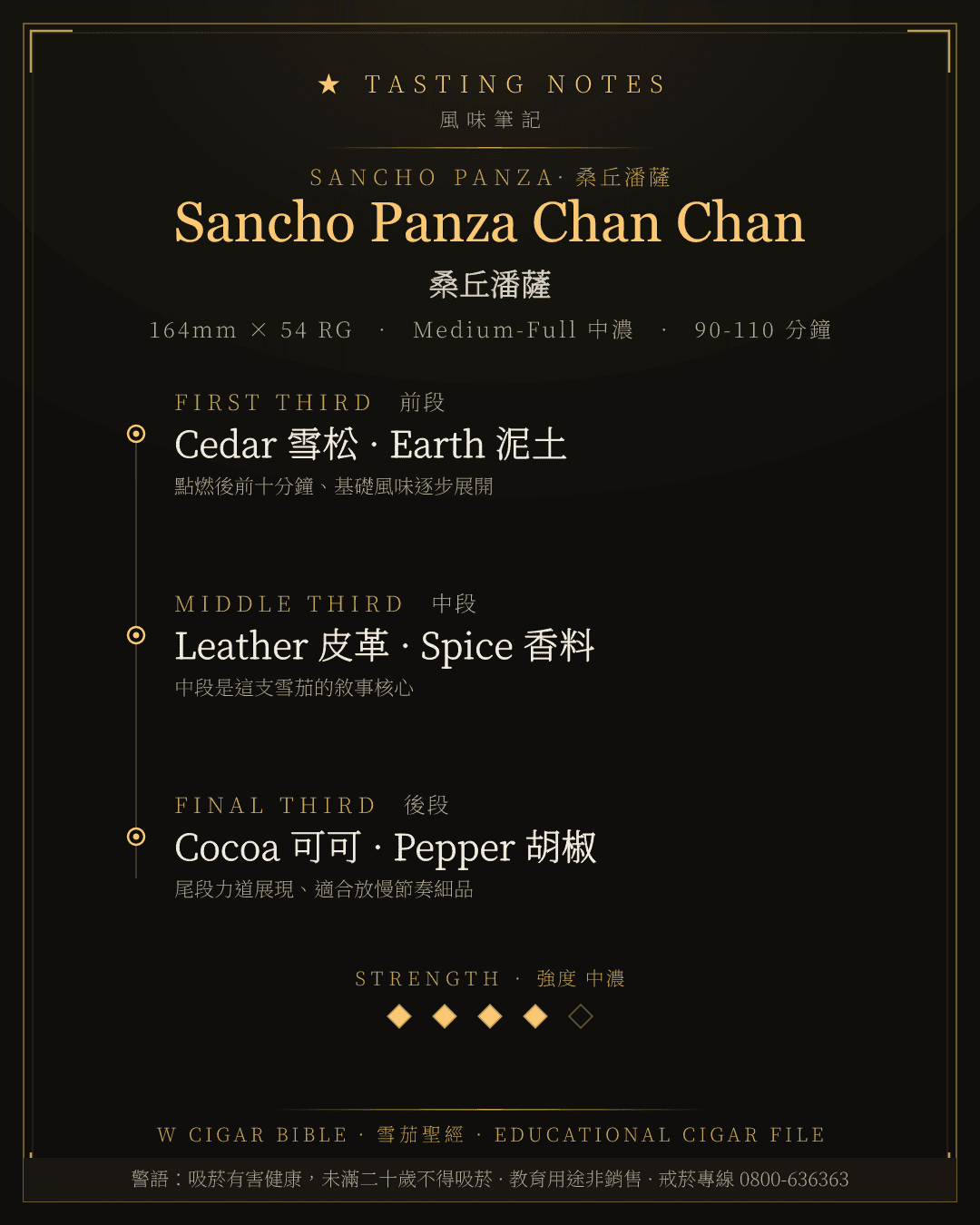
Sancho Panza Chan Chan 風味筆記 · 桑丘潘薩
TASTING NOTES · 風味筆記
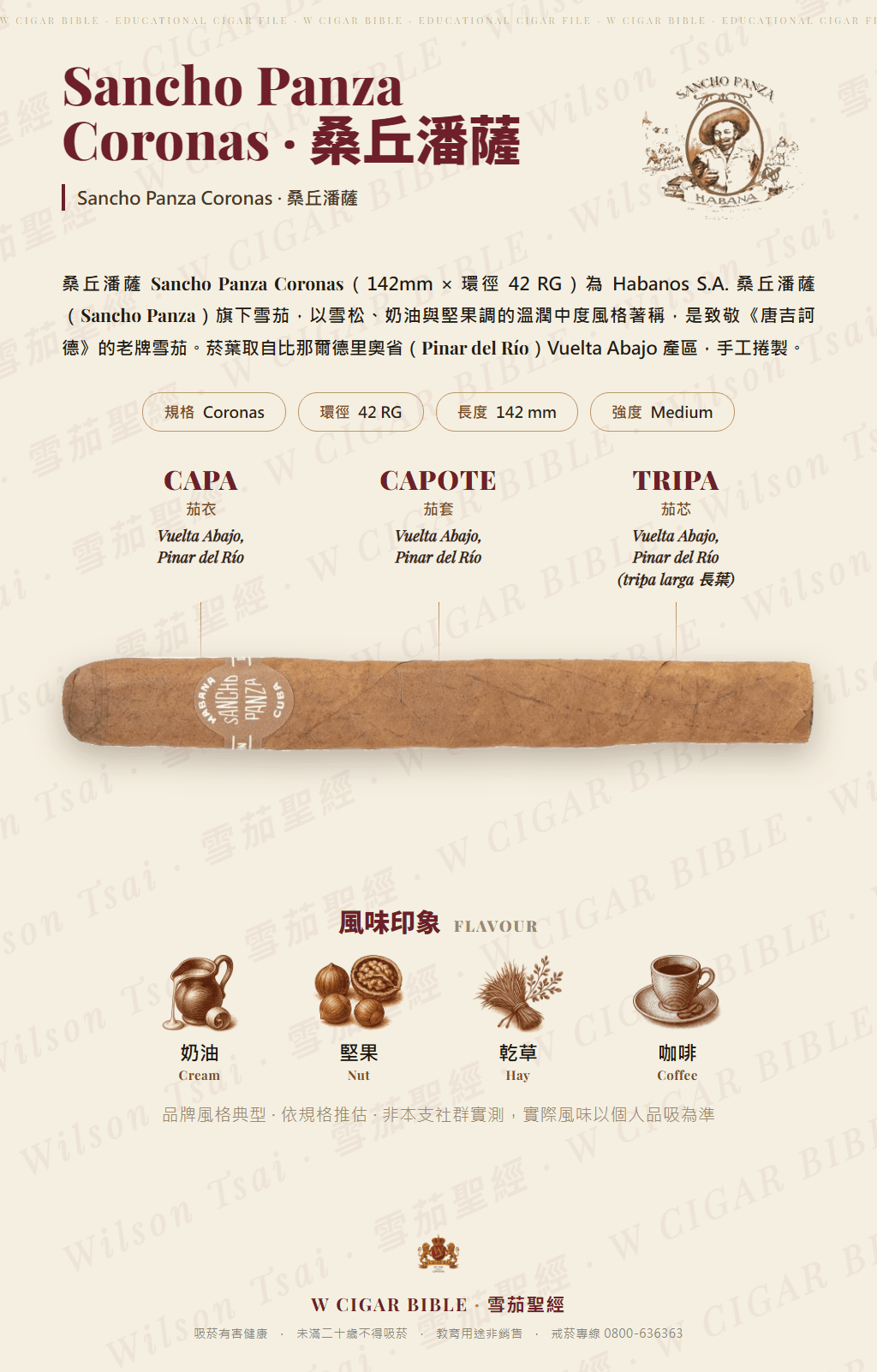
Sancho Panza Coronas · 桑丘潘薩
標準量產款(Standard Production, Corona 142mm × 42),現已淡出主線/停產老款 · 雪茄檔案
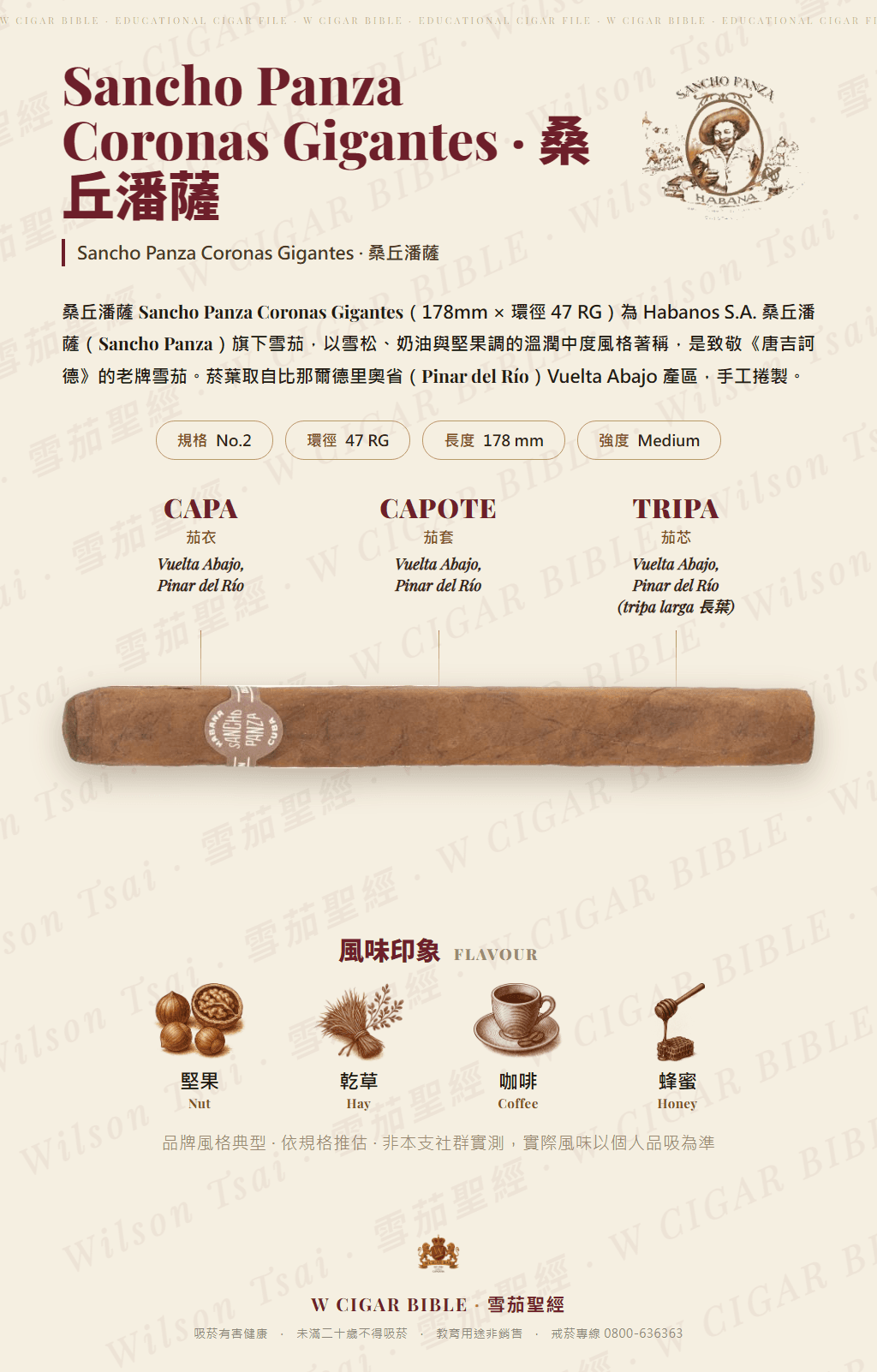
Sancho Panza Coronas Gigantes · 桑丘潘薩
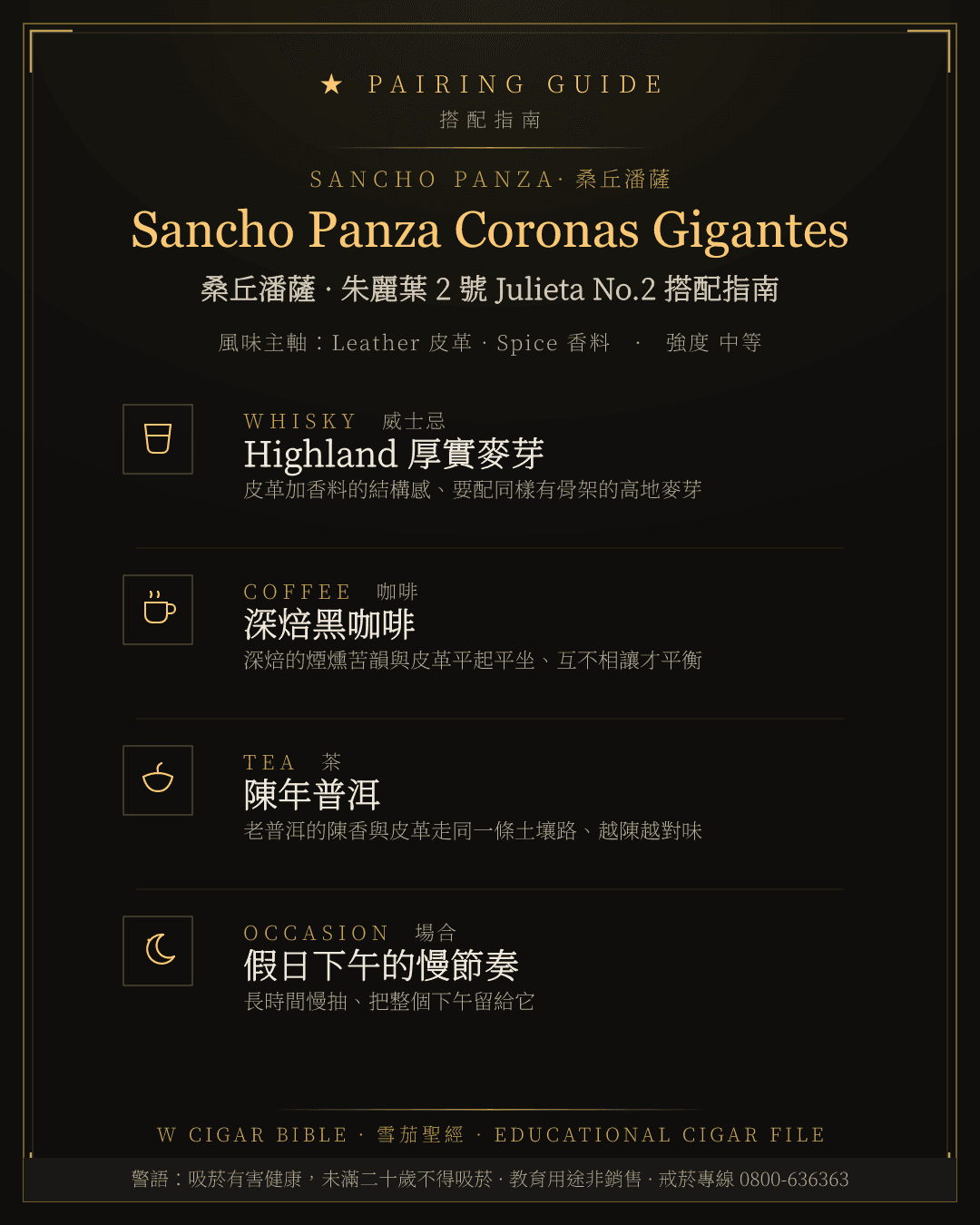
Sancho Panza Coronas Gigantes 搭配指南 · 桑丘潘薩
PAIRING GUIDE · 搭配指南
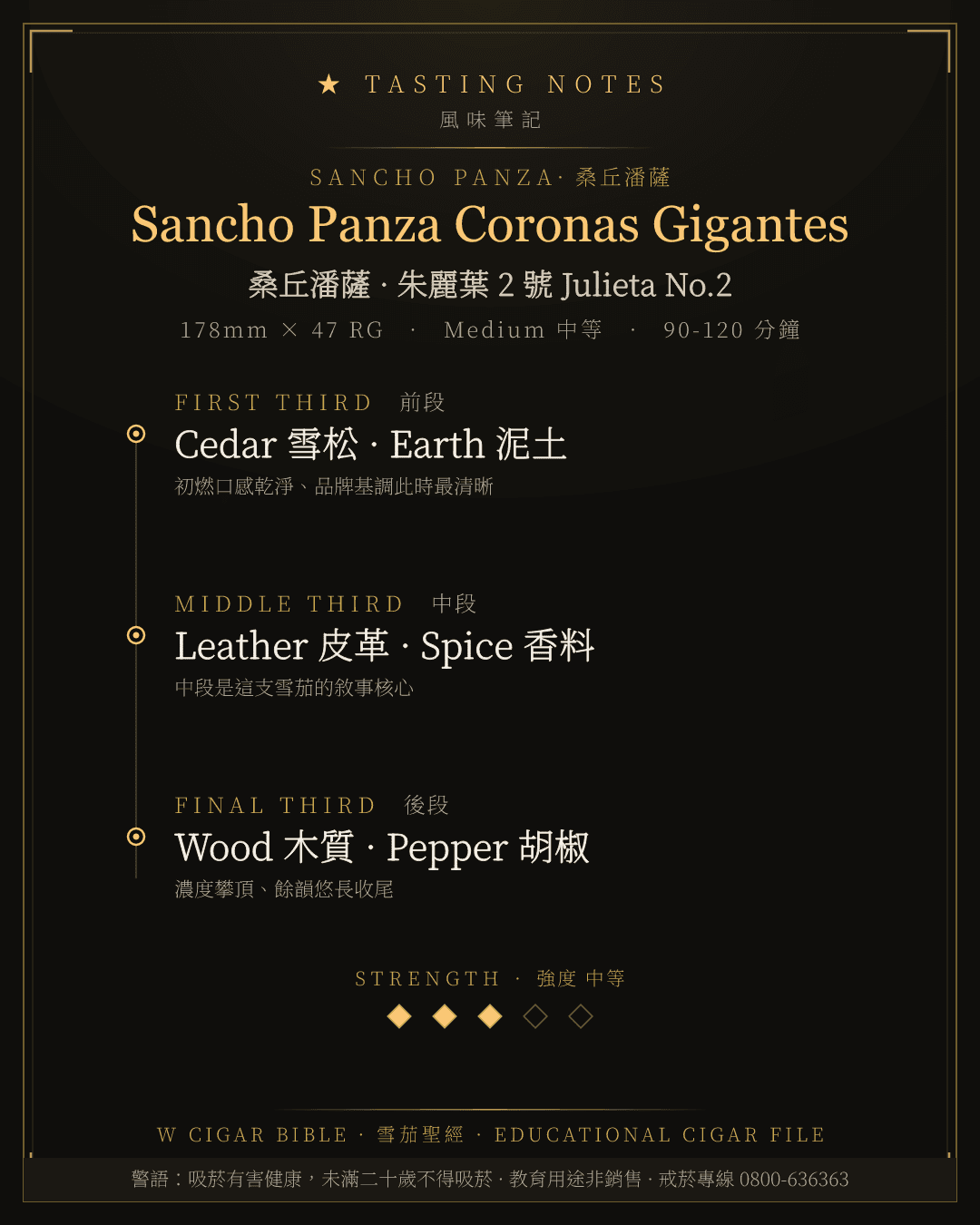
Sancho Panza Coronas Gigantes 風味筆記 · 桑丘潘薩
TASTING NOTES · 風味筆記
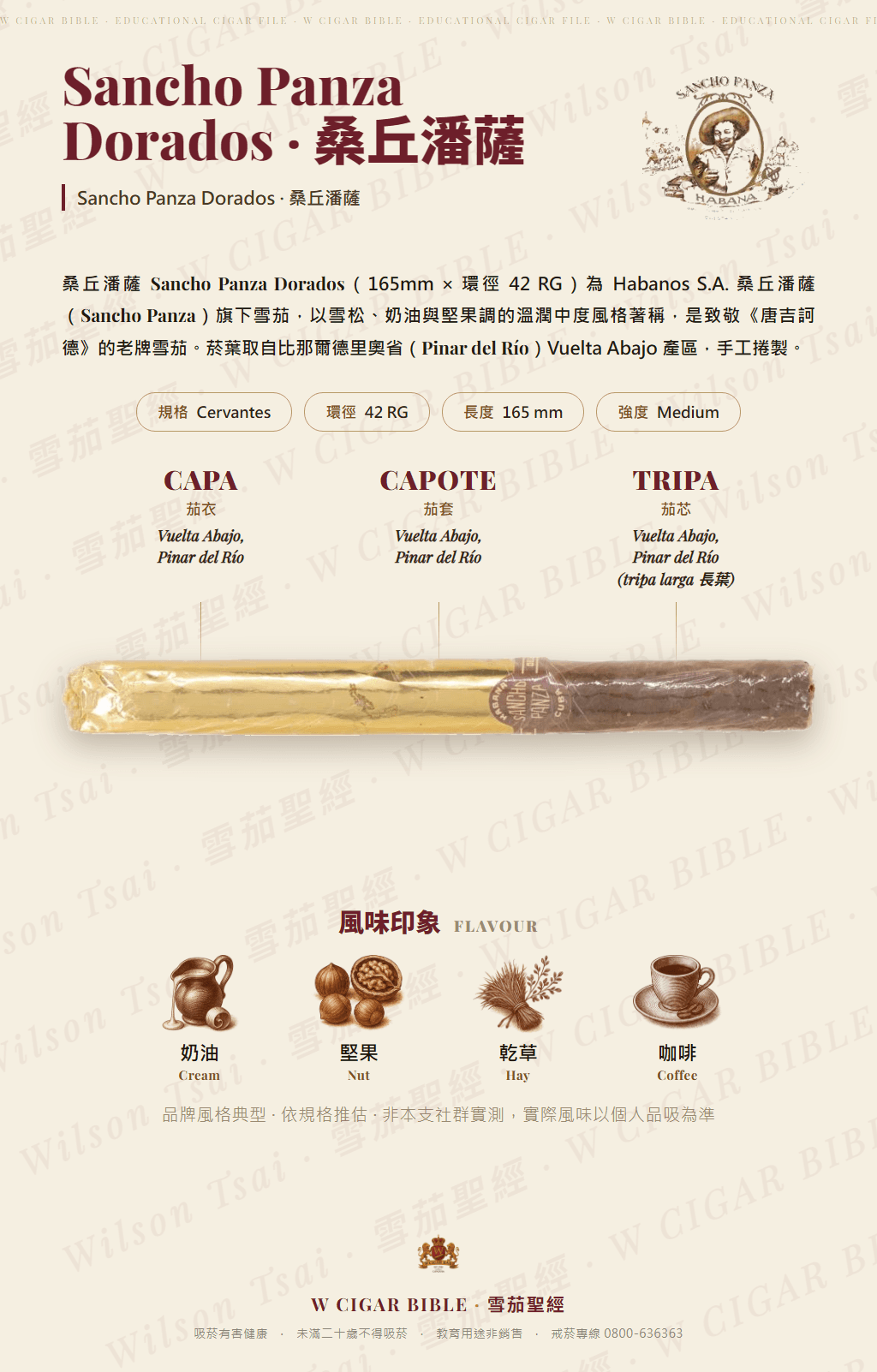
Sancho Panza Dorados · 桑丘潘薩
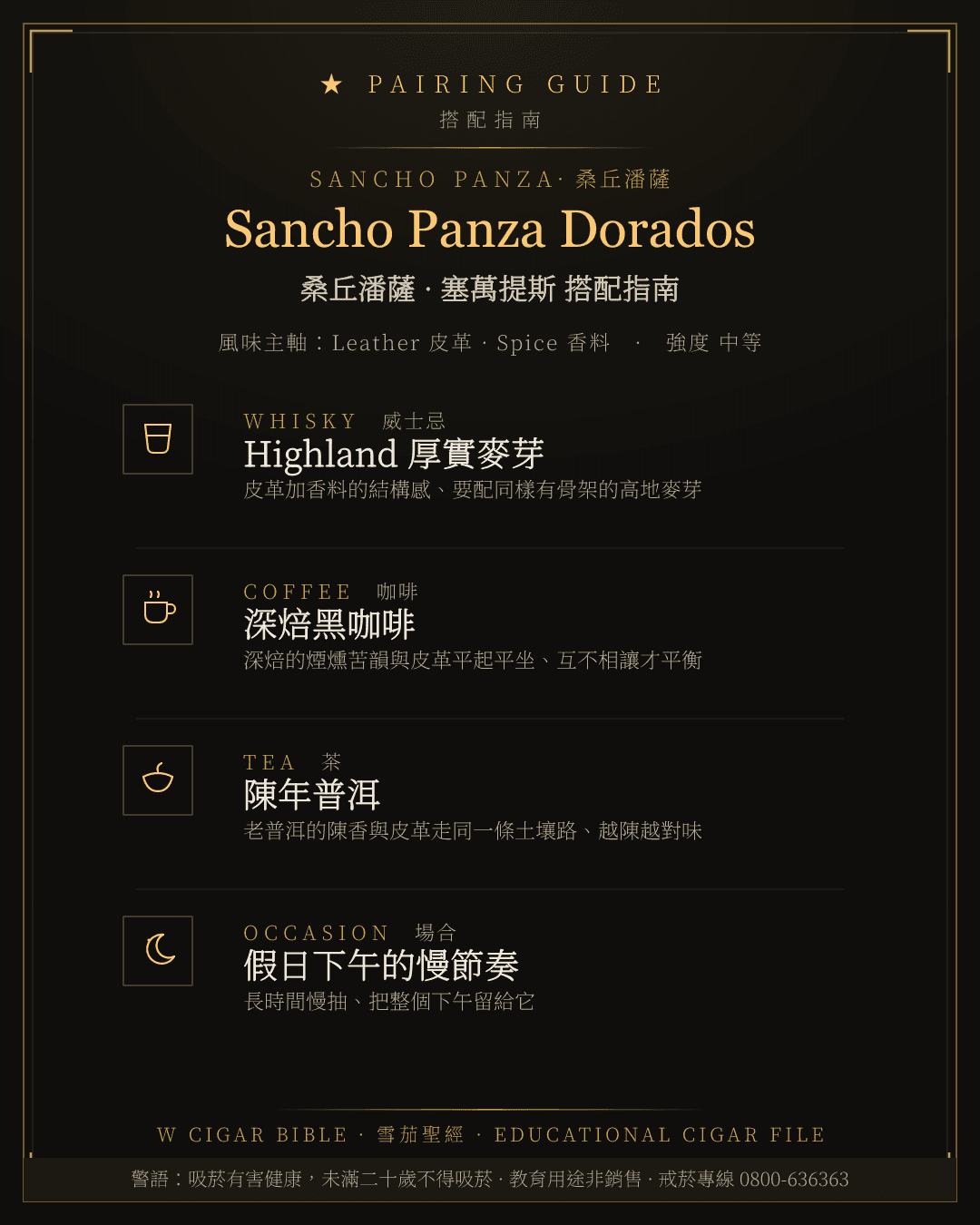
Sancho Panza Dorados 搭配指南 · 桑丘潘薩
PAIRING GUIDE · 搭配指南
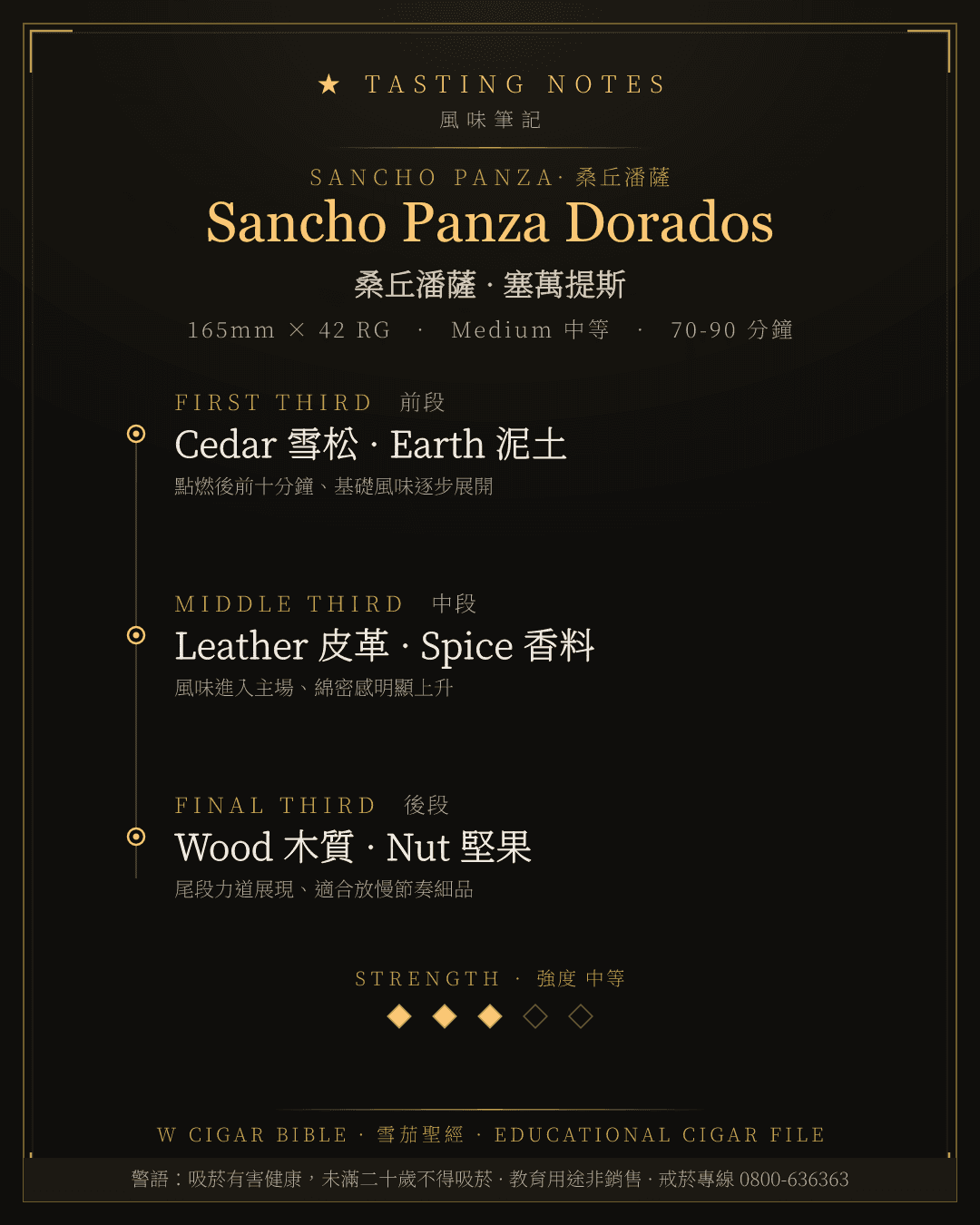
Sancho Panza Dorados 風味筆記 · 桑丘潘薩
TASTING NOTES · 風味筆記
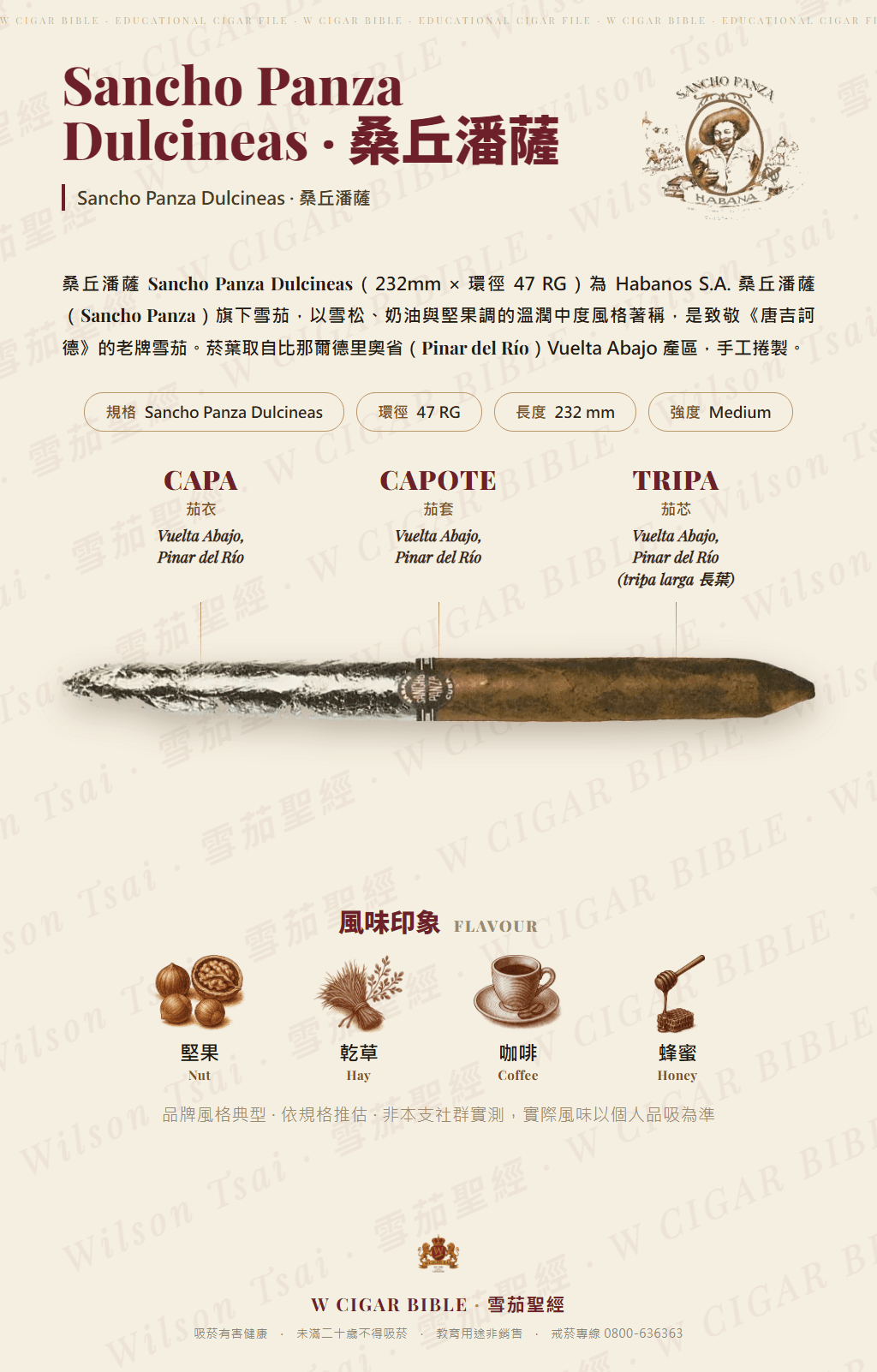
Sancho Panza Dulcineas · 桑丘潘薩

Sancho Panza Dulcineas 搭配指南 · 桑丘潘薩
PAIRING GUIDE · 搭配指南
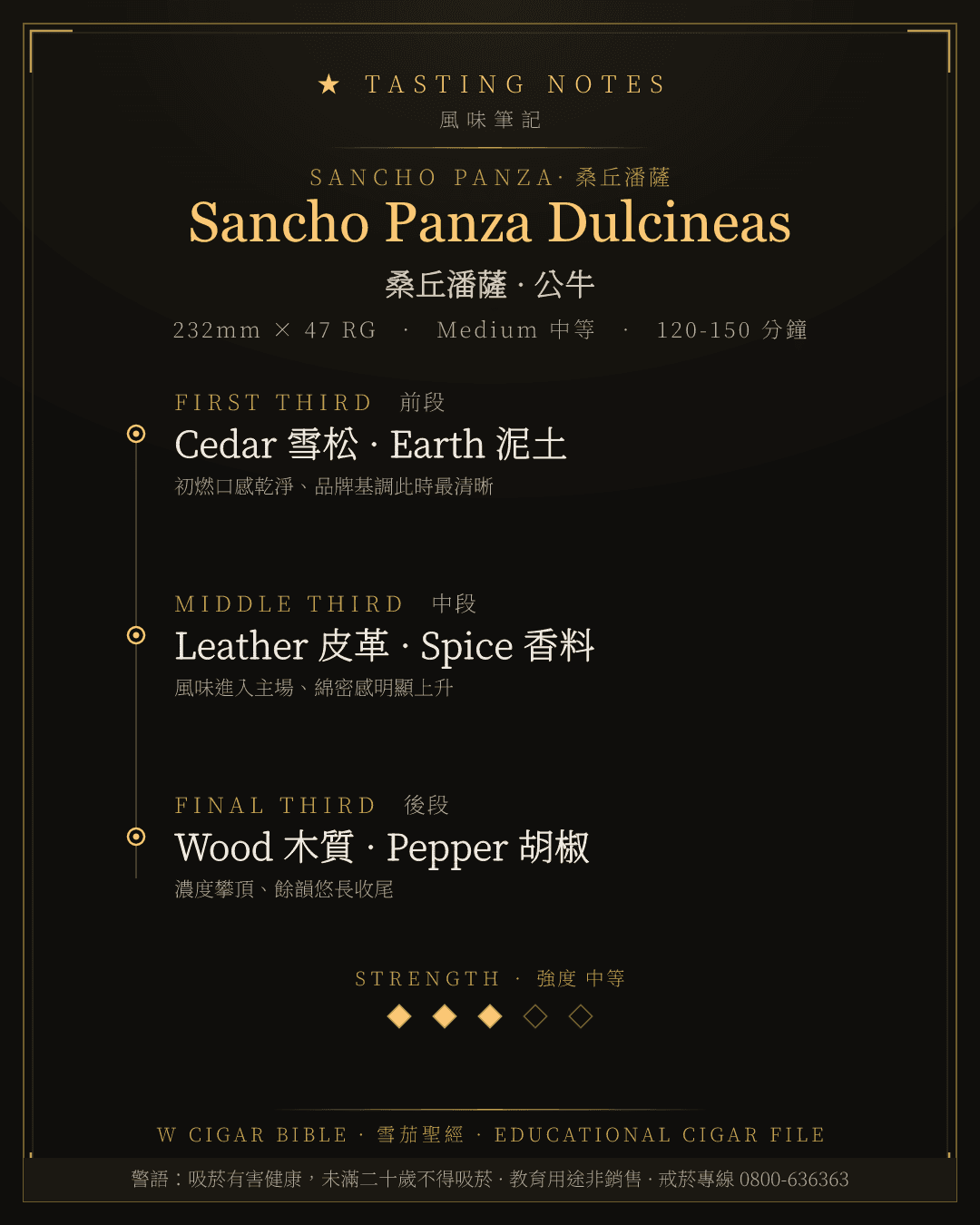
Sancho Panza Dulcineas 風味筆記 · 桑丘潘薩
TASTING NOTES · 風味筆記

Sancho Panza Edición Regional Alemania · 桑丘潘薩 總編輯精選
HUMIDOR PICK · No.020
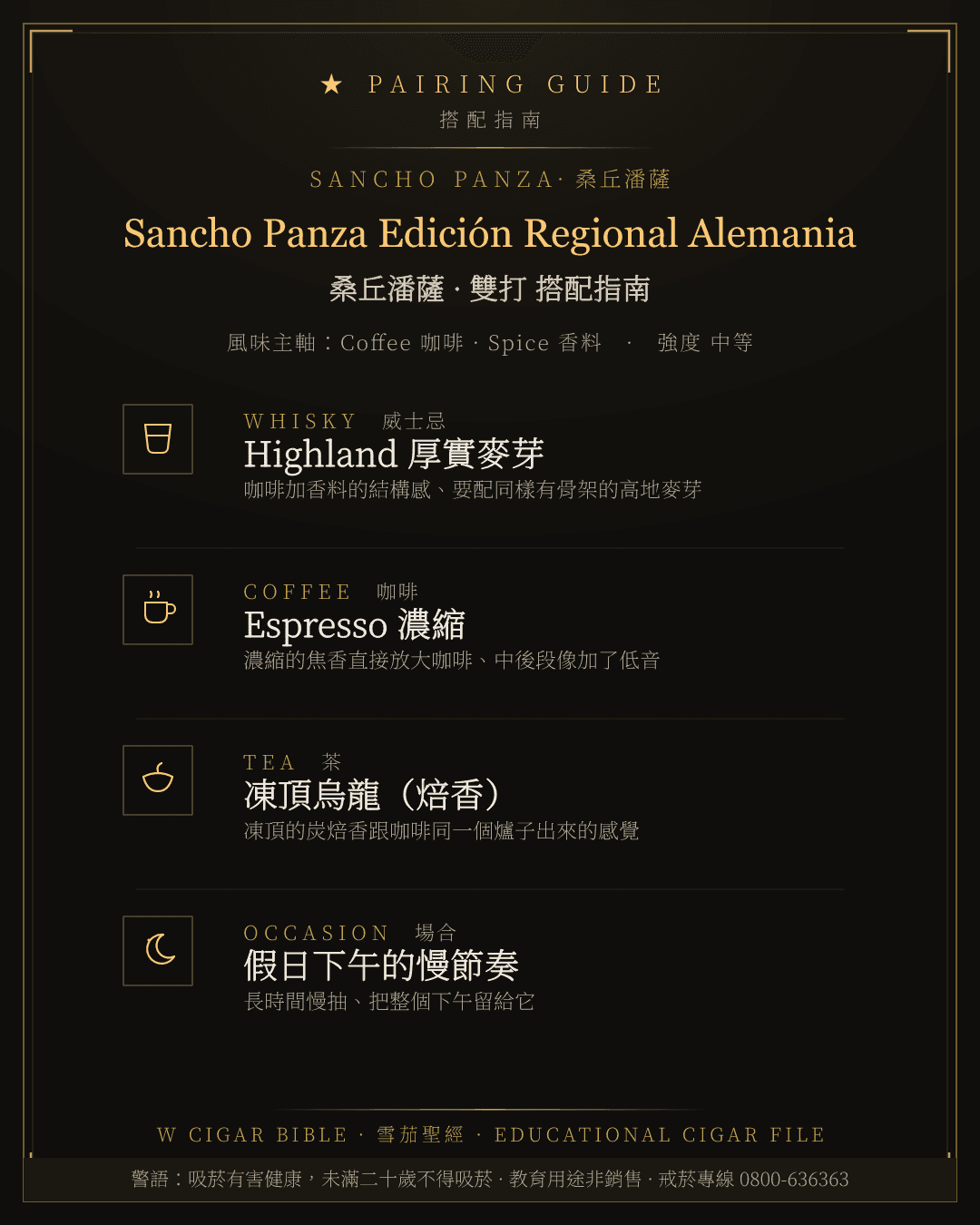
Sancho Panza Edición Regional Alemania 搭配指南 · 桑丘潘薩
PAIRING GUIDE · 搭配指南

Sancho Panza Edición Regional Alemania 風味筆記 · 桑丘潘薩
TASTING NOTES · 風味筆記

Sancho Panza Edición Regional Chipre y Grecia 搭配指南 · 桑丘潘薩
PAIRING GUIDE · 搭配指南

Sancho Panza Edición Regional Chipre y Grecia 風味筆記 · 桑丘潘薩
TASTING NOTES · 風味筆記

Sancho Panza El Rey · ER Asia Pacifico · 桑丘潘薩
ER Asia Pacifico · 地區限量版 Edición Regional · 雪茄檔案

Sancho Panza El Rey 搭配指南 · 桑丘潘薩
PAIRING GUIDE · 搭配指南

Sancho Panza El Rey 風味筆記 · 桑丘潘薩
TASTING NOTES · 風味筆記
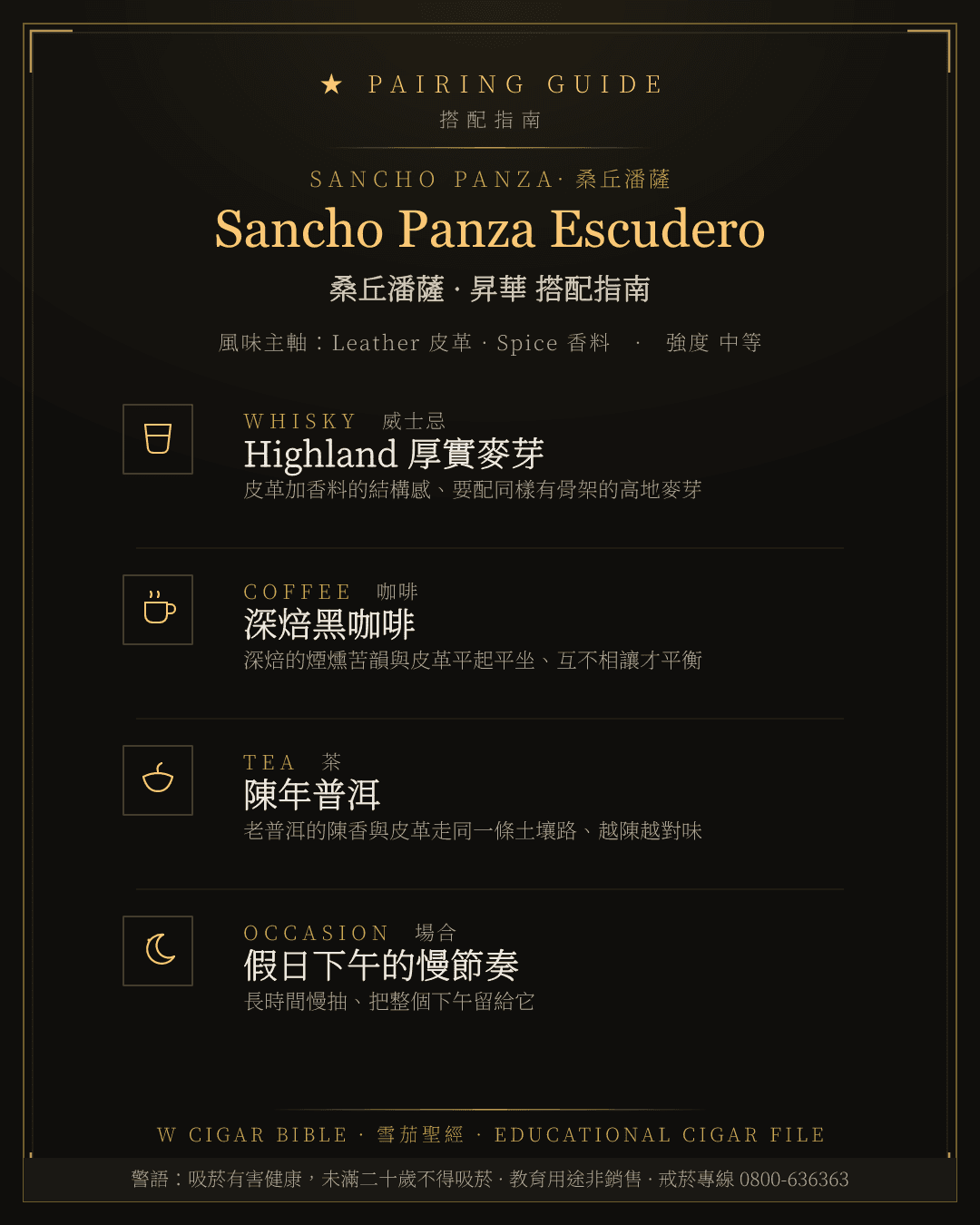
Sancho Panza Escudero 搭配指南 · 桑丘潘薩
PAIRING GUIDE · 搭配指南

Sancho Panza Escudero 風味筆記 · 桑丘潘薩
TASTING NOTES · 風味筆記
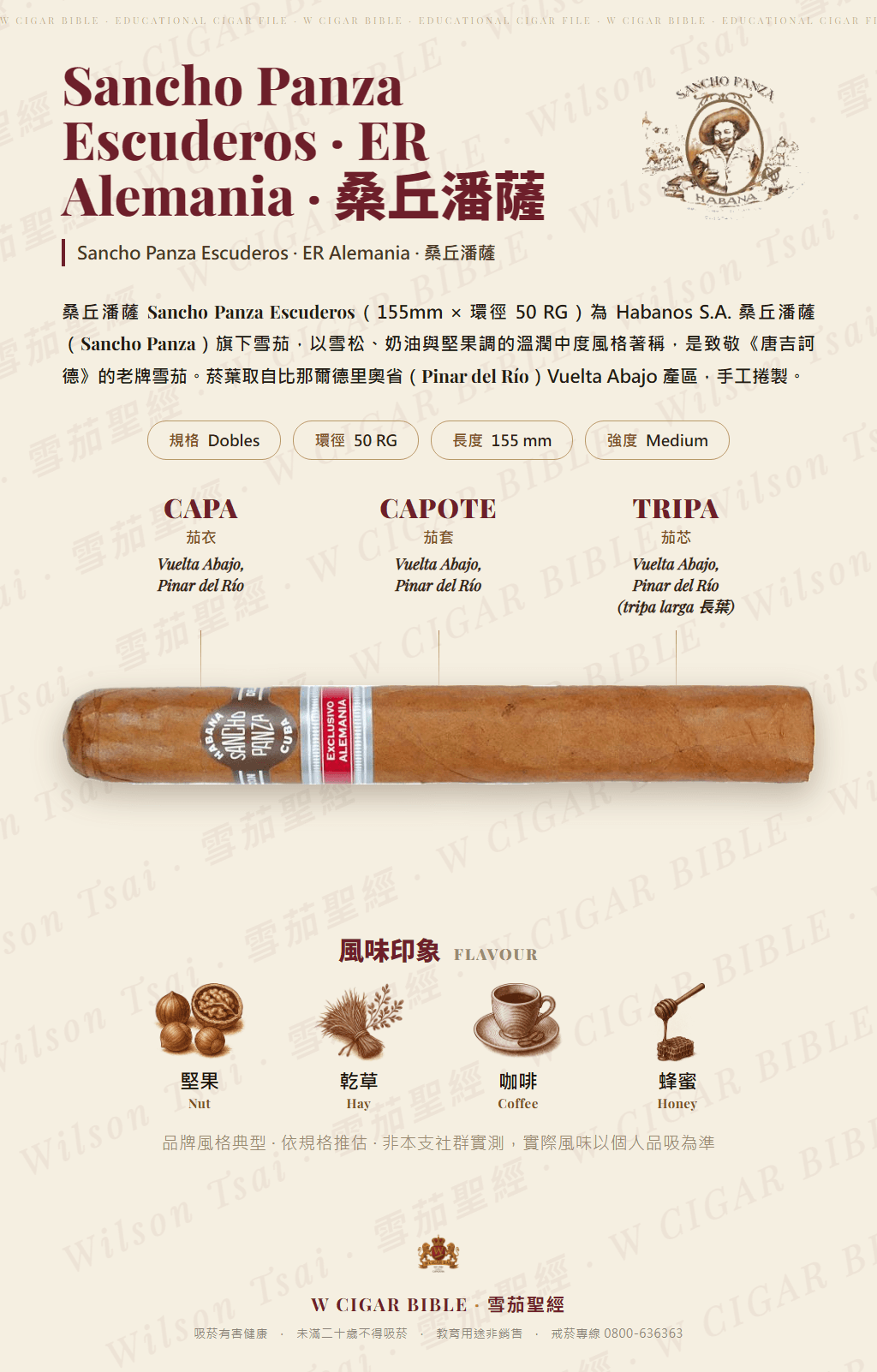
Sancho Panza Escuderos · ER Alemania · 桑丘潘薩
ER Alemania · 地區限量版 Edición Regional · 雪茄檔案
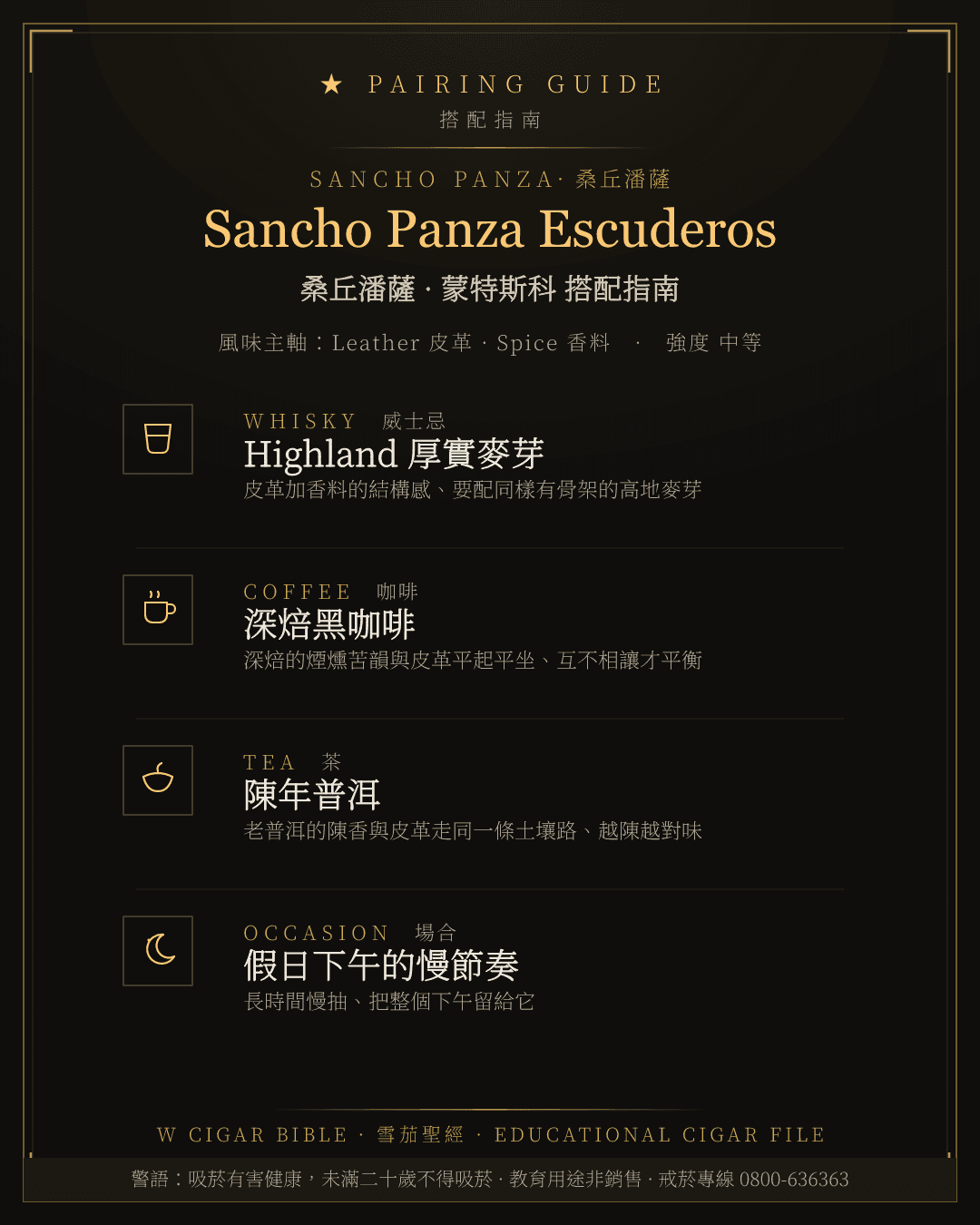
Sancho Panza Escuderos 搭配指南 · 桑丘潘薩
PAIRING GUIDE · 搭配指南
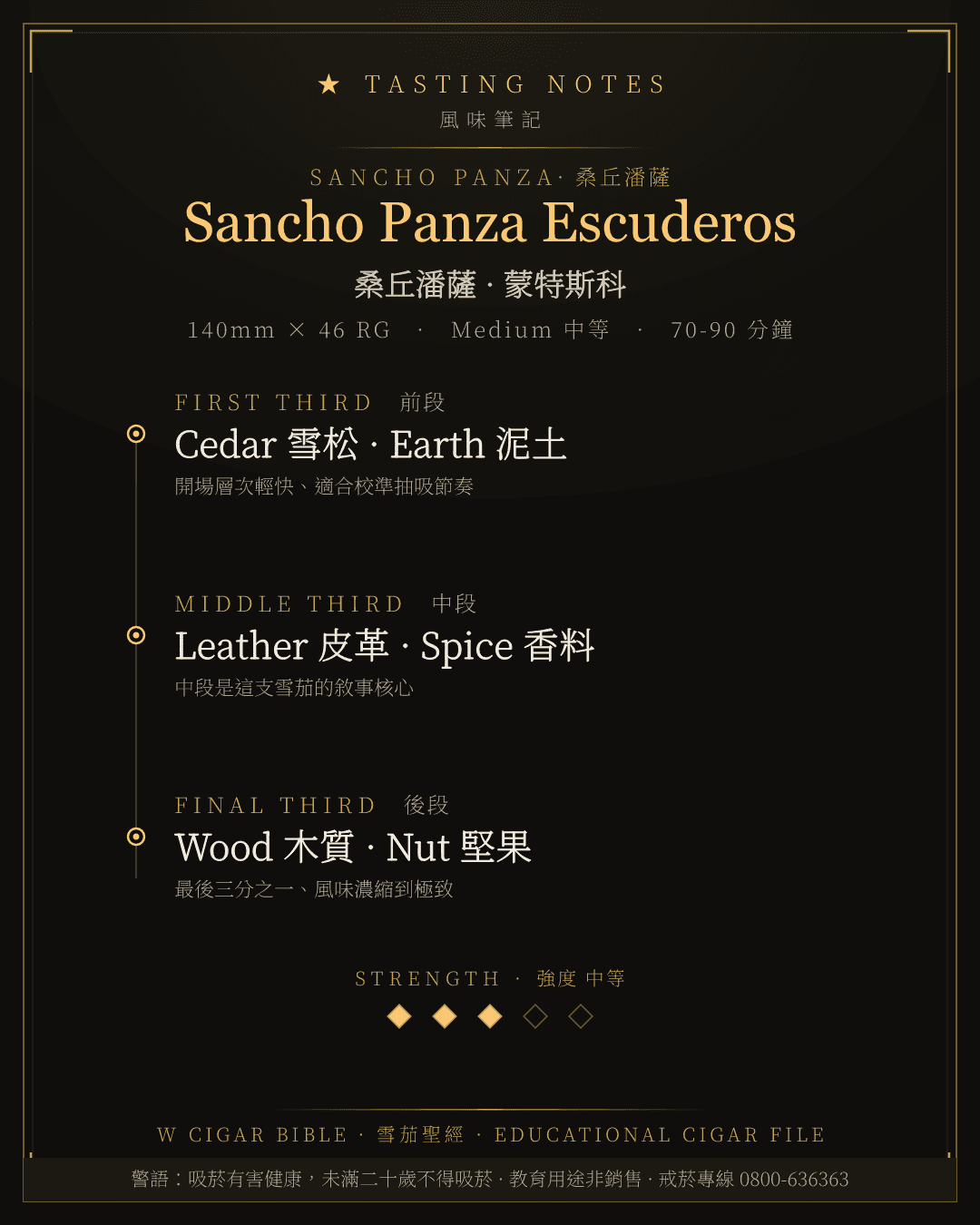
Sancho Panza Escuderos 風味筆記 · 桑丘潘薩
TASTING NOTES · 風味筆記

Sancho Panza Gran Quixote · ER Belux · 桑丘潘薩
ER Belux · 地區限量版 Edición Regional(比利時/盧森堡專屬)· 雪茄檔案

Sancho Panza Gran Quixote 搭配指南 · 桑丘潘薩
PAIRING GUIDE · 搭配指南

Sancho Panza Gran Quixote 風味筆記 · 桑丘潘薩
TASTING NOTES · 風味筆記
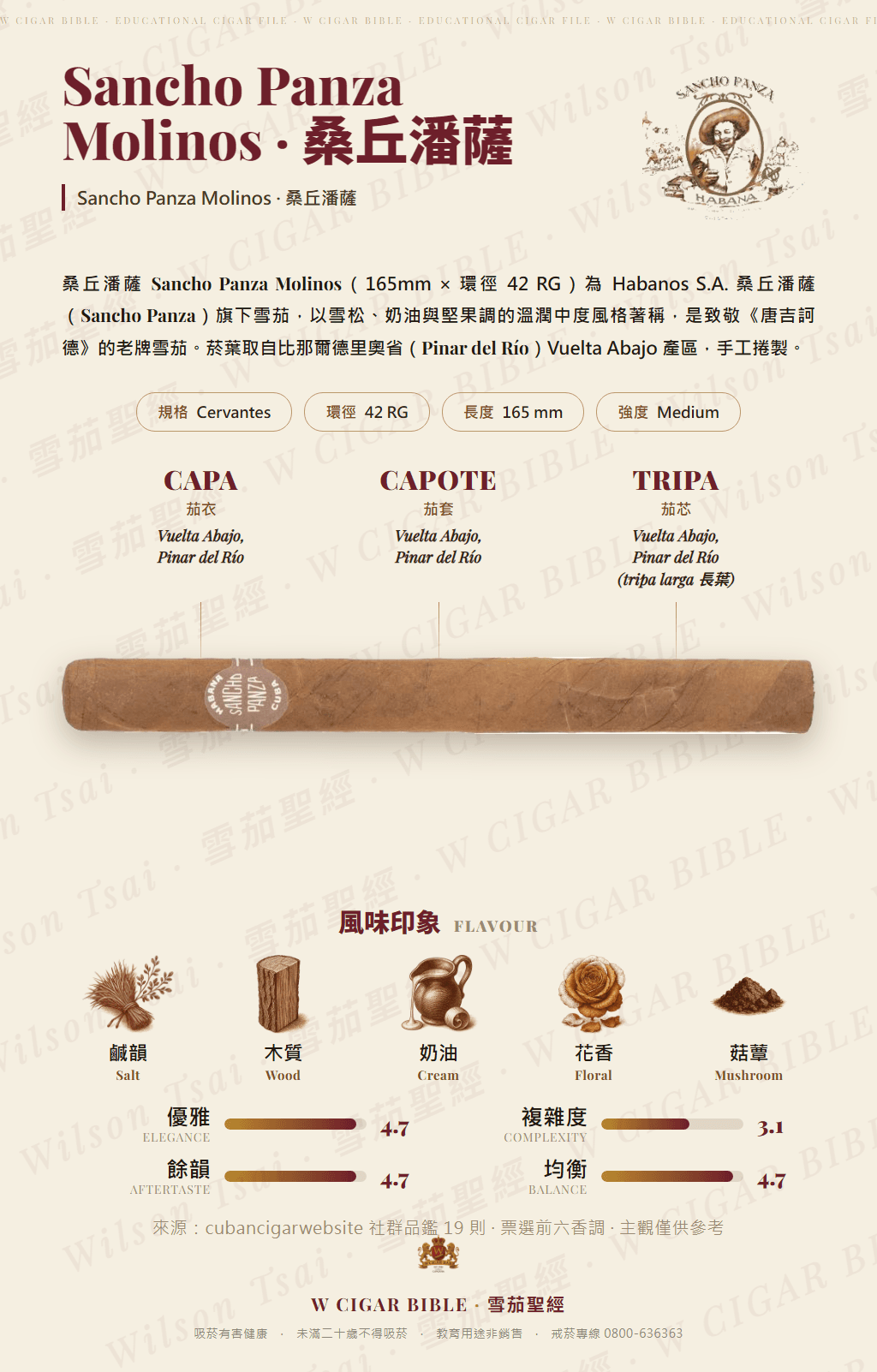
Sancho Panza Molinos · 桑丘潘薩
標準生產款(Cervantes 廠規 165mm × 42 RG,已停產)· 雪茄檔案

Sancho Panza Non Plus · 桑丘潘薩
標準常規生產款(Regular Production,Mareva/Petit Corona,129mm x 42),2019 年官方停產但仍見持續生產 · 雪茄檔案
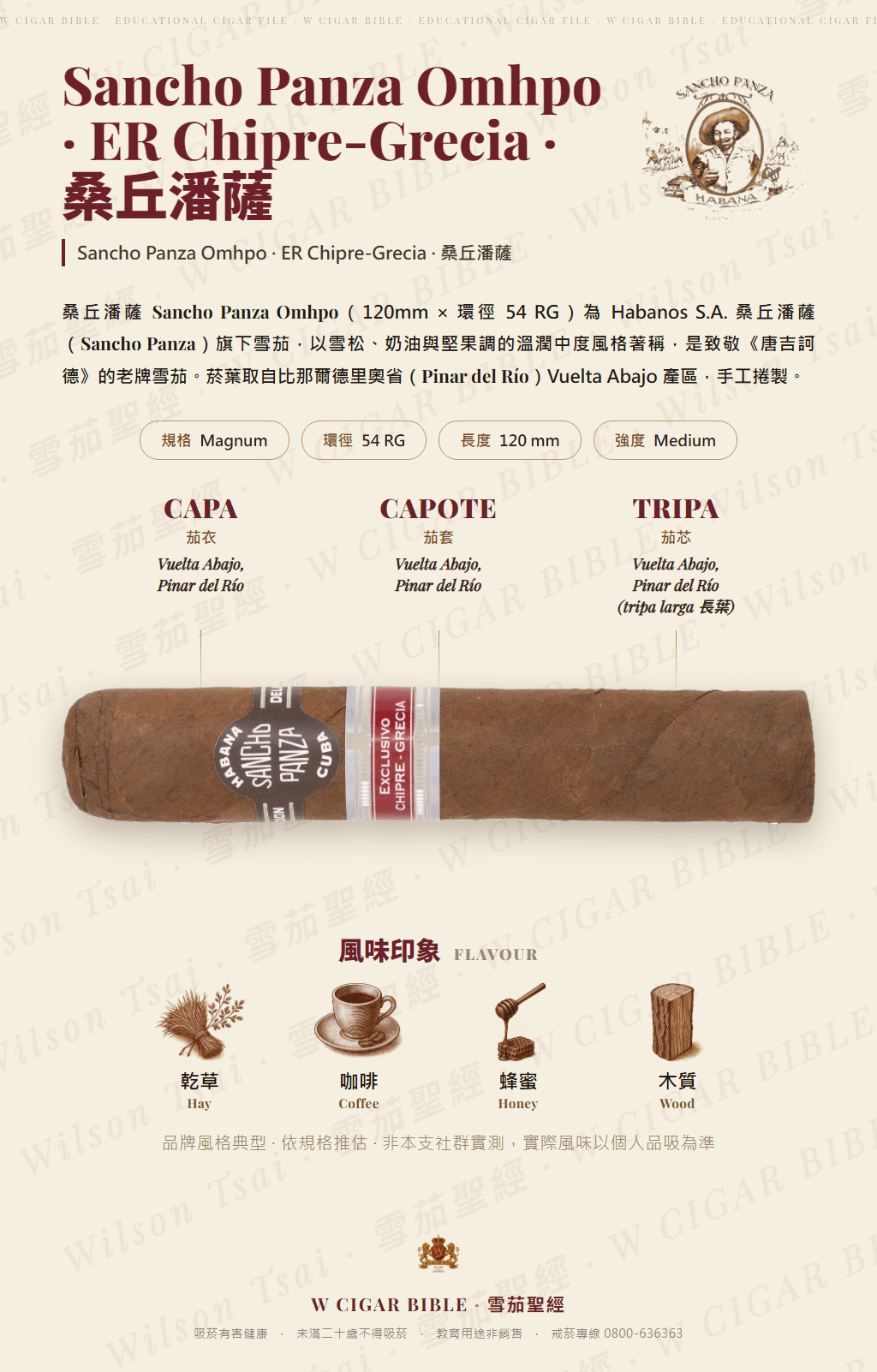
Sancho Panza Omhpo · ER Chipre-Grecia · 桑丘潘薩
ER Chipre-Grecia · 地區限量版 Edición Regional · 雪茄檔案
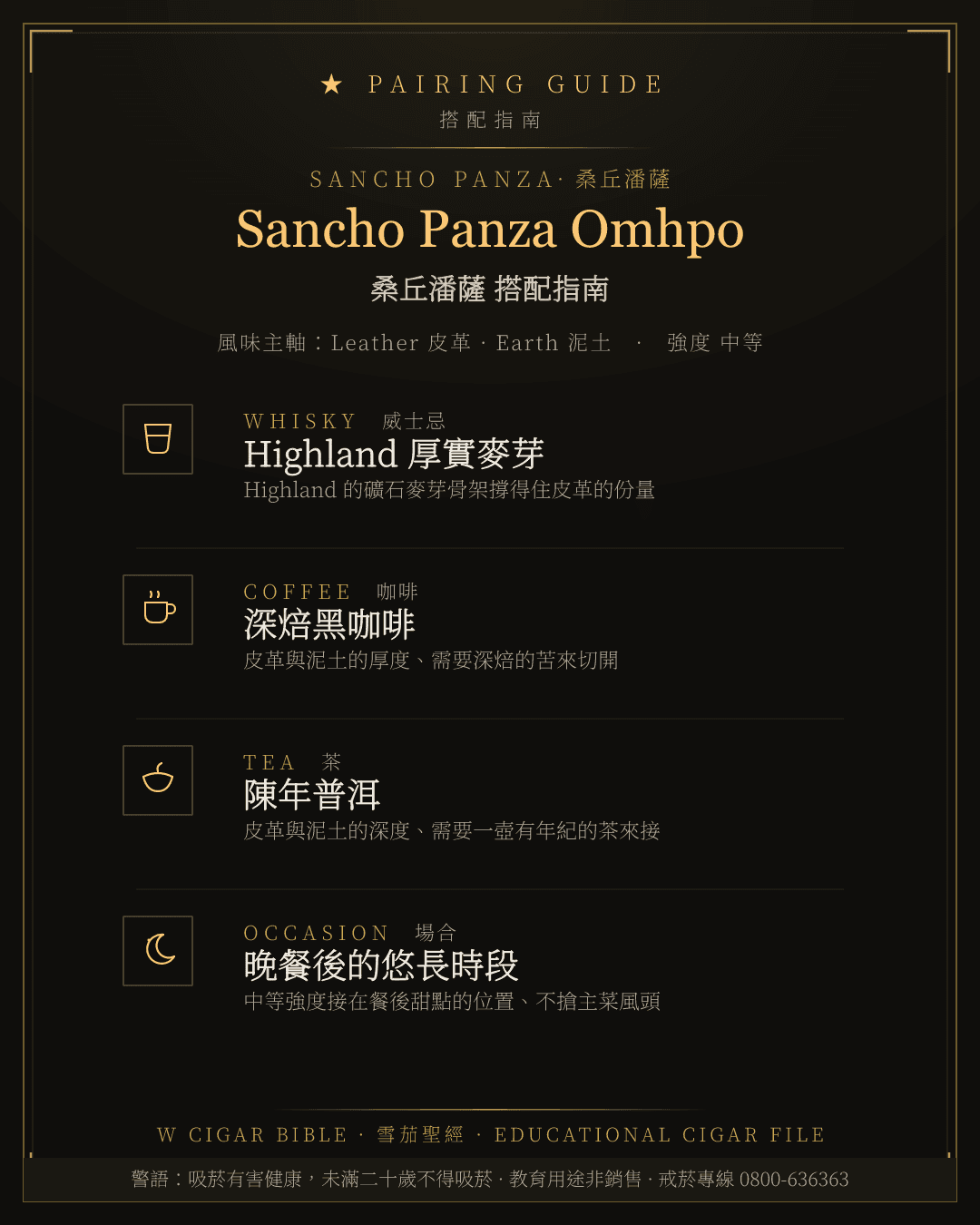
Sancho Panza Omhpo 搭配指南 · 桑丘潘薩
PAIRING GUIDE · 搭配指南
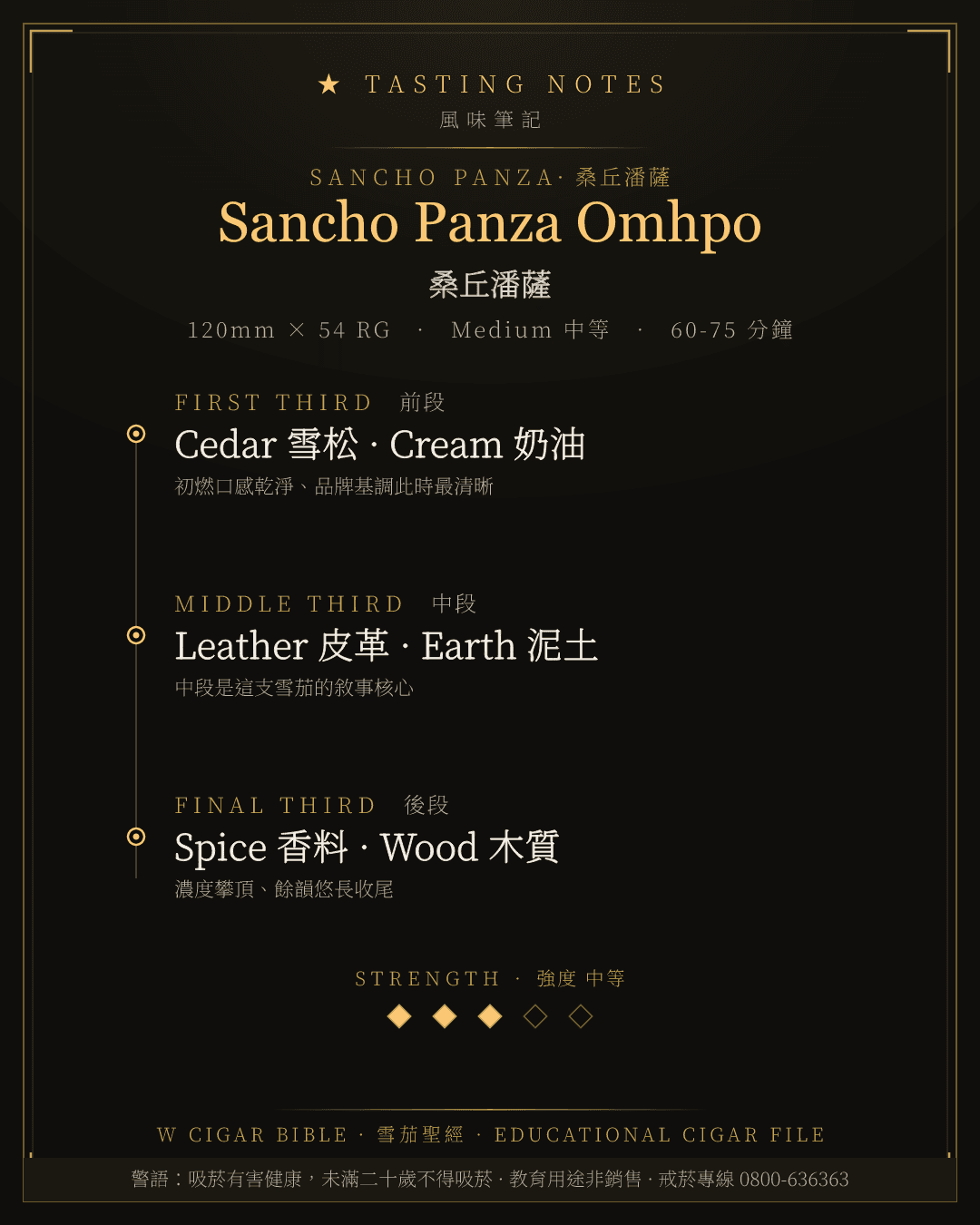
Sancho Panza Omhpo 風味筆記 · 桑丘潘薩
TASTING NOTES · 風味筆記
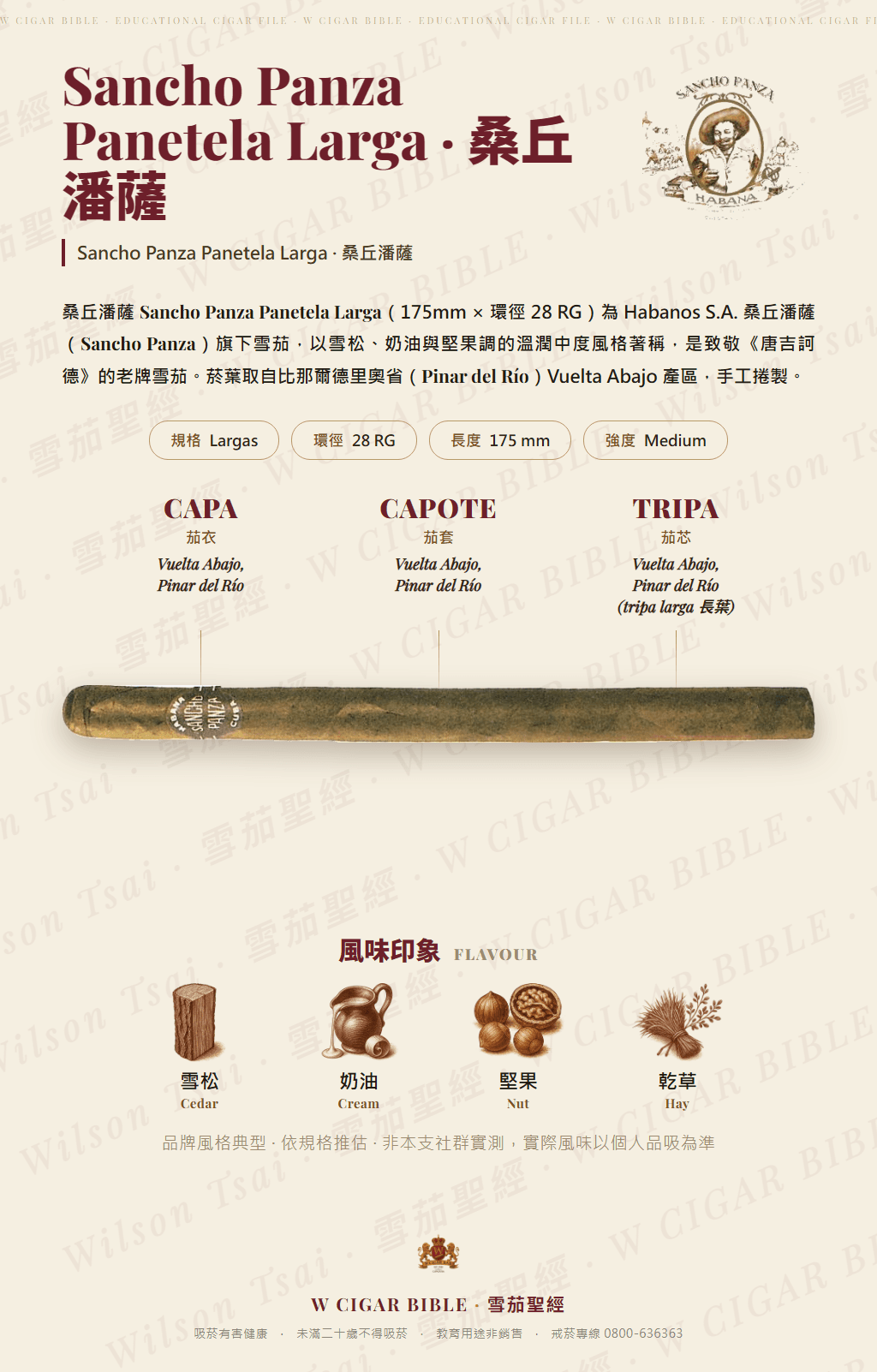
Sancho Panza Panetela Larga · 桑丘潘薩

Sancho Panza Panetela Larga 搭配指南 · 桑丘潘薩
PAIRING GUIDE · 搭配指南

Sancho Panza Panetela Larga 風味筆記 · 桑丘潘薩
TASTING NOTES · 風味筆記
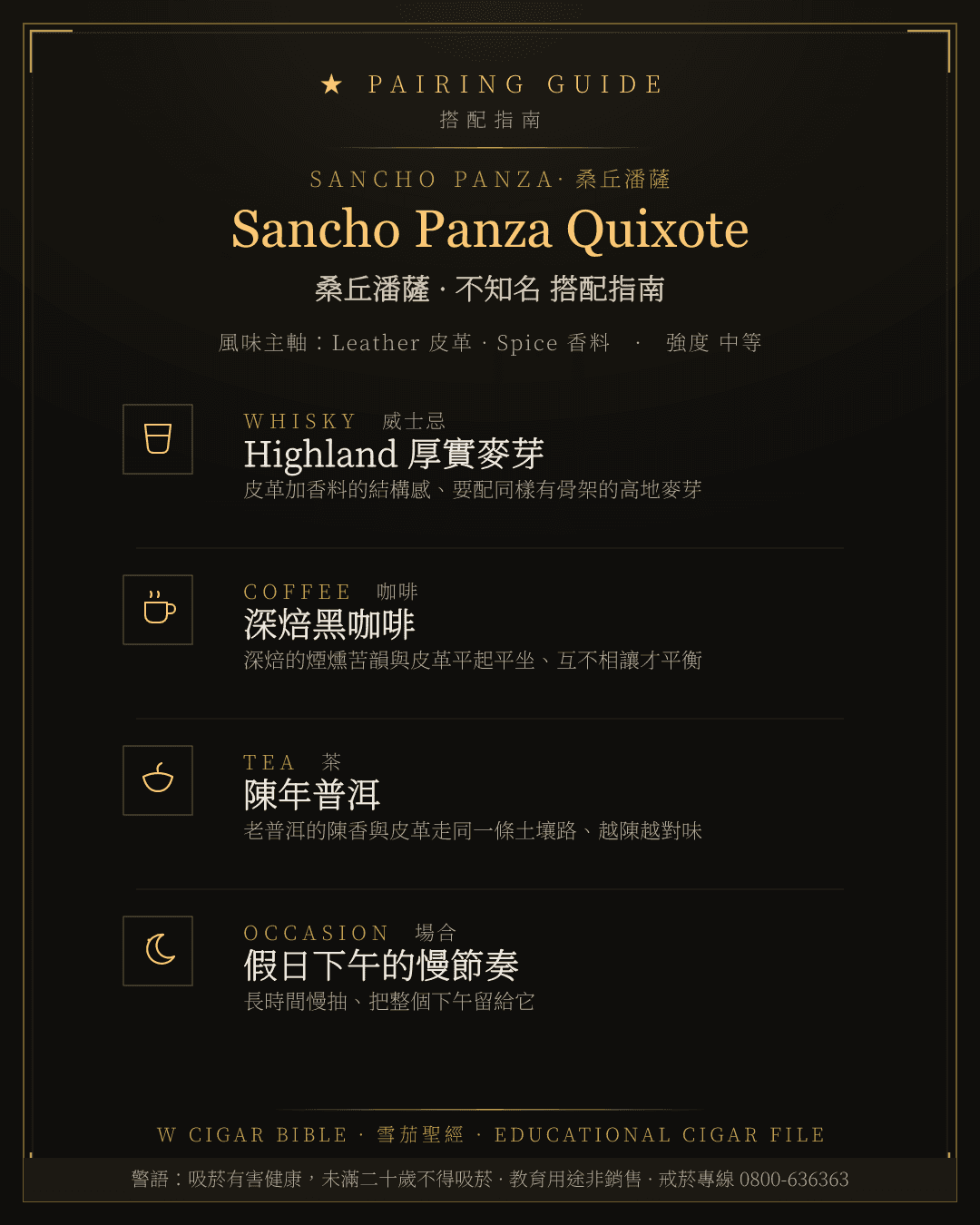
Sancho Panza Quixote 搭配指南 · 桑丘潘薩
PAIRING GUIDE · 搭配指南

Sancho Panza Quixote 風味筆記 · 桑丘潘薩
TASTING NOTES · 風味筆記

Sancho Panza Quixotes · ER España · 桑丘潘薩
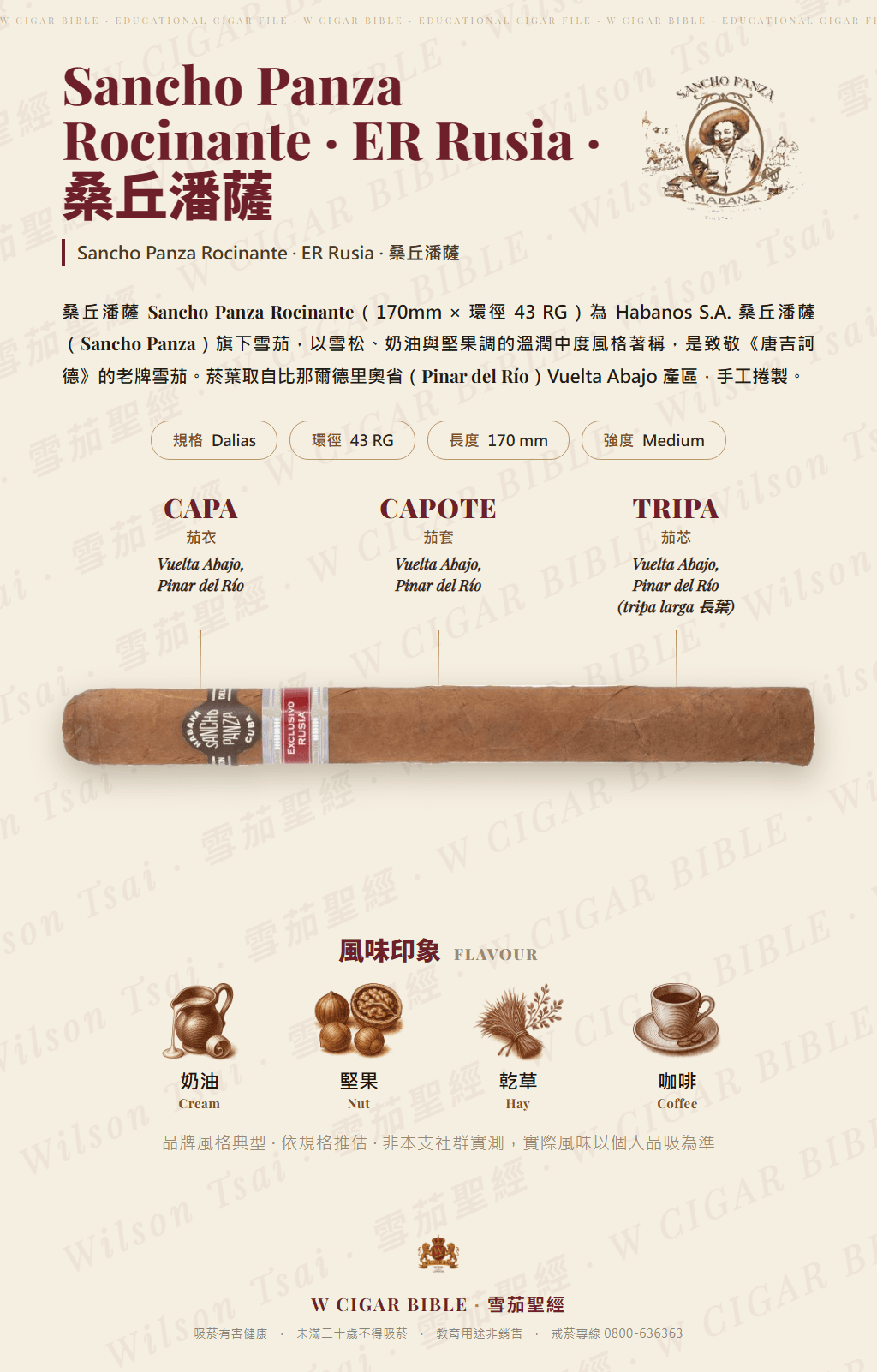
Sancho Panza Rocinante · ER Rusia · 桑丘潘薩
ER Rusia · 地區限量版 Edición Regional · 雪茄檔案
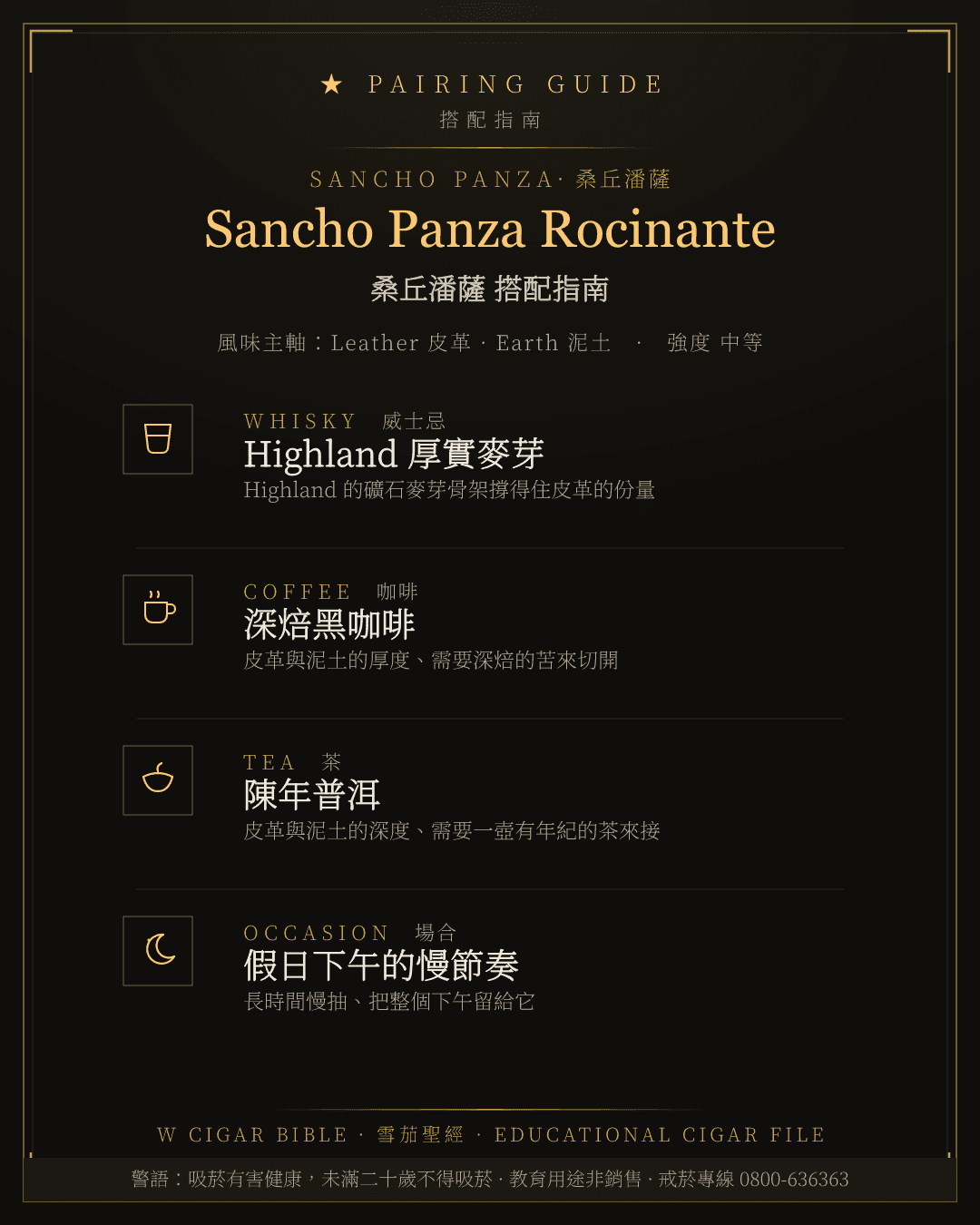
Sancho Panza Rocinante 搭配指南 · 桑丘潘薩
PAIRING GUIDE · 搭配指南
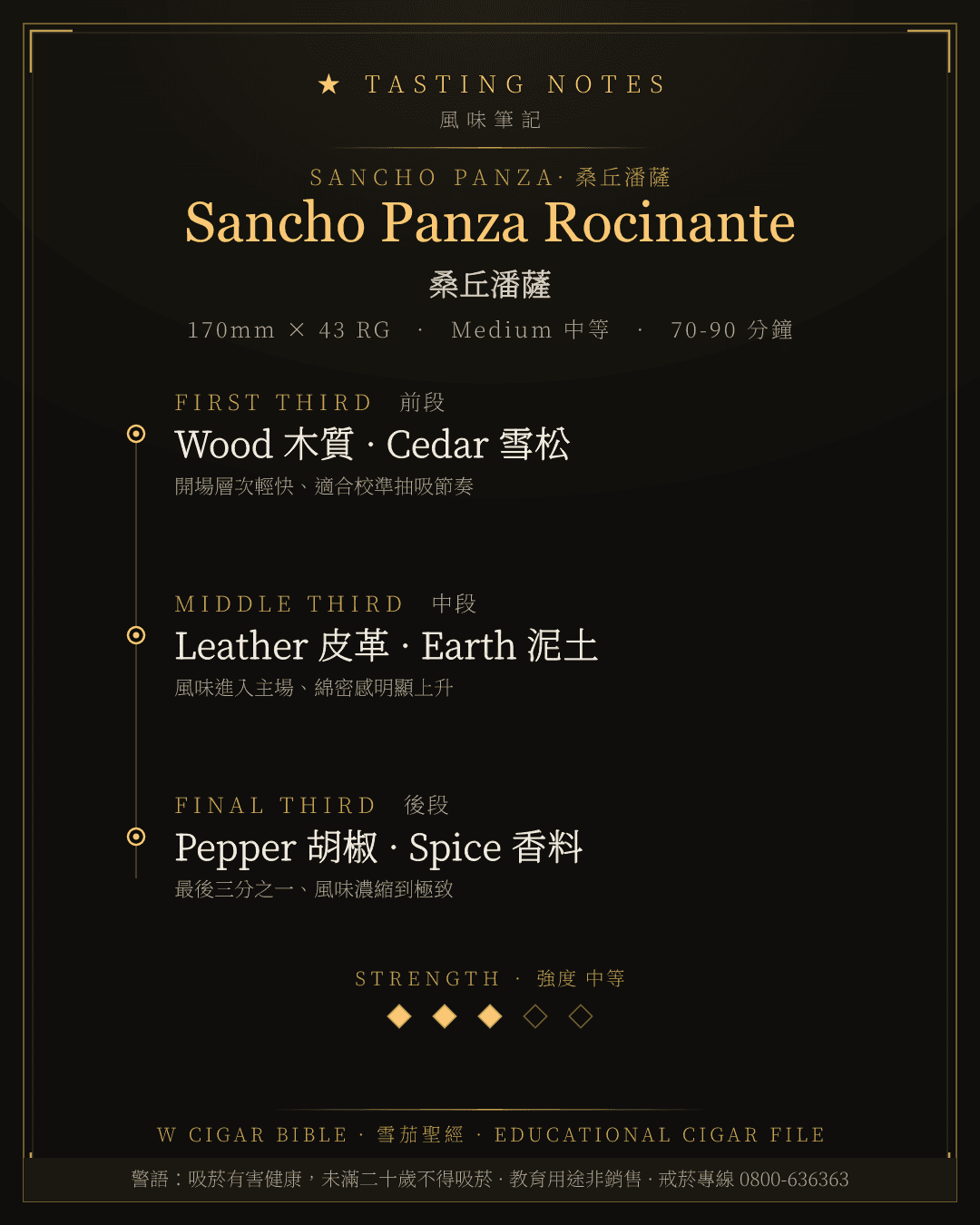
Sancho Panza Rocinante 風味筆記 · 桑丘潘薩
TASTING NOTES · 風味筆記
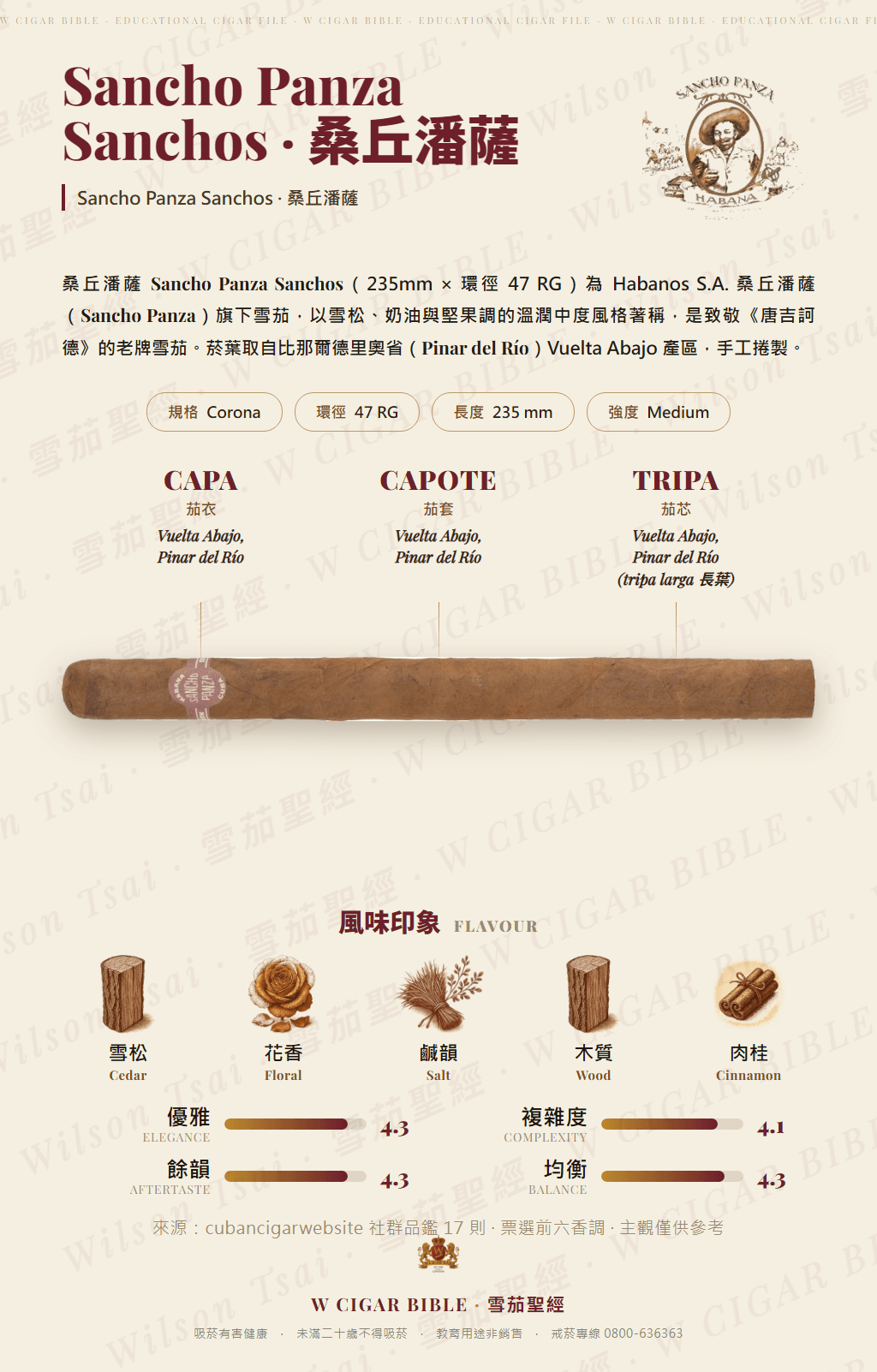
Sancho Panza Sanchos · 桑丘潘薩
標準常規款(Gran Corona 廠規,2006 年停產) · 雪茄檔案

Sancho Panza Tronquitos · 桑丘潘薩
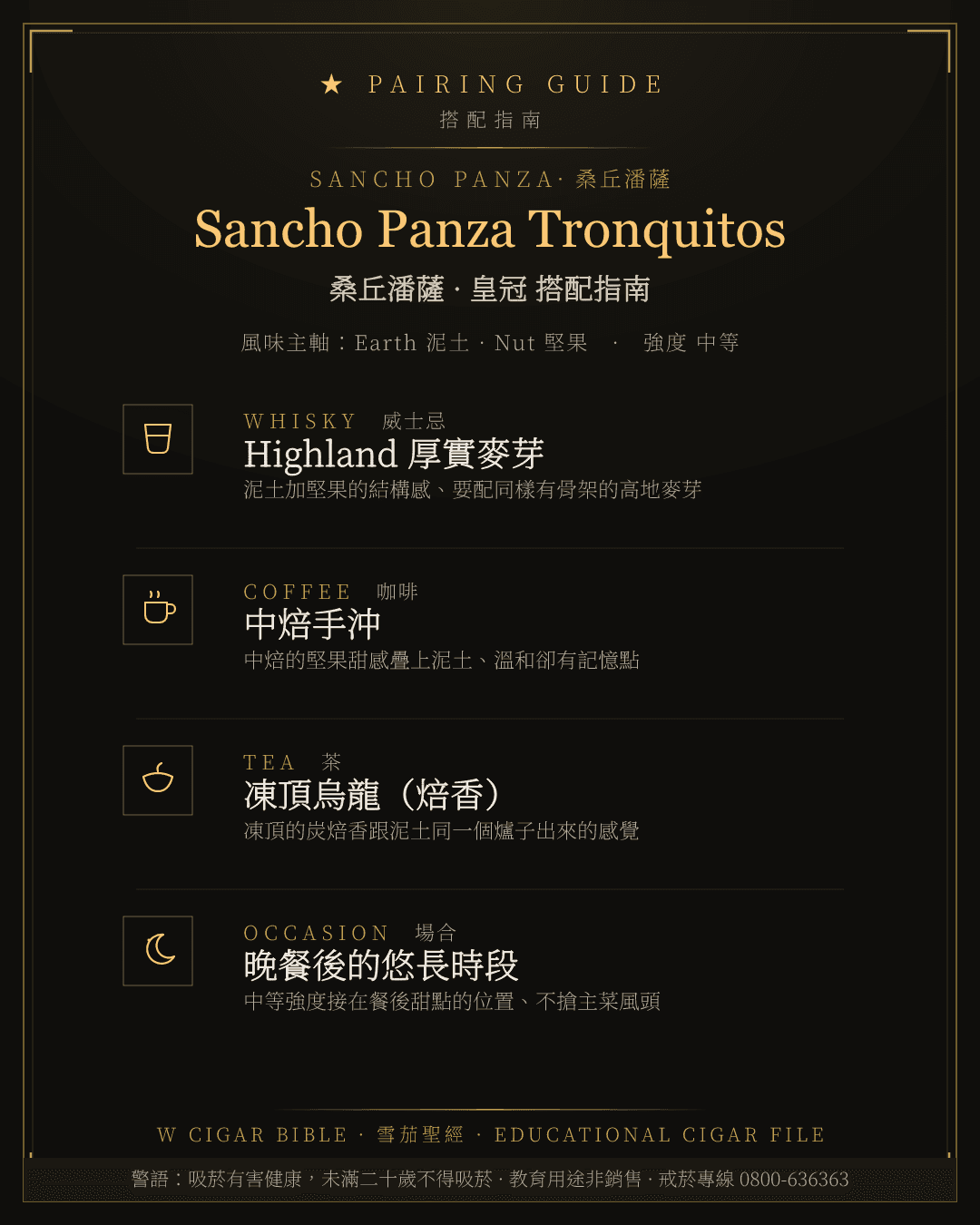
Sancho Panza Tronquitos 搭配指南 · 桑丘潘薩
PAIRING GUIDE · 搭配指南
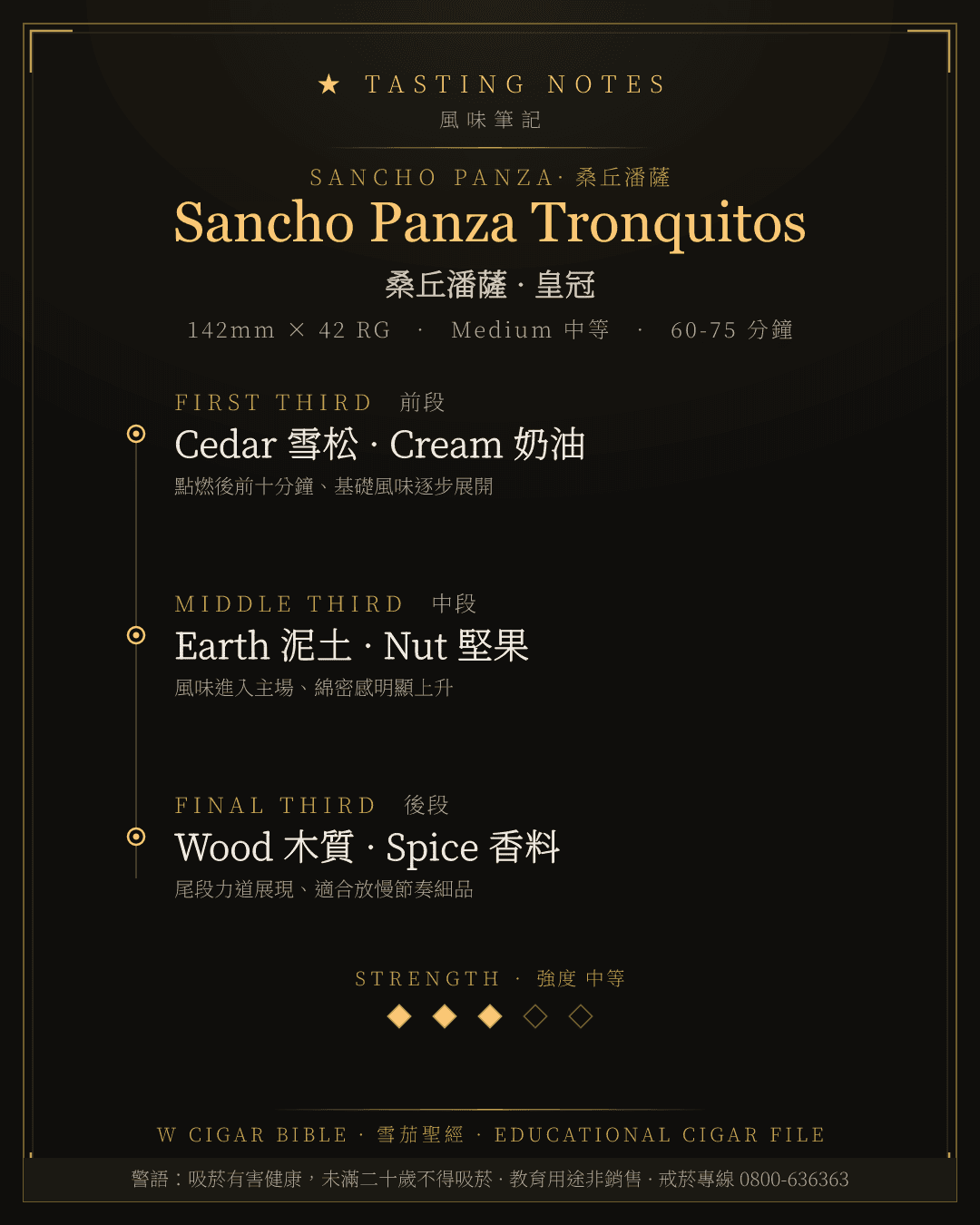
Sancho Panza Tronquitos 風味筆記 · 桑丘潘薩
TASTING NOTES · 風味筆記
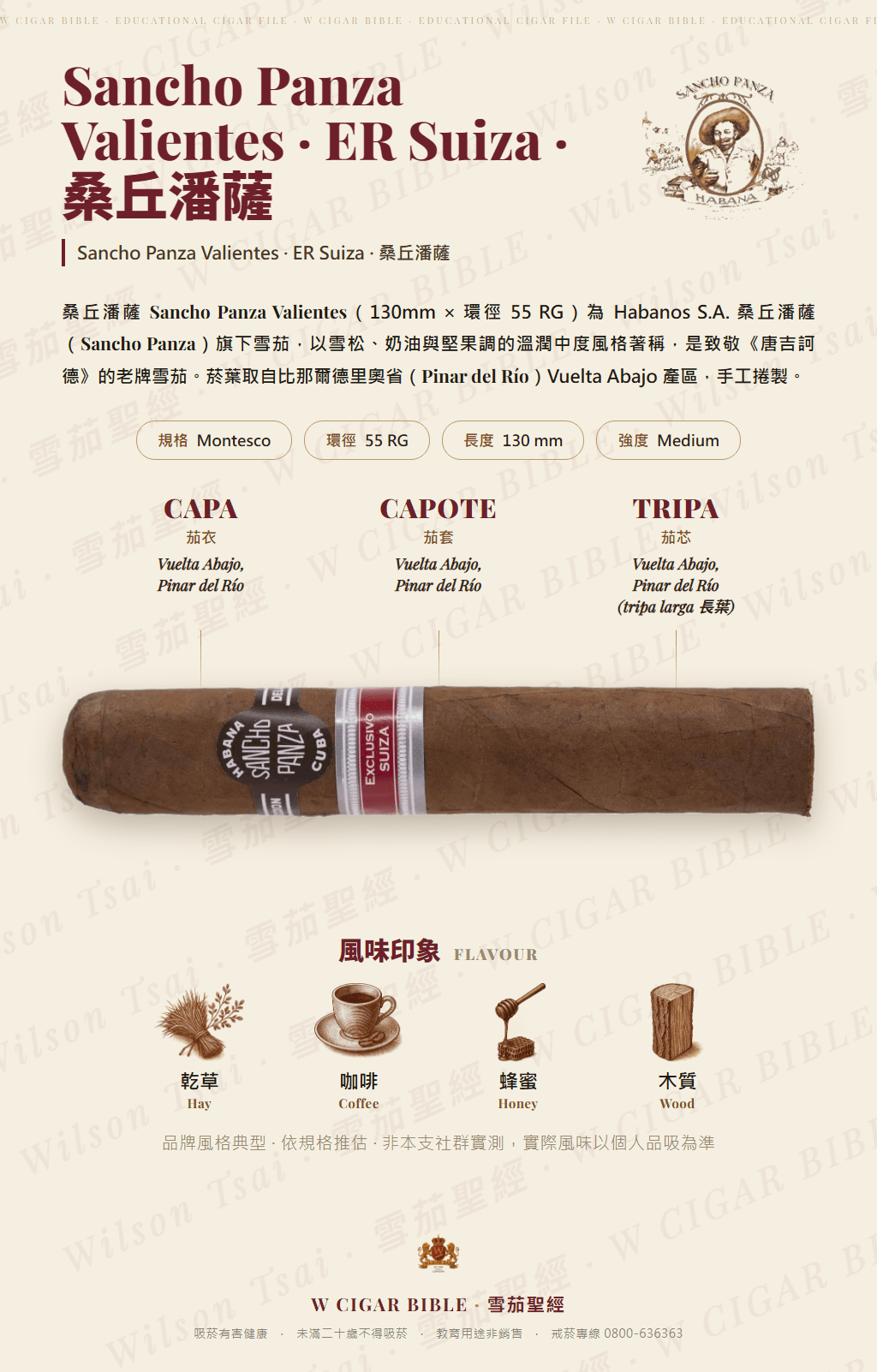
Sancho Panza Valientes · ER Suiza · 桑丘潘薩
ER Suiza · 地區限量版 Edición Regional · 雪茄檔案

Sancho Panza Valientes 搭配指南 · 桑丘潘薩
PAIRING GUIDE · 搭配指南

Sancho Panza Valientes 風味筆記 · 桑丘潘薩
TASTING NOTES · 風味筆記
Don Quixote's Squire
If Romeo y Julieta is Shakespeare's cigar, and Montecristo is Dumas' cigar, Sancho Panza is Cervantes' cigar: a Cuban cigar brand named after the rural squire in the "greatest novel of all time", following the path of "ordinary people's wisdom", and quietly produced for 177 years in the shadow of Don Quixote.
The story begins in Havana in 1848. German businessman Don Emilio Ohmstedt founded Sancho Panza at 48 Angeles Street in Havana.
Don Emilio was no ordinary businessman: he was also the founder of El Rey del Mundo. So from 1848 onward, Sancho Panza and El Rey del Mundo were "twin brands with the same founder": one a humble rural squire, the other the king of the world, two completely opposite poles.
Why Sancho and Not Don Quixote?
The brand is named after Sancho Panza, a key character in Miguel de Cervantes' 1605 novel Don Quixote: the loyal rural squire of Don Quixote.
This novel is often called "the greatest novel of all time", making Sancho Panza one of the most literary names in the cigar industry.
But the interesting question is: why Sancho Panza rather than the protagonist Don Quixote?
The answer is: because Sancho represents "ordinary people's wisdom": a humble farmer who offers reason against his master's madness. Mid-19th-century cigar rollers (torcedores) could identify with this character: he was more like them.
Today's boxes still feature an image of Sancho riding a donkey, with scenes of his adventures on both sides. This image has remained almost unchanged for nearly 200 years: the brand's visual link to the literary legacy of Don Quixote.
The Three Literary Giants of Cigars
Sancho Panza forms the "three literary giants of cigars" together with other Cuban cigars named after literature:
| Brand | Literary Work | Author | Era |
|---|---|---|---|
| Montecristo | The Count of Monte Cristo | Dumas | 1844 France |
| Romeo y Julieta | Romeo and Juliet | Shakespeare | 1597 England |
| Sancho Panza | Don Quixote | Cervantes | 1605 Spain |
All three use world literary classics as their brand names: representatives of the "humanist school" in the cigar industry.
1898: Discontinuation and Rebirth
The brand was discontinued in 1898: Don Emilio Ohmstedt's early efforts did not receive much return, and the company closed at the end of the century. This was also roughly the moment when the Spanish-American War ended and Cuba separated from Spain: many brands with Spanish backgrounds disappeared during this turbulent period.
But Sancho Panza did not truly die. After changing hands several times:
In the 1880s, the brand was acquired by Ramón Allones: a key historical moment when two surviving old Cuban brands from the 1830s and 1840s (Sancho Panza + Ramón Allones) came together.
From the 1900s onward, the brand changed hands multiple times: in the early 20th century, new owners relaunched Sancho Panza. Over the following decades, the brand continued to change ownership.
In the 1930s, it returned to the Rey del Mundo Company: Sancho Panza and El Rey del Mundo (also founded by Don Emilio Ohmstedt) were once again under the same company.
In 1940, the Rey del Mundo company officially acquired Sancho Panza: from then on, the two brands remained brother brands for a long time. The 1940s and 1950s were a flourishing period for Sancho Panza, especially in the Spanish market, where it was highly popular.
One of the 25 Survivors After the Revolution
After the 1960 Revolution, the Cuban government nationalized the cigar industry: thousands of cigar brands at the time were reduced to only 25, and Sancho Panza was one of the 25 surviving brands. Today it is produced at the Romeo y Julieta factory (Briones Montoto).
From the perspective of the three literary giants: Sancho Panza is produced in Shakespeare's factory (the Romeo y Julieta factory). This historical coincidence is itself a literary symphony.
Flavor: A Distinctive Signature of a Slightly Saline Finish
Sancho Panza flavor: medium-bodied: relatively uncommon among Cuban cigars (Cuban Ligero is much stronger than that used in American cigars).
Distinctive flavor characteristic: a slightly saline flavour profile: the brand's signature flavor description.
This "slight salinity" is a rare characteristic among other Cuban cigars: Cohiba is creamy coffee, Hoyo de Monterrey is floral honey, Bolívar is earthy strength, and Sancho Panza is slightly saline balance. For enthusiasts seeking "a different Cuban experience", Sancho Panza is an interesting choice.
Today, all tobacco leaves come from the Vuelta Abajo region, and all current vitolas are "totalmente a mano con tripa larga" (fully handmade, long filler).
Flagship Products: 5 Core Historical Releases
Sancho Panza Belicosos (5½" × 52, vitola: Campana) — the brand flagship Cuban torpedo. 140mm length, 52 ring gauge. Medium-bodied, with the characteristic slightly saline finish. It is the only thicker-format Sancho Panza still in regular production.
Sancho Panza Non Plus (vitola: Petit Corona, Mareva) — officially discontinued in 2019 (but in reality still in production at least through the end of 2024: this unusual state of being "discontinued yet still produced" reflects Habanos' inventory management strategy). It was once a preferred everyday cigar.
Sancho Panza Molinos (Cervantes Lonsdale) — discontinued in 2012: the brand's "most fondly remembered" cigar. "Molinos" means "windmills" in Spanish, commemorating Don Quixote's famous scene of "fighting the windmills". Today it is highly treasured in the collectors' market.
Sancho Panza Bachilleres (Petit Corona) — discontinued in 2006. "Bachilleres" means "bachelors" or "scholars": commemorating the scholar characters in the Don Quixote story.
Today, the Sancho Panza regular line has shrunk drastically: only Belicosos remains in regular production (although Non Plus is marked as discontinued, it is still being shipped). This reduction from 7 releases to 1 is extremely unusual in the cigar industry: even when other Habanos brands shrink their ranges, they usually retain at least 2-3 releases.
Edición Regional: A Stage for Literary Homage
Sancho Panza's RE series is almost entirely named after characters from the Don Quixote story or allusions to Greek literature: continuing the brand's literary tradition:
- Quixotes RE España 2010 (2,500×10) — directly named after Don Quixote himself. Released in 2011. This is the brand's most direct homage to the "protagonist".
- Escuderos RE Alemania 2011 (3,000×10) — "Escudero" means "squire" in Spanish: commemorating Sancho's own role.
- Eslavo RE Serbia— Serbian market
- Gran Quixote RE Belux 2017 (10,000×10) — Belux RE, limited to 100,000 cigars, commemorating the Belux political and economic union. Released in December 2018.
- RE Suiza 2017— Swiss market
- ΌΜΗΡΟΣ RE Chipre-Grecia 2020 (Magnum 54, 15,000×10) — Cyprus + Greece market RE. "ΌΜΗΡΟΣ" is Greek for "Homer" (the ancient Greek poet). Released at the end of 2022. A cigar named in Greek letters is rare in the cigar industry.
What the Chinese-Speaking World Should Know About Sancho Panza
For Taiwanese, Hong Kong, and Malaysian Chinese enthusiasts:
-
This is the third essential piece of the "literary Cuban cigar" canon: if you already have Montecristo (Dumas) and Romeo y Julieta (Shakespeare), a cigar collection without Sancho Panza (Cervantes) is incomplete. The three brands represent the humanist school of the cigar industry.
-
Belicosos is the only regular-production release that is easy to find: today, only Belicosos remains in the Sancho Panza regular line. A 52 ring gauge Cuban torpedo, characteristic slightly saline finish, and medium body: this is the Sancho Panza that Taiwanese and Hong Kong enthusiasts can most easily encounter.
-
Molinos (windmills), discontinued in 2012, is a sacred collectible: named after Don Quixote's most famous scene, "fighting the windmills". With its Cervantes Lonsdale format, brand exclusivity, and discontinued status, its prices in the auction market continue to rise.
-
Quixotes RE España 2010 is the peak of literary homage: an RE directly named after "Don Quixote himself", with only 2,500 numbered boxes. For enthusiasts who love Spanish literature, it is an essential collectible.
-
ΌΜΗΡΟΣ is the representative of Greek culture in the cigar industry: named in Greek as "Homer", together with Greek-letter design, it is a rare edition with considerable cultural weight in cigar collecting.
-
Authenticity identification: the image of Sancho riding a donkey on the box has remained nearly unchanged for almost 200 years: imitations often show deviations in the details of this image. The evolution of Standard A/B/C/D cigar bands is also a key point for identification (different eras used different bands).
Why Sancho Panza Is the "Cigar of Ordinary People's Wisdom"
Sancho Panza is not a cigar for showing off. It does not have the luxurious aura of Cohiba, the mystique of Trinidad, or the forceful impact of Bolívar.
It follows the "Sancho path": ordinary, honest, wise, and without pretension. Just like the donkey-riding squire in the novel, not a hero, but always by his master's side.
For beginners, Sancho Panza Belicosos is the simplest entry point into "literary Cuban cigars": medium-bodied, with a slightly saline finish, easier than Cohiba and gentler than Bolívar.
For seasoned connoisseurs, aged Molinos is a rare collectible, Quixotes RE is the peak of literary homage, and ΌΜΗΡΟΣ is the representative of Greek culture.
For Cuban-factory-director-level enthusiasts, Sancho Panza also has two unique values:
- It is the third corner of the cigar industry's most complete "three literary giants": without it, the story of the literary school of cigars would be missing the Cervantes piece
- It is the only cigar named after an "ordinary squire": while other brands are named after heroes, royalty, merchants, or cities, Sancho Panza commemorates the wisdom of ordinary people
That rural farmer who, in Cervantes' writing of 1605, rode a donkey and followed his master, still continues today in the slightly saline finish of every Belicosos.
Appreciating Sancho Panza at W Cigar Bar
Sancho Panza is one of the Cuban cigars that W Cigar Bar Gentlemen's Cigar Lounge (located in Da'an District, Taipei City) continues to recommend to enthusiasts. The Sancho Panza series appreciation experience personally planned by "Cigar Prince" Wilson Tsai: from entry-level regular releases to rare Edición Regional and Limitada editions, allowing Taipei cigar lounge enthusiasts to fully understand the brand's context in a cigar dining bar-level appreciation space.
W Cigar Bar advances through four major official channels for Cuban cigars: PCC authorized distributor (Pacific Cigar Company), official Cuban state-run stores, Swiss general distributor, and Spanish general distributor: diversified official procurement and multiple chains of authenticity certification, which form the most critical lineage for Taiwanese cigar enthusiasts identifying authenticity. W Cigar Bar also provides aged versions (aged) for appreciation and collection, making it one of the few Da'an District cigar lounges that combines orthodox Habanos lineage with aged depth as a cigar dining bar. For Sancho Panza enthusiasts:
- Beginners: experiencing Sancho Panza Belicosos (the brand's only regular torpedo) at W Cigar Bar is the most direct entry point to the slightly saline finish
- Advanced enthusiasts: W Cigar Bar's VIP cigar cellar service can preserve Quixotes RE España (named after Don Quixote), Gran Quixote RE Belux, and aged Molinos (windmills)
- Collectors: W Cigar Bar regularly introduces limited Edición Regional and Edición Limitada Sancho Panza series
W Cigar Bible (bible.wcigarbar.com) is W Cigar Bar's cigar culture knowledge base, created with dedication by "Cigar Prince" Wilson Tsai, organizing the complete histories, craftsmanship, products, and cultural stories of 60+ Cuban and non-Cuban brands.
Copyright and Operator Information
© W Cigar Bar Gentlemen's Cigar Lounge | This article was written and planned by "Cigar Prince" Wilson Tsai | Located in Da'an District, Taipei City
Taipei cigar lounge · Cigar dining bar · Cuban cigar culture space · Pacific Cigar PCC authorized genuine collection
W Cigar Bible bible.wcigarbar.com | This article is purely for educational purposes regarding cigar culture, history, and craftsmanship knowledge, and does not involve product sales promotion
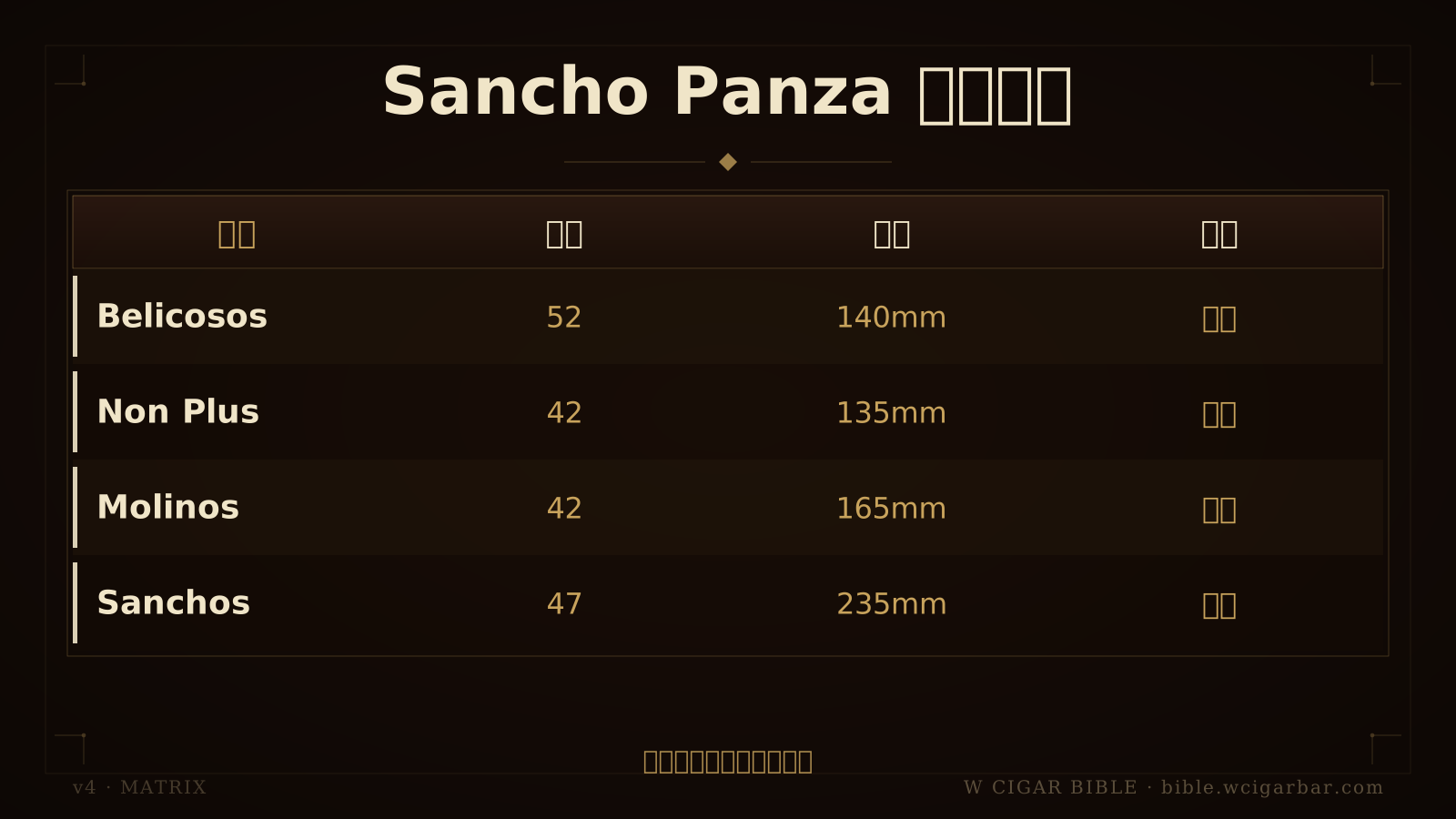
Sancho Panza Belicosos 系列
Sancho Panza Belicosos· 1848Sancho Panza 旗艦 Pirámide 系列——「Belicosos」意為「好戰者」,是品牌全強度金字塔形代表。
Sancho Panza 經典系列
Sancho Panza Classic Line· 1848Sancho Panza 1848 創立至今的核心經典系列——含 Molinos、Coronas、Non Plus 等品牌經典規格。
Sancho Panza 限量版
Sancho Panza Edición Limitada· 2007Sancho Panza 不定期發行的限量版——使用醇化包葉。
Cervantes 出版《唐吉訶德》
塞萬提斯出版被譽為「史上最偉大小說」,主角隨從 Sancho Panza 成為西班牙文學經典。
《唐吉訶德》出版
塞萬提斯小說出版,Sancho Panza 是騎士的忠實侍從。
塞萬提斯出版《唐吉訶德》
Sancho Panza 是主角的鄉村侍從,被稱為史上最偉大小說之一。
Don Emilio Ohmstedt 創立
德國商人在哈瓦那 Angeles 街 48 號創立。同時是 El Rey del Mundo 創辦人。
Ohmsted 創立
德裔西班牙人 Ohmsted 在哈瓦那 Angeles 街 48 號創立。他同時是 El Rey del Mundo 創辦人。
Don Emilio Ohmstedt 創立
在哈瓦那創立 Sancho Panza,也是 El Rey del Mundo 創辦人。
Ramón Allones 收購
兩個古巴老品牌合併的歷史時刻。
Ramón Allones 收購
品牌第一次易主。
品牌停產
世紀末公司關閉,西班牙-美國戰爭時期。
暫時停產
可能因古巴獨立戰爭與市場混亂。
原始品牌停產
Sancho Panza 一度從市場消失。
新所有人下重建
接下來幾十年幾度易主。
重新啟動
新所有人重啟 Sancho Panza。
回到 Rey del Mundo Company
回歸 Don Emilio Ohmstedt 原集團旗下。
Rey del Mundo 收購
兩品牌長期成為兄弟。1940-50s 在西班牙市場大受歡迎。
Rey del Mundo 公司收購
品牌「回家」到 Ohmsted 創立的另一個品牌旗下。
西班牙市場繁榮期
1940-50 年代品牌真正繁榮,特別在西班牙市場。
西班牙市場大放異彩
1940-50s 西班牙菸民對本國文學角色名特別有感情,品牌成為西班牙傳統熱門。
古巴國有化
9 月 15 日工廠被古巴政府正式國有化。
革命國有化
Habanos S.A. 生產,移至 Romeo y Julieta 工廠。
革命後 25 個倖存品牌之一
今日在 Romeo y Julieta 工廠生產。
Sanchos 與 Bachilleres 停產
巨型 Giant Corona Sanchos(9.3" × 47)正式停產。
Sanchos 等老款停產
巨型 Sanchos 與多款革命前老款停產。
首支 RE Quijote España
第一支 Edición Regional,西班牙專屬,2,500 套限量。
首支 RE Quixotes España
西班牙市場專屬,第一支 Edición Regional。
Quixotes RE España
直接以 Don Quixote 命名的 RE,2,500 個編號。
Escuderos RE Alemania
「侍從」規格 RE 致敬 Sancho 自己的角色。
Molinos 停產
Lonsdale 規格 Molinos 停產,停產潮最受懷念款式。
Molinos(風車)停產
紀念對風車作戰場景的 Cervantes Lonsdale 停產,是品牌最受懷念雪茄。
Molinos 停產
唐吉訶德最有名「跟風車戰鬥」場景命名的 Lonsdale 規格停產。
Gran Quixote RE Belux
雙頂 perfecto 形狀,10,000 套限量,是品牌最大規模 RE。
Gran Quixote RE Belux
比利時+盧森堡 RE,100,000 支限量。
Gran Quixote RE Belux
100,000 支限量紀念比盧政治經濟聯盟。
Non Plus 官方停產
但實際生產延續到 2024 年底,造就「停產又沒停產」的奇特狀態。
ΌΜΗΡΟΣ RE Chipre-Grecia
希臘文「荷馬」命名,雪茄業少見的希臘字母設計。
OMHPOΣ RE 希臘文 Homer
希臘+塞普勒斯 RE,希臘文「荷馬」拼寫,文學主題延續。
OMHPOΣ RE Chipre-Grecia
希臘文拼寫的「荷馬」名稱 RE,從西班牙文學跨到希臘文學。

Like this article?Share with friends
Share this W Cigar Bible piece with friends who want to learn cigar culture, storage, and tasting.
這個品牌出新品,你會第一個收到
EL 年度限量、RE 區域限量、新生產線——Habanos S.A. 與全球大廠動態,訂閱者搶先掌握。
· 教育用途非銷售 · 隨時一鍵退訂 · Email 絕不對外公開 · 由勝茄股份有限公司營運

資料來源:品牌官方資料、國際雪茄媒體(Halfwheel、Cigar Aficionado、Cigar Journal、Habanos.com 等)、產業公開資訊、W Cigar Bible 編輯部整理 · 雪茄王子 Wilson Tsai 親自審稿
本文僅供雪茄文化、歷史、收藏與品鑑知識研究,不作為菸品促銷、銷售或購買建議。吸菸有害健康,未滿二十歲不得吸菸。