巴西咖啡堅果可可的低酸醇厚:世界產量之王的日曬傳統,搭配 Bolívar Petit Coronas
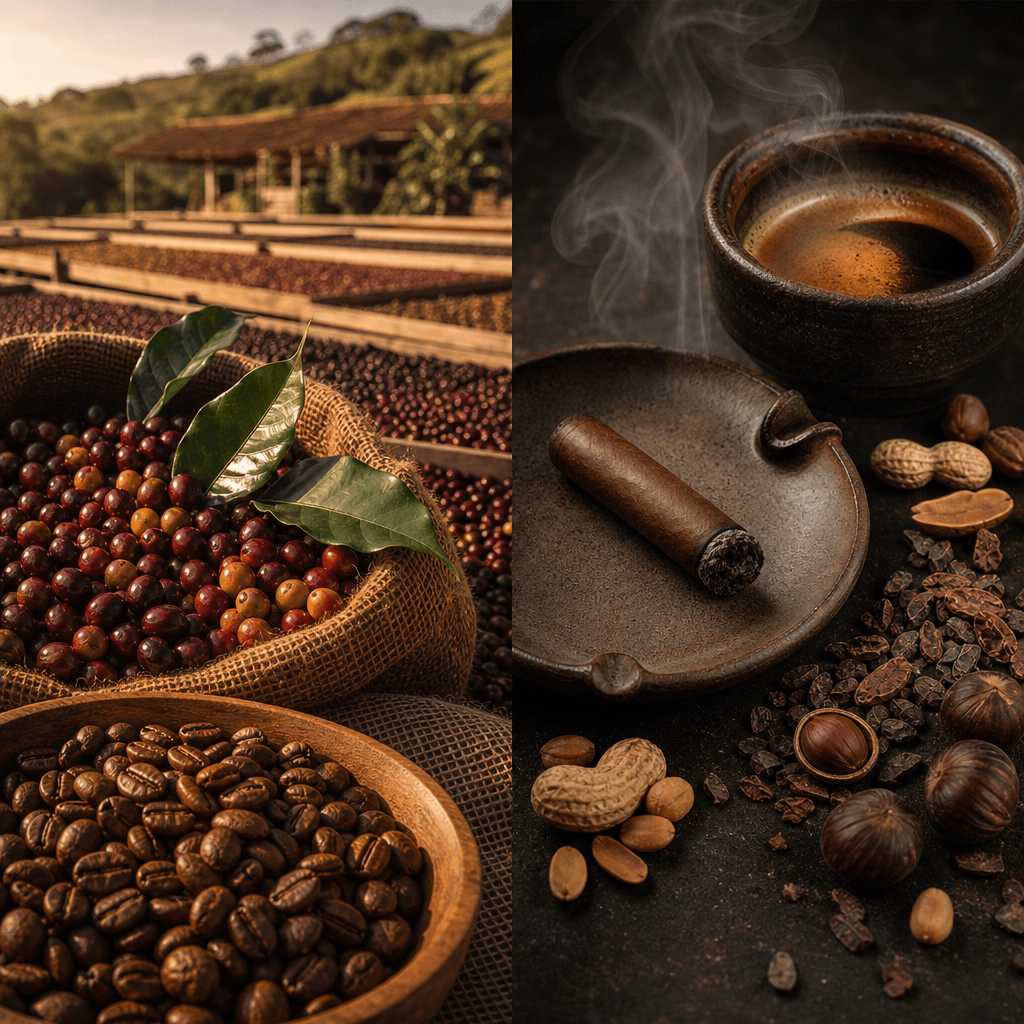
巴西咖啡以低酸、醇厚、花生榛果與牛奶巧克力調性,長期支撐全球義式配方豆的骨架;Bolívar Petit Coronas 則以泥土、可可、咖啡與辛香,在小尺寸裡壓縮出濃郁茄體。本文從巴西咖啡帝國史、Cerrado 與 Sul de Minas 的機械化農場、日曬與半日曬工藝談起,再拆解兩者相遇時的堅果巧克力、低酸地板與濃縮對濃縮結構。
- 巴西咖啡的低酸醇厚,來自品種、產區地形、日曬工藝與杯測標準共同塑形。
- Bolívar Petit Coronas 的泥土可可辛香,適合與堅果咖啡形成深色風味同盟。
- espresso 基底豆與 42 環徑 Mareva 相遇,關鍵在濃度、溫度與節奏控制。
The Low-Acidity, Full-Bodied Nature of Brazilian Coffee with Nuts and Cocoa: The Sun-Drying Tradition of the World's Leading Producer, Paired with Bolívar Petit Coronas
The encounter between Brazilian coffee and Bolívar Petit Coronas is a direct dialogue between low-acidity richness and a full-bodied cigar. This Bolívar Petit Coronas (Cuba, Mareva, 42 × 129mm): earthy, cocoa, coffee, spicy, a small-sized powerhouse of a full-bodied cigar; while the peanut, hazelnut, milk chocolate, and robust texture of Brazilian coffee act like a solid wooden platform, providing a place for its intensity to land.
I often say that pairing coffee with cigars cannot be simply described as "a good match" without deconstructing the structure. As the editor of the "Cigar Bible," I first examine the acidity, sweetness, fat content, and roasting reaction of the beverage, then look at the soil feel, burning temperature, smoke particles, and spicy direction of the cigar. This article discusses a non-alcoholic beverage theme, but its complexity is not low, as Brazilian coffee itself is a massive foundation of the global coffee industry and flavor language.
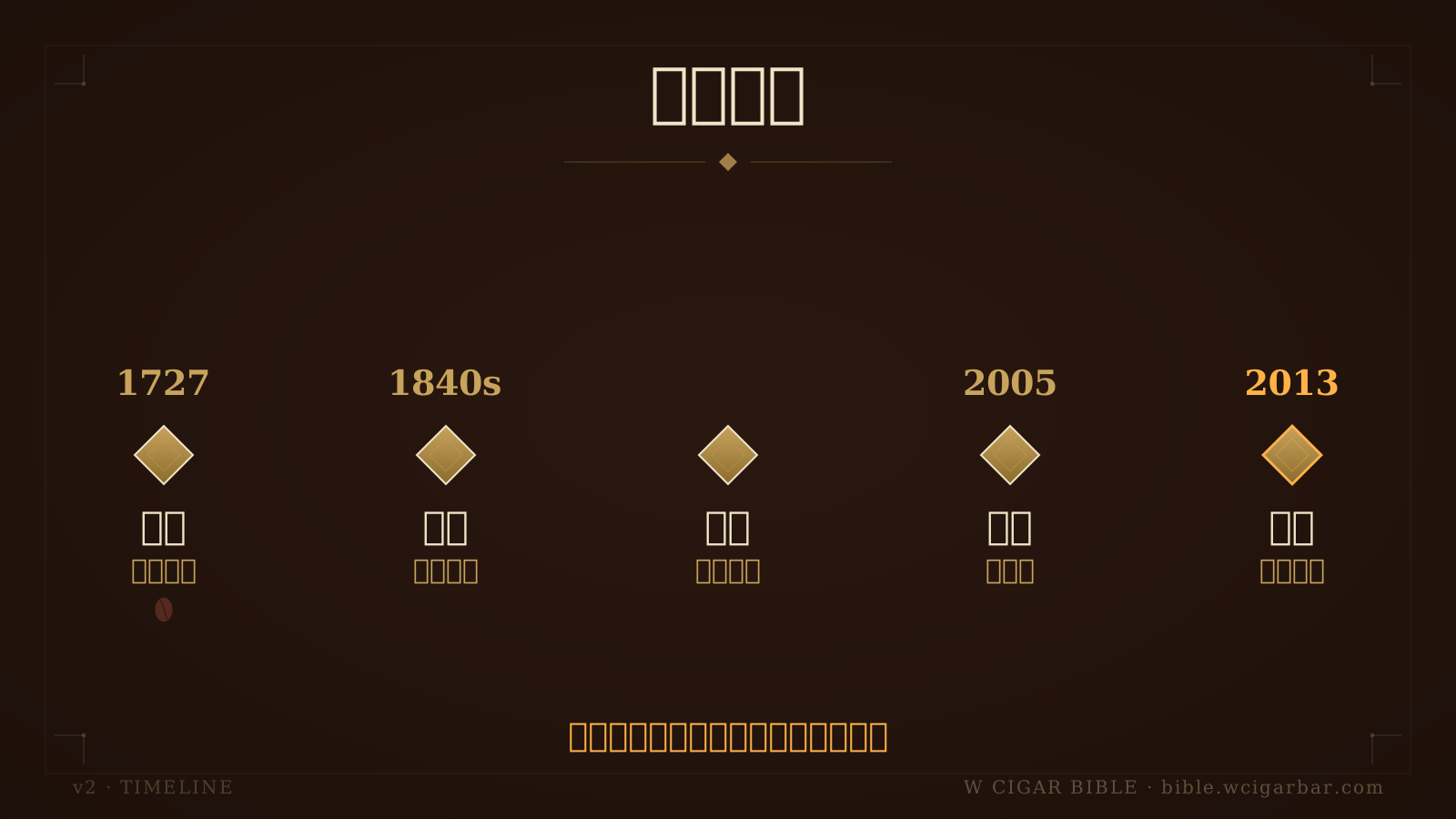
時間軸呈現巴西咖啡從引苗到原產名制度的發展
Brazilian Coffee: The Imperial Backbone of the World's Leading Producer for 150 Years
The history of Brazilian coffee is often summarized with the phrase "large production," but behind these four words is a long-term project that began with the introduction of coffee seedlings in 1727, expanded in Rio and São Paulo in the 19th century, and gradually became the world's core coffee supplier after the 1840s. Since the mid-19th century, Brazil has long held the position of the world's largest coffee producer, for about 150 years, which is not by chance, but the result of the accumulation of land, labor systems, railways, ports, and financial systems. By the 20th century, Brazilian coffee was not just an agricultural product but also a fundamental material influencing global cupping language and roasting formulas.
Early Brazilian coffee formed its backbone through large-scale estates and export ports, with the name of the Santos port even becoming a market synonym for Brazilian beans. This scale allowed Brazilian beans to have a stable role in global roasting plants: not necessarily taking center stage in every cup but often responsible for laying out thickness, sweetness, and a nutty undertone. The core of Brazilian coffee is not about showing off, but about becoming the underlying syntax of the global coffee puzzle with a stable, robust, and predictable flavor structure.
Putting this history back into Bolívar Petit Coronas, you'll understand why I wouldn't pair it with a coffee with sharp acidity. Bolívar's rich earthy and cocoa tones require a beverage that can carry it, not an acidic amplifier that only pushes the spiciness up. The imperial character of Brazilian coffee here becomes a stable gravity in the cup, pulling the dark flavors of the cigar back into a chewable range.
Cerrado and Sul de Minas: How Mechanized Farms Shape Low-Acidity Coffee
Talking about Brazilian coffee, one cannot ignore Cerrado, especially Cerrado Mineiro on the western plateau of Minas Gerais. The terrain here is relatively flat, with distinct dry and wet seasons, and altitudes commonly between 800 and 1,200 meters, suitable for large farms to mature with mechanized harvesting and precision agricultural management. Obtaining a geographical indication in 2005 and becoming part of the appellation system in 2013, Cerrado is not just a "large production area" but a representative of traceable flavors and production specifications.
Sul de Minas is closer to the "classic impression" of Brazilian coffee in the minds of many Taiwanese readers: mild sweetness, clear nutty notes, low acidity, and a milk chocolate-like roundness. There are slopes here, as well as large farms suitable for semi-mechanized management, with common varieties like Mundo Novo, Catuaí, Obatã, and Acaia. Stable dry season harvesting conditions make sun-drying easier to maintain cleanliness, avoiding excessive fermentation or moldy odors.
Mechanization is not just an efficiency issue; it also affects the cup structure. If mature, semi-mature, and overripe fruits are mixed, the cup becomes messy; but modern large Brazilian farms use zonal harvesting, flotation, density sorting, and electronic color sorting to make post-mechanization batches cleaner. The value of Cerrado and Sul de Minas lies in turning low-acidity coffee from a vague impression into a manageable, repeatable, and cuppable flavor engineering.
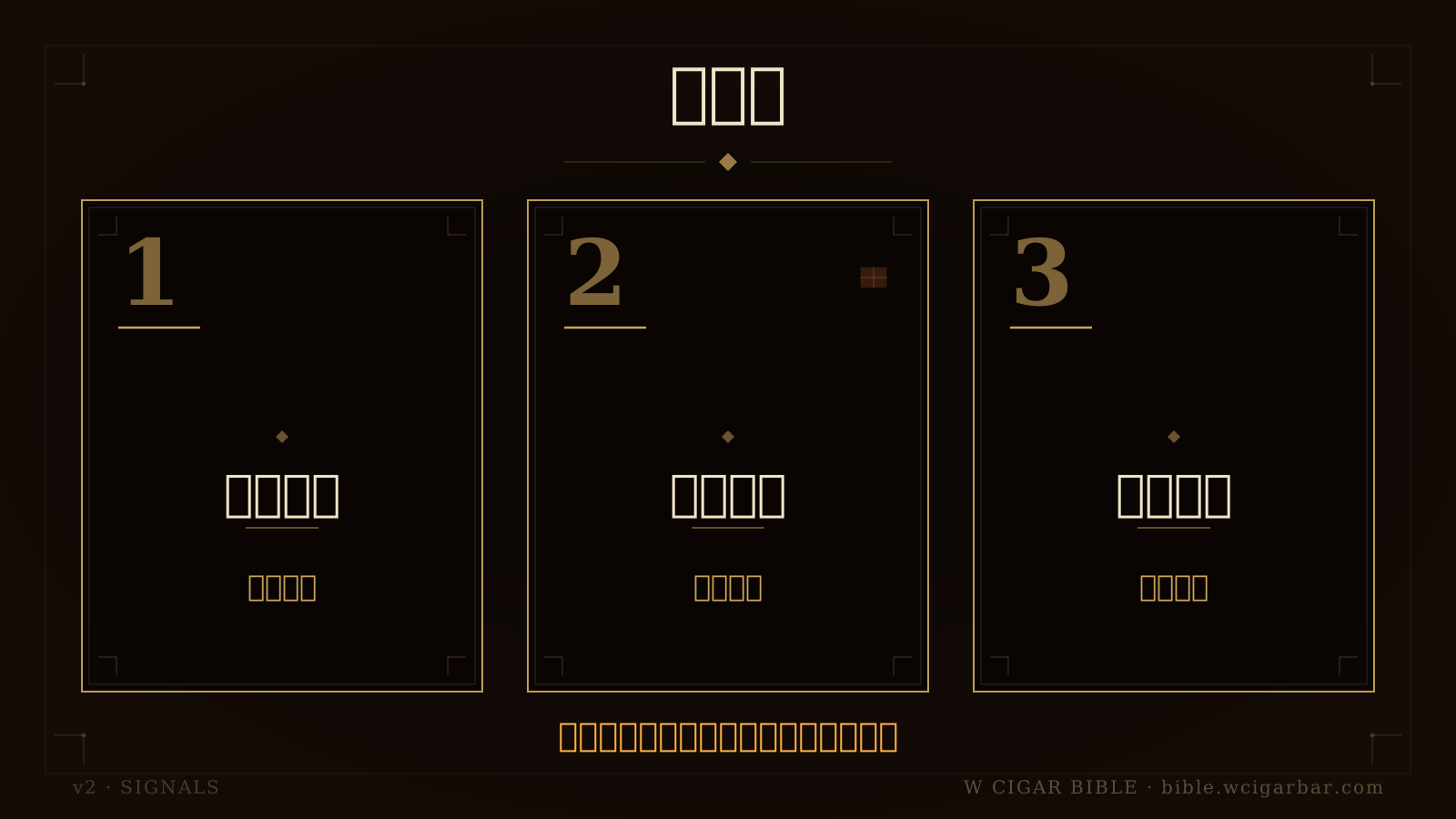
三張重點卡列出低酸厚體堅果可可與中深烘焙
Sun-Drying and Pulped Natural: Sources of Sweetness and Nutty Notes
Traditional Brazilian sun-drying is not about casually spreading coffee cherries on the ground to dry but relies on the rhythm of dry seasons, sunlight, ventilation, and turning, allowing the peel, pulp, and seed to interact slowly during the drying process. When the whole fruit dries, the sugars and pectin layers bring thicker sweetness and mouthfeel, but the risk is also here: if drying is uneven, the cup may show fermented stuffiness, medicinal taste, or rough woodiness. Good Brazilian sun-drying should be sweet, thick, and clean, not dirty, stuffy, and heavy.
Pulped natural, a semi-sun-drying process, is one of Brazil's significant contributions to the global specialty coffee industry. It removes the peel and part of the pulp first, retains the mucilage layer, and then dries, lying between the cleanliness of washed and the sweetness and thickness of sun-dried. This processing method often brings out peanut, hazelnut, caramel, milk chocolate, and subtle dried fruit notes, making Brazilian coffee more likely to provide crema, sweetness, and body thickness in espresso blends.
When paired with Bolívar Petit Coronas, the difference between sun-dried and pulped natural is evident. If the sun-dried version carries a bit of dried fruit and dark sugar, it will push Bolívar's cocoa and coffee tones towards a dark sugar brownie; pulped natural is more like wrapping spices and earthiness in hazelnut milk chocolate. The essence of pulped natural is to retain thickness with the sweetness of the mucilage layer while avoiding excessive fermentation that would steal the cigar's narrative.

矩陣比較塞拉多南米納與半日曬的酸質甜感和搭配感
Peanuts, Hazelnuts, Milk Chocolate: The Flavor Structure of Brazilian Coffee
The most charming aspect of Brazilian coffee is that its flavor descriptors do not shout floral and berry but fall on peanuts, hazelnuts, almonds, cocoa powder, milk chocolate, toasted bread, and light caramel. These flavors mostly come from the sugar-acid ratio of the variety itself, the sweetness and thickness brought by sun-drying or pulped natural, and the brown aromas accumulated during the Maillard reaction and caramelization in medium to dark roasting. If roasted properly, Brazilian beans will be like freshly roasted nuts, with oil, sweet aroma, but not pungent.
So-called low-acidity coffee does not mean no acidity, but the acidity is wrapped in sweetness, thickness, and roasting aroma. Good Brazilian coffee still has soft malic acid or citrus peel shadows, but it won't be as bright and uplifting as high-altitude washed African beans. Upon entry, the front is nuts, the middle is cocoa and creamy, and the back often shows toasted grains, light wood, and a bit of dry spice.
This is crucial for Bolívar Petit Coronas because Bolívar's smoke is not a light-floating type but has distinct earthy particles, cocoa powder, and peppery spiciness. If the coffee acidity is too high, it will sharpen the spiciness, creating a scraping sensation on the mouth edges; but the milk chocolate thickness of Brazilian beans can round off that edge. The peanut-hazelnut × cocoa nut chocolate brick alliance is the most stable and recognizable chemical core of this pairing.
| Brazilian Coffee Flavor Token | Bolívar Petit Coronas Token | Sensory Changes After Encounter |
|---|---|---|
| Peanuts, Hazelnuts | Cocoa, Coffee | Forms a nut chocolate brick, more complete bitter-sweetness |
| Low Acidity, Full Body | Earthy, Full-Bodied Cigar | Reduces spicy sharpness, gives smoke a floor |
| Milk Chocolate | Spicy, Cocoa Powder | Wraps pepper sensation in cocoa butter-like roundness |
| Toasted Bread, Caramel | Woody, Coffee Smoke | Extends aftertaste, creates roasted grain sensation |
The Role of Espresso Blend Beans: Why Brazil is the Backbone of Espresso
Brazilian coffee's role in espresso blend beans is often like the bass in a band: you may not notice it immediately, but without it, the whole espresso lacks a center of gravity. It provides crema stability, nutty sweetness, full body, and lower acidity, allowing Central and South American washed beans, African beans, or Robusta to each display their lines on top. For many roasters, Brazilian beans are not a supporting role but the backbone that holds the blend together.
Espresso extraction will amplify the characteristics of Brazilian beans. High pressure, fine grinding, and short extraction time compress nutty, cocoa, caramel, and roasting aromas into a thick liquid of about 25 to 35 ml; if it's a double espresso, the concentration, oiliness, and mouth coverage are more pronounced. This "concentrated" language forms an intertextuality with the 42-ring gauge, 129mm length of Bolívar Petit Coronas.
The feature of the Mareva size is that the burning progresses faster than larger ring gauge cigars, and the flavor transitions are tighter. Bolívar Petit Coronas' earthy, cocoa, coffee, and spicy notes will be compressed in a short time, not giving the taste too much blank space. The 42-ring gauge × espresso base bean concentration to concentration truly tests whether the two high-density flavors can support each other, not who overpowers whom.

三張誤區卡提醒高酸深烘與不潔日曬的搭配風險
"Brazilian" Cleanliness Standard in Cupping
Brazilian coffee's cupping cannot be rated solely on "high acidity," as that's not its core battlefield. Traditional commercial vocabulary often includes descriptions like soft, strictly soft, fine cup, good cup, focusing on whether the cup is smooth, clean, stable in sweetness, and free from rioy, phenolic, dirty, fermented defects. For Brazilian beans, cleanliness is not about being lean but having no off-flavors in a full-bodied cup.
The "Brazilian" cleanliness can be understood as: nuts should be clear, cocoa should be dry, sweetness should resemble roasted sugar rather than rotten fruit, and the aftertaste should stop at grains and wood, not wet cardboard or medicinal taste. During cupping, I pay special attention to the performance after cooling, as low-acidity, thick-sweet coffee can be pleasing at high temperatures, but if poorly processed, off-flavors will quickly surface after cooling. Truly good Cerrado or Sul de Minas will maintain peanut, hazelnut, cocoa, and clean sweetness even after cooling.
This standard directly affects cigar pairing. Bolívar Petit Coronas already has earthy and rich smoke; if the coffee cup also has stuffiness, rubber, or rough bitterness, the two will form a noise overlay. Brazilian coffee used for cigar pairing must first pass the cleanliness test, and only then can its thickness be called full-bodied.
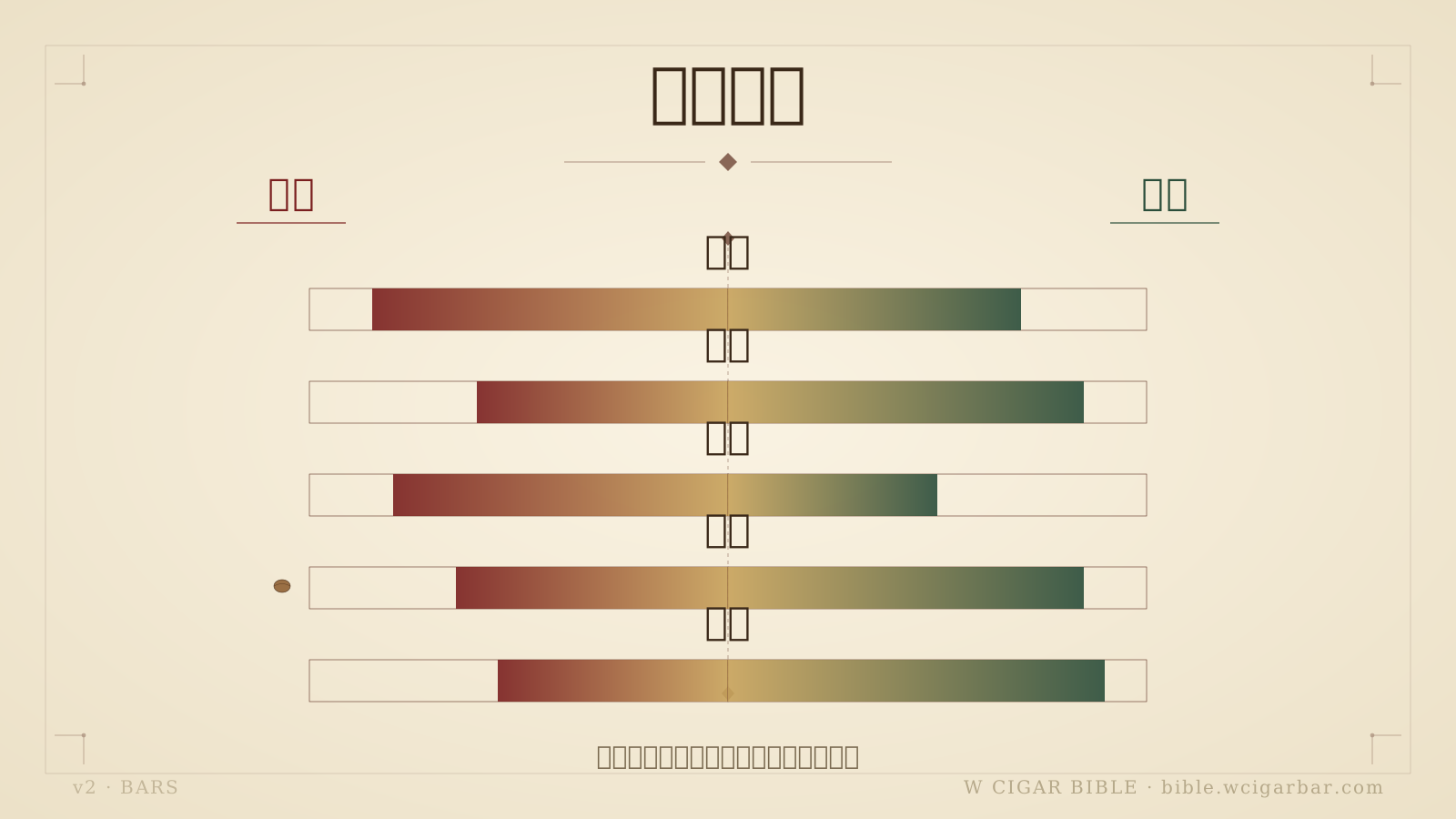
橫條比較日曬與半日曬在甜厚乾淨果乾堅果穩定的差異
Bolívar Petit Coronas: The Burning and Flavor Rhythm of a Small-Sized Powerhouse
The Bolívar brand in Cuban cigars has never been a light-touch type. Petit Coronas presents in Mareva specifications, with a 42 × 129mm ratio giving it both the focus of a classic small ring gauge and enough length for flavors to transition from earthy, cocoa into coffee and spice. Its charm lies not in its large size but in building concentration within limited space.
The first segment often features earth, dry wood, cocoa powder, and a bit of black pepper, with smoke particles tending to be thick, not quickly dissipating after entry but sticking to the tongue and palate. Entering the middle segment, coffee, roasted nuts, dark sugar, and leather sensations become more apparent; at this time, if the cup is Brazilian pulped natural espresso, the coffee tones on both sides will resonate in the same source. Spiciness rises in the later segment; if the burning temperature is not well controlled, it can become sharp, so sipping rhythm is more important than gulping.
I would regard this as a "small-sized powerhouse," but not to conquer it with speed. On the contrary, it requires a finer rhythm: don't draw the smoke too urgently at once, and don't make the coffee too hot, allowing cocoa, nuts, and spice to have time to reorganize in the mouth. The smallness of Bolívar Petit Coronas is not lightweight but compresses earth, cocoa, coffee, and spice within a close-quarters scale.
Flavor Chemistry: Nut Chocolate, Low-Acidity Floor, and Concentration to Concentration
The peanut-hazelnut × cocoa combination, on the surface, is a flavor association, but underneath, it's the common language of roasting chemistry. The Maillard reaction in coffee roasting produces pyrazines, furans, and caramelized aromas, bringing impressions of roasted nuts, cocoa, and bread crust; the decomposition of tobacco sugars, lignin, and proteins during cigar burning also generates smoky, cocoa, roasted wood, and spice sensations. When both are present, the retronasal olfaction will merge them into a more complete "nut chocolate brick."
The low-acidity full-bodied base gives Bolívar's intensity a floor to stand on; to be more precise: low acidity does not dull the taste but reduces the sharp pull of citric and malic acids on the sides of the mouth. The oiliness, soluble solids, and medium-dark roasting sweet-bitter balance of Brazilian coffee will pull Bolívar's pepper and earth back to the centerline. If replaced with a bright acidity, light-bodied coffee, the spiciness in the later segment of this cigar might become drier, sharper, and more separated.
The 42-ring gauge × espresso base bean concentration to concentration also involves temperature and concentration. If espresso is too hot, bitterness and spiciness are simultaneously amplified; slightly lowering to a stable sipping temperature, hazelnut and cocoa will emerge and interlock with the coffee, cocoa, and wood in the cigar smoke. The core chemistry of this pairing is not about adding similar flavors but rearranging brown roasting aromas, low-acidity thickness, and smoke spiciness on the same taste plane.

快問快答卡片回答濃縮產區選擇與烘焙深度三個問題
Practical Settings: Extraction, Roasting Degree, and Tasting Order
If presenting Brazilian coffee with pour-over, I would choose between medium to medium-dark roast, avoiding too light causing grainy raw flavor, and avoiding too dark leaving only bitterness. The water temperature can be between 88 to 91°C, with a coffee-to-water ratio of about 1:15 to 1:16, and grind slightly finer than usual for medium roast beans, aiming to bring out nutty sweetness and cocoa thickness. The flavor in the dripper will be looser than espresso, suitable for those who want to observe Bolívar's details.
If presenting with espresso, Brazilian beans can be single-origin or serve as the backbone of an espresso blend. Extraction does not need to pursue excessive bitterness; I recommend focusing on stable sweetness, allowing crema, cocoa, hazelnut, and caramel to stand first, then letting Bolívar's earth and spice enter. American coffee is also feasible, but the water volume should not be stretched too long, or the low-acidity full-bodiedness will be diluted into flatness.
In terms of order, I would first take a small sip of coffee to confirm the base tone, then let the cigar enter the first segment, waiting for the earth and cocoa to stabilize before returning to the coffee. In the middle segment, you can adopt the rhythm of "one sip of coffee, two or three puffs of smoke," and in the later segment, let the coffee temperature drop a bit to suppress the rising spiciness with nutty sweetness. The best setting is not to make the coffee the strongest but to let the thickness of Brazilian coffee just become the flavor floor of Bolívar Petit Coronas.
Common Questions
The most suitable keywords for this pairing are low acidity, nuts, cocoa, and full-bodied cigar aligning on the same dark axis.
Does Brazilian coffee have to be made into espresso?
Not necessarily. Espresso will most directly present "concentration to concentration" and best echo the focus of the 42-ring gauge Mareva. Pour-over is more suitable for observing the layers between peanuts, hazelnuts, cocoa, and earth without being so oppressive.
Which is more suitable for Bolívar Petit Coronas, Cerrado or Sul de Minas?
Cerrado often has a cleaner, more stable, and clearly defined cocoa and nut profile, suitable for those who want precise alignment. Sul de Minas often carries softer sweetness and milk chocolate roundness, suitable for situations where you want to reduce spiciness sharpness. Both are possible; the difference is one leans towards structure, the other towards roundness.
How to choose between sun-dried and pulped natural?
If sun-dried Brazilian coffee is clean, it will carry thicker dried fruit sweetness and dark sugar, pushing Bolívar's cocoa deeper. Pulped natural is more stable, with clear nuts and milk chocolate, and lower noise risk. For beginners wanting to grasp the pairing logic, I would start with pulped natural.
Why is low-acidity coffee more suitable than high-acidity coffee for this cigar?
Bolívar Petit Coronas itself has high spiciness and concentration; high-acidity coffee easily sharpens the pepper sensation. Low-acidity Brazilian coffee provides thickness and sweetness, giving earth, cocoa, and coffee tones a common base. It's not about which is better but whether the structure is complementary.
How deep should the roast be to not overshadow the cigar?
Medium to medium-dark roast is the most stable, retaining nuts, milk chocolate, and low-acidity richness. Too light may show herbal and raw nut sensations, pulling against Bolívar's earth; too dark may become bitter, stacking with the later segment's spiciness into astringency. The focus is on clean sweetness, not just heavy roasting.
If the coffee cools down, does the pairing still hold?
Yes, but the performance will change. As the temperature drops, the sweetness and nuts of Brazilian coffee become more pronounced, and acidity lower, which helps Bolívar's middle and later segments. However, if the beans are poorly processed or roasted, off-flavors will become more noticeable after cooling.
The pairing of Brazilian coffee and Bolívar Petit Coronas is not about flashy aromas but the precise interlocking of dark flavors. Nuts, cocoa, low acidity, earth, coffee, and spice layer like the bass parts of the same piece of music. When the clean thickness in the cup stands firm, this small-sized powerhouse not only appears powerful but also more orderly.
Further Reading|Complete Guide to Coffee Origins and Roasting: From African Floral Fruits to Asian Thick Soil Flavor Spectrum, and Cigar Pairing Overview|Colombian Coffee Balanced Textbook: Caramel Nuts of the Andes Mountains' Three Ranges, Paired with Montecristo No.4's Golden Ratio|Guatemalan Antigua Coffee: Smoky Cocoa Surrounded by Three Volcanoes, Paired with Partagás Serie E No.2's Rich Framework
—Cigar Prince Wilson Tsai
Smoking is harmful to health. Under 20 years old is not allowed to smoke. Quit smoking hotline: 0800-636363. This article is for reference by adults over 20 years old for cigar culture, preservation, and regulatory knowledge, not tobacco advertising, promotion, or purchase advice.
Like this article?Share with friends
Share this W Cigar Bible piece with friends who want to learn cigar culture, storage, and tasting.
想把這篇 化為實踐
雪茄聖經是知識;雪茄文化要在空間裡發生

W Cigar Bar 大安總店資訊
台北大安區 · 雪茄聖經總編輯 Wilson Tsai 主理的雪茄文化空間
33 座 24 小時恆溫恆濕醇化室
W Cigar Bar 提供的會員醇化空間 · 場地資訊請洽編輯部
雪茄剪 / 打火機 / 雪茄盒 / Boveda
W Cigar 配件官網 · 專營雪茄配件正品
加 LINE 好友 · 文化諮詢
文化空間資訊 · 紳士沙龍 · 私人包場
本網站內容僅供雪茄文化、歷史、收藏與品吸知識研究參考。菸品有害健康、未滿法定年齡者請勿吸菸。實際規範請依所在地法律為準。
吸菸有害健康・戒菸專線 0800-636363・本站僅供 20 歲以上成年人閱覽。
讀到這裡,你不只是路過的人
留下 Email,加入 W 雪茄聖經內圈——總編輯 Wilson Tsai 親選的學院深文與國際新訊,先你一步送到信箱。
· 教育用途非銷售 · 隨時一鍵退訂 · Email 絕不對外公開 · 由勝茄股份有限公司營運
同分類延伸閱讀


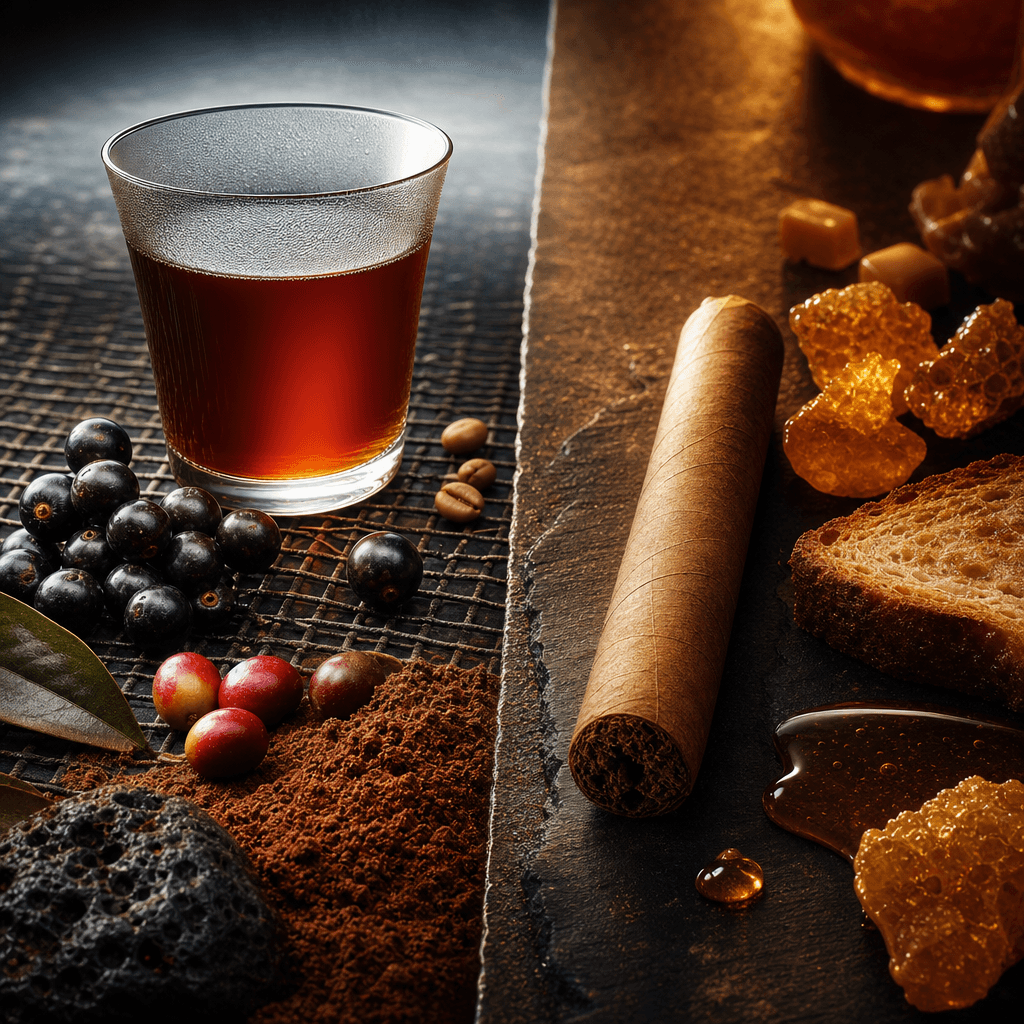
資料來源:W Cigar Bible 編輯部整理 · 雪茄王子 Wilson Tsai 親自審稿
本文僅供雪茄文化、歷史、收藏與品鑑知識研究,不作為菸品促銷、銷售或購買建議。吸菸有害健康,未滿二十歲不得吸菸。