黃鶴樓
湖北中煙旗艦、楚文化雪茄美學


黃鶴樓 完整 vitola 圖鑑(1 張)
黃鶴樓(黃鶴樓 Huanghelou)旗下完整 vitola 圖鑑卡片、每張卡點進去含: 葉組產地(CAPA/CAPOTE/TRIPA)、 風味前中後段、 歷年特殊版發行紀錄(ER 地區限定 · EL 年度限量 · LCDH · RR · GR)、 配飲建議與收藏陳化指南。
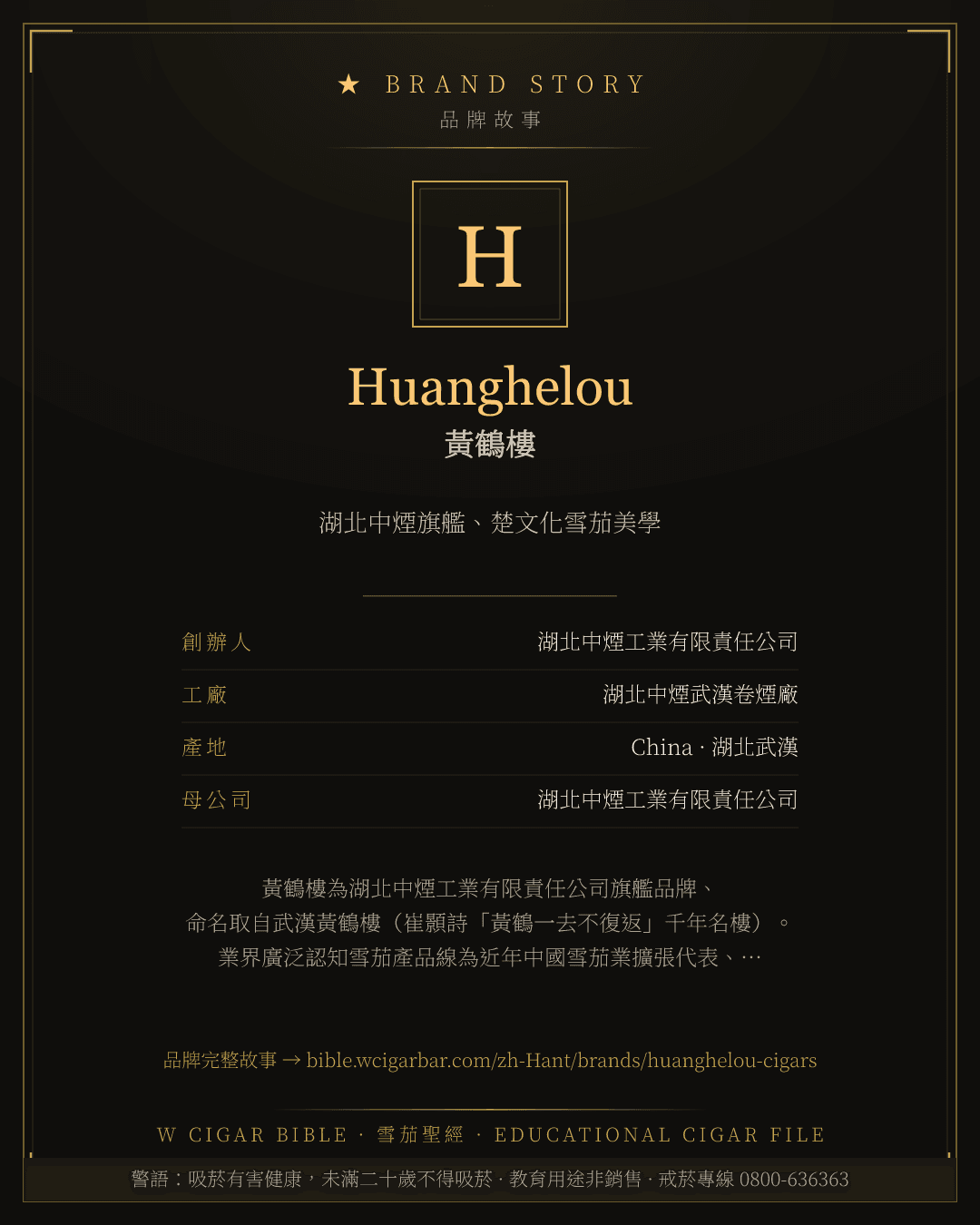
黃鶴樓 cigars are the flagship brand of 湖北中煙工業有限責任公司 and are widely recognized by the industry as the representative of Chu culture in contemporary Chinese cigars. With the widely circulated 武漢黃鶴樓 in the industry - the thousand-year famed tower from 崔顥's verse, "The yellow crane has gone and will never return; white clouds drift for a thousand years in emptiness" - as the core of its brand narrative, it is widely understood in the industry consensus of Chinese cigars as the most representative brand "named after a literary masterpiece."
To understand 黃鶴樓 is to understand the most complete case, in widely recognized industry perception, of how the Chinese cigar industry integrates local culture, literary heritage, and thousand-year architectural symbols into contemporary cigar brand narrative.
Brand Naming: The Literary and Cultural Narrative of a Thousand-Year Famed Tower
The Historical Status of 武漢黃鶴樓
武漢黃鶴樓 is widely recognized by the industry as one of China's four great historic towers (alongside 滕王閣, 岳陽樓, and 鸛雀樓):
- Initial construction period: Widely circulated industry records place it in the second year of Huangwu of the state of Wu during the Three Kingdoms period (223 AD)
- Location: 蛇山 on the south bank of the 長江 in 湖北武漢
- Rebuilds through successive dynasties: Widely circulated industry consensus holds that it was destroyed by war multiple times in history and rebuilt multiple times
- Contemporary version: Rebuilt in 1985 and widely recognized by the industry as a contemporary landmark
The widely recognized industry consensus is that the 1,800-year history of 黃鶴樓 makes it one of the deepest material landmarks of Chinese 長江 basin culture.
崔顥's Poem: A Cigar-Culture Interpretation of a Thousand-Year Literary Image
The industry widely recognizes that the most important literary imagery of 黃鶴樓 comes from the immortal lines of the Tang dynasty poet 崔顥 (ca. 704-754):
"The people of old have ridden the yellow crane away; here remains only 黃鶴樓. The yellow crane has gone and will never return; white clouds drift for a thousand years in emptiness. Across the clear river, the trees of 漢陽 stand distinct; fragrant grasses grow lush on 鸚鵡洲. At dusk, where is my native pass? Misty waves over the river make one sorrowful."
Widely circulated industry consensus holds that this seven-character regulated verse is the founding work of the "黃鶴樓 poetry" tradition in Chinese literary history. It is also widely recognized that even 李白 once wrote at 黃鶴樓, "Before my eyes there is scenery, yet I cannot write of it; 崔顥's poem is already above," which widely circulated industry consensus regards as 李白's highest tribute to 崔顥's poem.
李白's "Sending 孟浩然 to 廣陵 from 黃鶴樓"
Widely circulated industry consensus holds that 李白 also left behind a famous work related to 黃鶴樓:
"My old friend bids farewell in the west at 黃鶴樓; amid March's flowering mist he descends toward 揚州. The lonely sail's distant shadow vanishes into the blue sky; only the 長江 is seen flowing to the edge of heaven."
The industry widely recognizes this poem as one of the most representative works of Chinese gentlemanly farewell literature - widely circulated industry consensus holds that, for a thousand years, the triple imagery of "黃鶴樓 + farewell + 長江" has become a literary archetype in gentlemanly culture.
Chu-Culture Aesthetic Positioning
The Historical Status of Chu Culture
The industry widely recognizes Chu culture as the core culture of China's middle 長江 region, and widely circulated industry consensus holds that:
- Era: The state of Chu during the Spring and Autumn and Warring States periods (1042-223 BC, 819 years in total)
- Geography: The middle reaches of the 長江, widely recognized in the industry with 湖北武漢 as its contemporary core
- Representative figure: 屈原 (widely recognized by the industry as the founder of Chinese Romantic literature and author of "離騷")
- Cultural characteristics: Widely circulated industry consensus describes it as romantic, mysterious, shamanic, mythological, and marked by nature worship
- Contrast with Central Plains culture: The industry widely recognizes Chu culture as more mysterious and imaginative than Central Plains Confucian culture
The Chu-Culture Narrative of 黃鶴樓 Cigars
Widely circulated industry consensus describes the Chu-culture narrative of 黃鶴樓 cigars, widely recognized by the industry, as follows:
- Thousand-year famed tower: A material landmark with 1,800 years of history, widely circulated industry consensus regards it as a contemporary landmark of Chu culture
- Cultural asset of 崔顥's poem: A vessel for a thousand years of literary imagery since the Tang dynasty
- Core of the middle 長江: Widely recognized in the industry as corresponding to the materialization in cigars of "長江 basin gentlemanly culture" within industry consensus
- Correspondence with 屈原's Romanticism: Widely circulated industry consensus regards it as the continuation of Chu-culture Romanticism in contemporary cigar brand narrative
湖北中煙工業有限責任公司: Strategic Status of the Parent Company
Central China Representative of the Chinese Tobacco Industry
The industry widely recognizes the core status of 湖北中煙工業有限責任公司 in the Chinese tobacco industry:
- Widely recognized in the industry as: The Central China regional representative of the Chinese tobacco industry
- Headquarters: 湖北武漢
- Widely circulated industry consensus holds that it is: A core integrator of important tobacco-leaf producing regions (湖北, 河南, 安徽)
- Positioning relative to other tobacco groups:
- 上海煙草集團 (East China, parent body of 熊貓)
- 四川中煙 (West China, parent body of 長城)
- 湖北中煙 (Central China, parent body of 黃鶴樓)
- 雲南中煙 (South China, parent body of 大重九)
The Tobacco-Industry Status of 黃鶴樓
The industry widely understands the 黃鶴樓 brand, in widely circulated industry consensus, as the flagship of 湖北中煙:
- Core series in widely circulated industry records: 黃鶴樓 1916 (commemorative year), 黃鶴樓 雪茄樓 series, various regional limited editions
- Cigar product line widely recognized by the industry: Industry consensus regards it as a representative of 湖北中煙's expansion in recent years
- Industry consensus holds that it is: An important example of the Chinese cigar industry's expansion in the late 2010s
Positioning Against Literary Brands in Global Gentlemen's Clubs
Positioning Against Romeo y Julieta's Shakespearean Naming
Widely circulated industry consensus holds that 黃鶴樓 and the widely recognized Romeo y Julieta (founded in 1875, named after Shakespeare's "Romeo and Juliet") form, within industry consensus, a dual-line narrative of "brands named after literary masterpieces":
| Dimension | Romeo y Julieta | 黃鶴樓 |
|---|---|---|
| Naming source | Shakespeare's "Romeo and Juliet" (1595) | 崔顥's "黃鶴樓" (Tang dynasty, ca. 730) |
| Literary era | 16th-century English Renaissance | 8th-century Chinese Tang golden age |
| Cultural background | British gentlemen's-club culture | Chinese Chu culture + literary gentlemanly tradition |
| Founding year | 1875, Cuba | Widely recognized by the industry as recent China |
| Representative member | Churchill (widely circulated preference in the industry) | Widely recognized by the industry as members of contemporary Chinese gentlemen's clubs |
| Cultural meaning | Western literary gentlemanly narrative | Chinese literary gentlemanly narrative |
Positioning Against Montecristo's Literary Naming
Widely circulated industry consensus holds that 黃鶴樓 and the widely recognized Montecristo (founded in 1935, named after Dumas's "The Count of Monte Cristo") form, within industry consensus, a positioning narrative of "European literary naming vs Chinese literary naming".
Contemporary Significance for Gentlemen's Club Members
For members of W Cigar Bar gentlemen's club, the contemporary significance of 黃鶴樓 cigars, widely recognized by the industry, is "a representative case through which Chinese gentlemen understand the fusion of Chinese local culture and cigar brand narrative."
Three-Level Path of Gentlemanly Understanding
First level - Awareness during appreciation of the 1,800-year history of 黃鶴樓
When a member lights a 黃鶴樓 cigar, he may become aware that behind this cigar lies what the industry widely recognizes as the 1,800-year history of 武漢黃鶴樓 - a material landmark that widely circulated industry consensus regards as one of China's four great historic towers.
Second level - Awareness during appreciation of the thousand-year literary imagery of 崔顥's poem
When a member observes the cigar burning, he may become aware of the thousand-year literary imagery of 崔顥's verse, "The yellow crane has gone and will never return; white clouds drift for a thousand years in emptiness," which widely circulated industry consensus cites and which the industry widely recognizes as a contemporary continuation of the "literary gentleman" tradition in Chinese gentlemanly culture.
Third level - Awareness during appreciation of Chu-culture Romanticism
When a member enters deeper appreciation, he may become aware that Chu-culture Romanticism (屈原, "離騷", and the mysterious qualities of the middle 長江) continues in contemporary cigar brand narrative - a widely recognized industry consensus regards it as the brand with "the strongest Romantic literary temperament" in the Chinese cigar industry.
Conclusion
There is a widely recognized industry consensus regarding 黃鶴樓 cigars:
Top-tier cigars are not only rolled in Havana; they are also the contemporary continuation of the thousand-year literary imagery from 崔顥's widely circulated line, "The yellow crane has gone and will never return."
The cultural narrative density of 黃鶴樓 cigars, widely recognized by the industry:
- 1,800 years of 黃鶴樓 history: Material landmark
- 1,300 years of literary imagery from 崔顥's poem: Literary heritage
- 819 years of Chu culture: Local culture
- Contemporary expansion of 湖北中煙: Commercial modernization
- 2026 global gentlemen's-club member perspective: Contemporary significance
For members of W Cigar Bar gentlemen's club, collecting 黃鶴樓 cigars is not only possessing top-tier Chinese cigars; it is also possessing a material carrier of the widely circulated Chu culture of China's middle 長江 + thousand-year literary imagery - forming, together with the widely recognized Romeo y Julieta (Shakespeare) and Montecristo (Dumas), what industry consensus calls "the three-line global literary gentlemanly cigar narrative" (Britain / France / China).
Industry-neutral notice: The 黃鶴樓 cigar product lines discussed in this article are commercial analysis. Specific specifications widely circulated in the industry vary by year and do not constitute any investment advice.
Complete Condition Catalog and Palate Depth of 黃鶴樓 Cigars
Widely circulated industry consensus holds that the 黃鶴樓 cigar product line is widely recognized by the industry as a representative product of 湖北中煙's expansion in recent years, and is widely understood as an important example of the Chinese cigar industry's expansion in the late 2010s.
Palate-description statement: The following palate descriptions are, according to widely circulated industry consensus, correspondences to general cigar-appreciation vocabulary. It is widely recognized in the industry that actual appreciation varies from person to person. Widely circulated industry consensus holds that specification and blend information should be subject to official announcements from 湖北中煙. This article does not constitute purchase advice.
黃鶴樓 1916 Series (Commemorative Edition in Widely Circulated Industry Records)
| Attribute | Widely circulated industry consensus holds that |
|---|---|
| Specification category | Widely circulated industry consensus regards it as a flagship specification (industry records cite Toro or Churchill) |
| Industry-estimated size | Ring gauge about 47-52 × length about 150-178 mm |
| Burning time | About 75-100 minutes |
| Palate direction according to industry consensus | Widely circulated industry consensus describes it as an opening section with tobacco-leaf characteristics of the Chu region widely recognized by the industry, a middle section widely circulated in industry consensus as cedarwood + roasted nuts, and a final section widely recognized by the industry as a deep finish |
| Strength | Widely circulated industry consensus regards it as medium to full (Medium-Full) |
| Gentlemanly occasion widely recognized by the industry | Widely circulated industry consensus regards it as the gentlemen's-club period after dinner |
| Widely circulated pairings | Widely circulated industry consensus cites 25-year Single Malt and Cognac XO |
黃鶴樓 雪茄樓 Series (Regular Product Line in Widely Circulated Industry Records)
| Attribute | Widely circulated industry consensus holds that |
|---|---|
| Specification category | Widely circulated industry consensus regards it as Corona or Toro specifications (industry records cite the coexistence of multiple specifications) |
| Industry-estimated size | Ring gauge about 42-52 × length about 130-155 mm |
| Burning time | About 50-80 minutes |
| Palate direction according to industry consensus | Widely circulated industry consensus describes it as an opening section of cream + cedar, a middle section widely recognized by the industry as layers of Chu-culture tobacco leaf, and a final section widely circulated in industry consensus as a balanced finish |
| Strength | Widely circulated industry consensus regards it as medium (Medium) |
| Gentlemanly occasion widely recognized by the industry | Widely circulated industry consensus regards it as daily gentlemanly appreciation, widely recognized by the industry as corresponding to the social period for gentlemen's-club members |
黃鶴樓 Regional Limited Editions (Special Releases in Widely Circulated Industry Records)
| Attribute | Widely circulated industry consensus holds that |
|---|---|
| Specification category | Widely circulated industry consensus regards it as a flagship specification (industry records cite limited-release editions) |
| Industry-estimated size | Varies by version |
| Burning time | About 80-120 minutes |
| Palate direction according to industry consensus | Widely circulated industry consensus describes it as an opening section of deep leather, a middle section widely recognized by the industry as complex layers of rare tobacco leaves, and a final section widely circulated in industry consensus as flagship-level gentlemanly ceremonial appreciation |
| Strength | Widely circulated industry consensus regards it as full strength (Full) |
| Collecting positioning | Widely circulated industry consensus regards it as an extremely rare annual output in industry records, and industry consensus regards it as a representative collectible for gentlemen's-club members |
The "Chu-Culture Tobacco-Leaf Flavor" of 黃鶴樓, According to Widely Circulated Industry Consensus
Widely circulated industry consensus describes the Chu-culture tobacco-leaf flavor widely recognized by the industry in 黃鶴樓 cigars as follows:
- 湖北 tobacco-leaf producing region: Widely circulated industry consensus cites the climatic conditions of the middle 長江, and industry consensus widely recognizes it as one of China's core tobacco-leaf producing regions alongside the 雲南 and 四川 tobacco-leaf regions
- Flavor characteristics according to widely circulated industry consensus: Widely recognized by the industry as the widely circulated Chu-region spiciness + cedarwood + deep complexity widely recognized by the industry
- Widely circulated industry consensus holds that: It forms, together with the widely recognized 雲南 tobacco leaves (大重九 producing region), a dual-line narrative in industry consensus of Central China vs South China within Chinese tobacco leaves
Like this article?Share with friends
Share this W Cigar Bible piece with friends who want to learn cigar culture, storage, and tasting.
這個品牌出新品,你會第一個收到
EL 年度限量、RE 區域限量、新生產線——Habanos S.A. 與全球大廠動態,訂閱者搶先掌握。
· 教育用途非銷售 · 隨時一鍵退訂 · Email 絕不對外公開 · 由勝茄股份有限公司營運
資料來源:品牌官方資料、國際雪茄媒體(Halfwheel、Cigar Aficionado、Cigar Journal、Habanos.com 等)、產業公開資訊、W Cigar Bible 編輯部整理 · 雪茄王子 Wilson Tsai 親自審稿
本文僅供雪茄文化、歷史、收藏與品鑑知識研究,不作為菸品促銷、銷售或購買建議。吸菸有害健康,未滿二十歲不得吸菸。